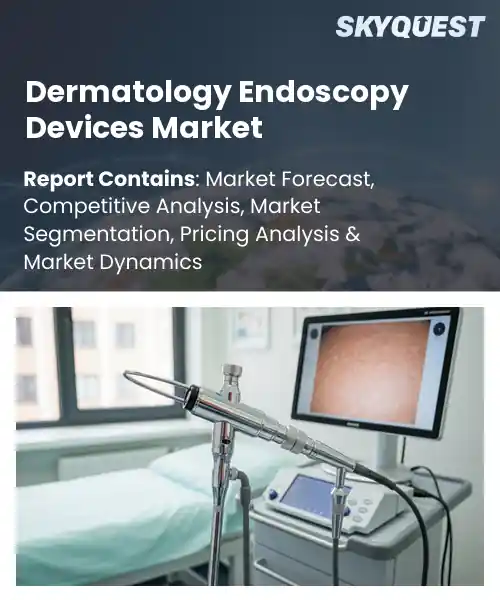
Dermatology Endoscopy Devices Market
Report ID: SQMIG35A3881
Report ID: SQMIG35A3881
[email protected]
USA +1 351-333-4748
Report ID:
SQMIG35A3881 |
Region:
Global |
Published Date: June, 2026
Pages:
157
|Tables:
127
|Figures:
77


Global Dermatology Endoscopy Devices Market size was valued at USD 1.9 Billion in 2024 and is poised to grow from USD 2.07 Billion in 2025 to USD 4.09 Billion by 2033, growing at a CAGR of 8.9% during the forecast period (2026-2033).
Surge in prevalence of skin disorders, increasing demand for early skin cancer detection, advancements in dermatological imaging technologies, rising adoption of minimally invasive diagnostic procedures, and expanding use of teledermatology solutions are driving sales of dermatology endoscopy devices.
Rising adoption of sophisticated imaging systems for melanoma and inflammatory conditions, as well as other dermatological applications, is concurrently increasing demand at hospitals, clinics, and specialized dermatology centers. Enhancement of resolution and visualization functions of images, digital imaging storage, and data analysis technologies are other areas of advancement to enhance clinical accuracy and efficiency. The integration of dermatological endoscopy equipment with telehealth systems and machine learning diagnostic software is another key development to increase access to dermatological care and prompt implementation of clinical decisions. Other trends holding potential to boost market growth include increase market for portable and highly user friendly imaging systems to reach global commercial prospects. The rising burden of skin diseases and growing awareness regarding the importance of early diagnosis are expected to primarily drive dermatology endoscopy devices market growth.
Contrastingly, high costs of advanced imaging devices, limited availability of skilled dermatology professionals, reimbursement challenges, and regulatory complexities associated with medical imaging technologies are anticipated to slow down dermatology endoscopy devices market penetration through 2033.
How is AI Enhancing Diagnostic Accuracy of Dermatology Endoscopy Devices?
AI is expected to play a role in enhancing diagnostic accuracy in the dermatology endoscopy devices market through providing a sophisticated image analysis and clinical decision-making support solution. AI will provide clinicians a real-time support tool to more quickly and confidently identify suspicious lesions in a clinical setting by automating pattern recognition and lesion segmentation tasks, as well as rapidly searching through images databases. AI is becoming more often embedded within handheld dermatoscopes, digital imaging systems, and total-body skin mapping systems-improving image standardization, flagging clinically significant results for specialist review, and streamlining workflow through prioritization of high-risk cases, thereby minimizing the risk of missed diagnosis. Rising demand for high-resolution early detection of skin cancers with integrated digital healthcare practice solutions is further providing momentum to AI adoption within the dermatology endoscopy devices market.
Market snapshot - (2026-2033)
Global Market Size
USD 1.9 Billion
Largest Segment
Handheld Dermatoscopes
Fastest Growth
Digital Dermatoscopes
Growth Rate
8.9% CAGR
To get more insights on this market click here to Request a Free Sample Report
Global dermatology endoscopy devices market is segmented by product type, technology, application, end user, and region. Based on product type, the market is segmented into dermatoscopes, video dermatoscopes, digital dermatoscopes, handheld dermatoscopes, trichoscopes, and others. Based on technology, the market is segmented into optical endoscopy devices, digital endoscopy devices, hybrid endoscopy devices, and AI-Integrated Imaging Systems. Based on application, the market is segmented into skin cancer detection, psoriasis diagnosis, acne evaluation, melanoma screening, hair and scalp disorders, infectious skin diseases, and others. Based on end user, the market is segmented into hospitals, dermatology clinics, ambulatory surgical centers, academic & research institutes, and others. Based on region, the market is segmented into North America, Europe, Asia Pacific, Latin America, and Middle East & Africa.
The digital dermatoscopes segment is predicted to account for the highest global dermatology endoscopy devices market share going forward. Their all-in-one package of high-quality imagery, storage, and compatibility with clinical workflows has made them the gold standard in skin visualization. The increased image fidelity packs a punch in blurring the lesion boundaries (allowing better diagnostic confidence and efficiency), the utility with telemedicine and EMRs accelerates institutional purchasing and vendor funding, reinforcing a virtuous cycle of adoption/incremental disruption in the dermatology endoscopy devices market.
However, video dermatoscopes are emerging as the fastest growing segment as live imaging facilitates dynamic lesion assessment, and procedural navigation increases the clinicians' proclivity for real time visualization. The video output also improved various teaching and remote consultations and allows incorporation with analytics software and service platforms enabling larger clinical adoption and market penetration.
The AI-integrated imaging systems segment is slated to lead the global dermatology endoscopy devices market revenue generation across the study period. The integration of machine learning-based lesion detection and classification in diagnostic workflows greatly improves consistency of diagnosis and decision support. Decreasing variability and requiring less time for triage in clinical workflows, these solutions increase efficiency for clinicians and patients, which encourages investment by vendors and integration partners, increases engagement with regulatory bodies, and further adoption as laboratories and clinics look for increased value through software-enabled diagnostic improvements in the dermatology endoscopy devices market.
Meanwhile, hybrid endoscopy devices are the fastest growing technology segment as per this dermatology endoscopy devices market forecast, as it streamlines clinician adoption and increases clinical adoption options. Its modular design allows upgrades to a variety of methods over time and interoperability with practice software, speeding adoption by providers looking for flexible, upgradeable platforms that expand workflows and revenue streams.
To get detailed segments analysis, Request a Free Sample Report
Advanced clinical infrastructure, concentrated centers of dermatologic excellence, and a mature device manufacturing ecosystem are helping North America lead global sales of dermatology endoscopy devices. In addition, the presence of sophisticated payer systems and established means of obtaining clinical approval for the use of endoscopic dermatology devices supports their routine use for diagnostic purposes in clinical practice. Clinical validation through collaboration among academic institutions, health care professionals, and industry enables rapid development and refinement of endoscopic dermatology devices because of fast evaluation by clinicians who use them. Regulatory agencies offer a high level of patient safety while providing a predictable pathway for the approval, training, and continued support of endoscopic dermatology by clinicians. The availability of substantial investment in prior therapies and research for continued physician education and clinical use of endoscopic dermatology devices creates a strong physician confidence in their use. Strong intellectual property protections and the access to capital create an environment conducive to the continued growth of research and development, while patient increasing awareness of minimally invasive treatment options creates a demand from clinicians and informs their purchasing decisions.
Sales of dermatology endoscopy devices in the United States is characterized by concentrated demand from advanced clinical centers, high adoption of minimally invasive diagnostic tools, and strong collaboration between device makers and dermatology specialists. Well established reimbursement frameworks and a robust private payer environment support clinical integration. The market benefits from sustained investment in training, clinical validation, and post market support that reinforce device uptake and clinician confidence and scalability considerations.
Dermatology endoscopy devices market in Canada reflects a balanced mix of public and private healthcare delivery, emphasis on equitable access, and growing clinician familiarity with endoscopic dermatologic procedures. Regional networks of collaboration between academic institutions and hospitals test new applicators for different devices. Its purchasing agent presses from its cost effectiveness, serviceability and training routes that can maintain a reliable quality procedure and disseminate innovative diagnostic tools over the regional population with satisfying rate.
Efforts to modernize dermatologic care pathways, increasing emphasis on minimally invasive diagnostics, and an expanding base of clinical champions are helping drive demand for dermatology endoscopy devices in the region. Centralized purchasing models in many of the European countries are making it easier to deploy large-scale systems and provide standardized training across Europe. There are also many device manufacturers clustered within Europe and numerous collaborative research networks that support the localization of global innovations for the specific needs of European clinicians. The harmonization of regulations across Europe, as well as the increasing alignment of clinical practice guidelines with diagnostic and procedure-related best practices, has also made it easier to adopt new technologies. In addition, both public and private insurance providers are becoming more willing to support new technologies that offer both improved diagnostic certainty and efficiencies in performing procedures, while professional societies have played a significant role in training and educating clinicians about such technologies and increasing their perceived value, resulting in increased adoption rates. The variation in the different European countries also creates opportunities for specific commercialization strategies, with advanced clinical centers being loaded with the requisite experience to serve as a springboard for greater regional development.
Dermatology Endoscopy Devices Market in Germany benefits from a strong medical technology manufacturing base, high concentration of specialized dermatology centers, and structured hospital procurement that favors validated clinical solutions. Industry and clinicians care are exploring professional boundaries through cross discipline and cross organisation partnerships and jointly design and executing more rigorous evaluation of endoscopic tools in clinical setting to establish and localize their adoption. Existing training course and endorsement by professional society serve as assure of clinicians timely confident injection into sophisticated diagnostic template throughout regional heavy hospital and sub-specialty clinics.
Dermatology Endoscopy Devices Market in the United Kingdom is expanding due to clinician engagement with minimally invasive diagnostics, integration of teledermatology workflows, and targeted adoption programs within clinical networks. Flexible procurement strategies and targeted initiatives that enhance diagnostic agility. A healthy combination of public and private providers is essential to creating a competitive supply landscape and effective collaboration between vendors and educational institutions enables clinicians to develop real-world skills and apply them clinically.
Dermatology Endoscopy Devices Market in France is emerging through focused investments in specialized centers, growing clinician interest in minimally invasive diagnostic tools, and collaborative initiatives between hospitals and institutions. National and regional pilot programs help demonstrate clinical value while manufacturers seek local partnerships for device adaptation. Clinical societies and training programs disseminate best procedural practices, supporting gradual adoption across hospital departments and private practices as clinician competence and awareness grow.
Expanding clinical capacity, growing local manufacturing capabilities, and strategic collaborations with global device manufacturers support consistent demand for dermatology endoscopy devices in the region. Countries in the region are investing heavily in specialized dermatological services and are developing talent through targeted training and knowledge transfer programs. The modernization of regulations in many markets and the adaptation of local standards will facilitate the entry of validated technologies into these markets by aligning them to the clinical needs of the region. Cost effective innovations and modular design will facilitate the adoption of these technologies in many healthcare settings. In addition, the increasing focus of both public and private sectors on the use of minimally invasive diagnostic procedures will further enhance patient experience. The development of cross border partnerships, regional centers of excellence, and the ability to generate extensive clinical evidence locally will enhance these regions' credibility and increase the extent to which suppliers source products from each other, while the use of telehealth pathways will enhance the capabilities in the healthcare delivery setting.
Dermatology endoscopy devices market in Japan is shaped by a strong culture of medical technology innovation, rigorous clinical evaluation, and established relationships between manufacturers and hospital systems. Skillful clinicians and training programs aid the uptake of advanced endoscopic methods. Regional developers' focus on device quality, reliability and incremental improvement in response to local requirements enhances the attractiveness of the product, where assured post market support is established through distribution networks and joint efforts with regards to research and development.
Adoption of dermatology endoscopy devices in South Korea benefits from a tech forward healthcare ecosystem, strong integration of advanced imaging and optics expertise, and agile local manufacturers focused on miniaturized diagnostic tools. Large hospitals and elite clinics work with industry for device customization and clinical validation. Supportive innovation policies and private sector healthcare promote prototype testing and clinician training. Strong links between clinical innovator and manufacturers streamline device optimization.
To know more about the market opportunities by region and country, click here to
Buy The Complete Report
Rising Demand For Minimally Invasive Procedures
Advances In Imaging And Optics
High Equipment Acquisition Costs
Stringent Regulatory Approval Requirements
Request Free Customization of this report to help us to meet your business objectives.
Competitive intensity in the global dermatology endoscopy devices market is rising as incumbent optics firms pursue M&A and platform partnerships while AI enabled entrants commercialize point of care diagnostics. Strategic moves include FotoFinder’s 2024 acquisition of DermLite to build an integrated imaging stack and recent FDA clearance of spectroscopy and AI devices that accelerate primary care adoption; these tactics shift competition toward software ecosystems and OEM alliances.
SkyQuest’s ABIRAW (Advanced Business Intelligence, Research & Analysis Wing) is our Business Information Services team that Collects, Collates, Correlates, and Analyses the Data collected by means of Primary Exploratory Research backed by robust Secondary Desk research.
As per SkyQuest analysis, high prevalence of skin disorders, increasing demand for early skin cancer detection, and rising adoption of advanced dermatological imaging technologies are anticipated to drive the demand for dermatology endoscopy devices going forward. However, high costs of advanced imaging systems and reimbursement challenges are slated to slow down the adoption of dermatology endoscopy devices in the future. North America is slated to spearhead the demand for dermatology endoscopy devices owing to high awareness of skin cancer screening, advanced healthcare infrastructure, and strong adoption of digital dermatology solutions. AI-powered lesion assessment tools and the integration of dermatology imaging devices with teledermatology platforms are anticipated to be key trends driving the dermatology endoscopy devices industry across the study period.
| Report Metric | Details |
|---|---|
| Market size value in 2024 | USD 1.9 Billion |
| Market size value in 2033 | USD 4.09 Billion |
| Growth Rate | 8.9% |
| Base year | 2024 |
| Forecast period | (2026-2033) |
| Forecast Unit (Value) | USD Billion |
| Segments covered |
|
| Regions covered | North America (US, Canada), Europe (Germany, France, United Kingdom, Italy, Spain, Rest of Europe), Asia Pacific (China, India, Japan, Rest of Asia-Pacific), Latin America (Brazil, Rest of Latin America), Middle East & Africa (South Africa, GCC Countries, Rest of MEA) |
| Companies covered |
|
| Customization scope | Free report customization with purchase. Customization includes:-
|
To get a free trial access to our platform which is a one stop solution for all your data requirements for quicker decision making. This platform allows you to compare markets, competitors who are prominent in the market, and mega trends that are influencing the dynamics in the market. Also, get access to detailed SkyQuest exclusive matrix.
Table Of Content
Executive Summary
Market overview
Parent Market Analysis
Market overview
Market size
KEY MARKET INSIGHTS
COVID IMPACT
MARKET DYNAMICS & OUTLOOK
Market Size by Region
KEY COMPANY PROFILES
Methodology
For the Dermatology Endoscopy Devices Market, our research methodology involved a mixture of primary and secondary data sources. Key steps involved in the research process are listed below:
1. Information Procurement: This stage involved the procurement of Market data or related information via primary and secondary sources. The various secondary sources used included various company websites, annual reports, trade databases, and paid databases such as Hoover's, Bloomberg Business, Factiva, and Avention. Our team did 45 primary interactions Globally which included several stakeholders such as manufacturers, customers, key opinion leaders, etc. Overall, information procurement was one of the most extensive stages in our research process.
2. Information Analysis: This step involved triangulation of data through bottom-up and top-down approaches to estimate and validate the total size and future estimate of the Dermatology Endoscopy Devices Market.
3. Report Formulation: The final step entailed the placement of data points in appropriate Market spaces in an attempt to deduce viable conclusions.
4. Validation & Publishing: Validation is the most important step in the process. Validation & re-validation via an intricately designed process helped us finalize data points to be used for final calculations. The final Market estimates and forecasts were then aligned and sent to our panel of industry experts for validation of data. Once the validation was done the report was sent to our Quality Assurance team to ensure adherence to style guides, consistency & design.
Analyst Support
Customization Options
With the given market data, our dedicated team of analysts can offer you the following customization options are available for the Dermatology Endoscopy Devices Market:
Product Analysis: Product matrix, which offers a detailed comparison of the product portfolio of companies.
Regional Analysis: Further analysis of the Dermatology Endoscopy Devices Market for additional countries.
Competitive Analysis: Detailed analysis and profiling of additional Market players & comparative analysis of competitive products.
Go to Market Strategy: Find the high-growth channels to invest your marketing efforts and increase your customer base.
Innovation Mapping: Identify racial solutions and innovation, connected to deep ecosystems of innovators, start-ups, academics, and strategic partners.
Category Intelligence: Customized intelligence that is relevant to their supply Markets will enable them to make smarter sourcing decisions and improve their category management.
Public Company Transcript Analysis: To improve the investment performance by generating new alpha and making better-informed decisions.
Social Media Listening: To analyze the conversations and trends happening not just around your brand, but around your industry as a whole, and use those insights to make better Marketing decisions.
REQUEST FOR SAMPLE
 REQUEST FREE CUSTOMIZATION
Global Dermatology Endoscopy Devices Market size was valued at USD 1.9 Billion in 2024 and is poised to grow from USD 2.07 Billion in 2025 to USD 4.09 Billion by 2033, growing at a CAGR of 8.9% during the forecast period (2026-2033).
Competitive intensity in the global dermatology endoscopy devices market is rising as incumbent optics firms pursue M&A and platform partnerships while AI enabled entrants commercialize point of care diagnostics. Strategic moves include FotoFinder’s 2024 acquisition of DermLite to build an integrated imaging stack and recent FDA clearance of spectroscopy and AI devices that accelerate primary care adoption; these tactics shift competition toward software ecosystems and OEM alliances. 'Karl Storz SE & Co. KG', 'Olympus Corporation', 'Fujifilm Holdings Corporation', 'Stryker Corporation', 'Medtronic plc', 'Boston Scientific Corporation', 'Johnson & Johnson', 'B. Braun Melsungen AG', 'Richard Wolf GmbH', 'HOYA Corporation', 'Smith & Nephew plc', 'Cook Medical', 'Conmed Corporation', 'PENTAX Medical', 'Ambu A/S', 'Ethicon Inc.', 'Intuitive Surgical, Inc.', 'Erbe Elektromedizin GmbH', 'Optomic España S.A.', 'XION GmbH'
Rising patient preference for minimally invasive dermatologic procedures has increased clinician adoption of endoscopy devices by enabling precise visualization and targeted treatment within office and ambulatory settings. Improved optics and ergonomics enhance diagnostic confidence and procedural efficiency, supporting broader procedural portfolios and clinician training. Greater acceptance among practitioners reduces reliance on more invasive alternatives and encourages investment in device procurement and service integration. This shift in care delivery models reinforces demand for specialized instrumentation, fosters incremental product development, and motivates manufacturers to prioritize dermatology-focused solutions.
Ai Driven Diagnostic Integration: Increasing incorporation of machine learning and computer vision into dermatology endoscopy devices is enabling enhanced lesion recognition, standardized image interpretation, and seamless decision support within clinical workflows. Vendors are focusing on algorithm explainability, interoperability with electronic records, and co development with clinicians to build trust and usability. This trend shifts product differentiation toward software capabilities, accelerates iterative improvements through clinical feedback, and encourages partnerships between device manufacturers, software developers, and healthcare providers to deliver more consistent, patient centered diagnostic outcomes.
Why does North America Dominate the Global Dermatology Endoscopy Devices Market? |@12


Want to customize this report? This report can be personalized according to your needs. Our analysts and industry experts will work directly with you to understand your requirements and provide you with customized data in a short amount of time. We offer $1000 worth of FREE customization at the time of purchase.
Feedback From Our Clients


 USA (+1) 351-333-4748

