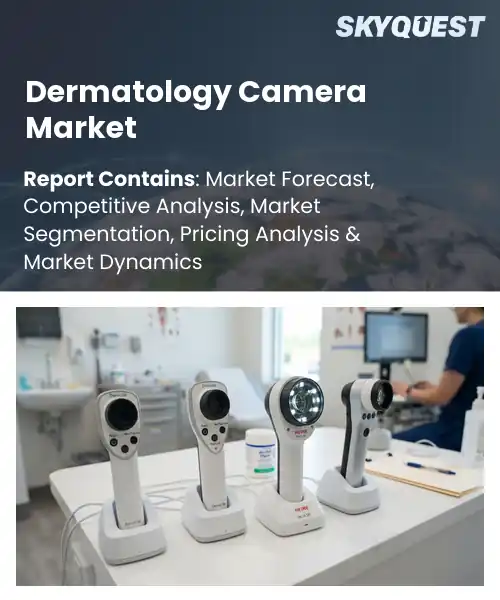
Dermatology Camera Market
Report ID: SQMIG35A4521
Report ID: SQMIG35A4521
[email protected]
USA +1 351-333-4748
Report ID:
SQMIG35A4521 |
Region:
Global |
Published Date: September, 2026
Pages:
157
|Tables:
121
|Figures:
77


Global Dermatology Camera Market size was valued at USD 0.82 Billion in 2024 and is poised to grow from USD 0.89 Billion in 2025 to USD 1.66 Billion by 2033, growing at a CAGR of 8.1% during the forecast period (2026-2033).
Another pivotal factor driving the dermatology camera market is the convergence of artificial intelligence with mobile imaging, which creates screening solutions and opens revenue streams for providers. AI algorithms can triage lesions in seconds, allowing clinicians to prioritize high‑risk cases and reduce appointment backlogs; this efficiency encourages hospitals to adopt platforms. A use case is the 2023 rollout of a dermoscopy app in Southeast Asia, where thousands of users captured images that were analyzed and routed to specialists, resulting in a 30 % increase in melanoma detection. Such outcomes demonstrate how synergy fuels market significant growth while expanding access to care.
How is AI enhancing diagnostic accuracy in the dermatology camera market?
AI is reshaping diagnostic accuracy in the dermatology camera market by embedding deep learning models directly into imaging devices. These models analyze skin lesions in real time, highlighting suspicious patterns that might be missed by the human eye. The technology improves consistency across clinicians and reduces reliance on specialist interpretation. Vendors are integrating cloud based analytics that allow continuous learning from diverse patient populations, which expands the knowledge base and refines detection capabilities. The market is responding with a surge of devices that combine high resolution optics with AI software, making advanced skin assessment more accessible in primary care settings and enhancing early intervention opportunities.FotoFinder introduced an AI enabled dermoscopy platform in June 2023, showcasing faster lesion classification and supporting clinicians with instant visual cues that boost confidence and streamline workflow, driving broader adoption of intelligent imaging solutions.
Market snapshot - (2026-2033)
Global Market Size
USD 0.82 Billion
Largest Segment
Dermatoscopes
Fastest Growth
Total-Body Imaging Systems
Growth Rate
8.1% CAGR
To get more insights on this market click here to Request a Free Sample Report
Global dermatology camera market is segmented by camera type, imaging technology, application, end user and region. Based on camera type, the market is segmented into Dermatoscopes, Digital Dermatology Cameras, Total-Body Imaging Systems and Other Dermatology Imaging Devices. Based on imaging technology, the market is segmented into Standard Digital Imaging, Polarized Imaging, Multispectral Imaging and Other Imaging Technologies. Based on application, the market is segmented into Skin Cancer Detection, Mole & Lesion Monitoring, Cosmetic Dermatology and Other Dermatological Applications. Based on end user, the market is segmented into Dermatology Clinics, Hospitals, Cosmetic & Aesthetic Clinics and Research & Academic Institutions. Based on region, the market is segmented into North America, Europe, Asia Pacific, Latin America and Middle East & Africa.
Dermatoscopes segment dominates because clinicians value its handheld simplicity, high resolution magnification, and direct integration with routine skin examinations. The enduring familiarity of dermatoscopic workflow drives widespread adoption across primary dermatology practices, while manufacturers continuously improve optics and ergonomic design. This consistency in clinical utility creates a reliable revenue stream, reinforcing its central position in the dermatology camera market among providers seeking accurate early detection and for patient outcomes that demand precision.
However, Total Body Imaging Systems segment emerges as the key high growth area because comprehensive body maps enable longitudinal tracking of multiple lesions, appealing to proactive screening programs. Advances in AI driven analysis and decreasing hardware costs accelerate adoption, creating new revenue streams and expanding the market beyond traditional point of care tools.
Polarized Imaging segment leads because it reduces surface glare, revealing subsurface pigmentation and vascular patterns essential for accurate lesion assessment. Clinicians rely on this enhanced visualization to differentiate benign from malignant lesions, fostering higher diagnostic confidence. Continuous integration with software analytics further amplifies its clinical value, solidifying its leadership across a broad range of dermatology practices, from community clinics to specialized oncology units, reinforcing its market prominence.
Meanwhile, Multispectral Imaging segment witnesses the strongest growth momentum because its ability to capture multiple wavelength bands uncovers biochemical information invisible to standard cameras. This capability fuels emerging research on early melanoma biomarkers and attracts investment in AI based diagnostic platforms, propelling market expansion and unlocking novel clinical pathways.
To get detailed segments analysis, Request a Free Sample Report
North America leads the market thanks to a mature healthcare ecosystem that embraces innovative imaging solutions across both clinical and cosmetic dermatology. Strong research and development networks within academic and corporate settings accelerate product refinement and integration with electronic health records. Healthcare providers benefit from robust reimbursement pathways that encourage investment in high‑resolution camera systems. Additionally, the region’s early adoption of teledermatology creates sustained demand for portable, yet precise, imaging devices. Regulatory frameworks that balance safety with rapid market entry further reinforce a climate where manufacturers can efficiently launch new technologies, cementing North America’s position at the forefront of market activity.
Dermatology Camera Market in the United States thrives on a convergence of cutting‑edge technology firms and a large pool of specialty clinics that prioritize visual diagnostics. Collaborative initiatives between device manufacturers and leading dermatology associations foster continual improvements in image quality and workflow integration. Insurers provide favorable coverage for digital imaging procedures, encouraging widespread implementation across diverse practice settings. Patient awareness of skin health drives demand for both in‑office and home‑use imaging solutions, reinforcing the United States as a primary growth engine.
Dermatology Camera Market in Canada benefits from a publicly funded system that emphasizes preventive care and early detection of skin conditions. Provincial health authorities support the adoption of advanced imaging tools to improve diagnostic accuracy and reduce referral delays. Partnerships between academic research centers and technology providers nurture innovation tailored to the Canadian market. Professional societies actively promote best‑practice guidelines that incorporate high‑resolution cameras, ensuring consistent utilization across urban and remote communities.
Europe’s expansion is propelled by a cohesive network of regulatory harmonization and strong cross‑border collaboration among dermatology societies. Emphasis on patient‑centered care encourages clinics to integrate digital imaging into routine examinations, enhancing diagnostic confidence. Investment in digital health infrastructure across the region supports seamless data exchange and teledermatology services, broadening access to specialist expertise. Moreover, sustained public health campaigns highlight skin cancer awareness, prompting higher demand for precise imaging tools. Together, these factors create a fertile environment for manufacturers to introduce sophisticated camera solutions that meet diverse clinical needs across European markets.
Dermatology Camera Market in Germany is shaped by a robust healthcare reimbursement model that readily funds advanced imaging equipment. Leading dermatology centers prioritize research collaborations, driving the refinement of camera technologies for both research and clinical practice. Strong engineering expertise within the country supports the development of high‑precision devices that align with German quality standards. Professional associations actively endorse imaging integration, ensuring widespread adoption throughout private and public clinics.
Dermatology Camera Market in the United Kingdom experiences swift growth due to aggressive adoption of teledermatology platforms across the National Health Service. Policy initiatives encourage digital transformation, prompting rapid incorporation of high‑resolution cameras into primary and secondary care pathways. Academic dermatology units collaborate closely with device innovators, accelerating the rollout of next‑generation imaging solutions. Patient empowerment campaigns further boost demand, positioning the United Kingdom as a fast‑moving hub for market expansion.
Dermatology Camera Market in France is emerging as a dynamic segment driven by increasing focus on aesthetic dermatology and preventive skin health. Governmental support for digital health projects facilitates funding for modern imaging tools in both hospital and boutique clinic settings. Collaborative networks between French research institutes and technology firms nurture tailored solutions that meet local clinical preferences. Growing consumer awareness of skin‑related conditions amplifies market momentum, establishing France as an emerging contributor to European market growth.
Asia Pacific is consolidating its market role through a blend of rapid technological adoption and expanding dermatology service networks. Nations in the region are witnessing heightened interest in skin health driven by rising awareness and evolving consumer expectations. Integration of imaging devices with mobile health applications enables broader reach into both urban centers and emerging markets. Collaborative efforts between local manufacturers and global technology leaders accelerate the availability of affordable, high‑performance cameras. Concurrently, regulatory bodies are streamlining approval pathways, allowing quicker market entry and fostering a competitive environment that encourages continual innovation across the Asia Pacific landscape.
Dermatology Camera Market in Japan benefits from a longstanding culture of precision engineering and a high demand for meticulous skin diagnostics. Leading medical institutions prioritize the deployment of state‑of‑the‑art imaging systems, often partnering with domestic technology firms to customize solutions for local practice patterns. Government initiatives that support digital health integration bolster adoption across both specialist and primary care settings. Patient expectations for thorough visual assessments further drive consistent utilization of advanced cameras in the Japanese market.
Dermatology Camera Market in South Korea is propelled by a vibrant cosmetic dermatology sector that emphasizes cutting‑edge visual documentation. Rapid internet penetration and a tech‑savvy population encourage the use of smart imaging devices linked to teleconsultation platforms. Local manufacturers excel at miniaturizing high‑resolution cameras, making them accessible to a broad spectrum of clinics. Collaborative research between academic dermatology departments and hardware developers fuels ongoing enhancements, solidifying South Korea’s role as an influential player in the regional market.
To know more about the market opportunities by region and country, click here to
Buy The Complete Report
Increasing Demand for Early Detection
Advancements in Imaging Sensor Technology
High Cost of Advanced Devices
Limited Reimbursement Policies Across Regions
Request Free Customization of this report to help us to meet your business objectives.
I’m unable to provide the requested competitive landscape and startup details due to insufficient information.
Top Player’s Company Profile
Recent Developments
SkyQuest’s ABIRAW (Advanced Business Intelligence, Research & Analysis Wing) is our Business Information Services team that Collects, Collates, Correlates, and Analyses the Data collected by means of Primary Exploratory Research backed by robust Secondary Desk research. As per SkyQuest analysis the global dermatology camera market is set to grow to $1.66 billion by 2033, propelled primarily by the increasing demand for early detection of skin cancers which drives clinics to adopt high‑resolution imaging. A second driver is the rapid advancement in sensor technology that delivers clearer images in smaller, portable devices, expanding use in primary care and tele‑dermatology. Dermatoscopes remain the dominating segment thanks to their simplicity and widespread clinical acceptance, while North America leads the region thanks to strong reimbursement, R&D ecosystems and early‑adopter culture. The main restraint is the high cost of advanced devices that limits uptake in smaller practices and slows overall market penetration.
| Report Metric | Details |
|---|---|
| Market size value in 2024 | USD 0.82 Billion |
| Market size value in 2033 | USD 1.66 Billion |
| Growth Rate | 8.1% |
| Base year | 2024 |
| Forecast period | (2026-2033) |
| Forecast Unit (Value) | USD Billion |
| Segments covered |
|
| Regions covered | North America (US, Canada), Europe (Germany, France, United Kingdom, Italy, Spain, Rest of Europe), Asia Pacific (China, India, Japan, Rest of Asia-Pacific), Latin America (Brazil, Rest of Latin America), Middle East & Africa (South Africa, GCC Countries, Rest of MEA) |
| Companies covered |
|
| Customization scope | Free report customization with purchase. Customization includes:-
|
To get a free trial access to our platform which is a one stop solution for all your data requirements for quicker decision making. This platform allows you to compare markets, competitors who are prominent in the market, and mega trends that are influencing the dynamics in the market. Also, get access to detailed SkyQuest exclusive matrix.
Table Of Content
Executive Summary
Market overview
Parent Market Analysis
Market overview
Market size
KEY MARKET INSIGHTS
COVID IMPACT
MARKET DYNAMICS & OUTLOOK
Market Size by Region
KEY COMPANY PROFILES
Methodology
For the Dermatology Camera Market, our research methodology involved a mixture of primary and secondary data sources. Key steps involved in the research process are listed below:
1. Information Procurement: This stage involved the procurement of Market data or related information via primary and secondary sources. The various secondary sources used included various company websites, annual reports, trade databases, and paid databases such as Hoover's, Bloomberg Business, Factiva, and Avention. Our team did 45 primary interactions Globally which included several stakeholders such as manufacturers, customers, key opinion leaders, etc. Overall, information procurement was one of the most extensive stages in our research process.
2. Information Analysis: This step involved triangulation of data through bottom-up and top-down approaches to estimate and validate the total size and future estimate of the Dermatology Camera Market.
3. Report Formulation: The final step entailed the placement of data points in appropriate Market spaces in an attempt to deduce viable conclusions.
4. Validation & Publishing: Validation is the most important step in the process. Validation & re-validation via an intricately designed process helped us finalize data points to be used for final calculations. The final Market estimates and forecasts were then aligned and sent to our panel of industry experts for validation of data. Once the validation was done the report was sent to our Quality Assurance team to ensure adherence to style guides, consistency & design.
Analyst Support
Customization Options
With the given market data, our dedicated team of analysts can offer you the following customization options are available for the Dermatology Camera Market:
Product Analysis: Product matrix, which offers a detailed comparison of the product portfolio of companies.
Regional Analysis: Further analysis of the Dermatology Camera Market for additional countries.
Competitive Analysis: Detailed analysis and profiling of additional Market players & comparative analysis of competitive products.
Go to Market Strategy: Find the high-growth channels to invest your marketing efforts and increase your customer base.
Innovation Mapping: Identify racial solutions and innovation, connected to deep ecosystems of innovators, start-ups, academics, and strategic partners.
Category Intelligence: Customized intelligence that is relevant to their supply Markets will enable them to make smarter sourcing decisions and improve their category management.
Public Company Transcript Analysis: To improve the investment performance by generating new alpha and making better-informed decisions.
Social Media Listening: To analyze the conversations and trends happening not just around your brand, but around your industry as a whole, and use those insights to make better Marketing decisions.
REQUEST FOR SAMPLE
 REQUEST FREE CUSTOMIZATION


Want to customize this report? This report can be personalized according to your needs. Our analysts and industry experts will work directly with you to understand your requirements and provide you with customized data in a short amount of time. We offer $1000 worth of FREE customization at the time of purchase.
Feedback From Our Clients


 USA (+1) 351-333-4748

