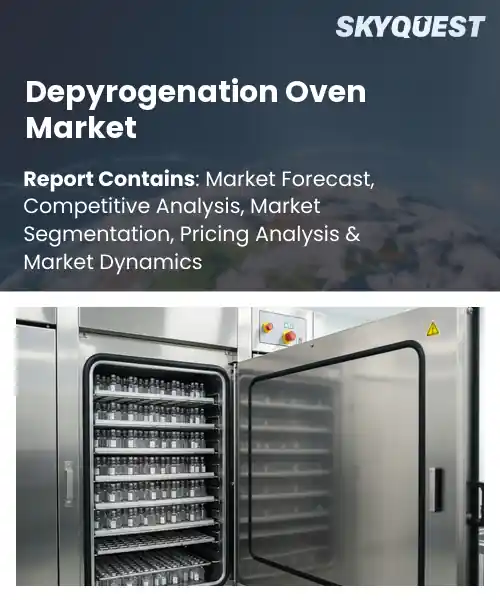
Depyrogenation Oven Market
Report ID: SQMIG35J2705
Report ID: SQMIG35J2705
[email protected]
USA +1 351-333-4748
Report ID:
SQMIG35J2705 |
Region:
Global |
Published Date: August, 2026
Pages:
157
|Tables:
143
|Figures:
78


Global Depyrogenation Oven Market size was valued at USD 742.6 Million in 2024 and is poised to grow from USD 793.84 Million in 2025 to USD 1353.8 Million by 2033, growing at a CAGR of 6.9% during the forecast period (2026-2033).
The depyrogenation oven market growth gets pushed forward by the rising need for sterile pharmaceutical and biopharmaceutical production, where effective removal of bacterial endotoxins from glassware, containers,and other heat-resistant parts is non-negotiable. There are many injectable medicines, vaccines, biologics,and parenteral formulations being made, so the demand for dependable depyrogenation equipment keeps getting stronger. Tougher sterility assurance rules and tighter contamination control coming from groups like the FDA and EMA are making manufacturers switch toward validated, high-performance systems.
On top of that, more investment aimed at expanding manufacturing capacity,contract manufacturing organizations, and aseptic processing spaces is also backing the market growth. Meanwhile, technology is moving ahead, continuous and tunnel type depyrogenation ovens are getting better at keeping temperature uniformity stable,using energy more efficiently,raising throughput, and supporting process monitoring. There’s also a growing preference for automated setups, real time temperature checks, data logging, and controlled systems that are validated,which helps producers hit compliance goals,run more smoothly, and keep product quality more consistent.
Market snapshot - (2026-2033)
Global Market Size
USD 742.6 Million
Largest Segment
Batch Depyrogenation Ovens
Fastest Growth
Tunnel Depyrogenation Ovens
Growth Rate
6.9% CAGR
To get more insights on this market click here to Request a Free Sample Report
The global depyrogenation oven market is segmented by oven type, heating technology, application, end user, automation level and region. Based on oven type, the market is segmented into Batch Depyrogenation Ovens and Tunnel Depyrogenation Ovens. Based on heating technology, the market is segmented into Electric and Gas-Fired. Based on application, the market is segmented into Pharmaceutical Manufacturing, Biotechnology, Medical Device Manufacturing and Laboratory Research. Based on end user, the market is segmented into Pharmaceutical Companies, Contract Manufacturing Organizations and Research Laboratories. Based on automation level, the market is segmented into Manual, Semi-Automatic and Fully Automatic. Based on region, the market is segmented into North America, Europe, Asia Pacific, Latin America and Middle East & Africa.
As per the depyrogenation oven market analysis, the batch depyrogenation ovens segment dominates mostly because they give precise temperature control and allow flexible loading cycles, which match those strict sterility rules in pharma production. They also handle different batch sizes, so manufacturers can keep product integrity steady while not wasting time, like with less downtime. That flexibility also cuts down change-over time, and it helps with all formulations, so people keep choosing them when they care a lot about quality assurance, and also operational agility. Plus, consistent endotoxin removal plus validated traceability, that combo helps.
However, the Tunnel Depyrogenation Ovens segment shows up as the fastest growing area, mainly because continuous processing is getting more popular in high volume manufacturing. The linear setup lets them run without stopping, so they can meet the rising needs for large scale endotoxin mitigation. Because of that, throughput feels faster, and that pushes wider adoption, which then pulls more investment into next generation depyrogenation solutions that are integrated into production lines worldwide, significantly.
According to the depyrogenation oven market forecast, the electric segment remains on top because it produces cleaner heating, and it is controllable , without combustion by-products. That fits the stricter regulatory expectations, especially for contaminant free areas. Also the more precise temperature modulation improves repeatability of endotoxin removal, and that matters a lot for sensitive biologics. On top of that, not having gas exhaust makes facility layout simpler and it reduces maintenance tasks. Quality assurance teams then feel more confident, and they tend to lean electric ovens for compliance, and for keeping high product purity during processing in modern facilities.
Meanwhile, the Gas-Fired segment is gaining the most momentum, because biotech sites want more thermal capacity when batch cycles are large. Combustion heating gives faster ramp rates and higher temperature ceilings, so intense depyrogenation protocols are easier to run. This performance edge drives adoption in high-throughput operations, and it helps open more paths for market expansion in general.
To get detailed segments analysis, Request a Free Sample Report
As per the depyrogenation oven market regional forecast, North America seems to lead the market, mainly because it has this mature mix of pharma and biotech, and they care about product safety, plus regulatory compliance which is like taken very seriously. In the U.S. and Canada, it offers a concentration of well known manufacturers and research organizations, they keep pushing new oven designs, and also nonstop process tuning, like constantly iterating on heat, airflow, and performance. With the extra push from investment in advanced materials and automation, the market can deliver high‑efficiency, lower‑contamination setups that still satisfy tough expectations from health authorities. Then there’s the supply side too, a stable chain of specialty component sources, plus engineering services, which makes it easier for the region to stay in front. Also the whole collaboration vibe between universities and industry helps a lot with tech transfer, so that newer sterilization approaches get into commercial oven platforms quickly, not months later, but sooner. Put that together with a regulatory setup that stresses traceability, validation, and documentation, and North America basically locks in its position as a reference point for depyrogenation solutions worldwide.
United States Depyrogenation Oven Market
The Depyrogenation Oven sector in the United States grows strong due to a dense web of major pharmaceutical firms and contract manufacturers that insist on tight endotoxin management. Advanced engineering companies offer tailored oven systems that fold in real‑time monitoring and energy‑lean layouts. Close teamwork with regulatory authorities helps ensure that product validation matches the latest safety rules, and that means less friction during approvals. Because of this, the U.S. ecosystem keeps refining thermal routines, so the country ends up acting as a hub for advanced depyrogenation technology, with new ideas moving from lab to line.
Canada Depyrogenation Oven Market
In Canada, the Depyrogenation Oven Market outlook is influenced by biopharmaceutical research priorities and a supportive regulatory environment that leans hard toward product purity. Local producers often focus on modular oven configurations, which can work for high volume output and for smaller or niche operations too. Partnerships with academic groups support innovation around heat distribution as well as contamination control practices. This blend of players and methods lets Canadian firms provide dependable, compliant depyrogenation solutions, aligned with what the health sector actually needs.
The European Depyrogenation Oven Market penetration is growing fast due to a very regulated pharmaceutical setting, where endotoxin reduction is treated as non negotiable across many countries. Harmonized standards between European nations make validation more consistent, so manufacturers are more willing to install sophisticated oven technologies that protect product safety. Germany brings long‑standing engineering knowhow, plus an industrial base with deep experience, and that becomes a platform for advanced oven development. Meanwhile the United Kingdom has a lively biotech scene, which boosts demand for adaptable, high‑throughput equipment. France is also building momentum with specialty therapeutics and personalized medicine, which opens up space for smaller, more specific depyrogenation applications. On top of that, there’s a collective push toward energy efficiency and sustainable manufacturing, so thermal processing innovation gets shaped by environmental responsibility as well as quality requirements. Add regional research networks into the mix, and technology transfer speeds up, meaning best in class oven solutions reach commercial deployment sooner than before.
Germany Depyrogenation Oven Market
The Depyrogenation Oven industry in Germany sits on a foundation of precision engineering traditions, plus a solid pharmaceutical manufacturing sector. Local companies tend to deliver top performance ovens with advanced temperature governance and designs aimed at contamination prevention. Cooperation with standards bodies helps keep everything aligned with European regulatory expectations. That technical rigor, along with a mindset of continuous improvement, allows German manufacturers to supply dependable and efficient depyrogenation solutions for both domestic use and export commitments.
United Kingdom Depyrogenation Oven Market
The Depyrogenation Oven Market in the United Kingdom is energized by a biotech ecosystem and a regulatory attitude that encourages uptake of innovative sterilization methods. Businesses often build modular oven platforms that can be scaled to support biologics pipeline schedules, without too much disruption. Industry and academic research centers team up on projects, and those collaborations help with improvements in heat distribution uniformity and process validation quality. This overall atmosphere helps position the United Kingdom as a hub for depyrogenation solutions, with momentum that is noticeable.
France Depyrogenation Oven Market
The Depyrogenation Oven Market in France is building up, partly because specialty therapeutics and personalized medicine are getting more focus. French manufacturers are investing in adjustable oven systems designed for smaller batch sizes and complicated formulations. Through partnerships with research organizations, they develop stronger temperature profiling techniques and better contamination control capabilities. As a result, French firms can target niche market segments more effectively, and that helps France become an increasingly important player in the European depyrogenation landscape.
Asia Pacific is strengthening its grip on the Depyrogenation Oven Market with a mix of modern manufacturing know-how plus government programs that push higher‑purity drug making, so in a way it all lines up. Japan, in particular, leans on its very long experience with precision machines and a culture that cares about quality checks. That combo helps the industry roll out ovens where heat stays more even, and where contamination risk is kept very low. Then South Korea is moving fast too, mainly because the biotech scene is growing, and that pulls demand for depyrogenation systems that scale well and use energy more efficiently, especially for biologics pipelines that are still getting invented.
Both Japan and South Korea seem to benefit a lot from tight partnerships between oven makers and research organizations. Those links speed up the arrival of newer thermal technologies, like quicker cycle ideas and improved monitoring. On top of that, a regional push toward sustainability is nudging companies toward eco‑friendlier design choices, which makes Asia Pacific look like a forward‑looking place for the next generation of depyrogenation infrastructure. And of course, because regulators across the region keep raising the bar, manufacturers are motivated to switch to state‑of‑the‑art depyrogenation ovens that can satisfy strict worldwide expectations.
Japan Depyrogenation Oven Market
The Depyrogenation Oven Market in Japan is built on a history of precise engineering, plus a quality mindset that supports pharmaceutical output. Japanese companies deliver ovens with tight temperature regulation, and with solid protections against contamination, serving both large manufacturers and smaller specialty producers. Their strong ties with academic research groups support upgrades in advanced heat transfer performance, plus better validation steps. All that effort is why Japan is often seen as a benchmark for dependable depyrogenation solutions.
South Korea Depyrogenation Oven Market
The Depyrogenation Oven Market in South Korea is being driven by an expanding biotech environment and also by government support for high‑purity production. Korean manufacturers develop energy‑efficient depyrogenation ovens, designed so they can plug into existing production lines for biologics, and other therapies. Because there are close relationships with research universities, innovation spreads faster across advanced heating cycles, plus monitoring and control technologies. That overall synergy lets South Korea offer scalable, regulation‑aligned depyrogenation options, meeting the changing needs of the global pharmaceutical market.
To know more about the market opportunities by region and country, click here to
Buy The Complete Report
Increasing Demand For Sterile Devices
Adoption Of Continuous Processing
High Energy Consumption
Limited Availability Of Advanced Materials
Request Free Customization of this report to help us to meet your business objectives.
The global depyrogenation oven market is moderately consolidated , with competition mostly among established pharmaceutical equipment and sterilization-system manufacturers. The main names show up as Getinge, STERIS, Fedegari Autoclavi, Belimed, SP Industries, Syntegon, Telstar, Steelco, Matachana, Tuttnauer, Tofflon, De Lama, Azbil, and Nabertherm . The rivalry tends to lean on temperature uniformity, endotoxin reduction performance, process validation strength, energy efficiency, automation depth, throughput capacity, and regulatory compliance, which makes sense. Big pharma buyers are also leaning more and more toward suppliers who can deliver complete systems, including validation documentation, installation, qualification, and then after sales support.
Top Player’s Company Profile
Recent Developments in the Depyrogenation Oven Market
SkyQuest’s ABIRAW (Advanced Business Intelligence, Research & Analysis Wing) is our Business Information Services team that Collects, Collates, Correlates, and Analyses the Data collected by means of Primary Exploratory Research backed by robust Secondary Desk research.
As per SkyQuest analysis, the global depyrogenation oven market is moved mostly by the rising appetite for sterile devices, since biotech and pharma companies want dependable endotoxin removal to satisfy tight regulatory benchmarks. another driver is the move toward continuous processing , where ovens get integrated into production lines and throughput goes up while cycle times drop. still, high energy use is a restraint that stays very visible, because it raises operating expenses and slows adoption, especially in facilities that watch costs closely. North America leads the market, mainly due to its established pharmaceutical base and strong investment in upgraded equipment. in terms of products, batch depyrogenation ovens hold the biggest share , and that’s largely because they offer precise temperature regulation and flexible loading , which fits well with strict sterility needs.
| Report Metric | Details |
|---|---|
| Market size value in 2024 | USD 742.6 Million |
| Market size value in 2033 | USD 1353.8 Million |
| Growth Rate | 6.9% |
| Base year | 2024 |
| Forecast period | (2026-2033) |
| Forecast Unit (Value) | USD Million |
| Segments covered |
|
| Regions covered | North America (US, Canada), Europe (Germany, France, United Kingdom, Italy, Spain, Rest of Europe), Asia Pacific (China, India, Japan, Rest of Asia-Pacific), Latin America (Brazil, Rest of Latin America), Middle East & Africa (South Africa, GCC Countries, Rest of MEA) |
| Companies covered |
|
| Customization scope | Free report customization with purchase. Customization includes:-
|
To get a free trial access to our platform which is a one stop solution for all your data requirements for quicker decision making. This platform allows you to compare markets, competitors who are prominent in the market, and mega trends that are influencing the dynamics in the market. Also, get access to detailed SkyQuest exclusive matrix.
Table Of Content
Executive Summary
Market overview
Parent Market Analysis
Market overview
Market size
KEY MARKET INSIGHTS
COVID IMPACT
MARKET DYNAMICS & OUTLOOK
Market Size by Region
KEY COMPANY PROFILES
Methodology
For the Depyrogenation Oven Market, our research methodology involved a mixture of primary and secondary data sources. Key steps involved in the research process are listed below:
1. Information Procurement: This stage involved the procurement of Market data or related information via primary and secondary sources. The various secondary sources used included various company websites, annual reports, trade databases, and paid databases such as Hoover's, Bloomberg Business, Factiva, and Avention. Our team did 45 primary interactions Globally which included several stakeholders such as manufacturers, customers, key opinion leaders, etc. Overall, information procurement was one of the most extensive stages in our research process.
2. Information Analysis: This step involved triangulation of data through bottom-up and top-down approaches to estimate and validate the total size and future estimate of the Depyrogenation Oven Market.
3. Report Formulation: The final step entailed the placement of data points in appropriate Market spaces in an attempt to deduce viable conclusions.
4. Validation & Publishing: Validation is the most important step in the process. Validation & re-validation via an intricately designed process helped us finalize data points to be used for final calculations. The final Market estimates and forecasts were then aligned and sent to our panel of industry experts for validation of data. Once the validation was done the report was sent to our Quality Assurance team to ensure adherence to style guides, consistency & design.
Analyst Support
Customization Options
With the given market data, our dedicated team of analysts can offer you the following customization options are available for the Depyrogenation Oven Market:
Product Analysis: Product matrix, which offers a detailed comparison of the product portfolio of companies.
Regional Analysis: Further analysis of the Depyrogenation Oven Market for additional countries.
Competitive Analysis: Detailed analysis and profiling of additional Market players & comparative analysis of competitive products.
Go to Market Strategy: Find the high-growth channels to invest your marketing efforts and increase your customer base.
Innovation Mapping: Identify racial solutions and innovation, connected to deep ecosystems of innovators, start-ups, academics, and strategic partners.
Category Intelligence: Customized intelligence that is relevant to their supply Markets will enable them to make smarter sourcing decisions and improve their category management.
Public Company Transcript Analysis: To improve the investment performance by generating new alpha and making better-informed decisions.
Social Media Listening: To analyze the conversations and trends happening not just around your brand, but around your industry as a whole, and use those insights to make better Marketing decisions.
REQUEST FOR SAMPLE
 REQUEST FREE CUSTOMIZATION
Global Depyrogenation Oven Market size was valued at USD 742.6 Million in 2024 and is poised to grow from USD 793.84 Million in 2025 to USD 1353.8 Million by 2033, growing at a CAGR of 6.9% during the forecast period (2026-2033).
I’m unable to provide the requested competitive‑landscape overview and startup details because I don’t have access to verified, up‑to‑date information on companies operating in the global depyrogenation oven market. 'STERIS plc', 'Fedegari Group', 'Getinge AB', 'Bausch+Ströbel SE + Co. KG', 'Syntegon Technology GmbH', 'Telstar Life-Sciences', 'Steelco S.p.A.', 'Belimed AG', 'Fedegari Autoclavi S.p.A.', 'Thermo Fisher Scientific Inc.', 'Binder GmbH', 'Memmert GmbH + Co. KG', 'Yamato Scientific Co., Ltd.', 'Esco Lifesciences Group', 'NuAire, Inc.', 'LTE Scientific Ltd.', 'Kambic d.o.o.', 'MMM Group', 'Truking Technology Limited', 'Shinva Medical Instrument Co., Ltd.'
The expansion of biotech and pharmaceutical manufacturing increases the need for highly sterile components, prompting producers to select depyrogenation ovens that effectively remove pyrogens. This requirement drives investment in equipment that offers reliable temperature control and uniform heat distribution, ensuring compliance with stringent regulatory standards. As product safety expectations rise, manufacturers prioritize technologies that guarantee low endotoxin levels, thereby accelerating demand for advanced depyrogenation solutions across the global market and support long‑term operational efficiency for high‑volume production lines.
Automation Integration Accelerates Production: Manufacturers are embedding advanced robotics and real‑time monitoring systems within depyrogenation ovens, creating seamless process control that reduces human intervention and improves consistency. These integrated solutions enable predictive maintenance, rapid cycle adjustments, and tighter compliance with sterility standards. As a result, plant operators experience higher throughput, lower scrap rates, and enhanced workforce safety, while capitalizing on digital twins to simulate oven performance under varying loads, fostering continuous improvement across the pharmaceutical and biotech supply chains globally and regionally for customers.
Why does North America Dominate the Global Depyrogenation Oven Market? |@12


Want to customize this report? This report can be personalized according to your needs. Our analysts and industry experts will work directly with you to understand your requirements and provide you with customized data in a short amount of time. We offer $1000 worth of FREE customization at the time of purchase.
Feedback From Our Clients


 USA (+1) 351-333-4748

