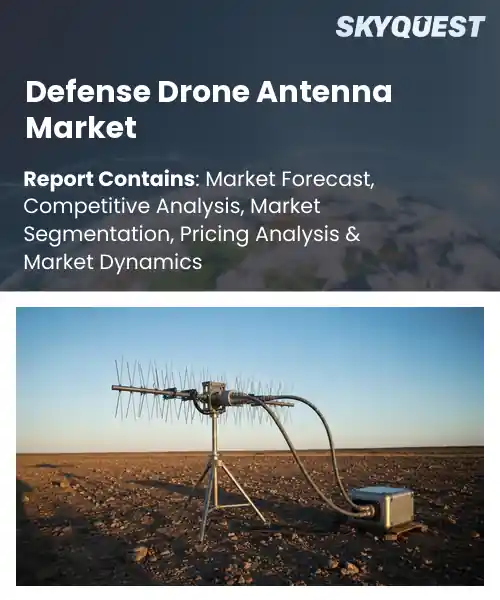
Defense Drone Antenna Market
Report ID: SQMIG20A2821
Report ID: SQMIG20A2821
[email protected]
USA +1 351-333-4748
Report ID:
SQMIG20A2821 |
Region:
Global |
Published Date: July, 2026
Pages:
157
|Tables:
149
|Figures:
78


Global Defense Drone Antenna Market size was valued at USD 538.2 Million in 2024 and is poised to grow from USD 617.32 Million in 2025 to USD 1849.33 Million by 2033, growing at a CAGR of 14.7% during the forecast period (2026-2033).
Increasing demands for network warfare are one of the main drivers for the defense drone antenna industry, as modern military operations need drones to operate as portable repeaters and ensure secure and fast communications in hostile regions. It requires the use of adaptable antennas that can provide frequency hopping capability and protection from jamming. The Integrated Visual Augmentation System of the US Army shows how a reliable antenna system can be used to deliver HD video and data fusion between scattered units. It helps show the operational relevance and create new possibilities for companies developing artificial intelligence-enabled lightweight antennas.
How is AI Integration Shaping the Performance of Defense Drone Antenna Systems?
AI technologies are now being integrated into the design of defense drone antenna systems to improve the quality of signal, flexibility and robustness of operation. Machine learning algorithms interpret the patterns of interference in real-time, thus enabling antenna systems to change the beam direction independently. The processing is conducted by edge AI chipsets mounted on drones and eliminating the need for data transfer to distant servers to perform the task. The system also features the capabilities of predicting the wear of components preventing potential failures from occurring. With the growth of defense drones market, such antenna systems turn out to be a unique selling proposition of manufacturers.
Market snapshot - (2026-2033)
Global Market Size
USD 538.2 Million
Largest Segment
Directional Antennas
Fastest Growth
Phased Array Antennas
Growth Rate
14.7% CAGR
To get more insights on this market click here to Request a Free Sample Report
Global defense drone antenna market is segmented by antenna type, frequency band, application, platform, end user and region. Based on antenna type, the market is segmented into Omni-Directional Antennas, Directional Antennas, Phased Array Antennas and SATCOM Antennas. Based on frequency band, the market is segmented into L-Band, S-Band, C-Band, X-Band and Ku/Ka-Band. Based on application, the market is segmented into Communication, Navigation, Electronic Warfare and Intelligence, Surveillance & Reconnaissance (ISR). Based on platform, the market is segmented into Fixed-Wing UAVs, Rotary-Wing UAVs, and VTOL UAVs. Based on end user, the market is segmented into Military, Homeland Security and Defense Contractors. Based on region, the market is segmented into North America, Europe, Asia Pacific, Latin America and Middle East & Africa.
Segment on Phased Array Antennas leads owing to the provision of electronic beam steering that facilitates the tracking of several targets at once, and also secure and high capacity communications on defense drones. The design is modular making it easy to integrate it with various payloads in UAVs in order to cut down on the weight of the system. This flexibility serves the purpose of meeting the demands of mission critical tasks and enhances survivability with low probability of intercept.
On the other hand, the fastest-growing segment is the SATCOM Antennas segment because of the rising need for beyond line-of-sight communication in long-range missions. Improvements in the design of small transceivers and adaptable frequency management help to provide resilient satellite communication links, which lead to innovation in the field and increased interest in high-altitude and maritime drones.
Segment X-Band is leading due to its combination of bandwidth and atmospheric attenuation properties, ensuring stable high-resolution radar and data links for tactical drones. Ease of integration with existing military aviation equipment along with the presence of powerful anti-jamming solutions make it ideal for use in mission-critical communication and sensors fusion, ensuring its crucial position within the market adoption of drones for electronic warfare.
However, Ku/Ka-Band segments show the most robust growth prospects in light of increasing demands for HTS and 5G-aligned backhaul in the context of long-duration ISR operations. Miniaturization of high-gain antenna arrays and real-time HD video streaming make up the key drivers behind the procurement process, opening doors to a variety of commercial-grade data services.
To get detailed segments analysis, Request a Free Sample Report
North America remains at the forefront of the defense drones antenna market through a combination of robust aerospace capacity, rich research and development infrastructure, and strong integration of defense organizations within governments and private sector innovators. The region enjoys an established production chain which facilitates fast prototyping, evaluation, and deployment of novel antennas designed specifically for drones. Significant investment in digital communication, communication security, and autonomous flight control further contributes to this leadership position. Collaborations between universities, defense contractors, and tech startups expedite implementation of state-of-the-art antenna solutions. In addition to that, the favorable regulatory environment and existing defense procurement processes ensure fast adoption of new technologies.
The Defense Drone Antenna Market in the US is supported by the country's well-integrated defense industry, which comprises some of the best aerospace companies alongside communications innovators. The constant investments in the development of new generations of unmanned systems increase the need for antennas with high performance and low observability. Collaborations between government labs and private companies ensure a quick transfer of innovations, and testing facilities ensure that technologies are qualified for deployment in the field.
Canada Defense Drone Antenna market capitalizes on the fact that there is heavy investment in indigenous technologies and collaborations with defense projects of allied countries. The government encourages indigenous companies to develop small but sturdy antennas suited for diverse missions. The use of advanced materials and networked security features is in line with national security interests. Collaborations with universities and North American entities help ensure a continuous stream of innovative products.
There is rapid growth being witnessed in the defense drone antenna industry in Europe due to sovereign capabilities, collaborative research, and interoperability among allied forces. The engineering prowess of this region coupled with the defensive efforts ensures that there is an innovative antenna architecture that is highly secure and functional. Borderless programs focus on standardization and modularity to ensure joint procurement and testing. Technologies such as low-frequency stealth antennas and adaptive beam-forming technology have been adopted to ensure that the technological superiority is achieved. Policy support and funding ensure that private sector players participate in this industry.
Defense Drone Antenna Market in Germany is anchored by a robust industrial base renowned for precision engineering and high‑frequency component manufacturing. Close collaboration between the Bundeswehr, research institutes, and leading OEMs drives the creation of highly reliable, mission‑critical antennas for unmanned platforms. Emphasis on miniaturization and electronic warfare resilience reflects national defense priorities. Ongoing participation in multinational development projects further enhances technology exchange, positioning Germany as a benchmark for quality and innovation within the European arena.
Defense Drone Antenna Market in the United Kingdom experiences the fastest growth, propelled by ambitious defense modernization programs and strong partnerships between the Ministry of Defence and innovative tech clusters. Focus on rapid prototyping and integration of artificial intelligence into antenna control systems accelerates capability delivery. Investment in secure, high‑bandwidth communication links supports a wide array of unmanned missions. Collaborative efforts with NATO allies facilitate standards alignment, reinforcing the United Kingdom’s position as a dynamic hub for cutting‑edge drone antenna solutions.
France’s Defense Drone Antenna Market has emerged as a niche market strategy, driven by various government policies that aim to improve the autonomy of the system. The French aerospace companies bring together their experience in radar and electronic systems along with the focus on designing antennas for the drones that are light and stealthy in nature. The application of the latest technology in signal processing and secure data transmission goes well with the national security policy of the country.
Asia Pacific is developing its presence in the defense drone antenna market by adopting unmanned systems rapidly, making significant investments in indigenous R&D, and prioritizing regional security cooperation. Countries in the region are building unique manufacturing centers that allow for not only cost-effective manufacturing but also the increasing sophistication of their designs. Closely coordinated efforts between defense ministries and cutting-edge technology sectors will ensure the creation of compact high-gain antennas that can be utilized in any environment ranging from urban areas to sea. Joint exercises and testing will contribute to the improvement of interoperability and the creation of common standards.
Japan’s Defense Drone Antenna Market demonstrates its tendency towards miniaturization and high reliability due to the highly developed electronic industry and demanding defense procurement processes within the country. Cooperation between Self-Defense Forces, major semiconductor producers, and research universities brings constant improvements in the field of high-performance antennas. The low-observable design of the antennas and reliable communication channels are among the important aspects related to Japanese strategic interests in terms of defending its maritime and island territories. Participation in international development projects contributes to the integration of Japanese technology into regional projects.
Defense Drone Antenna Market in South Korea benefits from a vibrant defense industry that integrates cutting‑edge semiconductor technology with expertise in high‑frequency communications. Government‑backed programs encourage rapid development of adaptable, high‑throughput antenna arrays for a wide spectrum of unmanned missions. Collaborative efforts between the armed forces, major conglomerates, and academic institutions accelerate the translation of innovative concepts into operational hardware. Focus on secure, low‑latency data transmission aligns with national defense imperatives, positioning South Korea as an emerging leader in the regional defense drone antenna landscape.
To know more about the market opportunities by region and country, click here to
Buy The Complete Report
Increasing Use of AI
Growing Demand for Long‑Range Surveillance
Stringent Export Control Regulations
High Development Cost and Complexity
Request Free Customization of this report to help us to meet your business objectives.
Antennas for defense drones remain a hotly contested product segment, with manufacturers seeking to integrate antennas with greater gain and smaller profiles into future unmanned aerial vehicles. Such moves by companies as Anduril, which acquired a signal-processing company, and Shield AI, with its recent $200 million contract from the Pentagon involving an antenna manufacturer, are indicative of such trends.
Recent Developments in the Defense Drone Antenna Market
SkyQuest’s ABIRAW (Advanced Business Intelligence, Research & Analysis Wing) is our Business Information Services team that Collects, Collates, Correlates, and Analyses the Data collected by means of Primary Exploratory Research backed by robust Secondary Desk research.
As per SkyQuest analysis, the major driving factors in the market for defense drones antenna include artificial intelligence, as it enables real-time beam steering, prediction of maintenance and enhances the need for smart, faster antennas. The second major driver is the growing need for long-range surveillance, which will drive the market towards the adoption of high gain antennas that can maintain a persistent data link. The major constraint in the market is the growing restrictions on export controls as this will create problems in transferring technologies. North America leads in the market due to advanced research and development activities, while the phased array antennas hold the largest share due to its capabilities.
| Report Metric | Details |
|---|---|
| Market size value in 2024 | USD 538.2 Million |
| Market size value in 2033 | USD 1849.33 Million |
| Growth Rate | 14.7% |
| Base year | 2024 |
| Forecast period | (2026-2033) |
| Forecast Unit (Value) | USD Million |
| Segments covered |
|
| Regions covered | North America (US, Canada), Europe (Germany, France, United Kingdom, Italy, Spain, Rest of Europe), Asia Pacific (China, India, Japan, Rest of Asia-Pacific), Latin America (Brazil, Rest of Latin America), Middle East & Africa (South Africa, GCC Countries, Rest of MEA) |
| Companies covered |
|
| Customization scope | Free report customization with purchase. Customization includes:-
|
To get a free trial access to our platform which is a one stop solution for all your data requirements for quicker decision making. This platform allows you to compare markets, competitors who are prominent in the market, and mega trends that are influencing the dynamics in the market. Also, get access to detailed SkyQuest exclusive matrix.
Table Of Content
Executive Summary
Market overview
Parent Market Analysis
Market overview
Market size
KEY MARKET INSIGHTS
COVID IMPACT
MARKET DYNAMICS & OUTLOOK
Market Size by Region
KEY COMPANY PROFILES
Methodology
For the Defense Drone Antenna Market, our research methodology involved a mixture of primary and secondary data sources. Key steps involved in the research process are listed below:
1. Information Procurement: This stage involved the procurement of Market data or related information via primary and secondary sources. The various secondary sources used included various company websites, annual reports, trade databases, and paid databases such as Hoover's, Bloomberg Business, Factiva, and Avention. Our team did 45 primary interactions Globally which included several stakeholders such as manufacturers, customers, key opinion leaders, etc. Overall, information procurement was one of the most extensive stages in our research process.
2. Information Analysis: This step involved triangulation of data through bottom-up and top-down approaches to estimate and validate the total size and future estimate of the Defense Drone Antenna Market.
3. Report Formulation: The final step entailed the placement of data points in appropriate Market spaces in an attempt to deduce viable conclusions.
4. Validation & Publishing: Validation is the most important step in the process. Validation & re-validation via an intricately designed process helped us finalize data points to be used for final calculations. The final Market estimates and forecasts were then aligned and sent to our panel of industry experts for validation of data. Once the validation was done the report was sent to our Quality Assurance team to ensure adherence to style guides, consistency & design.
Analyst Support
Customization Options
With the given market data, our dedicated team of analysts can offer you the following customization options are available for the Defense Drone Antenna Market:
Product Analysis: Product matrix, which offers a detailed comparison of the product portfolio of companies.
Regional Analysis: Further analysis of the Defense Drone Antenna Market for additional countries.
Competitive Analysis: Detailed analysis and profiling of additional Market players & comparative analysis of competitive products.
Go to Market Strategy: Find the high-growth channels to invest your marketing efforts and increase your customer base.
Innovation Mapping: Identify racial solutions and innovation, connected to deep ecosystems of innovators, start-ups, academics, and strategic partners.
Category Intelligence: Customized intelligence that is relevant to their supply Markets will enable them to make smarter sourcing decisions and improve their category management.
Public Company Transcript Analysis: To improve the investment performance by generating new alpha and making better-informed decisions.
Social Media Listening: To analyze the conversations and trends happening not just around your brand, but around your industry as a whole, and use those insights to make better Marketing decisions.
REQUEST FOR SAMPLE
 REQUEST FREE CUSTOMIZATION
Global Defense Drone Antenna Market size was valued at USD 538.2 Million in 2024 and is poised to grow from USD 617.32 Million in 2025 to USD 1849.33 Million by 2033, growing at a CAGR of 14.7% during the forecast period (2026-2033).
The defense drone antenna market is fiercely contested as firms race to embed higher‑gain, low‑profile arrays into next‑gen UAVs. Recent M&A activity, such as Anduril’s acquisition of a signal‑processing specialist, and partnerships like Shield AI’s $200 million Pentagon contract with a leading antenna maker, illustrate how technology integration and strategic deals are driving competitive advantage. 'RTX Corporation', 'L3Harris Technologies, Inc.', 'Lockheed Martin Corporation', 'Northrop Grumman Corporation', 'BAE Systems plc', 'Thales S.A.', 'Leonardo S.p.A.', 'Israel Aerospace Industries Ltd.', 'Elbit Systems Ltd.', 'Cobham Limited', 'Viasat, Inc.', 'Kymeta Corporation', 'Honeywell International Inc.', 'General Dynamics Corporation', 'Hensoldt AG', 'Rohde & Schwarz GmbH & Co. KG', 'Antenna Research Associates, Inc.', 'MP Antenna, Ltd.', 'Comrod Communication AS', 'MTI Wireless Edge Ltd.'
The integration of artificial intelligence into unmanned aerial platforms enables real‑time processing of imagery and adaptive flight patterns, which in turn requires antennas capable of higher data throughput and dynamic frequency management; as operators seek more autonomous capabilities, demand for sophisticated antenna solutions rises, fostering broader market penetration and encouraging manufacturers to accelerate product innovation and supply chain readiness. These advancements also improve mission reliability and reduce communication latency, further solidifying the strategic importance of advanced antenna technologies across defense stakeholders.
Ai-Driven Beamforming Advances: Manufacturers are integrating AI-driven beamforming capabilities into defense drone antennas to dynamically optimize signal direction and strength in cluttered electromagnetic environments. This technology leverages real‑time machine learning algorithms that adapt to terrain variations, target maneuvers, and interference sources, thereby enhancing communication reliability and situational awareness. As operational doctrines emphasize network‑centric warfare, the ability to maintain high‑fidelity links without manual reconfiguration is becoming a decisive factor for mission success and providing commanders with timely intelligence for rapid decision‑making across contested domains.
Why does North America Dominate the Global Defense Drone Antenna Market? |@12


Want to customize this report? This report can be personalized according to your needs. Our analysts and industry experts will work directly with you to understand your requirements and provide you with customized data in a short amount of time. We offer $1000 worth of FREE customization at the time of purchase.
Feedback From Our Clients


 USA (+1) 351-333-4748

