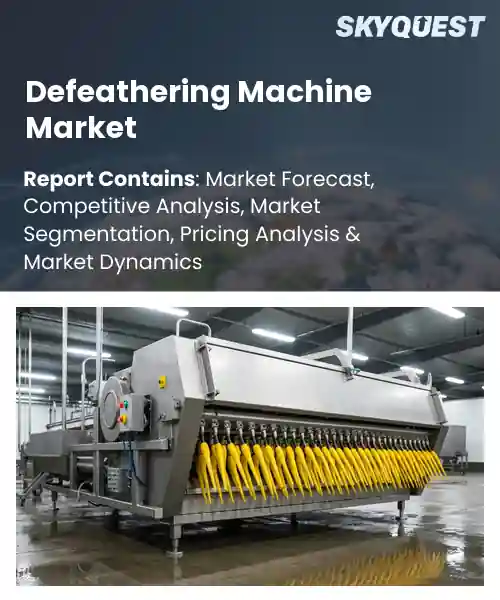
Defeathering Machine Market
Report ID: SQMIG20I3157
Report ID: SQMIG20I3157
[email protected]
USA +1 351-333-4748
Report ID:
SQMIG20I3157 |
Region:
Global |
Published Date: June, 2026
Pages:
157
|Tables:
141
|Figures:
78


Global Defeathering Machine Market size was valued at USD 382.5 Million in 2024 and is poised to grow from USD 400.55 Million in 2025 to USD 582.4 Million by 2033, growing at a CAGR of 4.72% during the forecast period (2026-2033).
The defeathering machine market globally consists of machines that remove feathers from birds efficiently and is important for large agricultural businesses, but also for more niche organic companies as well. Defeathering poultry is necessary to increase production speed, decrease labor costs, and meet strict hygiene standards imposed by supermarkets and export agencies. Prior to 1970, the primary method of defeathering was manually plucking feathers, but in the late 1960s more efficient methods of using pneumatic and rotary systems were being developed in the U.S. Finally, this innovation was adopted by Brazil and China in the mid-1990s due to the rapid increase in demand for poultry products.
Today, there are highly advanced defeathering machines that are fully automated with sensor-based technology that allows for real-time monitoring and demonstrates how far defeathering machine operations have evolved from simple hand tools to high-tech, data-rich machines in the manufacturing industry. The most significant driver of the demand for defeathering equipment today is the significant increase in demand for ready-to-cook poultry products. This creates a need for poultry processors to install faster-working defeathering units in order to take full advantage of shorter supply chains. As manufacturers modernize with automated equipment, their defeathering cycle times can be reduced by 30%, providing poultry processors with decreased labor costs per unit and enabling them to meet the needs of their retail customers for timely deliveries.
As such, this efficiency allows manufacturers to expand into some of the new consumption markets such as Southeast Asia where the growing numbers of middle-class citizens are increasing demand for value-added chicken dishes. Consequently, equipment vendors are launching modular models that accommodate smaller facilities while preserving the economies of scale essential for profitability.
How is AI-driven Automation Reshaping The Defeathering Machine Market?
Automated systems are being integrated into defeathering machines. Using computer vision sensors to assess the density of feathers allows for instant adjustments in blade speeds, increasing the efficiency of feather removal. Predictive wear modeling of the rollers allows for predictive maintenance and reduced machine downtime. Bird position is now managed by integrated robotics which provides more accurate positioning, resulting in reduced labor costs and increased hygiene. As producers strive for increased throughput to satisfy rising poultry consumption, larger revenues can be generated through new predictive technologies and products, as chicken and turkey producers are seeking advanced systems or products that enable them to quickly and easily modify their defeathering machine operation to accommodate differences in size between birds.
Manufacturers are also increasing the availability of services offering remote monitoring of poultry production operations as data-led operations are becoming more prevalent. This shift in operations will also result in tighter coordination across supply chains.
Market snapshot - (2026-2033)
Global Market Size
USD 382.5 Million
Largest Segment
Rotary Drum Defeathering Machines
Fastest Growth
Disc Plucker Machines
Growth Rate
4.72% CAGR
To get more insights on this market click here to Request a Free Sample Report
Global defeathering machine market is segmented by type, capacity, application, end-use, distribution and region. Based on type, the market is segmented into Rotary Drum Defeathering Machines, Vertical Defeathering Machines and Disc Plucker Machines. Based on capacity, the market is segmented into Small (<500 Birds/Hour), Medium (500-2000 Birds/Hour) and Large (>2000 Birds/Hour). Based on application, the market is segmented into Poultry Processing Plants and Abattoirs. Based on end-use, the market is segmented into Chicken Processing and Turkey Processing. Based on distribution, the market is segmented into Direct OEM and Equipment Dealers. Based on region, the market is segmented into North America, Europe, Asia Pacific, Latin America and Middle East & Africa.
The rotary drum defeathering machines segment continues to lead due to their sturdy construction, which can accommodate various bird sizes and feather-shaping designs so that processors can consistently remove feathers with minimal adjustment. Their mechanical simplicity results in reduced downtime while their ability to work with existing equipment adds operational flexibility. When taken together, these features attract both high volume and specialty processors alike to this leading position in the defeathering equipment market and help continue to support throughput improvements.
On the other hand, the disc plucker machines segment is rapidly growing due to the speed at which they pluck feathers matching the increased demand for ultra-fast line speeds in today's facilities. Innovative blade designs reduce feather loss, and their potential to interface with automation provides another catalyst for new installations, creating additional opportunities for further market expansion.
The segment involving medium sized capacity is leading because it can meet throughput requirements while still maintaining a small amount of equipment; this allows for growth of a processor's operational capacity with minimal capital investment (more flexibility in terms of seasonal fluctuations) at both small and large plants looking to expand using modular systems. Operators are confident in the operational reliability and ease of maintenance of their equipment, making them more likely to select this type of equipment for their process.
The large capacity segment is growing faster than all others due to new large scale processing facilities focusing on maximum throughput as a result of increased demand. Advancements made in terms of electric motor operating efficiency and scalable design have driven down the costs associated with owning and operating large capacity systems, resulting in higher rate of adoption of large capacity units. This growth is creating opportunities for the market as it exists today while opening up entirely new revenue opportunities via the investment in additional complementary automation technologies.
To get detailed segments analysis, Request a Free Sample Report
Due to its well-established manufacturing capabilities, strong supply chain networks, and advanced automation in poultry processing, Asia Pacific is leading the way in global Defeathering Machines. Additionally, Japan and South Korea have a high level of engineering capability which leads to quick innovation cycles and high-quality machines. The fact that these two countries are located very close to major poultry producers means that new technologies will be adopted quickly and with less cost than if they were farther away. Joint Research Centers and government-sponsored programs also facilitate technology transfer and training for workers. Furthermore, sustainability initiatives promote the use of energy-efficient machines, which lowers cost for the processors. Additionally, with strong trade agreements within the region and a high export content, manufacturers located in Asia have a great opportunity for global impact.
With its solid foundation in precision engineering along with a commitment to continual improvement, the Defeathering Machine market in Japan has developed quite well. Manufacturers implement advanced sensors to increase throughput while solving challenges associated with gently handling birds. Strong collaboration between poultry growers and equipment manufacturers allows for speedy feedback regarding any issues needing to be resolved so that all players can adjust quickly when there is a change in requirements. Furthermore, compact and modular designs provide flexibility when designing large and small-sized facilities.
The Defeathering Machine Market in South Korea thrives because of technology-driven manufacturing and cost containment. By utilizing cutting-edge robotics and AI technologies, Korean companies are able to maximize feather removal efficiency and reduce the risk of product loss/damage. Close relationships exist between domestic poultry processors which allows for pilot test projects to be conducted in order to improve machine ergonomics and user interface software. The focus on fast scalability and export-ready certifications allows Korean manufacturers to compete worldwide by reinforcing South Korea’s image as being one of the most innovative and affordable places around the world.
The rapid expansion of the Defeathering Machine Market in North America is propelled by strong consumer demand for high‑quality poultry products and a relentless pursuit of operational efficiency among processors. Industry players invest heavily in automation to reduce labor costs and ensure consistent product standards. Collaborative research initiatives between equipment manufacturers and food safety agencies drive the adoption of hygienic designs that meet stringent regulatory expectations. In addition, a growing focus on sustainability encourages the deployment of energy‑saving machines that lower the carbon footprint of processing facilities. These combined forces create a fertile environment for technology adoption and market growth across the United States and Canada. Supply chain integration and advanced data analytics further enhance traceability, allowing processors to respond swiftly to market fluctuations. Moreover, strategic partnerships with equipment innovators enable faster rollout of next‑generation machines, solidifying the region’s leadership in modern poultry processing.
Defeathering Machine Market in United States is characterized by large‑scale processing operations that prioritize speed and consistency. Domestic manufacturers focus on integrating real‑time monitoring systems that provide granular control over feather removal parameters. Partnerships with leading poultry integrators accelerate field testing and rapid implementation of novel technologies. Emphasis on compliance with rigorous food safety guidelines drives continuous refinement of machine sanitation features, supporting the United States reputation for high‑quality poultry products worldwide.
Defeathering Machine Market in Canada benefits from a strong emphasis on sustainability and niche market customization. Canadian firms adapt equipment to accommodate diverse poultry breeds prevalent in regional farms, ensuring gentle handling and minimal waste. Collaborative research with agricultural colleges yields eco‑friendly solutions that reduce water and energy consumption. Government incentives for modernizing food processing infrastructure further encourage adoption of advanced Defeathering technologies across both large and specialized facilities.
Europe is strengthening its position in the Defeathering Machine Market through a combination of regulatory leadership, technological collaboration, and a focus on premium product quality. Stringent food safety and animal welfare standards compel manufacturers to deliver machines that meet high hygiene and precision requirements. Cross‑border research projects foster the development of modular and energy‑efficient systems that can be easily integrated into varied processing environments. Additionally, a deep tradition of engineering excellence supports continuous improvement in sensor accuracy and automation algorithms. These dynamics collectively enhance Europe’s reputation as a hub for sophisticated Defeathering solutions that cater to discerning global customers. The region also benefits from a mature supply chain that offers specialized components and aftermarket services, ensuring long‑term reliability of installed equipment. Strategic participation in international trade shows showcases European innovations, attracting interest from emerging markets seeking advanced processing capabilities.
Defeathering Machine Market in Germany is driven by a legacy of precision engineering and a commitment to Industry 4.0 integration. German manufacturers embed advanced connectivity and predictive maintenance features that minimize downtime for high‑volume processors. Close cooperation with research institutes accelerates the adoption of artificial intelligence for real‑time defect detection. A focus on robust construction ensures machines operate reliably under rigorous European standards, reinforcing Germany’s role as a benchmark for quality and technological sophistication.
Defeathering Machine Market in United Kingdom reflects a strong emphasis on automation and lean manufacturing principles. British firms prioritize flexible machine designs that can be reconfigured for varying production volumes, supporting both large processors and specialty producers. Collaboration with food safety authorities drives the integration of hygienic surfaces and rapid cleaning cycles. Investment in digital twins enables virtual testing of machine performance, reducing development time and bolstering the United Kingdom reputation for innovative and adaptable processing equipment.
Defeathering Machine Market in France benefits from a blend of culinary tradition and advanced engineering, encouraging machines that preserve meat quality while maximizing efficiency. French manufacturers focus on ergonomic interfaces and precise control mechanisms that align with the country’s high standards for food presentation. Partnerships with agribusiness clusters foster the development of low‑energy solutions that address both cost and environmental concerns. This combination of aesthetic sensitivity and technological rigor positions France as a key contributor to the European Defeathering landscape.
To know more about the market opportunities by region and country, click here to
Buy The Complete Report
Increasing Demand for Automated Processing
Advancements in Sensor Integration
High Initial Capital Investment
Limited Availability of Skilled Technicians
Request Free Customization of this report to help us to meet your business objectives.
The competitive landscape is shaped by established equipment manufacturers expanding through strategic acquisitions, joint ventures, and technology upgrades, while new entrants leverage automation and IoT to differentiate. Recent M&A activity includes Baader Group’s acquisition of a niche sensor supplier to enhance machine precision, and Big Dutchman’s partnership with a robotics firm to integrate AI‑driven feather removal, intensifying competition on performance and cost efficiency.
SkyQuest’s ABIRAW (Advanced Business Intelligence, Research & Analysis Wing) is our Business Information Services team that Collects, Collates, Correlates, and Analyses the Data collected by means of Primary Exploratory Research backed by robust Secondary Desk research.
As per SkyQuest analysis, the market is being propelled primarily by the rising demand for automated processing, which lets producers cut labor costs and meet fast‑moving consumer expectations, while a second strong driver comes from advances in sensor integration that enable real‑time monitoring and predictive maintenance, boosting efficiency and product consistency. A major restraint remains the high initial capital outlay required for state‑of‑the‑art equipment, discouraging smaller operators. Asia Pacific continues to dominate the landscape due to its advanced manufacturing base and strong poultry production, and within the product mix the rotary‑drum defeathering machine leads the segment because of its versatility and reliability across bird sizes.
| Report Metric | Details |
|---|---|
| Market size value in 2024 | USD 382.5 Million |
| Market size value in 2033 | USD 582.4 Million |
| Growth Rate | 4.72% |
| Base year | 2024 |
| Forecast period | (2026-2033) |
| Forecast Unit (Value) | USD Million |
| Segments covered |
|
| Regions covered | North America (US, Canada), Europe (Germany, France, United Kingdom, Italy, Spain, Rest of Europe), Asia Pacific (China, India, Japan, Rest of Asia-Pacific), Latin America (Brazil, Rest of Latin America), Middle East & Africa (South Africa, GCC Countries, Rest of MEA) |
| Companies covered |
|
| Customization scope | Free report customization with purchase. Customization includes:-
|
To get a free trial access to our platform which is a one stop solution for all your data requirements for quicker decision making. This platform allows you to compare markets, competitors who are prominent in the market, and mega trends that are influencing the dynamics in the market. Also, get access to detailed SkyQuest exclusive matrix.
Table Of Content
Executive Summary
Market overview
Parent Market Analysis
Market overview
Market size
KEY MARKET INSIGHTS
COVID IMPACT
MARKET DYNAMICS & OUTLOOK
Market Size by Region
KEY COMPANY PROFILES
Methodology
For the Defeathering Machine Market, our research methodology involved a mixture of primary and secondary data sources. Key steps involved in the research process are listed below:
1. Information Procurement: This stage involved the procurement of Market data or related information via primary and secondary sources. The various secondary sources used included various company websites, annual reports, trade databases, and paid databases such as Hoover's, Bloomberg Business, Factiva, and Avention. Our team did 45 primary interactions Globally which included several stakeholders such as manufacturers, customers, key opinion leaders, etc. Overall, information procurement was one of the most extensive stages in our research process.
2. Information Analysis: This step involved triangulation of data through bottom-up and top-down approaches to estimate and validate the total size and future estimate of the Defeathering Machine Market.
3. Report Formulation: The final step entailed the placement of data points in appropriate Market spaces in an attempt to deduce viable conclusions.
4. Validation & Publishing: Validation is the most important step in the process. Validation & re-validation via an intricately designed process helped us finalize data points to be used for final calculations. The final Market estimates and forecasts were then aligned and sent to our panel of industry experts for validation of data. Once the validation was done the report was sent to our Quality Assurance team to ensure adherence to style guides, consistency & design.
Analyst Support
Customization Options
With the given market data, our dedicated team of analysts can offer you the following customization options are available for the Defeathering Machine Market:
Product Analysis: Product matrix, which offers a detailed comparison of the product portfolio of companies.
Regional Analysis: Further analysis of the Defeathering Machine Market for additional countries.
Competitive Analysis: Detailed analysis and profiling of additional Market players & comparative analysis of competitive products.
Go to Market Strategy: Find the high-growth channels to invest your marketing efforts and increase your customer base.
Innovation Mapping: Identify racial solutions and innovation, connected to deep ecosystems of innovators, start-ups, academics, and strategic partners.
Category Intelligence: Customized intelligence that is relevant to their supply Markets will enable them to make smarter sourcing decisions and improve their category management.
Public Company Transcript Analysis: To improve the investment performance by generating new alpha and making better-informed decisions.
Social Media Listening: To analyze the conversations and trends happening not just around your brand, but around your industry as a whole, and use those insights to make better Marketing decisions.
REQUEST FOR SAMPLE
 REQUEST FREE CUSTOMIZATION
Global Defeathering Machine Market size was valued at USD 382.5 Million in 2024 and is poised to grow from USD 400.55 Million in 2025 to USD 582.4 Million by 2033, growing at a CAGR of 4.72% during the forecast period (2026-2033).
The competitive landscape is shaped by established equipment manufacturers expanding through strategic acquisitions, joint ventures, and technology upgrades, while new entrants leverage automation and IoT to differentiate. Recent M&A activity includes Baader Group’s acquisition of a niche sensor supplier to enhance machine precision, and Big Dutchman’s partnership with a robotics firm to integrate AI‑driven feather removal, intensifying competition on performance and cost efficiency. 'Meyn Food Processing Technology', 'Baader Group', 'Stork (Marel)', 'Marel hf.', 'Foodmate BV', 'Cantrell International', 'DMK (Poultry Equipment)', 'Systemate Numafa', 'Dutch Poultry Technology', 'Kuhl Corp.', 'Linco Food Systems', 'Cattaruzzi (Industrie Poultry)', 'Jarvis Products Corporation', 'Jongerius Hanco BV', 'Meyn Food Equipment', 'BANSS Group', 'NABEL Poultry Equipment', 'Poultry Processing Machinery', 'Big Dutchman International', 'Roxell BV'
Manufacturers are shifting toward fully automated defeathering solutions to meet rising consumer expectations for faster processing times and consistent product quality. This shift encourages adoption of advanced machines that reduce manual labor, minimize errors, and improve throughput. The ability to integrate seamlessly with existing production lines further enhances operational efficiency, making such equipment an attractive investment for processors seeking to expand capacity while maintaining stringent hygiene standards and lowering long‑term operational costs. Additionally, the streamlined workflow supports quicker response to market fluctuations and enhances overall supply chain resilience.
Sustainable Materials Adoption: Manufacturers increasingly prioritize eco‑friendly feather‑removal solutions to align with global sustainability mandates and consumer expectations for greener products. This shift drives demand for machines built with low‑energy motors, recyclable components, and minimal waste generation throughout the processing cycle. Suppliers responding with modular designs and renewable‑energy‑compatible interfaces enable plant operators to reduce carbon footprints while maintaining throughput. Consequently, green procurement policies become a decisive factor in equipment selection, accelerating market growth for environmentally responsible defeathering technologies across diversified manufacturing sectors worldwide.
Why does Asia Pacific Dominate the Global Defeathering Machine Market? |@12


Want to customize this report? This report can be personalized according to your needs. Our analysts and industry experts will work directly with you to understand your requirements and provide you with customized data in a short amount of time. We offer $1000 worth of FREE customization at the time of purchase.
Feedback From Our Clients


 USA (+1) 351-333-4748

