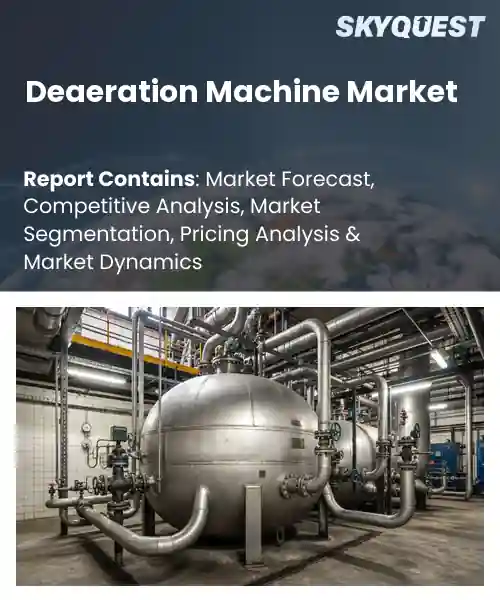
Deaeration Machine Market
Report ID: SQMIG20I3279
Report ID: SQMIG20I3279
[email protected]
USA +1 351-333-4748
Report ID:
SQMIG20I3279 |
Region:
Global |
Published Date: July, 2026
Pages:
157
|Tables:
147
|Figures:
78


Global Deaeration Machine Market size was valued at USD 5.17 Billion in 2024 and is poised to grow from USD 5.42 Billion in 2025 to USD 7.92 Billion by 2033, growing at a CAGR of 4.86% during the forecast period (2026-2033).
Rising investments in power generation and industrial infrastructure, increasing demand for boiler water treatment, stringent regulations for plant efficiency and emissions, expansion of petrochemical and desalination facilities, and rising adoption in renewable energy projects are driving demand for deaeration machines.
The growing use of deaeration machines in various industries including power stations, petrochemical plants, food processing plants, pharmaceutical industry, and water treatment plants is propelling the growth of the market through prevention of corrosion and enhancing the reliability of the systems. The growing focus on renewable energy projects, hydrogen fuel, and desalination plants is also generating demand for effective gas removal equipment. Furthermore, increasing compliance issues, upgrading of industrial infrastructure, and collaborations between the suppliers and EPC contractors will help the deaeration machines market grow in the future. High focus on improving operational efficiency and extending the lifespan of industrial equipment is expected to primarily drive deaeration machine market growth.
On the contrary, high installation and maintenance costs, complex integration with existing industrial systems, fluctuations in raw material prices, and limited adoption among small-scale industries are anticipated to slow down deaeration machine market penetration through 2033.
How is AI-driven Automation Reshaping Global Deaeration Machine Demand?
AI is bringing about significant changes in the deaeration machine industry through improved process control, efficiency, and reliability of the equipment. AI-based sensors constantly check the temperature, pressure, and amounts of gases present, while machine learning uses the information gathered to identify any problems that might arise from these before they become operational. Predictive maintenance enables operators to carry out maintenance only when necessary, thus minimizing downtime, costs, and energy used. AI further ensures the adjustment of operation settings to maximize efficiency in the removal of gases.
Market snapshot - (2026-2033)
Global Market Size
USD 5.17 Billion
Largest Segment
Vacuum Deaerators
Fastest Growth
Mechanical Deaerators
Growth Rate
4.86% CAGR
To get more insights on this market click here to Request a Free Sample Report
Global deaeration machine market is segmented by type, material composition, volumetric capacity, end-use industry, distribution channel, and region. Based on type, the market is segmented into vacuum deaerators, steam deaerators, thermal deaerators, and mechanical deaerators. Based on material composition, the market is segmented into stainless steel, carbon steel, and alloy steel. Based on volumetric capacity, the market is segmented into up to 50 cubic meters per hour, 50 to 100 cubic meters per hour, 100 to 200 cubic meters per hour, and over 200 cubic meters per hour. Based on end-use industry, the market is segmented into food & beverage industry, pharmaceutical industry, chemical industry, energy & power plants, and oil & gas industry. Based on distribution channel, the market is segmented into direct and indirect. Based on region, the market is segmented into North America, Europe, Asia Pacific, Latin America, and Middle East & Africa.
The vacuum deaerators segment is forecasted to lead the global deaeration machine market revenue generation across the study period. They offer high oxygen removal efficiency without needing any additional heating, and that is why these membrane modules are highly favored due to meeting the requirements of high quality that are set by the processes industries. Their operational capability over different temperature ranges and compatibility with plant control system is what gives them the edge over other products and makes them number one in the market.
However, steam deaerators are witnessing the strongest growth momentum since renewable energy projects coming up require large-scale water treatment along with their steam cycle system. The ability of these plants to make use of waste heat contributes to better efficiency of the plant and invites investment in upgrading the existing plants.
The stainless steel segment is predicted to account for the highest global deaeration machine market share in the future. The corrosion resistance and hygiene of the material suit the high demands on purity in food, pharmaceutical, and chemical production processes. Its resistance to high temperatures and harsh chemicals guarantees a long-term performance and minimized need for maintenance. Such properties correspond to the current industrial standards, thus making the material more preferred in the industry and ensuring its leading position in deaerators’ construction.
Conversely, alloy steel is emerging as the key high‑growth subsegment as per this deaeration machine market forecast, due to the high level of heat resistance made possible by the advanced alloy composition, which will be able to cater to the future needs of power stations and oil/gas plants. The manufacturers are exploiting these alloys to develop smaller and more efficient deaerators.
To get detailed segments analysis, Request a Free Sample Report
Advanced industrial capacity, strong investment in water and chemical processing, and a deep pool of engineering expertise are forecasted to help this region hold sway over others. The region’s industries have an advantage due to their interconnection with growing industries like petrochemicals, food processing, and power generation, leading to constant demand for effective deaeration systems. The presence of strong logistics networks, policies from the government favoring the uptake of new technology, and continuous improvement contribute to competitiveness. In addition, collaborative efforts between the developers of the equipment and users lead to innovations to meet the required high standards at low costs.
Deaeration machine market in Japan is driven by a mature manufacturing ecosystem that emphasizes precision engineering and stringent quality control. Local demand is reinforced by extensive food and beverage processing facilities, as well as sophisticated chemical plants that require consistent removal of dissolved gases. Collaborative research initiatives between universities and industry foster technology upgrades, while strong domestic supply chains enable rapid response to customer specifications. The market benefits from a culture of continuous improvement that aligns closely with global standards, positioning Japan as a benchmark for reliability and efficiency.
Deaeration machine demand in South Korea thrives on a dynamic industrial base focused on petrochemicals, electronics, and heavy manufacturing. Strategic focus of the country on efficient process control and energy use makes the use of high performance deaerators possible. Relationships between equipment producers and end users make it easier to tailor the deaerator systems to suit the particular needs. Incentives from the government promoting technology development and competitive exports contribute towards market expansion. This way, South Korea has managed to build up its reputation in innovative and reliable deaerators.
Rigorous environmental regulations, a strong focus on sustainability, and a well-established industrial base are slated to boost demand for deaeration machine across Europe. All businesses operating in the region need to increase efficiency and decrease emissions, thus providing a strong rationale for new deaerators. The existence of major chemical, pharmaceutical, and beverage manufacturers ensure the necessity of precision machinery that would be able to comply with high-quality requirements. Cooperation between research groups and a high degree of technical knowledge result in the development of innovations, and governmental policies support energy-saving technologies. All these factors help develop an effective market, thereby ensuring the leading position of Europe in terms of deaeration applications.
Deaeration machine market in Germany benefits from a strong engineering heritage and a concentrated cluster of high‑tech chemical and automotive suppliers. The market is reinforced by rigorous quality expectations and a proactive approach to process optimization, encouraging adoption of efficient deaeration systems. Partnerships between equipment manufacturers and research institutes accelerate technology refinement, ensuring solutions meet both performance and sustainability criteria. Germany’s export‑oriented industry also drives the need for reliable, standardized equipment that can operate across diverse international production sites.
Deaeration machine sales in United Kingdom experience rapid growth driven by expanding food and beverage processing capacities and heightened emphasis on water reuse. Industry players favor innovations that help decrease operating costs while adhering to strict environmental regulations. The connection between the research facilities and industrial firms helps develop the latest generation of deaeration equipment. At the same time, the agility of the market to respond to new regulatory challenges is what makes the UK a leader in implementing advanced equipment.
Deaeration machine market in France is emerging alongside increasing investment in renewable energy and pharmaceutical production. In France, producers tend to invest in developing systems of deaeration which correspond to principles of sustainability and high levels of purity of products. Coordinated efforts of governmental research and private business ensure better technology transfer and facilitate entering the market with innovative devices. Due to the increasing demand for eco-friendly processing in French industry, demands for efficient deaeration systems will grow.
Extensive industrial diversification, robust research and development activities, and a strong emphasis on operational excellence create new opportunities n the region. Large-scale industries in the region like those for chemicals, oil and gas, and food processing require highly effective deaeration systems to ensure quality control and efficient use of energy. Innovation resulting from the efforts of engineering giants alongside investment in automation and digital technology increases reliability of machinery and makes process control more efficient. Besides, regulations on emission reduction and water usage also encourage the uptake of deaeration technologies. This combination of factors explains the rising importance of North America in the deaeration industry.
Deaeration machine market in United States is shaped by massive chemical manufacturing complexes and a thriving food processing industry that seek to optimize production efficiency. The market benefits from a strong ecosystem of technology providers who integrate advanced sensors and control systems to improve deaeration performance. Collaborative innovation between corporations and research institutions accelerates product development, ensuring alignment with stringent environmental and quality standards. The United States also leverages a well‑developed supply chain that supports rapid deployment and service support across diverse industrial sites.
Deaeration machine market in Canada is driven by a growing focus on sustainable resource extraction and water treatment within its energy and mining sectors. Industry players prioritize equipment that reduces dissolved gases to improve process stability and lower energy consumption. Partnerships with research centers encourage the adaptation of cold‑climate‑appropriate deaeration technologies, ensuring reliable operation under varied environmental conditions. As Canadian firms increasingly adopt best‑in‑class process solutions, demand for efficient, low‑maintenance deaeration systems continues to rise.
To know more about the market opportunities by region and country, click here to
Buy The Complete Report
Increasing Demand For Water Treatment
Adoption Of Energy Efficient Technologies
High Capital Investment Costs
Stringent Environmental Regulatory Requirements
Request Free Customization of this report to help us to meet your business objectives.
The competitive landscape of the global deaeration machine market is shaped by intense rivalry among established manufacturers and emerging innovators, with M&A activity and strategic partnerships driving consolidation and technology sharing. Recent cross‑border acquisitions have expanded product portfolios, while collaborations with water‑treatment firms accelerate the rollout of advanced vacuum deaeration solutions, intensifying competition for market share.
SkyQuest’s ABIRAW (Advanced Business Intelligence, Research & Analysis Wing) is our Business Information Services team that Collects, Collates, Correlates, and Analyses the Data collected by means of Primary Exploratory Research backed by robust Secondary Desk research.
As per SkyQuest analysis, high investments in power generation and industrial infrastructure, increasing demand for boiler water treatment, stringent regulations for plant efficiency and emissions, and expansion of petrochemical and desalination facilities are anticipated to drive the demand for deaeration machines going forward. However, high installation and maintenance costs and complex integration with existing industrial systems are slated to slow down the adoption of deaeration machines in the future. North America is slated to spearhead the demand for deaeration machines owing to advanced power generation infrastructure, strong presence of petrochemical industries, stringent industrial efficiency standards, and continuous investments in water treatment technologies. AI-enabled process optimization and integration of predictive maintenance solutions are anticipated to be key trends driving the deaeration machine sector over the coming years.
| Report Metric | Details |
|---|---|
| Market size value in 2024 | USD 5.17 Billion |
| Market size value in 2033 | USD 7.92 Billion |
| Growth Rate | 4.86% |
| Base year | 2024 |
| Forecast period | (2026-2033) |
| Forecast Unit (Value) | USD Billion |
| Segments covered |
|
| Regions covered | North America (US, Canada), Europe (Germany, France, United Kingdom, Italy, Spain, Rest of Europe), Asia Pacific (China, India, Japan, Rest of Asia-Pacific), Latin America (Brazil, Rest of Latin America), Middle East & Africa (South Africa, GCC Countries, Rest of MEA) |
| Companies covered |
|
| Customization scope | Free report customization with purchase. Customization includes:-
|
To get a free trial access to our platform which is a one stop solution for all your data requirements for quicker decision making. This platform allows you to compare markets, competitors who are prominent in the market, and mega trends that are influencing the dynamics in the market. Also, get access to detailed SkyQuest exclusive matrix.
Table Of Content
Executive Summary
Market overview
Parent Market Analysis
Market overview
Market size
KEY MARKET INSIGHTS
COVID IMPACT
MARKET DYNAMICS & OUTLOOK
Market Size by Region
KEY COMPANY PROFILES
Methodology
For the Deaeration Machine Market, our research methodology involved a mixture of primary and secondary data sources. Key steps involved in the research process are listed below:
1. Information Procurement: This stage involved the procurement of Market data or related information via primary and secondary sources. The various secondary sources used included various company websites, annual reports, trade databases, and paid databases such as Hoover's, Bloomberg Business, Factiva, and Avention. Our team did 45 primary interactions Globally which included several stakeholders such as manufacturers, customers, key opinion leaders, etc. Overall, information procurement was one of the most extensive stages in our research process.
2. Information Analysis: This step involved triangulation of data through bottom-up and top-down approaches to estimate and validate the total size and future estimate of the Deaeration Machine Market.
3. Report Formulation: The final step entailed the placement of data points in appropriate Market spaces in an attempt to deduce viable conclusions.
4. Validation & Publishing: Validation is the most important step in the process. Validation & re-validation via an intricately designed process helped us finalize data points to be used for final calculations. The final Market estimates and forecasts were then aligned and sent to our panel of industry experts for validation of data. Once the validation was done the report was sent to our Quality Assurance team to ensure adherence to style guides, consistency & design.
Analyst Support
Customization Options
With the given market data, our dedicated team of analysts can offer you the following customization options are available for the Deaeration Machine Market:
Product Analysis: Product matrix, which offers a detailed comparison of the product portfolio of companies.
Regional Analysis: Further analysis of the Deaeration Machine Market for additional countries.
Competitive Analysis: Detailed analysis and profiling of additional Market players & comparative analysis of competitive products.
Go to Market Strategy: Find the high-growth channels to invest your marketing efforts and increase your customer base.
Innovation Mapping: Identify racial solutions and innovation, connected to deep ecosystems of innovators, start-ups, academics, and strategic partners.
Category Intelligence: Customized intelligence that is relevant to their supply Markets will enable them to make smarter sourcing decisions and improve their category management.
Public Company Transcript Analysis: To improve the investment performance by generating new alpha and making better-informed decisions.
Social Media Listening: To analyze the conversations and trends happening not just around your brand, but around your industry as a whole, and use those insights to make better Marketing decisions.
REQUEST FOR SAMPLE
 REQUEST FREE CUSTOMIZATION
Global Deaeration Machine Market size was valued at USD 5.17 Billion in 2024 and is poised to grow from USD 5.42 Billion in 2025 to USD 7.92 Billion by 2033, growing at a CAGR of 4.86% during the forecast period (2026-2033).
The competitive landscape of the global deaeration machine market is shaped by intense rivalry among established manufacturers and emerging innovators, with M&A activity and strategic partnerships driving consolidation and technology sharing. Recent cross‑border acquisitions have expanded product portfolios, while collaborations with water‑treatment firms accelerate the rollout of advanced vacuum deaeration solutions, intensifying competition for market share. 'GEA Group', 'Alfa Laval', 'SPX FLOW', 'JBT Corporation', 'Tetra Pak International', 'Krones AG', 'Sidel', 'Bucher Industries', 'Andritz AG', 'Sulzer', 'Veolia Environnement', 'Suez SA', 'Xylem Inc', 'DuPont', 'Dow Inc', 'Honeywell International', 'Siemens AG', 'Emerson Electric', 'Yokogawa Electric', 'Endress+Hauser'
The rise in water treatment projects across industrial and municipal sectors creates a sustained need for effective deaeration solutions, as dissolved gases can impair process efficiency and product quality. Operators increasingly recognize that removing oxygen and other gases prevents corrosion, scaling, and microbial growth, thereby extending equipment lifespan and reducing operational downtime. This growing awareness drives procurement of advanced deaeration machines, fostering market expansion and encouraging manufacturers to innovate for higher performance and reliability in diverse applications such as power generation, pharmaceuticals, and food processing.
Renewable Power Integration: The de‑aeration equipment sector is rapidly aligning with renewable electricity sources, as manufacturers retrofit plants with solar and wind‑linked power supplies to reduce carbon footprints. This shift not only satisfies growing sustainability commitments from end‑users but also lowers operating expenses by leveraging lower‑cost, intermittently available energy. Companies are investing in energy‑storage solutions and grid‑responsive controls, enabling continuous operation during peak demand periods while showcasing environmental stewardship and enhancing brand reputation across the value chain for long‑term growth.
Why does Asia Pacific Dominate the Global Deaeration Machine Market? |@12


Want to customize this report? This report can be personalized according to your needs. Our analysts and industry experts will work directly with you to understand your requirements and provide you with customized data in a short amount of time. We offer $1000 worth of FREE customization at the time of purchase.
Feedback From Our Clients


 USA (+1) 351-333-4748

