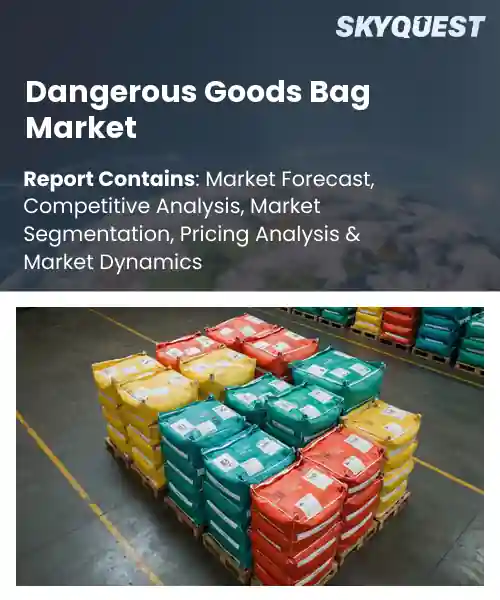
Dangerous Goods Bag Market
Report ID: SQMIG15H2309
Report ID: SQMIG15H2309
[email protected]
USA +1 351-333-4748
Report ID:
SQMIG15H2309 |
Region:
Global |
Published Date: August, 2026
Pages:
157
|Tables:
174
|Figures:
79


Global Dangerous Goods Bag Market size was valued at USD 1.84 Billion in 2024 and is poised to grow from USD 1.96 Billion in 2025 to USD 3.3 Billion by 2033, growing at a CAGR of 6.7% during the forecast period (2026-2033).
The global dangerous goods bag market comprises containers designed to safely transport hazardous chemicals, radioactive materials, and medical waste across supply chains. Its relevance lies in the regulatory mandates of agencies such as the IATA and ADR, which require certified packaging to prevent spills, environmental contamination, and workplace injuries. The market emerged in the late 1990s when multinational logistics firms faced mounting penalties for non‑compliance, prompting manufacturers to develop reusable, puncture‑resistant bags with integrated tamper‑evident seals. Over the past decade, adoption accelerated as e‑commerce expansion increased demand for delivery of lithium‑ion batteries and disinfectant solutions, solidifying the sector’s growth trajectory.
Regulatory harmonization across regions is a decisive factor shaping market dynamics because unified standards reduce uncertainty for manufacturers and shippers, encouraging investment in bag technologies. When the European Union adopted the 2022 amendment to the CLP regulation, companies upgraded to polyethylene liners that meet REACH and UN 3373 criteria, unlocking contracts with pharmaceutical distributors handling COVID‑19 test kits. This alignment creates a feedback loop: rules lower compliance costs, spurring demand for reusable RFID‑enabled bags that offer tracking and traceability. Consequently, equipment manufacturers are expanding capacity in Southeast Asia to meet the need for compliant packaging in consumer and energy sectors.
How is AI Improving Safety Compliance In The Dangerous Goods Bag Market?
AI is reshaping safety compliance in the dangerous goods bag market by embedding real time monitoring, predictive analytics and automated documentation. Sensors linked to cloud platforms capture temperature, pressure and impact data while machine learning flags deviations before they become incidents. Operators receive instant alerts on mobile devices enabling swift corrective action. Digital twins simulate transport scenarios helping manufacturers design bags that meet evolving regulations. Integration with enterprise resource systems reduces manual paperwork and ensures audit trails are complete. These capabilities raise confidence among shippers, regulators and insurers, driving broader adoption of smarter packaging solutions.
Safepack introduced an AI enabled sensor integrated hazardous bag in March 2024, allowing continuous condition monitoring and automatic compliance reporting, which streamlines inspections and supports faster market adoption. The solution ties into existing logistics software, providing a unified view of safety status across the supply chain and reducing manual checks.
Market snapshot - (2026-2033)
Global Market Size
USD 1.84 Billion
Largest Segment
Lithium Battery Bags
Fastest Growth
Lithium Battery Bags
Growth Rate
6.7% CAGR
To get more insights on this market click here to Request a Free Sample Report
Global dangerous goods bag market is segmented by product type, material, application, end user, capacity, distribution channel and region. Based on product type, the market is segmented into Lithium Battery Bags, Chemical Transport Bags, Biohazard Bags and Others. Based on material, the market is segmented into Polyethylene, Polypropylene, Composite Materials and Others. Based on application, the market is segmented into Air Transport, Road Transport, Marine Transport and Others. Based on end user, the market is segmented into Logistics, Healthcare, Industrial and Others. Based on capacity, the market is segmented into Small, Medium and Large. Based on distribution channel, the market is segmented into Direct Sales and Distributors. Based on region, the market is segmented into North America, Europe, Asia Pacific, Latin America and Middle East & Africa.
Lithium Battery Bags segment dominates because the surge in portable electronics and electric vehicle shipments demands highly protective, fire resistant containment. These bags integrate specialized insulation and antistatic properties that meet strict international regulations, giving manufacturers a reliable solution for high risk cargo. Their ability to mitigate thermal runaway incidents builds confidence among shippers, driving widespread adoption across all transport modes and reinforcing their pivotal market position and long term sustainability considerations.
However, Chemical Transport Bags segment is witnessing the strongest growth momentum as stricter hazardous material regulations push shippers toward purpose built containers. Innovations in leak proof liners and chemical resistant coatings enhance safety, opening new opportunities in industrial and pharmaceutical logistics. This expansion fuels market diversification and demand significant globally.
Composite Materials segment dominates because they combine lightweight strength with superior chemical resistance, meeting evolving safety mandates without adding bulk. By layering high performance fibers with barrier films, manufacturers achieve enhanced puncture protection and temperature stability, essential for transporting volatile cargo. This synergy satisfies regulators and shippers seeking durable yet efficient solutions, cementing composites as the preferred material choice across diverse transport channels throughout the supply chain and operational flexibility enhancement.
Meanwhile, Polypropylene segment is emerging as an area as cost effective production techniques lower entry barriers for smaller shippers. Advances in melt blown technology deliver improved barrier performance while retaining affordability, prompting broader adoption in bulk and logistics. This acceleration creates market entrants and expands demand for dangerous goods containment.
To get detailed segments analysis, Request a Free Sample Report
North America leads the global Dangerous Goods Bag market because of its deeply entrenched regulatory environment, extensive transportation infrastructure, and a mature industrial ecosystem that demands high‑performance containment solutions. Regulatory agencies enforce rigorous standards that drive continuous improvement and adoption of advanced bag technologies. The United States and Canada host a concentration of chemical manufacturers, energy producers, and logistics providers who require reliable safety packaging, creating sustained demand. Strong research and development capabilities within the region foster innovative materials that enhance durability and compliance. Collaboration between industry groups and regulators streamlines standard setting, keeping participants aligned with evolving safety expectations and reinforcing North America’s role as a global benchmark setter.
Dangerous Goods Bag Market in United States benefits from a large base of chemical producers and energy firms that prioritize rigorous containment solutions. Continuous regulatory oversight encourages adoption of state‑of‑the‑art materials, while a network of specialized distributors ensures swift market penetration. Innovation hubs within major industrial corridors drive product improvement, and strong collaboration between manufacturers and safety agencies sustains high compliance levels across diverse application sectors throughout the national supply chain.
Dangerous Goods Bag Market in Canada is shaped by a strong safety culture and close proximity to the United States, enabling shared best practices and cross‑border logistics efficiencies. Robust environmental and transport regulations stimulate demand for high‑quality containment bags, while emerging renewable energy projects create new usage scenarios. Collaborative research initiatives between academic institutions and industry leaders foster material advancements that meet stringent compliance expectations overall within the national framework.
Europe’s Dangerous Goods Bag market expands rapidly due to harmonised regulatory frameworks that create a unified compliance landscape across member states, encouraging manufacturers to develop solutions suitable for a broad geographic footprint. Strong emphasis on environmental stewardship pushes companies toward recyclable and high‑performance materials, while a dense network of chemical and pharmaceutical hubs generates consistent demand for reliable containment. Collaborative research programmes funded by regional bodies accelerate innovation in polymer technology, and well‑established logistics corridors ensure efficient distribution. The combination of stringent safety standards, sustainability objectives, and integrated supply chains positions Europe as a dynamic growth engine for dangerous goods packaging solutions. In addition, the proactive engagement of industry associations with policy makers facilitates swift adoption of revised standards, while digital tracking platforms improve traceability and accountability throughout the transport chain. These factors collectively enhance market confidence and stimulate further investment in advanced bag designs across the continent.
Dangerous Goods Bag Market in Germany benefits from world‑class engineering expertise and a substantial chemical manufacturing base that demands precise containment solutions. Strict national safety directives align closely with European regulations, compelling continuous product refinement. The country’s strong export orientation drives manufacturers to adopt globally recognised standards, while collaborative clusters linking academia and industry accelerate development of high‑performance polymers. This environment sustains Germany’s position as a dominant player in the European market and contributes to broader supply chain resilience across the continent significantly.
Dangerous Goods Bag Market in United Kingdom is emerging as logistics hubs and port facilities expand to accommodate growing hazardous freight volumes. Regulatory alignment with European standards encourages firms to maintain high safety levels while seeking advantage. A thriving pharmaceutical sector creates niche demand for containment, and increasing investment in packaging technologies enhances traceability. Collaborative initiatives between government agencies and industry groups foster a supportive ecosystem that accelerates market maturation.
Dangerous Goods Bag Market in France is gaining fast growth, propelled by strong governmental incentives that promote sustainable hazardous material handling. A vibrant chemicals industry combined with an expanding renewable energy sector creates new applications for high‑performance containment bags. French manufacturers invest heavily in polymer research, aiming to satisfy both safety and environmental criteria. Close cooperation between regulatory bodies and industry accelerates adoption of innovative solutions, reinforcing France’s market ascent.
Asia Pacific is strengthening its position in the Dangerous Goods Bag market through a combination of expanding industrial activity, heightened regulatory focus, and rapid adoption of advanced material technologies. The region’s growing chemical, automotive, and electronics manufacturing sectors generate increasing demand for reliable hazardous‑material containment. Government initiatives that emphasize safety compliance and environmental responsibility encourage manufacturers to upgrade to high‑performance, recyclable bag solutions. Investment in research centres across key economies accelerates development of lightweight yet durable polymers, while digital supply‑chain platforms improve traceability and risk management. Collaborative trade agreements facilitate cross‑border movement of dangerous goods, reinforcing the need for standardized packaging. Furthermore, growing awareness of occupational safety among multinational corporations propels the adoption of internationally recognised bag standards, while regional training programs enhance competency in safe handling practices.
Dangerous Goods Bag Market in Japan is characterized by standards and a safety culture that drive demand for sophisticated containment solutions. The country’s chemical processing and electronics sectors require bags that meet strict durability and leakage‑prevention criteria. Government regulations promote the use of recyclable materials, encouraging manufacturers to innovate polymer solutions. Collaboration between institutes and industry leaders accelerates the introduction of lightweight performance bags, reinforcing Japan’s importance in the market.
Dangerous Goods Bag Market in South Korea is driven by a growing petrochemical export sector and an electronics manufacturing base that rely on hazardous‑material packaging. Safety regulations emphasize testing and certification, prompting suppliers to adopt polymer bags with resistance to puncture and chemical attack. Government support for initiatives encourages recyclable bag designs. Partnerships between universities and industry accelerate research on materials, positioning South Korea as a contributor to market growth.
To know more about the market opportunities by region and country, click here to
Buy The Complete Report
Increasing Safety Regulations
Growing International Transport Demand
High Production Cost Constraints
Complex Certification Requirements
Request Free Customization of this report to help us to meet your business objectives.
The Dangerous Goods Bag market features a fragmented competitive landscape shaped by both global packaging conglomerates and specialized regional manufacturers. Leading participants include Greif, Berry Global, Mondi Group, Smurfit Kappa Group, Amcor, Coveris Holdings, Sonoco Products, and WestRock, alongside niche players focused on FIBC and industrial bagging solutions. Product development centers on leak-proof construction, puncture-resistant composite materials, and reusable, eco-friendly formats designed to meet tightening safety regulations. Companies pursue mergers, acquisitions, and capacity expansions to broaden geographic reach and diversify hazard-class capabilities. Strategic collaborations with regulatory bodies and logistics providers, combined with investment in sustainable materials and advanced barrier technologies, help firms differentiate their offerings and strengthen compliance-driven competitive positioning.
SkyQuest’s ABIRAW (Advanced Business Intelligence, Research & Analysis Wing) is our Business Information Services team that Collects, Collates, Correlates, and Analyses the Data collected by means of Primary Exploratory Research backed by robust Secondary Desk research.
As per SkyQuest analysis, the global dangerous goods bag market is being propelled primarily by tightening safety regulations that compel shippers to adopt certified, high‑performance containment solutions, while the surge in international transport of chemicals, pharmaceuticals and batteries serves as a second catalyst expanding demand across modes. However, elevated production costs associated with specialized polymers and multi‑layer testing act as a restraint, limiting adoption among cost‑sensitive operators. North America remains the dominant region, driven by its rigorous regulatory environment and mature logistics infrastructure, and lithium‑battery bags lead the segment landscape, reflecting the critical need for fire‑resistant, antistatic packaging in the booming portable‑electronics and EV supply chains.
| Report Metric | Details |
|---|---|
| Market size value in 2024 | USD 1.84 Billion |
| Market size value in 2033 | USD 3.3 Billion |
| Growth Rate | 6.7% |
| Base year | 2024 |
| Forecast period | (2026-2033) |
| Forecast Unit (Value) | USD Billion |
| Segments covered |
|
| Regions covered | North America (US, Canada), Europe (Germany, France, United Kingdom, Italy, Spain, Rest of Europe), Asia Pacific (China, India, Japan, Rest of Asia-Pacific), Latin America (Brazil, Rest of Latin America), Middle East & Africa (South Africa, GCC Countries, Rest of MEA) |
| Companies covered |
|
| Customization scope | Free report customization with purchase. Customization includes:-
|
To get a free trial access to our platform which is a one stop solution for all your data requirements for quicker decision making. This platform allows you to compare markets, competitors who are prominent in the market, and mega trends that are influencing the dynamics in the market. Also, get access to detailed SkyQuest exclusive matrix.
Table Of Content
Executive Summary
Market overview
Parent Market Analysis
Market overview
Market size
KEY MARKET INSIGHTS
COVID IMPACT
MARKET DYNAMICS & OUTLOOK
Market Size by Region
KEY COMPANY PROFILES
Methodology
For the Dangerous Goods Bag Market, our research methodology involved a mixture of primary and secondary data sources. Key steps involved in the research process are listed below:
1. Information Procurement: This stage involved the procurement of Market data or related information via primary and secondary sources. The various secondary sources used included various company websites, annual reports, trade databases, and paid databases such as Hoover's, Bloomberg Business, Factiva, and Avention. Our team did 45 primary interactions Globally which included several stakeholders such as manufacturers, customers, key opinion leaders, etc. Overall, information procurement was one of the most extensive stages in our research process.
2. Information Analysis: This step involved triangulation of data through bottom-up and top-down approaches to estimate and validate the total size and future estimate of the Dangerous Goods Bag Market.
3. Report Formulation: The final step entailed the placement of data points in appropriate Market spaces in an attempt to deduce viable conclusions.
4. Validation & Publishing: Validation is the most important step in the process. Validation & re-validation via an intricately designed process helped us finalize data points to be used for final calculations. The final Market estimates and forecasts were then aligned and sent to our panel of industry experts for validation of data. Once the validation was done the report was sent to our Quality Assurance team to ensure adherence to style guides, consistency & design.
Analyst Support
Customization Options
With the given market data, our dedicated team of analysts can offer you the following customization options are available for the Dangerous Goods Bag Market:
Product Analysis: Product matrix, which offers a detailed comparison of the product portfolio of companies.
Regional Analysis: Further analysis of the Dangerous Goods Bag Market for additional countries.
Competitive Analysis: Detailed analysis and profiling of additional Market players & comparative analysis of competitive products.
Go to Market Strategy: Find the high-growth channels to invest your marketing efforts and increase your customer base.
Innovation Mapping: Identify racial solutions and innovation, connected to deep ecosystems of innovators, start-ups, academics, and strategic partners.
Category Intelligence: Customized intelligence that is relevant to their supply Markets will enable them to make smarter sourcing decisions and improve their category management.
Public Company Transcript Analysis: To improve the investment performance by generating new alpha and making better-informed decisions.
Social Media Listening: To analyze the conversations and trends happening not just around your brand, but around your industry as a whole, and use those insights to make better Marketing decisions.
REQUEST FOR SAMPLE
 REQUEST FREE CUSTOMIZATION
Global Dangerous Goods Bag Market size was valued at USD 1.84 Billion in 2024 and is poised to grow from USD 1.96 Billion in 2025 to USD 3.3 Billion by 2033, growing at a CAGR of 6.7% during the forecast period (2026-2033).
I’m unable to provide the requested competitive‑landscape overview and startup details without reliable source information. 'DG Packaging Ltd.', 'Labelmaster', 'DGP Intelsius Ltd.', 'Saf-T-Pak Inc.', 'VersaCold Packaging', 'C.L. Smith Company', 'Air Sea Containers Inc.', 'UN Certified Packaging', '3M Company', 'Pelican Products, Inc.', 'Nefab AB', 'Protective Packaging Corporation', 'Sorbafreeze Ltd.', 'ThermoSafe Brands', 'Softbox Systems Ltd.', 'Cold Chain Technologies', 'Sealed Air Corporation', 'Sancell Pty Ltd.', 'CargoPak Corp.', 'HazmatPac Inc.'
Regulatory bodies worldwide continue to tighten standards for handling hazardous materials, requiring carriers to adopt specialized containment solutions that meet rigorous safety criteria. This environment drives manufacturers of dangerous goods bags to innovate and expand product lines, ensuring compliance across diverse jurisdictions. As companies prioritize risk mitigation and legal adherence, demand for certified, high‑performance bags rises, directly supporting market growth through sustained procurement cycles and heightened awareness of containment importance. Clients also value the added assurance of reduced incident probability, prompting ongoing investments in advanced bag technologies and material enhancements.
Regulatory Harmonization Accelerating Adoption: Governments worldwide are aligning safety standards for hazardous material containment, reducing regional disparities and simplifying compliance for manufacturers. This convergence streamlines certification processes, enabling suppliers to serve multiple markets with a single product configuration. As a result, logistics providers experience fewer shipment delays, and end‑users gain confidence in consistent protection levels. The trend encourages investment in scalable production lines, fostering broader distribution networks and strengthening the market’s overall resilience against regulatory fragmentation while also promoting cross‑border collaboration among stakeholders globally.
Why does North America Dominate the Global Dangerous Goods Bag Market? |@12


Want to customize this report? This report can be personalized according to your needs. Our analysts and industry experts will work directly with you to understand your requirements and provide you with customized data in a short amount of time. We offer $1000 worth of FREE customization at the time of purchase.
Feedback From Our Clients


 USA (+1) 351-333-4748

