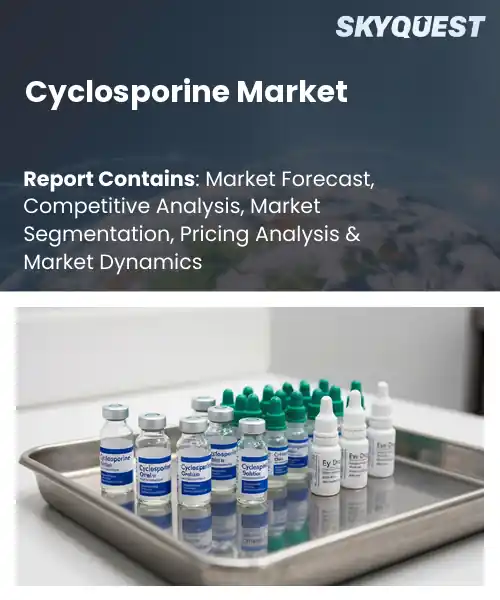
Cyclosporine Market
Report ID: SQMIG35I3229
Report ID: SQMIG35I3229
[email protected]
USA +1 351-333-4748
Report ID:
SQMIG35I3229 |
Region:
Global |
Published Date: July, 2026
Pages:
157
|Tables:
92
|Figures:
76


Global Cyclosporine Market size was valued at USD 3.15 Billion in 2024 and is poised to grow from USD 3.61 Billion in 2025 to USD 10.87 Billion by 2033, growing at a CAGR of 14.8% during the forecast period (2026-2033).
The global cyclosporine market growth is driven by a potent immunosuppressant that was discovered in the 1970s and received approval for organ transplant prophylaxis in the early 1980s. The significance of the drug is based on its ability to prevent rejection, thus to extend graft survival and to reduce post operative mortality. The clinical role of the drug has resulted in a constant need from transplant centers and dermatology clinics around the world. Over the last four decades the market has evolved from a niche pharmaceutical into a multi billion dollar industry driven by growth of kidney, liver and heart transplant programs, the advent of autoimmune disease indications and the development of generic options that have increased access whilst maintaining therapeutic significance.
The next wave of cyclosporine market share is being driven by three interlocking forces; increasing transplant volumes in emerging economies, the rising prevalence of autoimmune diseases such as psoriasis and rheumatoid arthritis and the development of novel cyclosporine based formulations that improve patient compliance. And the increase in healthcare infrastructure in Asia Pacific and Latin America is resulting in more patients undergoing transplants, directly driving drug use. Meanwhile doctors are utilizing cyclosporine in topical gels and oral capsules to treat chronic skin conditions, creating new sources of income outside the original transplant market. Additional advances in drug delivery technology, such as nanoparticle encapsulated cyclosporine, offer increased bioavailability and less side effects, leading physicians to use the agent earlier in disease courses. These dynamics together point to heightened sales expectations, increased competitive pressure between branded and generic manufacturers, and a strategic impetus for companies to invest in R&D and market expansion efforts.
How is AI-driven Drug Monitoring Influencing the Cyclosporine Market?
AI-powered drug monitoring is changing the game in the cyclosporine market trends with the ability to monitor therapeutic drug levels in real time, reduce clinic visits and personalize dosing adjustments. Streams of continuous data from smart sensors are used to feed predictive algorithms that can flag potential toxicity or sub therapeutic exposure before adverse events occur. This technology enhances patient compliance and confidence and gives clinicians better insight into drug interaction patterns. Therefore, there is a growing market demand for integrated monitoring platforms that combine pharmacokinetic modeling with electronic health records, enabling a more efficient and patient-centric care model.
For example, Incyte, Sep 2025, announced the integration of an AI-powered monitoring system into its cyclosporine portfolio, accelerating dose optimization and expanding market adoption.
Market snapshot - (2026-2033)
Global Market Size
USD 3.15 Billion
Largest Segment
Oral Formulations
Fastest Growth
Ophthalmic Emulsions
Growth Rate
14.76% CAGR
To get more insights on this market click here to Request a Free Sample Report
Global cyclosporine market is segmented by dosage form formulation, therapeutic indication focus, distribution network and region. Based on dosage form formulation, the market is segmented into oral formulations, ophthalmic emulsions and injectable intravenous solutions. Based on therapeutic indication focus, the market is segmented into organ transplant rejection prophylaxis, rheumatoid arthritis management, severe psoriasis management, dry eye disease keratoconjunctivitis sicca and others. Based on distribution network, the market is segmented into hospital institutional pharmacies, retail drugstores and online specialty delivery networks. Based on region, the market is segmented into North America, Europe, Asia Pacific, Latin America and Middle East & Africa.
The oral formulations segment dominates, as it corresponds to the chronic dosing patterns required for long term immunosuppression, offering patients a convenient, non-invasive route of administration. Doctors love pills for the convenience of prescribing and compliance . Manufacturers have scalable tablet technology and existing supply chains . This combination of clinical preference, manufacturing efficiency and patient convenience further strengthens oral products as the overall core driver of pharmaceutical cyclosporine sales across therapeutic areas industry market.
Meanwhile the injectable intravenous solutions is the most expanding area. Clinicians prefer IV delivery due to the acute rejection episodes and perioperative protocols requiring therapeutic levels. Innovations in formulation stability and infusion devices drive adoption and reimbursement frameworks supporting hospital-based administration propel market expansion and opportunity creation.
Cyclosporine remains an essential component of lifelong immunosuppression, providing reliable graft protection that physicians can rely on, thus the organ transplant rejection prophylaxis segment continues to dominate. It inhibits calcineurin, which decreases the risk of acute and chronic rejection. There is a lot of research that demonstrates how to give the drug for many different types of organs. The primary R&D focus for manufacturers is on formulation improvements to increase bioavailability that increases prescriber confidence and supports continued high utilization in transplant centers collectively worldwide and continued investment in therapeutic monitoring programs.
In the meantime, the dry eye disease keratoconjunctivitis sicca segment is expected to be the biggest growth driver with ophthalmologists increasingly using cyclosporine eye drops for treating the inflammation that causes refractory dry eye. Emulsion technologies increase ocular residence time and patient awareness of eye health drives demand, leading to higher prescription volumes and opening the door for combination therapy development.
To get detailed segments analysis, Request a Free Sample Report
North America leads due to its advanced healthcare ecosystem, extensive transplant programs, and early implementation of novel immunosuppressive therapies. The region benefits from strong reimbursement mechanisms that ensure access to patients and a robust network of research institutions that continue to push forward the clinical evaluation and formulation improvements. Furthermore, extensive usage across therapeutic areas is propelled by sophisticated distribution channels and high physician awareness. These factors collectively contribute to a strong demand base and further strengthen North America’s position as the major driver of the market.
Cyclosporine market outlook in the United States is propelled by a mature transplant infrastructure and vigorous clinical research activity. Market participants benefit from comprehensive insurance coverage that mitigates patient cost barriers, while leading medical centers actively incorporate the drug into standard immunosuppression protocols. Ongoing educational initiatives keep healthcare professionals abreast of emerging evidence, fostering sustained prescribing confidence across diverse therapeutic indications.
Cyclosporine market forecast in Canada is supported by a publicly funded healthcare system that prioritizes equitable access to essential therapies. Collaborative networks among provincial health authorities and transplant specialists ensure consistent incorporation of cyclosporine into treatment guidelines. Continued investment in pharmacovigilance and therapeutic monitoring reinforces safety perceptions, encouraging steady utilization within the national immunosuppression landscape.
Europe’s growth is being driven by harmonized regulatory pathways that cut approval times for products across member states and speed up market entry. Strong commitment to organ transplantation and autoimmune disease care drive clinical need. Access disparities are mitigated by coordinated reimbursement structures. Multinational manufacturers are forging strategic alliances with regional academic centers to generate real-world evidence, which will boost confidence in therapeutic results. Also, the growing emphasis on personalised medicine fits well with the established position of cyclosporine, making Europe a vibrant growth area for the product.
Cyclosporine market regional outlook in Germany is anchored by a robust network of transplant centers that integrate the drug into standardized care protocols. Health insurance structures provide comprehensive coverage, encouraging consistent prescribing practices among specialists. Ongoing clinical collaborations generate localized data that reinforce therapeutic confidence, sustaining strong market activity across both established and emerging indications.
Cyclosporine market regioanl forecast in the United Kingdom is experiencing accelerated uptake due to proactive national health policies that emphasize early intervention for transplant recipients. Centralized procurement processes streamline supply, while extensive clinician education programs raise awareness of cyclosporine’s efficacy profile. The integration of the drug into multidisciplinary treatment pathways further amplifies its presence within the therapeutic landscape.
Cyclosporine market analysis in France is emerging as a focal point for specialty care providers seeking reliable immunosuppressive options. Reimbursement schemes that prioritize evidence‑based therapies facilitate broader patient access, while collaborative research initiatives between hospitals and industry generate momentum for adoption. Growing awareness of long‑term outcome benefits contributes to the expanding footprint of cyclosporine within the French market.
Rapid development of medical infrastructure coupled with increasing incidence of transplantation procedures is boosting Asia Pacific’s position. National health agendas that place high priority on chronic disease management provide enabling environments for the uptake of immunosuppressive therapy. A country can reduce its dependency on imports and improve the durability of its supply chain through strategic investment in local manufacturing capacity. Efforts to educate clinicians on best-practice guidelines and to integrate cyclosporine into emerging therapeutic protocols further solidify the region’s growing influence on the global stage.
Cyclosporine market penetration in Japan benefits from an extensive network of specialized transplant facilities that incorporate the drug into long‑standing treatment regimens. Government‑backed reimbursement policies ensure patient affordability, while continuous professional development programs keep physicians updated on optimal dosing strategies. Collaborative clinical research contributes to a nuanced understanding of cyclosporine’s role in the Japanese therapeutic context.
Cyclosporine industry in South Korea is reinforced by a proactive health system that emphasizes early adoption of proven immunosuppressants. Strong governmental support for pharmaceutical innovation encourages domestic production, bolstering availability and cost‑effectiveness. Integrated care pathways and focused physician outreach programs promote consistent prescribing practices, driving the market’s progressive expansion.
To know more about the market opportunities by region and country, click here to
Buy The Complete Report
Increasing Organ Transplant Demand
Advancements in Formulation Technology
Stringent Regulatory Requirements
High Cost of Therapy
Request Free Customization of this report to help us to meet your business objectives.
The cyclosporine market is characterized by strong competition among established pharmaceutical manufacturers that compete through generic product launches, formulation improvements, geographic expansion, and strategic investments in specialty pharmaceuticals. Companies including Novartis, Viatris, Teva Pharmaceutical Industries, Sun Pharmaceutical Industries, Dr. Reddy's Laboratories, Cipla, and Lupin continue to strengthen their market positions by expanding production capacity, enhancing supply chain resilience, and developing improved oral and ophthalmic cyclosporine formulations. Increasing demand for transplant immunosuppression and dry eye disease therapies is encouraging manufacturers to invest in advanced drug delivery technologies, regulatory approvals, and strategic collaborations to improve patient outcomes while maintaining cost competitiveness.
Top Player’s Company Profile
Recent Developments in the Cyclosporine Market
SkyQuest’s ABIRAW (Advanced Business Intelligence, Research & Analysis Wing) is our Business Information Services team that Collects, Collates, Correlates, and Analyses the Data collected by means of Primary Exploratory Research backed by robust Secondary Desk research. As per SkyQuest analysis, the global cyclosporine market is being propelled primarily by the rising demand for organ transplants, which fuels sustained need for effective immunosuppression, while advancements in formulation technology that improve bioavailability and reduce side effects serve as a second catalyst expanding use into autoimmune indications; the high cost of long‑term therapy acts as a notable restraint limiting adoption in price‑sensitive markets. North America emerges as the dominant region thanks to its advanced healthcare infrastructure, comprehensive reimbursement, and strong transplant programs, and within the market, oral formulations dominate because they suit chronic dosing, offer patient convenience, and benefit from scalable manufacturing.
| Report Metric | Details |
|---|---|
| Market size value in 2024 | USD 3.15 Billion |
| Market size value in 2033 | USD 10.87 Billion |
| Growth Rate | 14.76% |
| Base year | 2024 |
| Forecast period | (2026-2033) |
| Forecast Unit (Value) | USD Billion |
| Segments covered |
|
| Regions covered | North America (US, Canada), Europe (Germany, France, United Kingdom, Italy, Spain, Rest of Europe), Asia Pacific (China, India, Japan, Rest of Asia-Pacific), Latin America (Brazil, Rest of Latin America), Middle East & Africa (South Africa, GCC Countries, Rest of MEA) |
| Companies covered |
|
| Customization scope | Free report customization with purchase. Customization includes:-
|
To get a free trial access to our platform which is a one stop solution for all your data requirements for quicker decision making. This platform allows you to compare markets, competitors who are prominent in the market, and mega trends that are influencing the dynamics in the market. Also, get access to detailed SkyQuest exclusive matrix.
Table Of Content
Executive Summary
Market overview
Parent Market Analysis
Market overview
Market size
KEY MARKET INSIGHTS
COVID IMPACT
MARKET DYNAMICS & OUTLOOK
Market Size by Region
KEY COMPANY PROFILES
Methodology
For the Cyclosporine Market, our research methodology involved a mixture of primary and secondary data sources. Key steps involved in the research process are listed below:
1. Information Procurement: This stage involved the procurement of Market data or related information via primary and secondary sources. The various secondary sources used included various company websites, annual reports, trade databases, and paid databases such as Hoover's, Bloomberg Business, Factiva, and Avention. Our team did 45 primary interactions Globally which included several stakeholders such as manufacturers, customers, key opinion leaders, etc. Overall, information procurement was one of the most extensive stages in our research process.
2. Information Analysis: This step involved triangulation of data through bottom-up and top-down approaches to estimate and validate the total size and future estimate of the Cyclosporine Market.
3. Report Formulation: The final step entailed the placement of data points in appropriate Market spaces in an attempt to deduce viable conclusions.
4. Validation & Publishing: Validation is the most important step in the process. Validation & re-validation via an intricately designed process helped us finalize data points to be used for final calculations. The final Market estimates and forecasts were then aligned and sent to our panel of industry experts for validation of data. Once the validation was done the report was sent to our Quality Assurance team to ensure adherence to style guides, consistency & design.
Analyst Support
Customization Options
With the given market data, our dedicated team of analysts can offer you the following customization options are available for the Cyclosporine Market:
Product Analysis: Product matrix, which offers a detailed comparison of the product portfolio of companies.
Regional Analysis: Further analysis of the Cyclosporine Market for additional countries.
Competitive Analysis: Detailed analysis and profiling of additional Market players & comparative analysis of competitive products.
Go to Market Strategy: Find the high-growth channels to invest your marketing efforts and increase your customer base.
Innovation Mapping: Identify racial solutions and innovation, connected to deep ecosystems of innovators, start-ups, academics, and strategic partners.
Category Intelligence: Customized intelligence that is relevant to their supply Markets will enable them to make smarter sourcing decisions and improve their category management.
Public Company Transcript Analysis: To improve the investment performance by generating new alpha and making better-informed decisions.
Social Media Listening: To analyze the conversations and trends happening not just around your brand, but around your industry as a whole, and use those insights to make better Marketing decisions.
REQUEST FOR SAMPLE
 REQUEST FREE CUSTOMIZATION
Global Cyclosporine Market size was valued at USD 3.15 Billion in 2024 and is poised to grow from USD 3.61 Billion in 2025 to USD 10.87 Billion by 2033, growing at a CAGR of 14.76% during the forecast period (2026-2033).
The cyclosporine market is increasingly shaped by AI‑driven biotech firms that challenge traditional generic manufacturers through rapid formulation innovation, strategic partnerships and high‑profile acquisitions; for example, Chai Discovery’s multi‑round funding has accelerated its platform for immunosuppressant redesign, while HavocAI’s recent $197 million equity raise funds collaborations with established pharma to co‑develop next‑generation cyclosporine analogues, intensifying competitive pressure on legacy players. 'Novartis', 'AbbVie', 'Teva Pharmaceutical Industries', 'Viatris', 'Sun Pharmaceutical Industries', 'Cipla', 'Lupin', 'Dr. Reddy's Laboratories', 'Aurobindo Pharma', 'Torrent Pharmaceuticals', 'Zydus Lifesciences', 'Hikma Pharmaceuticals', 'Fresenius SE', 'Bausch + Lomb', 'Santen Pharmaceutical', 'Alcon', 'Pfizer', 'Sanofi', 'Merck & Co', 'GlaxoSmithKline'
The rising prevalence of end‑stage organ failure drives greater demand for immunosuppressive therapies, positioning cyclosporine as a critical component in post‑transplant regimens. Clinicians rely on its proven efficacy to prevent graft rejection, encouraging broader adoption across medical centers. As transplantation programs expand globally, the need for reliable maintenance drugs grows, directly supporting market expansion. This sustained clinical reliance fosters continuous procurement and encourages manufacturers to invest in product innovation and supply chain robustness, further reinforcing growth momentum and long‑term sustainability.
Emerging Biosimilar Competition Intensifies: The introduction of biosimilar versions of cyclosporine is reshaping prescribing habits worldwide. As manufacturers achieve comparable efficacy and safety profiles, clinicians increasingly consider cost‑effective alternatives, prompting healthcare systems to revise formularies. This shift encourages originators to enhance patient support programs and explore differentiated formulations, while fostering competitive pricing that expands market accessibility. Consequently, the landscape is moving toward a more balanced ecosystem where therapeutic choice is driven by value propositions rather than legacy brand dominance in global transplant care settings.
Why does North America Dominate the Global Cyclosporine Market? |@12


Want to customize this report? This report can be personalized according to your needs. Our analysts and industry experts will work directly with you to understand your requirements and provide you with customized data in a short amount of time. We offer $1000 worth of FREE customization at the time of purchase.
Feedback From Our Clients


 USA (+1) 351-333-4748

