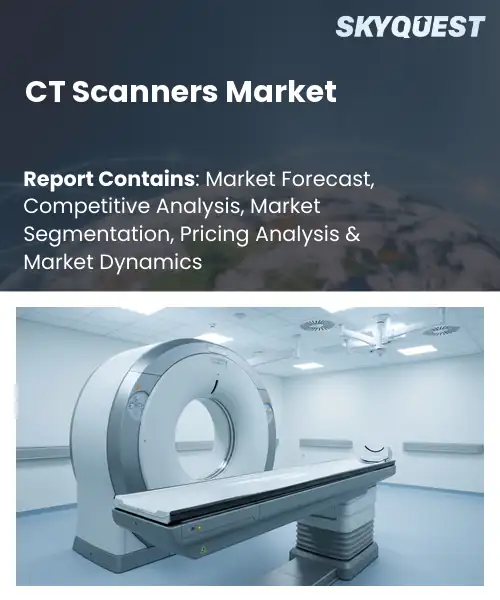
CT Scanners Market
Report ID: SQMIG35A3884
Report ID: SQMIG35A3884
[email protected]
USA +1 351-333-4748
Report ID:
SQMIG35A3884 |
Region:
Global |
Published Date: June, 2026
Pages:
157
|Tables:
144
|Figures:
78


Global Ct Scanners Market size was valued at USD 8.06 Billion in 2024 and is poised to grow from USD 8.58 Billion in 2025 to USD 14.09 Billion by 2033, growing at a CAGR of 6.4% during the forecast period (2026-2033).
The global computed tomography (CT) scanner market encompasses manufacturers of multidetector and single‑slice systems that serve hospitals, imaging centers, and research facilities. Its significance lies in enabling rapid imaging that underpins diagnosis, treatment planning, and disease monitoring across oncology, cardiology, and emergency medicine. A primary driver has been the expanding demand for early detection of chronic diseases, especially as aging populations in North America, Europe, and Asia increase the volume of screening programs. Over two decades, advances from 4‑slice to 256‑slice devices have reduced scan time and radiation dose, prompting adoption significant illustrated by the surge in installations reported by WHO in 2021. An decisive factor shaping the global CT scanner market is the integration of artificial intelligence and advanced analytics into imaging workflows, which unlocks revenue streams and efficiencies. AI‑driven dose‑optimization algorithms enable hospitals to comply with stricter radiation‑safety regulations while maintaining image quality, prompting procurement of units. In the United States, health systems such as Kaiser Permanente have piloted AI‑assisted lung‑cancer screening programs that reduce radiologist reading time by 30 percent and increase early‑stage detection, thereby demonstrating cost‑effectiveness. These outcomes attract investors to fund R&D, expand service contracts, and accelerate adoption in markets where specialist availability makes automated interpretation a compelling solution.
How is AI improving diagnostic accuracy in the CT scanner market?
Artificial intelligence is reshaping computed tomography by automating image reconstruction, enhancing noise reduction, and providing precise lesion segmentation. Machine‑learning models learn from vast datasets, enabling rapid identification of subtle pathologies that might escape the human eye. Integrated AI tools streamline workflow, prioritize urgent cases, and offer decision support that boosts radiologist confidence. This convergence of smart software with advanced hardware aligns with a market that is expanding as hospitals seek faster, more reliable diagnostics. The push for early and accurate diagnosis fuels investment in AI‑driven CT solutions, creating a feedback loop that accelerates both technological adoption and market growth.Recent AI‑enhanced CT platforms have demonstrated improved lesion detection and reduced interpretation time, reinforcing the value proposition for hospitals striving for higher diagnostic precision while supporting the broader expansion of the CT scanner market.
Market snapshot - (2026-2033)
Global Market Size
USD 8.06 Billion
Largest Segment
High-End Slice CT Scanners
Fastest Growth
Low-End Slice CT Scanners
Growth Rate
6.4% CAGR
To get more insights on this market click here to Request a Free Sample Report
Global ct scanners market is segmented by slice configuration tier, device design architecture, detector technology modality, diagnostic clinical application, institutional end user environment and region. Based on slice configuration tier, the market is segmented into High-End Slice CT Scanners, Mid-End Slice CT Scanners and Low-End Slice CT Scanners. Based on device design architecture, the market is segmented into Stationary Standalone CT Scanners and Portable Mobile CT Units. Based on detector technology modality, the market is segmented into Conventional Energy-Integrating Detectors and Photon-Counting Spectral Detectors. Based on diagnostic clinical application, the market is segmented into Oncology Scanning, Cardiovascular Imaging, Neurology Scanning, Musculoskeletal Diagnostics and Others. Based on institutional end user environment, the market is segmented into Acute Care Hospitals, Diagnostic Imaging Centers and Outpatient Clinical Facilities. Based on region, the market is segmented into North America, Europe, Asia Pacific, Latin America and Middle East & Africa.
High End Slice CT Scanners segment dominates because they provide unmatched image clarity and rapid scan cycles, satisfying the increasing clinical need for precise diagnostics across complex cases. Their sophisticated detector arrays and high computational throughput enable advanced imaging protocols that support early disease detection and treatment planning. This reputation drives hospitals and imaging centers to prioritize high end technology as a cornerstone of modern radiology practice.
However, Mid End Slice CT Scanners segment is witnessing the strongest growth momentum as healthcare providers seek cost effective solutions that still deliver reliable image quality. Ongoing improvements in detector design and software algorithms lower acquisition costs while expanding usability in diverse clinical settings, thereby accelerating market adoption and opening new avenues for expansion.
Photon Counting Spectral Detectors segment leads because they capture individual photon energies, enabling true material differentiation and dramatically reducing radiation exposure. This capability enhances diagnostic confidence in oncology and cardiovascular studies while supporting emerging quantitative imaging techniques. Manufacturers emphasize integration of these detectors into next generation CT platforms, positioning them as pivotal for precision medicine and prompting providers to adopt systems that can exploit spectral data for superior patient outcomes.
On the other hand, Conventional Energy Integrating Detectors segment experiences rapid expansion as legacy systems are upgraded to meet rising imaging volumes. Continued improvements in detector efficiency and cost reductions make them attractive for facilities prioritizing budget constraints while still requiring dependable performance, fostering broader market penetration and sustaining growth trajectories.
To get detailed segments analysis, Request a Free Sample Report
The dominance of North America stems from a mature healthcare ecosystem that prioritizes early diagnostic imaging and invests heavily in cutting‑edge technology. A robust network of research hospitals and academic centers fuels continuous innovation, while well‑established reimbursement frameworks encourage the acquisition of advanced CT solutions. Strong supplier presence and a culture of clinical excellence promote rapid adoption of high‑performance scanners. Additionally, integrated health‑IT systems and emphasis on patient safety create an environment where advanced imaging modalities are essential to standard care pathways, reinforcing North America’s lead in market influence and technology leadership.
United States CT Scanners Market
CT Scanners Market in the United States benefits from a dense concentration of tertiary care facilities that drive demand for high‑resolution imaging. The ecosystem supports rapid integration of next‑generation detector technology and advanced workflow software, enhancing diagnostic confidence. Strategic collaborations between manufacturers and academic institutions accelerate product development, while comprehensive payer coverage sustains steady procurement cycles across varied healthcare settings.
Canada CT Scanners Market
CT Scanners Market in Canada is shaped by a publicly funded health system that emphasizes equitable access to high‑quality imaging across provinces. Emphasis on preventive health and early disease detection fuels continuous upgrades to scanner fleets. Collaborative procurement processes and emphasis on cost‑effective solutions encourage adoption of versatile, multi‑slice CT platforms. Strong regulatory standards ensure consistent performance and patient safety, reinforcing confidence among clinicians and administrators.
Europe’s rapid expansion is propelled by unified health‑policy initiatives that prioritize diagnostic accuracy and patient outcomes. Widespread implementation of clinical pathways that integrate CT imaging encourages hospitals to modernize their equipment portfolios. Collaborative research networks across member states foster shared innovation, while regulatory harmonization simplifies market entry for new technologies. Emphasis on sustainability and energy‑efficient design aligns with broader environmental goals, prompting investment in next‑generation scanners. Strong reimbursement mechanisms and a growing focus on personalized medicine further stimulate demand, positioning Europe as a dynamic hub for advanced imaging adoption.
Germany CT Scanners Market
CT Scanners Market in Germany is anchored by a dense network of specialized clinics and university hospitals that drive high adoption of precision imaging. The market values reliability and technical excellence, leading to a preference for high‑performance systems with advanced dose‑reduction features. Close cooperation between manufacturers and research institutions accelerates integration of AI‑enhanced workflow solutions. Consistent reimbursement policies and a focus on maintaining cutting‑edge diagnostic capabilities underpin sustained investment in scanner upgrades.
United Kingdom CT Scanners Market
CT Scanners Market in the United Kingdom is experiencing accelerated growth as national health strategies emphasize early detection and integrated care pathways. Public healthcare entities prioritize procurement of versatile, high‑throughput scanners to meet rising imaging volumes. Collaborative initiatives between NHS trusts and technology providers foster rapid adoption of digital workflow platforms. Emphasis on training and clinical expertise ensures optimal utilization of advanced imaging capabilities, reinforcing the United Kingdom’s position as a fast‑moving market within the region.
France CT Scanners Market
CT Scanners Market in France is emerging as a focal point for modernizing diagnostic infrastructure within both public and private sectors. Policy incentives encourage replacement of legacy equipment with multi‑slice CT systems that deliver enhanced image quality and patient comfort. Partnerships with research laboratories promote integration of novel reconstruction algorithms. Growing awareness of preventive health drives demand for accessible imaging, supporting steady expansion of scanner deployments across regional hospitals and specialty centers.
Asia Pacific is strengthening its position through a combination of expanding healthcare access and a surge in diagnostic imaging demand across both urban and emerging markets. Investment in hospital infrastructure and government‑driven health initiatives catalyze adoption of higher‑capacity CT solutions. Regional manufacturers are increasingly collaborating with global technology leaders, enhancing localization of advanced features and after‑sales support. Growing clinical focus on non‑invasive diagnostics and an emphasis on workflow efficiency drive continuous upgrades to scanner fleets, positioning the region as a dynamic contributor to global imaging advancement.
Japan CT Scanners Market
CT Scanners Market in Japan is characterized by a strong emphasis on precision and reliability, reflecting the country’s commitment to high‑quality patient care. Leading medical institutions prioritize advanced detector technologies and low‑dose imaging protocols, fostering a market that values technical sophistication. Collaborative research programs between hospitals and equipment suppliers accelerate the introduction of innovative features such as AI‑assisted interpretation. Robust reimbursement structures support consistent acquisition cycles, reinforcing Japan’s role as a mature and technology‑focused market.
South Korea CT Scanners Market
CT Scanners Market in South Korea is driven by rapid modernization of medical facilities and a keen focus on digital health integration. Hospitals seek versatile, high‑speed scanners that align with evolving clinical workflows and tele‑medicine platforms. Strong government backing for health‑technology development encourages local adaptation of cutting‑edge imaging solutions. Emphasis on training and skill development ensures effective utilization of advanced CT capabilities, contributing to a vibrant market environment that continually embraces next‑generation diagnostic tools.
To know more about the market opportunities by region and country, click here to
Buy The Complete Report
Increasing Demand for Early Diagnosis
Advancements In Detector Technology
High Capital Expenditure Requirements
Regulatory Approval Complexity
Request Free Customization of this report to help us to meet your business objectives.
The global CT scanner market is intensely competitive, with leading manufacturers accelerating AI‑driven image reconstruction and energy‑efficient designs to capture market share. Recent FDA clearances for AI‑enabled CT workflows have prompted partnerships between hardware firms and software providers, while the push for helium‑free, ultra‑high‑end scanners reflects a technology‑innovation race that fuels differentiation.
Top Player’s Company Profile
Recent Developments
SkyQuest’s ABIRAW (Advanced Business Intelligence, Research & Analysis Wing) is our Business Information Services team that Collects, Collates, Correlates, and Analyses the Data collected by means of Primary Exploratory Research backed by robust Secondary Desk research. As per SkyQuest analysis, the global CT scanner market is being propelled primarily by the rising demand for early diagnosis, which pushes hospitals to invest in advanced imaging for better patient outcomes. A second strong driver is rapid progress in detector technology, especially AI‑enhanced reconstruction and photon‑counting sensors that improve image quality while lowering radiation dose. High‑End Slice CT Scanners remain the dominant segment, offering the clarity and speed required for complex cases. North America continues to lead the market, supported by mature healthcare systems and robust reimbursement. However, the high capital expenditure needed for these sophisticated units acts as a notable restraint on broader adoption.
| Report Metric | Details |
|---|---|
| Market size value in 2024 | USD 8.06 Billion |
| Market size value in 2033 | USD 14.09 Billion |
| Growth Rate | 6.4% |
| Base year | 2024 |
| Forecast period | (2026-2033) |
| Forecast Unit (Value) | USD Billion |
| Segments covered |
|
| Regions covered | North America (US, Canada), Europe (Germany, France, United Kingdom, Italy, Spain, Rest of Europe), Asia Pacific (China, India, Japan, Rest of Asia-Pacific), Latin America (Brazil, Rest of Latin America), Middle East & Africa (South Africa, GCC Countries, Rest of MEA) |
| Companies covered |
|
| Customization scope | Free report customization with purchase. Customization includes:-
|
To get a free trial access to our platform which is a one stop solution for all your data requirements for quicker decision making. This platform allows you to compare markets, competitors who are prominent in the market, and mega trends that are influencing the dynamics in the market. Also, get access to detailed SkyQuest exclusive matrix.
Table Of Content
Executive Summary
Market overview
Parent Market Analysis
Market overview
Market size
KEY MARKET INSIGHTS
COVID IMPACT
MARKET DYNAMICS & OUTLOOK
Market Size by Region
KEY COMPANY PROFILES
Methodology
For the CT Scanners Market, our research methodology involved a mixture of primary and secondary data sources. Key steps involved in the research process are listed below:
1. Information Procurement: This stage involved the procurement of Market data or related information via primary and secondary sources. The various secondary sources used included various company websites, annual reports, trade databases, and paid databases such as Hoover's, Bloomberg Business, Factiva, and Avention. Our team did 45 primary interactions Globally which included several stakeholders such as manufacturers, customers, key opinion leaders, etc. Overall, information procurement was one of the most extensive stages in our research process.
2. Information Analysis: This step involved triangulation of data through bottom-up and top-down approaches to estimate and validate the total size and future estimate of the CT Scanners Market.
3. Report Formulation: The final step entailed the placement of data points in appropriate Market spaces in an attempt to deduce viable conclusions.
4. Validation & Publishing: Validation is the most important step in the process. Validation & re-validation via an intricately designed process helped us finalize data points to be used for final calculations. The final Market estimates and forecasts were then aligned and sent to our panel of industry experts for validation of data. Once the validation was done the report was sent to our Quality Assurance team to ensure adherence to style guides, consistency & design.
Analyst Support
Customization Options
With the given market data, our dedicated team of analysts can offer you the following customization options are available for the CT Scanners Market:
Product Analysis: Product matrix, which offers a detailed comparison of the product portfolio of companies.
Regional Analysis: Further analysis of the CT Scanners Market for additional countries.
Competitive Analysis: Detailed analysis and profiling of additional Market players & comparative analysis of competitive products.
Go to Market Strategy: Find the high-growth channels to invest your marketing efforts and increase your customer base.
Innovation Mapping: Identify racial solutions and innovation, connected to deep ecosystems of innovators, start-ups, academics, and strategic partners.
Category Intelligence: Customized intelligence that is relevant to their supply Markets will enable them to make smarter sourcing decisions and improve their category management.
Public Company Transcript Analysis: To improve the investment performance by generating new alpha and making better-informed decisions.
Social Media Listening: To analyze the conversations and trends happening not just around your brand, but around your industry as a whole, and use those insights to make better Marketing decisions.
REQUEST FOR SAMPLE
 REQUEST FREE CUSTOMIZATION


Want to customize this report? This report can be personalized according to your needs. Our analysts and industry experts will work directly with you to understand your requirements and provide you with customized data in a short amount of time. We offer $1000 worth of FREE customization at the time of purchase.
Feedback From Our Clients


 USA (+1) 351-333-4748

