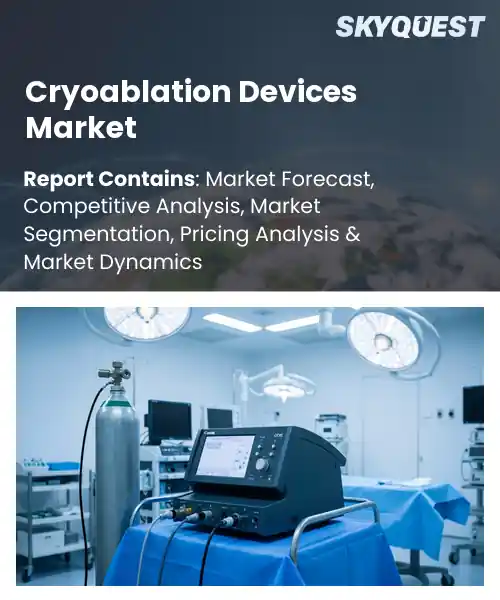
Cryoablation Devices Market
Report ID: SQMIG35A3520
Report ID: SQMIG35A3520
[email protected]
USA +1 351-333-4748
Report ID:
SQMIG35A3520 |
Region:
Global |
Published Date: May, 2026
Pages:
157
|Tables:
122
|Figures:
77


Global Cryoablation Devices Market size was valued at USD 521.7 Million in 2024 and is poised to grow from USD 560.2 Million in 2025 to USD 990.22 Million by 2033, growing at a CAGR of 7.38% during the forecast period (2026-2033).
As a research analyst, I identify the primary driver of the cryoablation devices market as the convergence of rising chronic disease burden and demand for minimally invasive therapies, transforming cryotherapy from probes to catheter systems. The market includes devices that apply extreme cold to destroy pathological tissue across cardiology, oncology and pain management, and it matters because these tools reduce hospital stays and complications while enabling outpatient workflows. Over two decades companies like Medtronic popularized cryoballoon treatment for atrial fibrillation and oncology use grew through percutaneous systems, reflecting advances in imaging integration and temperature control and improved procedural safety profiles.
The most influential factor propelling global cryoablation growth is accumulating clinical evidence that lowers procedural risk and strengthens economic value, which in turn drives clinician adoption and payer support. For example, randomized trials demonstrating cryoballoon noninferiority in atrial fibrillation translate into higher referral rates and reimbursement pathways, causing hospitals to invest in catheter suites optimized for same-day discharge. Similarly, consistent local control in percutaneous renal and lung tumor ablations enables outpatient oncology workflows and fosters trials combining cryoablation with immunotherapy, creating new commercial opportunities for portable systems and integrated imaging solutions in emerging markets globally.
How is AI improving clinical outcomes in the cryoablation devices market?
AI is improving clinical outcomes in the cryoablation devices market by enhancing imaging interpretation, treatment planning, procedural guidance, and outcome prediction. Key aspects include automated lesion mapping, real time monitoring of freeze dynamics, and risk stratification for candidate selection. The current state shows growing integration of machine learning into imaging workflows and ablation consoles which reduces procedural variability and supports consistent lesion delivery. In practice clinicians use AI augmented ultrasound and MRI analytics to refine probe placement and freeze duration and rely on predictive models to flag patients at higher risk of recurrence. These capabilities improve safety and make therapies more reproducible and efficient.
IceCure March 2026, the company received FDA approval to begin a ChoICE postmarketing study of its ProSense cryoablation system, demonstrating concrete market momentum. AI driven imaging analytics and predictive modeling can complement this device by improving patient selection and intraprocedural monitoring which supports broader adoption and greater clinical efficiency.
Market snapshot - (2026-2033)
Global Market Size
USD 521.7 Million
Largest Segment
Cryoablation Systems
Fastest Growth
Cryoprobes
Growth Rate
7.38% CAGR
To get more insights on this market click here to Request a Free Sample Report
Global cryoablation devices market is segmented by product type, application, technology, end user and region. Based on product type, the market is segmented into Cryoablation Systems, Cryoprobes and Accessories & Consumables. Based on application, the market is segmented into Oncology, Cardiology, Dermatology, Gynecology, Pain Management, Urology and Others. Based on technology, the market is segmented into Liquid Nitrogen-Based Cryoablation, Argon Gas-Based Cryoablation and Nitrous Oxide-Based Cryoablation. Based on end user, the market is segmented into Hospitals, Specialty Clinics, Ambulatory Surgical Centers and Cancer Treatment Centers. Based on region, the market is segmented into North America, Europe, Asia Pacific, Latin America and Middle East & Africa.
Cryoprobes segment dominates because cryoprobes constitute the primary clinical interface between technology and tissue, determining freeze profile and lesion accuracy, which directly impacts procedural success. Their design versatility across indications, ease of handling, compatibility with multiple systems and improvements in tip geometry and thermal conductance drive clinician preference. As a result, demand for advanced probe platforms fuels procurement decisions, manufacturer focus on R&D and sustained adoption across hospital and clinic settings.
However, Cryoablation Systems are emerging as the most rapidly expanding area because console innovations, integrated imaging, workflow automation and bundled service models simplify procedures, reduce learning curves and make institutions more willing to invest in comprehensive solutions, thereby accelerating procurement cycles, enabling wider adoption across care settings and creating recurring revenue and upgrade opportunities for manufacturers.
Argon Gas-Based Cryoablation segment dominates because argon delivers rapid, controllable cooling with predictable iceball formation, enabling precise ablation margins critical for complex oncologic and cardiac procedures, which builds clinician trust. Compatibility with advanced imaging and probe technologies, established vendor portfolios and clinical evidence supports widespread adoption. Consequently, hospitals and specialists prioritize argon-based platforms for high-acuity interventions, sustaining investment in argon-capable systems and continued procedural preference.
Meanwhile, Nitrous Oxide-Based Cryoablation is witnessing the strongest growth momentum as portable, lower-infrastructure systems expand point-of-care and outpatient applications, lowering capital barriers and appealing to specialty clinics. Ongoing device miniaturization, supplier focus on single-use probes and regulatory clarity are accelerating adoption, creating new clinical use cases and channel opportunities that broaden the market footprint.
To get detailed segments analysis, Request a Free Sample Report
North America dominates due to a convergence of clinical leadership, advanced healthcare infrastructure, and proximity to major device manufacturers that drive rapid innovation and commercialization. A supportive reimbursement landscape and established referral networks enable hospitals to invest in minimally invasive technologies, while a dense concentration of specialist clinicians sustains procedural expertise and fosters continual skill development. Robust regulatory and post market surveillance systems facilitate evidence generation and clinician confidence. Industry investment in training, service support, and collaborative research with academic centers accelerates technology refinement and guideline incorporation. Extensive collaboration among academic centers, industry and payers supports multicenter clinical programs and real world data collection, which in turn informs guideline updates and hospital procurement decisions.
Cryoablation Devices Market benefits from concentrated clinical expertise, wide procedural adoption, and close collaboration between major manufacturers and leading medical centers. Payers and referral networks support technology adoption through defined pathways. Investment in clinician training and multidisciplinary programs accelerates uptake. Strong distribution channels and active post market evaluation foster iterative device improvements and confidence among physicians and hospital procurement teams. Robust clinical evidence generation supports guideline inclusion and clinician acceptance.
Cryoablation Devices Market in Canada is supported by centralized healthcare planning, regional centers of excellence, and growing clinician engagement with minimally invasive interventions. Collaborative programs link academic hospitals with community providers to expand procedural reach. Health technology assessment pathways encourage value demonstration and selective reimbursement decisions. Vendor partnerships focus on training, service support, and tailored offerings to meet regional procurement priorities, enabling steady adoption among interventional specialists and hospital networks.
Rapid expansion in Europe is driven by coordinated health system initiatives, strong clinical research networks, and a growing emphasis on minimally invasive treatment pathways across major healthcare markets. Regulatory convergence and established conformity assessment processes provide a clear pathway for device approval and cross market distribution, encouraging manufacturers to invest in localized clinical evidence generation. Centralized procurement mechanisms and health technology assessment frameworks promote value demonstration and selective adoption in reference centers, while academic hospitals lead comparative studies that inform national guidelines. Increasing collaboration between industry, clinical societies, and payers supports structured pilot programs, scaled training efforts, and service models that facilitate wider integration of cryoablation into care pathways across diverse European healthcare settings. Growing patient awareness and clinician networks further support diffusion into broader practice settings.
Cryoablation Devices Market in Germany benefits from a strong medical technology industry, dense network of specialized cardiac and oncology centers, and proactive clinical leadership. Hospitals emphasize adoption of proven minimally invasive therapies and maintain structured pathways for new device evaluation. Collaboration between industry and clinical researchers supports local evidence generation. Reimbursement frameworks and hospital budgets enable investment in advanced procedural platforms, while comprehensive training programs sustain clinician proficiency across centers.
Cryoablation Devices Market in United Kingdom is characterized by dynamic adoption pathways, focused pilot programs within public health networks, and growing clinician interest in less invasive alternatives. Health technology appraisal processes encourage generation of robust clinical and economic evidence. Industry collaborations prioritize scalable training and service models to meet national procurement requirements. Academic centers drive early clinical validation while regional hospitals expand capacity to integrate cryoablation into standard care pathways.
Cryoablation Devices Market in France shows emerging adoption driven by specialized clinical networks and supportive academic research. Hospitals in urban centers evaluate cryoablation for targeted indications within multidisciplinary programs. Reimbursement evaluations emphasize clinical value and shape procurement decisions. Manufacturers prioritize localized training, service support, and research agreements to demonstrate utility. Uptake in leading centers is creating pathways for wider clinical adoption as evidence and clinician familiarity grow, supporting regional uptake.
Asia Pacific is strengthening its position through targeted investments in healthcare infrastructure, rising clinical expertise, and active collaboration between international manufacturers and local partners. Market dynamics reflect strategic regulatory engagement and growing capabilities in device development and post market research. Centers of clinical excellence in key urban hubs are leading adoption and training initiatives, while national health authorities are establishing pathways for technology evaluation that inform procurement decisions. Increasing availability of trained interventionalists, expanding hospital service capacity, and focused vendor support models enable broader procedural adoption. Cross border partnerships, technology transfer, and local manufacturing initiatives are enhancing cost competitiveness and supply resilience, positioning the region as an increasingly important contributor to global cryoablation advancement. Investment in clinician education and regional collaborative registries further supports evidence building and confidence in procedural outcomes across diverse healthcare settings.
Cryoablation Devices Market in Japan is characterized by advanced clinical research, strong hospital capabilities, and close collaboration between device manufacturers and academic institutions. High standards of clinical evaluation and structured training programs foster early clinical validation. Local regulatory pathways encourage careful introduction of novel therapies, while leading hospitals act as centers of excellence. Vendor service networks and targeted clinician education support wider procedural adoption across urban centers and specialty clinics.
Cryoablation Devices Market in South Korea benefits from strong hospital infrastructure, proactive clinician adoption, and growing local manufacturing capabilities. Collaborative initiatives between industry and academic centers promote clinical trials and technology validation. National health institutions support evaluation pathways that inform procurement and clinical guidelines. Emphasis on clinician training and service support from vendors helps integrate cryoablation into cardiology and oncology treatment pathways, enabling wider use across hospitals and specialized clinics.
To know more about the market opportunities by region and country, click here to
Buy The Complete Report
Rising Adoption Of Minimally Invasive Procedures
Technological Advances In Device Design
High Procedure Costs and Reimbursement Challenges
Limited Clinical Awareness and Training
Request Free Customization of this report to help us to meet your business objectives.
Competitive landscape is shaped by incumbent M&A and strategic partnerships plus rapid product innovation from focused startups. Established leaders like Medtronic strengthened capabilities via the CryoCath acquisition while regional players pursue distributor and partnership deals for respiratory and oncology applications for example Cryofocus partnered with Boston Scientific in 2024. Emerging firms such as Ananya Health and Sedivention accelerate novel point of care and nerve targeting cryo platforms.
SkyQuest’s ABIRAW (Advanced Business Intelligence, Research & Analysis Wing) is our Business Information Services team that Collects, Collates, Correlates, and Analyses the Data collected by means of Primary Exploratory Research backed by robust Secondary Desk research.
As per SkyQuest analysis, the global cryoablation devices market is propelled by the growing burden of chronic disease and a rising preference for minimally invasive therapies that shorten recovery and enable outpatient workflows. Accumulating clinical evidence that improves procedural safety and strengthens economic value is a second important driver, increasing clinician adoption and payer support. However high procedure costs and inconsistent reimbursement act as a notable restraint, slowing procurement in resource constrained settings. North America remains the dominating region thanks to mature clinical infrastructure and strong industry presence, while cryoprobes are the dominating segment because they directly determine freeze profiles and lesion accuracy.
| Report Metric | Details |
|---|---|
| Market size value in 2024 | USD 521.7 Million |
| Market size value in 2033 | USD 990.22 Million |
| Growth Rate | 7.38% |
| Base year | 2024 |
| Forecast period | (2026-2033) |
| Forecast Unit (Value) | USD Million |
| Segments covered |
|
| Regions covered | North America (US, Canada), Europe (Germany, France, United Kingdom, Italy, Spain, Rest of Europe), Asia Pacific (China, India, Japan, Rest of Asia-Pacific), Latin America (Brazil, Rest of Latin America), Middle East & Africa (South Africa, GCC Countries, Rest of MEA) |
| Companies covered |
|
| Customization scope | Free report customization with purchase. Customization includes:-
|
To get a free trial access to our platform which is a one stop solution for all your data requirements for quicker decision making. This platform allows you to compare markets, competitors who are prominent in the market, and mega trends that are influencing the dynamics in the market. Also, get access to detailed SkyQuest exclusive matrix.
Table Of Content
Executive Summary
Market overview
Parent Market Analysis
Market overview
Market size
KEY MARKET INSIGHTS
COVID IMPACT
MARKET DYNAMICS & OUTLOOK
Market Size by Region
KEY COMPANY PROFILES
Methodology
For the Cryoablation Devices Market, our research methodology involved a mixture of primary and secondary data sources. Key steps involved in the research process are listed below:
1. Information Procurement: This stage involved the procurement of Market data or related information via primary and secondary sources. The various secondary sources used included various company websites, annual reports, trade databases, and paid databases such as Hoover's, Bloomberg Business, Factiva, and Avention. Our team did 45 primary interactions Globally which included several stakeholders such as manufacturers, customers, key opinion leaders, etc. Overall, information procurement was one of the most extensive stages in our research process.
2. Information Analysis: This step involved triangulation of data through bottom-up and top-down approaches to estimate and validate the total size and future estimate of the Cryoablation Devices Market.
3. Report Formulation: The final step entailed the placement of data points in appropriate Market spaces in an attempt to deduce viable conclusions.
4. Validation & Publishing: Validation is the most important step in the process. Validation & re-validation via an intricately designed process helped us finalize data points to be used for final calculations. The final Market estimates and forecasts were then aligned and sent to our panel of industry experts for validation of data. Once the validation was done the report was sent to our Quality Assurance team to ensure adherence to style guides, consistency & design.
Analyst Support
Customization Options
With the given market data, our dedicated team of analysts can offer you the following customization options are available for the Cryoablation Devices Market:
Product Analysis: Product matrix, which offers a detailed comparison of the product portfolio of companies.
Regional Analysis: Further analysis of the Cryoablation Devices Market for additional countries.
Competitive Analysis: Detailed analysis and profiling of additional Market players & comparative analysis of competitive products.
Go to Market Strategy: Find the high-growth channels to invest your marketing efforts and increase your customer base.
Innovation Mapping: Identify racial solutions and innovation, connected to deep ecosystems of innovators, start-ups, academics, and strategic partners.
Category Intelligence: Customized intelligence that is relevant to their supply Markets will enable them to make smarter sourcing decisions and improve their category management.
Public Company Transcript Analysis: To improve the investment performance by generating new alpha and making better-informed decisions.
Social Media Listening: To analyze the conversations and trends happening not just around your brand, but around your industry as a whole, and use those insights to make better Marketing decisions.
REQUEST FOR SAMPLE
 REQUEST FREE CUSTOMIZATION
Global Cryoablation Devices Market size was valued at USD 521.7 Million in 2024 and is poised to grow from USD 560.2 Million in 2025 to USD 990.22 Million by 2033, growing at a CAGR of 7.38% during the forecast period (2026-2033).
Competitive landscape is shaped by incumbent M&A and strategic partnerships plus rapid product innovation from focused startups. Established leaders like Medtronic strengthened capabilities via the CryoCath acquisition while regional players pursue distributor and partnership deals for respiratory and oncology applications for example Cryofocus partnered with Boston Scientific in 2024. Emerging firms such as Ananya Health and Sedivention accelerate novel point of care and nerve targeting cryo platforms. 'Medtronic', 'Boston Scientific Corporation', 'Johnson & Johnson MedTech', 'Varian Medical Systems', 'IceCure Medical Ltd.', 'AtriCure, Inc.', 'CooperSurgical, Inc.', 'Metrum Cryoflex', 'Galil Medical', 'C2i Genomics', 'Erbe Elektromedizin GmbH', 'Celsion Corporation', 'Apyx Medical Corporation', 'Cardinal Health', 'Stryker Corporation', 'AngioDynamics, Inc.', 'BTG International Ltd.', 'SeedNet Gold Cryotherapy', 'Zimmer Biomet', 'Cynosure LLC'
Increasing clinician preference for minimally invasive cryoablation techniques is driven by their favorable safety profiles and potential for reduced recovery times, which encourages hospitals and outpatient centers to incorporate these technologies into treatment pathways. Enhanced procedural precision, smaller incisions, and targeted tissue ablation support broader clinical adoption across specialties. As care pathways emphasize patient comfort and shorter hospital stays, clinicians and administrators view cryoablation devices as complementary options, prompting investment in training and device procurement to expand service offerings and meet evolving care standards.
Expanding Clinical Indications: Cryoablation technologies are being applied beyond traditional targets as clinicians explore organ preserving minimally invasive options for a wider range of tumor types and arrhythmia substrates. Manufacturers pursue label expansions and investigator led studies to demonstrate safety and efficacy in novel anatomical sites, fostering multidisciplinary adoption. Patient preference for shorter recovery and reduced collateral damage is motivating referrals, while collaborative research with academic centers and device customization for challenging anatomies supports broader clinical uptake and long term market sustainability growth.
Why does North America Dominate the Global Cryoablation Devices Market? |@12


Want to customize this report? This report can be personalized according to your needs. Our analysts and industry experts will work directly with you to understand your requirements and provide you with customized data in a short amount of time. We offer $1000 worth of FREE customization at the time of purchase.
Feedback From Our Clients


 USA (+1) 351-333-4748

