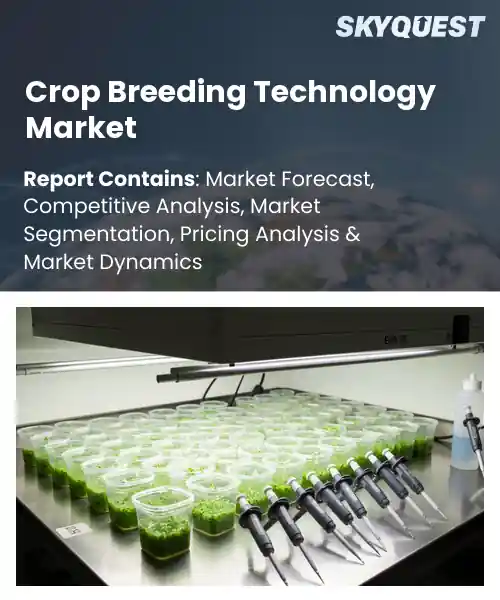
Crop Breeding Technology Market
Report ID: SQMIG30H2506
Report ID: SQMIG30H2506
[email protected]
USA +1 351-333-4748
Report ID:
SQMIG30H2506 |
Region:
Global |
Published Date: July, 2026
Pages:
157
|Tables:
120
|Figures:
77


Global Crop Breeding Technology Market size was valued at USD 8.46 Billion in 2024 and is poised to grow from USD 9.26 Billion in 2025 to USD 18.99 Billion by 2033, growing at a CAGR of 9.4% during the forecast period (2026-2033).
The crop breeding technology market encompasses tools and services that accelerate development of improved plant varieties, ranging from conventional marker‑assisted selection to CRISPR‑based genome editing. Its significance lies in securing food supplies while reducing reliance on chemical inputs, a priority as the world confronts climate change and a growing population. Historically, the sector evolved from simple cross‑breeding in the 20th century to molecular marker techniques in the 1990s and more recently to phenotyping platforms that generate data. For instance, Monsanto’s adoption of genomic selection in corn accelerated trait discovery by 30 % compared with methods, illustrating how progress reshapes the market.Rising demand for climate‑resilient crops drives significant growth because extreme weather jeopardizes yields and forces producers to seek varieties that tolerate drought, heat, or salinity. As governments allocate subsidies for sustainable agriculture, seed companies invest heavily in gene‑editing pipelines that shorten breeding cycles from a decade to three years, translating research speed into market share. For example, Corteva’s edited soybean line operates under 40 % reduced irrigation, enabling farmers to cut water use while preserving profit margins. This success spurs venture capital toward digital phenotyping startups, creating a loop where data‑driven selection accelerates trait discovery and expands the global market’s scope.
How is AI-driven automation reshaping the global crop breeding technology market?
AI-driven automation is redefining how new crop varieties are created by linking massive data streams with rapid decision loops. The technology combines high‑throughput phenotyping, machine‑learning models that predict trait performance, and automated genome‑editing design tools. Today, breeders use sensor‑rich fields, cloud‑based analytics and robotic greenhouse stations to evaluate thousands of lines in days rather than seasons. This integration shortens the breeding cycle, lowers labor costs and improves precision, allowing faster response to climate stress and consumer demand. As a result, the crop‑breeding technology market is expanding, attracting both established agribusinesses and innovative startups eager to scale AI solutions.In June 2026, a leading crop‑breeding firm introduced an AI‑driven phenotyping platform that scans field plots in real time, instantly linking visual traits to genetic markers. The system accelerates selection cycles and demonstrates how automation fuels market growth by delivering faster, more accurate variety development for growers worldwide and seed companies.
Market snapshot - (2026-2033)
Global Market Size
USD 8.46 Billion
Largest Segment
Conventional Breeding
Fastest Growth
Gene Editing
Growth Rate
9.4% CAGR
To get more insights on this market click here to Request a Free Sample Report
Global crop breeding technology market is segmented by technology, crop type, trait, end user and region. Based on technology, the market is segmented into Conventional Breeding, Marker-Assisted Breeding, Genomic Selection and Gene Editing. Based on crop type, the market is segmented into Cereals, Oilseeds, Fruits & Vegetables and Pulses. Based on trait, the market is segmented into Yield Improvement, Disease Resistance, Abiotic Stress Tolerance and Quality Enhancement. Based on end user, the market is segmented into Seed Companies, Research Institutes and Agricultural Organizations. Based on region, the market is segmented into North America, Europe, Asia Pacific, Latin America and Middle East & Africa.
Gene editing segment dominates because it provides unprecedented precision in altering plant genomes, enabling rapid development of varieties that meet evolving agronomic demands. The ability to directly insert, delete, or modify target genes accelerates breeding cycles far beyond conventional methods. This transformative capability attracts major seed companies and research institutes seeking competitive advantage, while regulatory frameworks increasingly accommodate edited crops, reinforcing its leadership in the crop breeding technology market.
However, marker assisted breeding segment is witnessing the strongest growth momentum as affordable genotyping platforms democratize access to molecular tools. Farmers and breeding programs increasingly rely on markers to accelerate trait introgression, reducing costs associated with phenotypic screening. This surge in adoption fuels market expansion, creating opportunities for technology integrators.
Disease resistance segment dominates because protecting crops from pathogens remains a priority for ensuring food security and yield stability. Advances in molecular breeding allow precise identification and stacking of resistance genes, delivering varieties that withstand disease pressures. This capability reduces reliance on chemical controls, aligning with sustainability goals and satisfying regulatory expectations. Consequently, seed developers and research institutes invest heavily in resistance‑focused technologies, cementing its preeminence in the crop breeding technology market.
Meanwhile, abiotic stress tolerance segment emerges as the fastest growing area as climate variability intensifies the need for resilient crops. Breeders leverage genomic selection and gene editing to incorporate drought, heat, and salinity tolerance, expanding variety applicability across marginal lands. This surge drives investment in technologies, unlocking market potential and reinforcing sector dynamism.
To get detailed segments analysis, Request a Free Sample Report
The region benefits from a mature ecosystem where leading research institutions partner seamlessly with a deep network of agribusiness innovators. Strong intellectual property frameworks encourage sustained investment in cutting‑edge genetics and digital phenotyping platforms. Abundant venture capital channels and a culture of rapid commercialization accelerate the translation of breakthroughs into field‑ready solutions. Robust regulatory pathways provide clarity while supporting responsible adoption of genome‑editing tools. Large scale farming operations across diverse climates create a fertile testing ground that validates technology at scale, reinforcing confidence among global partners and positioning the region as a benchmark for innovation excellence.
United States Crop Breeding Technology Market
Crop Breeding Technology Market in the United States thrives on a synergistic blend of world‑class universities, biotech incubators, and a vibrant startup scene. Collaborative programs between federal agencies and private firms accelerate gene‑editing research, while extensive public trial networks enable rapid field validation. The market is further bolstered by a strong tradition of data‑driven decision making, where precision agriculture platforms integrate seamlessly with advanced breeding pipelines. Investor confidence remains high, fostering continual infusion of capital that sustains pipeline development and drives early adoption among progressive growers.
Canada Crop Breeding Technology Market
Crop Breeding Technology Market in Canada leverages its expansive research infrastructure and a policy environment that emphasizes sustainability and food security. Close ties between provincial research centers and national funding bodies nurture innovative breeding initiatives tailored to cold‑climate challenges. The market enjoys strong collaboration between agricultural colleges and commercial seed developers, facilitating knowledge exchange and joint ventures. Emphasis on environmentally responsible practices aligns breeding objectives with emerging consumer preferences, encouraging growers to adopt resilient varieties that support long‑term ecosystem health.
Europe’s expansion is propelled by coordinated policy frameworks that prioritize climate‑smart agriculture and biodiversity preservation. Deep integration of public research programs with a vibrant network of specialized seed firms accelerates the development of varieties suited to heterogeneous soil and weather patterns. Strong emphasis on regulatory rigor ensures responsible deployment of genome‑editing tools, while generous public funding channels nurture early‑stage innovation. Collaborative cross‑border projects share data and best practices, amplifying scale and reducing time to market. Consumer demand for sustainable produce further incentivizes growers to adopt advanced breeding solutions that enhance yield stability and reduce input reliance.
Germany Crop Breeding Technology Market
Crop Breeding Technology Market in Germany is anchored by leading research institutes that excel in molecular genetics and high‑throughput phenotyping. Close cooperation between federal funding agencies and private seed companies drives a pipeline of resilient cultivars tailored to both intensive and organic farming sectors. The market benefits from a robust regulatory environment that balances innovation with safety, encouraging confidence among growers. Strong export orientation also pushes German firms to develop varieties that meet stringent European standards, reinforcing the country’s reputation as a leader in precision breeding.
United Kingdom Crop Breeding Technology Market
Crop Breeding Technology Market in the United Kingdom is experiencing swift growth fueled by strategic investments in biotech startups and academic‑industry partnerships. Government initiatives promote genome‑editing research aimed at enhancing disease resistance and climate adaptability. The market is distinguished by a proactive approach to digital agriculture, where data analytics integrate closely with breeding programs to accelerate trait selection. Growing consumer awareness of sustainability encourages rapid adoption of varieties that reduce pesticide dependence, positioning the United Kingdom as a dynamic hub for innovative crop solutions.
France Crop Breeding Technology Market
Crop Breeding Technology Market in France is emerging as a noteworthy player through concentrated efforts on sustainable agriculture and terroir‑specific varieties. Collaborative clusters linking regional research centers with seed enterprises focus on improving resilience to heat and water stress while preserving flavor profiles valued in premium markets. Government support for multidisciplinary projects nurtures the translation of laboratory discoveries into field‑tested cultivars. The market’s emphasis on environmentally friendly breeding aligns with rising demand for low‑impact farming practices, fostering a growing ecosystem of innovators.
Asia Pacific advances its position through a combination of governmental ambition, extensive agricultural land bases, and rapid adoption of digital tools. Nations within the region invest heavily in genomics research and foster public‑private consortia that accelerate trait discovery for staple crops. Integration of artificial intelligence and remote sensing with breeding pipelines enhances precision and shortens development cycles. Regional trade agreements facilitate technology transfer and collaborative trials across diverse climatic zones, expanding the applicability of new varieties. A cultural focus on food security and yield improvement drives continuous commitment to modern breeding methodologies, cementing the region’s role as an emerging innovation powerhouse.
Japan Crop Breeding Technology Market
Crop Breeding Technology Market in Japan leverages world‑class research universities and a strong tradition of meticulous experimentation. Collaborative frameworks between national institutes and private seed firms emphasize high‑value horticultural crops and climate‑resilient rice varieties. The market benefits from advanced robotics and phenotyping platforms that enable precise trait measurement, accelerating breeding cycles. Government incentives promote the responsible use of genome‑editing technology, ensuring alignment with safety standards while fostering rapid commercialization. Consumer preference for quality and safety further motivates growers to adopt cutting‑edge cultivars that meet stringent market expectations.
South Korea Crop Breeding Technology Market
Crop Breeding Technology Market in South Korea thrives on a forward‑looking approach that integrates biotechnology with smart farming solutions. Public research centers partner closely with venture‑backed startups to develop disease‑resistant grains and high‑yield vegetables suited to intensive production systems. The market is distinguished by swift regulatory pathways that support innovative gene‑editing applications while maintaining rigorous safety oversight. Strong emphasis on data analytics and sensor networks enhances breeder decision‑making, shortening time to variety release. National priorities on food self‑sufficiency reinforce sustained investment in breeding programs that address emerging climate and consumer challenges.
To know more about the market opportunities by region and country, click here to
Buy The Complete Report
Adoption is Driving Technology Uptake
Climate Challenges are Boosting Innovation
Regulatory Uncertainty is Slowing Commercialization
High Development Costs are Limiting Adoption
Request Free Customization of this report to help us to meet your business objectives.
The crop‑breeding technology market is defined by fierce rivalry as firms chase superior trait pipelines, data‑driven platforms and gene‑editing capabilities; recent M&A activity such as Indigo’s acquisition of a phenotyping analytics startup and strategic alliances like Pivot Bio’s partnership with a major fertilizer group illustrate how players accelerate product rollout and expand addressable markets while leveraging fresh venture capital to outpace rivals.
Top Player’s Company Profile
Recent Developments
SkyQuest’s ABIRAW (Advanced Business Intelligence, Research & Analysis Wing) is our Business Information Services team that Collects, Collates, Correlates, and Analyses the Data collected by means of Primary Exploratory Research backed by robust Secondary Desk research. As per SkyQuest analysis, the global crop‑breeding technology market is propelled primarily by the urgent need for climate‑resilient varieties, which pushes seed companies to adopt gene‑editing and digital phenotyping tools, while a second driver is the rapid integration of AI‑driven automation that shortens breeding cycles and cuts costs. The dominant segment is gene editing, reflecting its precision and speed, and North America remains the leading region thanks to its robust research ecosystem, supportive regulatory framework and abundant venture capital. However, regulatory uncertainty around edited crops acts as a restraint, slowing commercialization and forcing firms to allocate significant resources to compliance rather than pure R&D.
| Report Metric | Details |
|---|---|
| Market size value in 2024 | USD 8.46 Billion |
| Market size value in 2033 | USD 18.99 Billion |
| Growth Rate | 9.4% |
| Base year | 2024 |
| Forecast period | (2026-2033) |
| Forecast Unit (Value) | USD Billion |
| Segments covered |
|
| Regions covered | North America (US, Canada), Europe (Germany, France, United Kingdom, Italy, Spain, Rest of Europe), Asia Pacific (China, India, Japan, Rest of Asia-Pacific), Latin America (Brazil, Rest of Latin America), Middle East & Africa (South Africa, GCC Countries, Rest of MEA) |
| Companies covered |
|
| Customization scope | Free report customization with purchase. Customization includes:-
|
To get a free trial access to our platform which is a one stop solution for all your data requirements for quicker decision making. This platform allows you to compare markets, competitors who are prominent in the market, and mega trends that are influencing the dynamics in the market. Also, get access to detailed SkyQuest exclusive matrix.
Table Of Content
Executive Summary
Market overview
Parent Market Analysis
Market overview
Market size
KEY MARKET INSIGHTS
COVID IMPACT
MARKET DYNAMICS & OUTLOOK
Market Size by Region
KEY COMPANY PROFILES
Methodology
For the Crop Breeding Technology Market, our research methodology involved a mixture of primary and secondary data sources. Key steps involved in the research process are listed below:
1. Information Procurement: This stage involved the procurement of Market data or related information via primary and secondary sources. The various secondary sources used included various company websites, annual reports, trade databases, and paid databases such as Hoover's, Bloomberg Business, Factiva, and Avention. Our team did 45 primary interactions Globally which included several stakeholders such as manufacturers, customers, key opinion leaders, etc. Overall, information procurement was one of the most extensive stages in our research process.
2. Information Analysis: This step involved triangulation of data through bottom-up and top-down approaches to estimate and validate the total size and future estimate of the Crop Breeding Technology Market.
3. Report Formulation: The final step entailed the placement of data points in appropriate Market spaces in an attempt to deduce viable conclusions.
4. Validation & Publishing: Validation is the most important step in the process. Validation & re-validation via an intricately designed process helped us finalize data points to be used for final calculations. The final Market estimates and forecasts were then aligned and sent to our panel of industry experts for validation of data. Once the validation was done the report was sent to our Quality Assurance team to ensure adherence to style guides, consistency & design.
Analyst Support
Customization Options
With the given market data, our dedicated team of analysts can offer you the following customization options are available for the Crop Breeding Technology Market:
Product Analysis: Product matrix, which offers a detailed comparison of the product portfolio of companies.
Regional Analysis: Further analysis of the Crop Breeding Technology Market for additional countries.
Competitive Analysis: Detailed analysis and profiling of additional Market players & comparative analysis of competitive products.
Go to Market Strategy: Find the high-growth channels to invest your marketing efforts and increase your customer base.
Innovation Mapping: Identify racial solutions and innovation, connected to deep ecosystems of innovators, start-ups, academics, and strategic partners.
Category Intelligence: Customized intelligence that is relevant to their supply Markets will enable them to make smarter sourcing decisions and improve their category management.
Public Company Transcript Analysis: To improve the investment performance by generating new alpha and making better-informed decisions.
Social Media Listening: To analyze the conversations and trends happening not just around your brand, but around your industry as a whole, and use those insights to make better Marketing decisions.
REQUEST FOR SAMPLE
 REQUEST FREE CUSTOMIZATION


Want to customize this report? This report can be personalized according to your needs. Our analysts and industry experts will work directly with you to understand your requirements and provide you with customized data in a short amount of time. We offer $1000 worth of FREE customization at the time of purchase.
Feedback From Our Clients


 USA (+1) 351-333-4748

