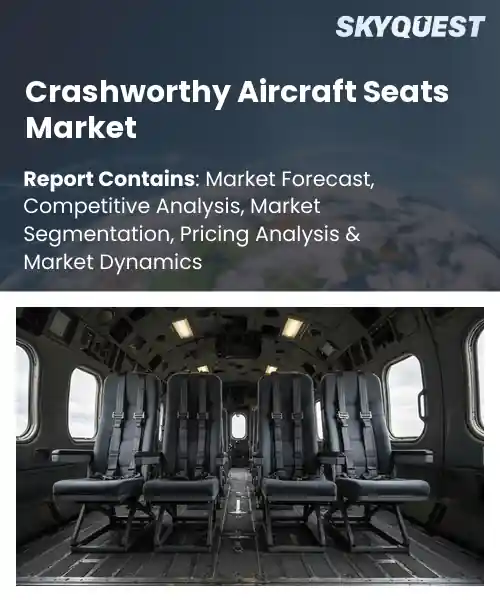
Crashworthy Aircraft Seats Market
Report ID: SQMIG20A2656
Report ID: SQMIG20A2656
[email protected]
USA +1 351-333-4748
Report ID:
SQMIG20A2656 |
Region:
Global |
Published Date: June, 2026
Pages:
157
|Tables:
175
|Figures:
79


Global Crashworthy Aircraft Seats Market size was valued at USD 1.35 Billion in 2024 and is poised to grow from USD 1.45 Billion in 2025 to USD 2.55 Billion by 2033, growing at a CAGR of 7.31% during the forecast period (2026-2033).
The market is benefiting from the increased need for lightweight seating systems to enhance fuel efficiency and are compliant with the evolving safety standards. Technological improvements in materials like carbon fiber composites, energy absorption structures, and ergonomic seat designs are further improving seat performance and longevity. The growing procurement of helicopters, transport aircraft, and special mission aircraft in the military sector is pushing the demand for enhanced crashworthy seating options. Meanwhile, commercial airlines are investing in next generation seats that combine safety, comfort and weight reduction to maximize operating efficiency.
North America continues to be an important market, supported by robust aerospace manufacturing capabilities and defense spending. On the other hand, the Asia-Pacific region is experiencing significant expansion driven by expanding airline fleets and increased investments in domestic aircraft manufacture. Finally, continuous advancements in seat design, strategic alliances between airlines and seat manufacturers, and greater focus on passenger safety are predicted to help in long-term market growth.
How is AI-driven automation influencing design and safety standards in the crashworthy aircraft seats market?
AI driven automation is reshaping crashworthy aircraft seat design by enabling rapid generative modeling and real time impact simulation. Engineers feed safety regulations into machine learning engines that propose optimal geometry, material placement and weight distribution. The resulting concepts are evaluated through virtual crash tests that cut down physical prototype cycles. This approach improves compliance with stringent certification standards while delivering lighter, stronger seats. Market analysts note that the growing demand for higher passenger protection is encouraging manufacturers to adopt these tools, creating a feedback loop that accelerates innovation and drives overall market momentum.
A recent industry report released in April 2026 highlighted that leading seat manufacturers are deploying AI powered design platforms, shortening development timelines and enhancing safety validation, thereby supporting the market’s expansion.
Market snapshot - (2026-2033)
Global Market Size
USD 1.35 Billion
Largest Segment
Fixed Wing Aircraft
Fastest Growth
Rotary Wing Aircraft
Growth Rate
7.31% CAGR
To get more insights on this market click here to Request a Free Sample Report
Global crashworthy aircraft seats market is segmented by platform type, fixed wing seat type, fixed wing aircraft type, fixed wing end user, rotary wing seat type, structural material base and region. Based on platform type, the market is segmented into Fixed Wing Aircraft and Rotary Wing Aircraft. Based on fixed wing seat type, the market is segmented into Passenger Seats, Pilot Seats, Troop Transport Seats and Crew Seats. Based on fixed wing aircraft type, the market is segmented into Commercial Aircraft, Military Aircraft, General Aviation Aircraft and Advanced Air Mobility Vehicles. Based on fixed wing end user, the market is segmented into Original Equipment Manufacturer, Maintenance Aftermarket, Repair Aftermarket and Overhaul Aftermarket. Based on rotary wing seat type, the market is segmented into Passenger Seats, Pilot Seats, Crew Seats and Gunner Observation Seats. Based on structural material base, the market is segmented into Lightweight Aluminum Alloys, Advanced Carbon Fiber Composites, Titanium Formulations and High-Performance Polymers. Based on region, the market is segmented into North America, Europe, Asia Pacific, Latin America and Middle East & Africa.
Pilot seats segment leads with large crashworthy aircraft seats market share because it directly addresses the critical safety and ergonomic requirements of flight crews, prompting OEMs to prioritize crashworthy designs for these seats. Their integration with advanced restraint systems and energy‑absorbing structures creates a compelling value proposition for both commercial and military aircraft, driving sustained demand. The essential role of pilots in mission success further reinforces manufacturers’ focus on continual innovation in this category.
As per crashworthy aircraft seats market outlook, crew seats segment is witnessing the strongest growth momentum because airlines and defense operators are expanding multi‑crew configurations that require enhanced crash protection and modular seating solutions. Emerging cabin layouts, longer mission durations, and regulatory emphasis on crew survivability are spurring rapid adoption, opening new opportunities for manufacturers to capture expanding demand.
As per crashworthy aircraft seats market analysis, advanced carbon fiber composites segment stands out because its high strength‑to‑weight ratio enables significant weight reduction while preserving crash energy absorption, a core demand for modern crashworthy seat designs. The material’s fatigue resistance and ease of forming complex geometries align with OEM goals for fuel efficiency and safety compliance, prompting extensive adoption across new aircraft platforms. Consequently, manufacturers prioritize carbon‑fiber‑reinforced structures to meet stringent performance standards.
Conversely, high-performance polymers segment is emerging as the key high‑growth area because ongoing research yields polymers with superior impact resistance and thermal stability, enabling lighter, integral seat frames that meet crash certification criteria. Rising interest in scalable manufacturing and cost‑effective alternatives to metals accelerates adoption, positioning polymers to expand market share rapidly.
To get detailed segments analysis, Request a Free Sample Report
The region benefits from a deeply entrenched aerospace manufacturing base that integrates advanced engineering expertise with rigorous safety regulations. Industry leaders leverage extensive research and development capabilities, fostering continual innovation in seat design and materials. Strong defense spending sustains demand for high‑performance safety solutions, while a mature commercial aviation sector ensures steady procurement cycles. Collaborative ecosystems between OEMs, suppliers, and certification bodies streamline product introduction, reinforcing market leadership. Moreover, an emphasis on passenger safety standards drives adoption of cutting‑edge crashworthy solutions, cementing the region’s pre‑eminence.
United States is propelled by a concentration of major aircraft manufacturers and a robust supply chain that emphasizes reliability and performance. Innovative research institutions partner with industry to advance impact‑mitigating technologies, while rigorous certification frameworks ensure consistent safety compliance. The presence of a sizable commercial airline fleet further accelerates demand for state‑of‑the‑art seating solutions that meet stringent regulatory expectations and enhance passenger protection.
Canada is shaped by a collaborative environment linking aerospace firms with governmental safety agencies that prioritize rigorous testing and certification. The nation’s focus on sustainable aviation practices encourages the integration of lightweight yet resilient materials, supporting the evolution of seat designs that balance safety with efficiency. Strategic partnerships with North American OEMs enable the rapid incorporation of cutting‑edge crash mitigation features, reinforcing the market’s growth trajectory.
Europe’s expansion is fueled by stringent aviation safety directives that mandate continual improvement of passenger protection systems. A strong network of specialized engineering firms and research centers drives innovation in energy‑absorbing structures and advanced composites. Growing emphasis on environmental performance aligns with the development of lighter, crash‑worthy seats that contribute to overall fuel efficiency. Collaborative initiatives across the European Union facilitate harmonized certification processes, expediting market entry for new technologies. Additionally, a resilient commercial airline landscape, coupled with ongoing defense initiatives, sustains robust demand for sophisticated safety solutions throughout the region.
Germany is anchored by a legacy of precision engineering and a dense concentration of component manufacturers. The country’s rigorous safety standards compel continuous refinement of seat structures, encouraging the adoption of cutting‑edge impact‑absorption technologies. Close collaboration between automotive safety experts and aerospace firms accelerates cross‑industry innovation, while strong academic research supports material advancements that enhance crashworthiness without compromising weight.
United Kingdom is experiencing rapid momentum due to aggressive regulatory frameworks that prioritize passenger safety. A vibrant ecosystem of aerospace startups and established OEMs fosters swift development of novel seat concepts featuring adaptive energy‑management systems. Government‑backed research initiatives promote the integration of smart materials, enabling seats to dynamically respond to impact forces. This innovative climate, combined with a bustling commercial aviation sector, drives swift market uptake of advanced crash‑worthy solutions.
France is emerging as a focal point for collaborative safety projects between industry and research institutions. Emphasis on lightweight composite applications aligns with broader sustainability goals, encouraging the design of seats that deliver superior crash protection while reducing overall aircraft mass. Government incentives for technology transfer accelerate the commercialization of novel impact‑mitigation designs, positioning France as an incubator for next‑generation crashworthy seating concepts.
As per crashworthy aircraft seats industry analysis, Asia Pacific is leveraging its expanding aviation footprint to enhance its role in the crashworthy seats arena. Nations within the region are investing heavily in advanced manufacturing capabilities and skill development, fostering a competitive environment for safety‑focused innovations. Adoption of global safety standards, coupled with a surge in both commercial and military aircraft procurement, creates a fertile market for sophisticated seating solutions. Collaboration between regional OEMs and international technology partners accelerates knowledge transfer, while burgeoning research hubs explore new material sciences that improve impact resistance. This combination of strategic investment, regulatory alignment, and collaborative R&D propels the region toward greater market influence.
As per crashworthy aircraft seats market regional forecast, Japan benefits from a strong tradition of precision manufacturing and a rigorous safety culture within its aviation sector. Close ties between major aircraft manufacturers and specialized seat suppliers enable rapid integration of cutting‑edge crash‑mitigation technologies. Ongoing research initiatives focus on high‑performance composites and smart sensor integration, delivering seats that enhance passenger protection while aligning with efficiency objectives.
As per crashworthy aircraft seats market regional outlook, South Korea is driven by an aggressive pursuit of technological advancement and a burgeoning domestic aerospace industry. Strategic government support encourages partnerships between aircraft manufacturers and innovative material developers, fostering the creation of lightweight, high‑strength seating solutions. Emphasis on rapid certification processes and alignment with international safety standards accelerates market adoption of next‑generation crashworthy seats.
To know more about the market opportunities by region and country, click here to
Buy The Complete Report
Regulatory Safety Standards Enforced
Advancements In Composite Materials
High Certification Costs
Complex Supply Chain Integration
Request Free Customization of this report to help us to meet your business objectives.
The global crashworthy aircraft seats industry is shaped by intense competition among established manufacturers and emerging suppliers, driven by stringent safety regulations and the demand for lighter, more efficient cabin solutions. Companies are pursuing strategic moves such as acquisitions of niche technology firms and joint development agreements with aircraft OEMs to integrate advanced energy‑absorbing materials, enhancing seat performance and compliance.
SkyQuest’s ABIRAW (Advanced Business Intelligence, Research & Analysis Wing) is our Business Information Services team that Collects, Collates, Correlates, and Analyses the Data collected by means of Primary Exploratory Research backed by robust Secondary Desk research.
As per SkyQuest analysis the global crashworthy aircraft seats market growth is being propelled primarily by tightening regulatory safety standards that force airlines to replace legacy seating, while a second powerful catalyst is the rapid adoption of lightweight composite materials that boost crash protection and fuel efficiency. The dominant region remains North America, benefitting from a deep aerospace supply chain and strong defense spending, and the pilot‑seat segment leads overall demand because of its critical safety and ergonomic role. However, the high cost of certification acts as a restraint, slowing entry for smaller suppliers and limiting the speed of new product launches. The global crashworthy aircraft seats market trend driven by increasing aircraft production, rising demand for enhanced passenger and crew safety, and growing investments in military aviation modernization programs.
| Report Metric | Details |
|---|---|
| Market size value in 2024 | USD 1.35 Billion |
| Market size value in 2033 | USD 2.55 Billion |
| Growth Rate | 7.31% |
| Base year | 2024 |
| Forecast period | (2026-2033) |
| Forecast Unit (Value) | USD Billion |
| Segments covered |
|
| Regions covered | North America (US, Canada), Europe (Germany, France, United Kingdom, Italy, Spain, Rest of Europe), Asia Pacific (China, India, Japan, Rest of Asia-Pacific), Latin America (Brazil, Rest of Latin America), Middle East & Africa (South Africa, GCC Countries, Rest of MEA) |
| Companies covered |
|
| Customization scope | Free report customization with purchase. Customization includes:-
|
To get a free trial access to our platform which is a one stop solution for all your data requirements for quicker decision making. This platform allows you to compare markets, competitors who are prominent in the market, and mega trends that are influencing the dynamics in the market. Also, get access to detailed SkyQuest exclusive matrix.
Table Of Content
Executive Summary
Market overview
Parent Market Analysis
Market overview
Market size
KEY MARKET INSIGHTS
COVID IMPACT
MARKET DYNAMICS & OUTLOOK
Market Size by Region
KEY COMPANY PROFILES
Methodology
For the Crashworthy Aircraft Seats Market, our research methodology involved a mixture of primary and secondary data sources. Key steps involved in the research process are listed below:
1. Information Procurement: This stage involved the procurement of Market data or related information via primary and secondary sources. The various secondary sources used included various company websites, annual reports, trade databases, and paid databases such as Hoover's, Bloomberg Business, Factiva, and Avention. Our team did 45 primary interactions Globally which included several stakeholders such as manufacturers, customers, key opinion leaders, etc. Overall, information procurement was one of the most extensive stages in our research process.
2. Information Analysis: This step involved triangulation of data through bottom-up and top-down approaches to estimate and validate the total size and future estimate of the Crashworthy Aircraft Seats Market.
3. Report Formulation: The final step entailed the placement of data points in appropriate Market spaces in an attempt to deduce viable conclusions.
4. Validation & Publishing: Validation is the most important step in the process. Validation & re-validation via an intricately designed process helped us finalize data points to be used for final calculations. The final Market estimates and forecasts were then aligned and sent to our panel of industry experts for validation of data. Once the validation was done the report was sent to our Quality Assurance team to ensure adherence to style guides, consistency & design.
Analyst Support
Customization Options
With the given market data, our dedicated team of analysts can offer you the following customization options are available for the Crashworthy Aircraft Seats Market:
Product Analysis: Product matrix, which offers a detailed comparison of the product portfolio of companies.
Regional Analysis: Further analysis of the Crashworthy Aircraft Seats Market for additional countries.
Competitive Analysis: Detailed analysis and profiling of additional Market players & comparative analysis of competitive products.
Go to Market Strategy: Find the high-growth channels to invest your marketing efforts and increase your customer base.
Innovation Mapping: Identify racial solutions and innovation, connected to deep ecosystems of innovators, start-ups, academics, and strategic partners.
Category Intelligence: Customized intelligence that is relevant to their supply Markets will enable them to make smarter sourcing decisions and improve their category management.
Public Company Transcript Analysis: To improve the investment performance by generating new alpha and making better-informed decisions.
Social Media Listening: To analyze the conversations and trends happening not just around your brand, but around your industry as a whole, and use those insights to make better Marketing decisions.
REQUEST FOR SAMPLE
 REQUEST FREE CUSTOMIZATION
Global Crashworthy Aircraft Seats Market size was valued at USD 1.35 Billion in 2024 and is poised to grow from USD 1.45 Billion in 2025 to USD 2.55 Billion by 2033, growing at a CAGR of 7.31% during the forecast period (2026-2033).
The global crashworthy aircraft seats market is shaped by intense competition among established manufacturers and emerging suppliers, driven by stringent safety regulations and the demand for lighter, more efficient cabin solutions. Companies are pursuing strategic moves such as acquisitions of niche technology firms and joint development agreements with aircraft OEMs to integrate advanced energy‑absorbing materials, enhancing seat performance and compliance. 'Safran', 'Collins Aerospace', 'Martin-Baker Aircraft Co. Ltd.', 'Recaro Aircraft Seating GmbH and Co. KG', 'Jamco Corporation', 'Acro Aircraft Seating', 'Autoflug GmbH', 'Geven S.p.A.', 'Ipeco Holdings Ltd.', 'Expliseat', 'Mirus Aircraft Seating', 'Thompson Aero Seating', 'ZIM Aircraft Seating GmbH', 'East West Industries Inc.', 'Aviointeriors S.p.A.', 'LifePort', 'Mobius Protection Systems Ltd.', 'Futureflite Inc.', 'Starling Aerospace Limited', 'United Safety and Survivability Corp'
The aviation industry worldwide continues to tighten crashworthiness requirements for passenger seating, mandating rigorous testing and compliance with updated certification protocols. Manufacturers respond by incorporating advanced energy‑absorbing structures and stronger attachment systems, which directly stimulate demand for compliant seat solutions. This regulatory pressure encourages continuous product innovation and accelerates adoption of newer designs, fostering market expansion as airlines must replace legacy equipment to meet safety obligations. Consequently, the need for certified crashworthy seats becomes a central growth driver within the sector.
Lightweight Composite Integration: Aircraft manufacturers are increasingly adopting lightweight composite materials for seat structures, driven by the need to reduce overall aircraft weight and improve fuel efficiency. These composites enable designers to maintain or enhance crashworthiness while delivering significant weight savings, facilitating compliance with stricter environmental regulations. The shift also supports modular design approaches, allowing faster customization for diverse cabin configurations and simplifying maintenance processes across airlines while significantly reducing operational costs for operators worldwide.
Why does North America Dominate the Global Crashworthy Aircraft Seats Market? |@12


Want to customize this report? This report can be personalized according to your needs. Our analysts and industry experts will work directly with you to understand your requirements and provide you with customized data in a short amount of time. We offer $1000 worth of FREE customization at the time of purchase.
Feedback From Our Clients


 USA (+1) 351-333-4748

