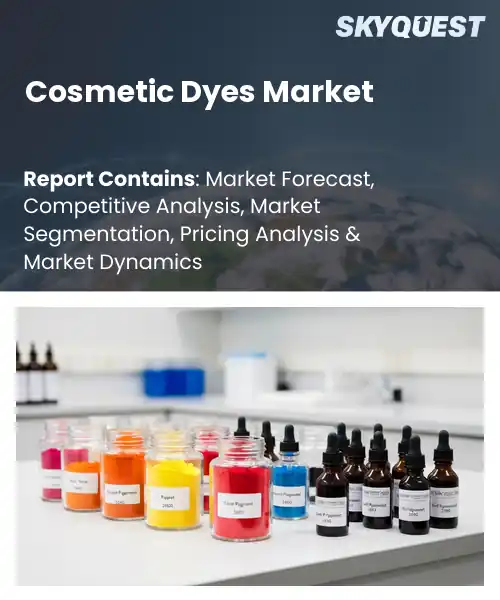
Cosmetic Dyes Market
Report ID: SQMIG15E3508
Report ID: SQMIG15E3508
[email protected]
USA +1 351-333-4748
Report ID:
SQMIG15E3508 |
Region:
Global |
Published Date: May, 2026
Pages:
157
|Tables:
95
|Figures:
76


Global Cosmetic Dyes Market size was valued at USD 534.9 Million in 2024 and is poised to grow from USD 554.69 Million in 2025 to USD 741.79 Million by 2033, growing at a CAGR of 3.7% during the forecast period (2026-2033).
The main factor for the cosmetic dyes market growth is driven by more people wanting personalization, like they want expressive color that fits them, and social media just keeps amplifying that, and fashion cycles are speeding up. So this market includes colorants made for hair, makeup, nails, and body art, and it really matters because pigments affect product differentiation, branding, and also regulatory compliance in a crowded field.
Moreover, regulatory tightening and sustainability-minded consumer preferences also shape growth, because bans on certain azo and heavy-metal colorants force formulators to pivot. They end up moving toward botanical and engineered pigments, and that automatically boosts demand for R&D and for alternative supply chains. That’s why suppliers put money into encapsulation techniques and bio-based dye synthesis, trying to hit both performance and safety goals. For instance, ammonia-free hair lines and plant-derived lip tints can deliver bright shades without toxic residues, and modular pigment concentrates help direct-to-consumer brands craft bespoke shades more easily. All of that snowballs into opportunities in specialty manufacturing, testing services, and natural portfolios built for rising demand in emerging markets, and premium segments.
Color formulation in cosmetics is basically the act of choosing pigments, matching spectra, and managing how ingredients interact, so that they end up with the shade people want, along with stability and skin feel. AI helps by using machine learning and spectral simulation to foresee pigment and binder interactions, then it suggests optimized recipes. That reduces the classic trial and error and shortens the time from lab work to the actual product. On top of that, brands face pressure to offer wider shade ranges and to stay more sustainable, so they adopt virtual try-on and predictive formulation. The point is personalization, but with less waste. In practice, AI-powered virtual makeup and hair color previews that consumers try before buying, and also in silico formulation tools where scientists test tons of variables before making physical samples.
Market snapshot - (2026-2033)
Global Market Size
USD 534.9 Million
Largest Segment
Synthetic Dyes
Fastest Growth
Natural Dyes
Growth Rate
3.7% CAGR
To get more insights on this market click here to Request a Free Sample Report
The global cosmetic dyes market is segmented by type, solubility, application, and region. Based on type, the market is segmented into Synthetic Dyes, Natural Dyes, Inorganic Pigments, and Others. Based on solubility, the market is segmented into Water-Soluble, Oil-Soluble, and Others. Based on application, the market is segmented into Hair Care Products, Facial Makeup, Eye Makeup, Nail Care Products, Lip Products, Toiletries, Soap, and Others. Based on region, the market is segmented into North America, Europe, Asia Pacific, Latin America, and the Middle East & Africa.
As per the cosmetic dyes market analysis, the Natural Dyes segment dominates, largely because more consumers now want clean, plant-based ingredients, so formulation priorities tilt toward botanically derived colorants that help with sustainable branding, also a sense of safety in the buying mind. Suppliers have been improving stability and shade range by using extraction methods and co-pigmentation, which lets formulators keep product performance steady, while still dealing with regulatory scrutiny and the marketing demands that come along with it. This cause-and-effect vibe pushes manufacturers to put natural colorants first across their whole portfolio. So the market leadership keeps getting reinforced.
Meanwhile, Synthetic Dyes are rising as the most rapidly expanding area, mainly due to an unmatched color gamut and a higher formulation flexibility, meaning faster product development and more high-performance shades. Improvements in safer synthetic chemistries, along with new encapsulation techniques, are making adoption accelerate in both premium and mass market products. That’s opening new applications and commercial growth opportunities for manufacturers.
According to the cosmetic dyes market forecast, the Hair Care Products segment dominates because people keep asking for hair coloring and treatments, so there are continuous replacement cycles and strong lifetime value. That situation pushes brands to invest a lot into dye performance, shade innovation, and formulation safety. Salon, as well as at-home application trends, support specialized chemistries and conditioning systems that help protect hair while still delivering vivid results. This ongoing demand for multifunctional hair color formulations channels research and development and marketing resources, and in turn, it strengthens market leadership.
On the other hand, the Lip Products category is predicted to have the largest cosmetic dyes market share, driven by demand for long-wear pigments, new stain technologies, and multifunctional formulations that blend color with care. Social media trends, along with influencer-led shade releases, are speeding up SKU proliferation. That encourages brands to dig deeper into pigment research and build new revenue streams across decorative cosmetics and also hybrid color care offerings.
To get detailed segments analysis, Request a Free Sample Report
As per the cosmetic dyes market regional forecast, Asia Pacific is leading the market, not just because of “advanced manufacturing” or dense shoppers, but more like a mix of capability, lots of beauty demand for different looks, and regulatory rules that keep pushing innovation forward. This can be witnessed in the way ingredient suppliers that are already well established, and focused dye producers, help teams move from idea to formulation, and then to scaling up, quickly. And also there are these real collaborations between local brands and research groups, it helps with product differentiation, and not only in the typical way, but in that more nuanced color technology, craftsmanship, along with a flexible mindset toward what people want region by region. Hair dyes, skin tints, decorative cosmetics, the portfolio stays broad, and it’s supported by continuous refinement in formulation and sustainable sourcing too. On top of that, there’s vibrant private label activity, and e-commerce adoption that is fast enough to make distribution feel way more efficient, and that improves accessibility for multiple market segments.
Japan Cosmetic Dyes Market
The Japan Cosmetic Dyes sector benefits a lot from a long background in color chemistry, careful manufacturing processes, and tight links between research institutions and beauty brands. Domestic manufacturers tend to push for purity, safety, and creative color formulations that match consumer preferences, and they also invest in testing like it’s a backbone. With established testing infrastructure and consumers that are genuinely picky, the market leans premium, and the technical sophistication grows, too. Across the value chain, collaboration supports quicker product development, and it also supports niche offerings where quality, performance, and more refined aesthetic outcomes become the credibility signal.
South Korea Cosmetic Dyes Market
In South Korea, the Cosmetic Dyes industry is fueled by a lively beauty culture, strong innovation ecosystems, and cosmetic companies that convert trends into actual products. There’s a noticeable preference for cutting-edge formulations, dye systems that do multiple jobs, and an aesthetic experiment mindset that keeps development moving fast. When brands, ingredient developers, and digital beauty platforms stay closely engaged, adoption speeds up, too. The market likes new textures, clean labeling, and bold color results, and that combination helps brands stand out and also keeps consumer attention locked in.
What is Driving the Rapid Expansion of Cosmetic Dyes Market in North America?
The rapid cosmetic dyes market penetration in North America is basically driven by strong demand for personalized and high-performance beauty products, and meaningful research and development capacity. Retail conditions there are also quite mature, supporting both premium names and indie labels without much friction. Formulation science is improving, there’s an emphasis on regulatory compliance and ingredient transparency, and partnerships between multinational suppliers and local innovators help commercialize new products faster. Consumer preference is shifting toward multifunctional dyes, safer chemistries, and clean labeling, so portfolio diversification becomes easier and more attractive. Heavy investment in marketing, digital commerce, and professional salon channels increases visibility and trial, then scale-up follows. This supports deeper penetration across different consumer groups, too. Sustainability concerns, private label growth, and even more collaborative dermatological testing all strengthen confidence, while also making differentiation more credible. Contract manufacturing flexibility and laboratory networks make it easier to adjust quickly to trends and niche needs, so North America can innovate, while still holding safety and efficacy standards steady.
United States Cosmetic Dyes Market
Cosmetic Dyes Market in the United States shows both major multinational innovation and indie brand activity, backed by advanced formulation science and broad testing infrastructure. Ingredient transparency, safety, and multifunctional performance are key themes, and they help expand usage across personal care and professional channels. Distribution is supported by strong retail ecosystems, e-commerce, and professional beauty networks, which also help consumer trial happen more naturally. Collaborative efforts between brands, ingredient suppliers, and contract manufacturers support custom dye solutions, and they improve the ability to execute supply chain changes quickly.
Canada Cosmetic Dyes Market
The Cosmetic Dyes Market in Canada is defined by a mix of demand for clean formulations, sustainable sourcing, and products that feel relevant to a wide range of consumers. Local manufacturers and specialized suppliers often lean toward gentle chemistries and very clear ingredient storytelling, which, in turn, builds trust in the whole category. When products line up with regulatory guidance and the usual industry testing norms, it tends to make safety and efficacy expectations stronger. At the same time, niche brands are using digital spaces and professional channels to bring in fresh color ideas, and they also work with contract manufacturers so production can scale smoothly, without getting messy or dragging on.
Europe is fortifying its role in the cosmetic dyes arena with rigorous regulatory oversight, a strong push on safety and ingredient transparency, and this deep tradition of formulation know-how. Investment in sustainable raw materials and eco-friendly processing steers product development toward what consumers seem to be asking for more, with higher expectations. Collaboration across academic centers, niche manufacturers, and long-standing cosmetic houses helps unlock advanced color technologies and specialty dye chemistries, even when the timelines get tight. There are solid testing frameworks and collective industry initiatives that support harmonization, yet at the same time, artisanal craftsmanship and designer-led trends is bringing a special aesthetic charge, that premium positioning across markets. Regional clusters tend to concentrate expertise in pigment synthesis, analytical characterization, and sustainable formulation, which makes the jump from research into commercial offerings feel more efficient. And then, emphasis on circular economy principles, recyclable packaging, and a lower environmental footprint guides how dye chemistries are selected. Strong luxury brand heritage and a vibrant indie scene together keep color creativity moving, while investments in digital color matching and application technologies boost the consumer experience, and also help professionals adopt new products more quickly.
Germany Cosmetic Dyes Market
The Cosmetic Dyes Market in Germany is grounded in chemical manufacturing, stringent quality standards, and a clear focus on safety and environmental compliance. Ingredient developers and manufacturers prioritize analytical validation, traceability, and sustainable sourcing because the industry requirements are demanding. Strong engineering capabilities help support scalable production of specialty dyes and stable pigment systems. Collaboration with technical universities and research centers speeds up formulation refinement, while a discerning professional market encourages high performance and proven efficacy.
United Kingdom Cosmetic Dyes Market
Cosmetic Dyes Market in the United Kingdom gets powered by creative design, regulatory know-how, and a thriving indie beauty scene that keeps pushing color innovation forward, you know, in a steady way. Many companies tend to stress sustainable chemistries, easy-to-read labeling, and formulations that are very style-forward; they resonate with consumers who care about aesthetics. Research collaborations with art and design institutions also help spark fresh color concepts as well as practical application techniques, not just the theory. With a lively retail and professional space supporting product discovery, the uptake of trend-led dyes and those distinctive consumer experiences tends to happen more often than expected.
France Cosmetic Dyes Market
Cosmetic Dyes Market in France leans on heritage in luxury cosmetics, artisanal color techniques, and an emphasis on sensory experience. Manufacturers blend classic pigment craftsmanship with formulation science to deliver refined hues and textures that match discerning consumer expectations. Regulatory rigor and a commitment to ingredient quality reinforce brand credibility, and that matters a lot. Boutique producers and established houses contribute innovative shade narratives, while collaborations with perfumers and designers strengthen product storytelling and make the overall aspirational positioning feel more compelling.
To know more about the market opportunities by region and country, click here to
Buy The Complete Report
Rising Demand For Natural Dyes
Innovations In Dye Technology
Stringent Regulatory Compliance Requirements
Raw Material Supply Constraints
Request Free Customization of this report to help us to meet your business objectives.
The competitive landscape for global cosmetic dyes is getting more intense lately, because sustainability and clean beauty demands are basically pushing the biggest players to lean into M&A co-development and technology licensing, not just incremental chemistry. This can be observed in pivot in how major pigment companies are doing portfolio moves, like DIC acquiring BASF Colors and Effects. Meanwhile, brands and ingredient suppliers are quietly forming pilot partnerships with biotech colorants such as Huue while material science spinouts like Sparxell chase commercial collaborations, and even seed funding, to speed up market entry.
Top Player’s Company Profile
Recent Developments in the Cosmetic Dyes Market
SkyQuest’s ABIRAW (Advanced Business Intelligence, Research & Analysis Wing) is our Business Information Services team that Collects, Collates, Correlates, and Analyses the Data collected by means of Primary Exploratory Research backed by robust Secondary Desk research.
As per SkyQuest analysis, the global cosmetic dyes market is powered by one big driver, which is basically the rush for personalization and expressive color, boosted by social media momentum and fast fashion cycles. One restraint, though, is the stringent regulatory compliance duties, which increase the testing, documentation, and reformulation expenses for manufacturers. The dominating region is the Asia Pacific, supported by advanced manufacturing capability, high consumer activity, and quick e‑commerce adoption. The dominating segment is natural dyes, because clean label habits keep pulling formulators toward plant-derived colorants. Another big driver is dye technology innovation, like encapsulation, bio-based pigments, and AI-assisted predictive formulation tools, and this all helps speed development up, reduce waste, and lets teams craft broader shade ranges as well.
| Report Metric | Details |
|---|---|
| Market size value in 2024 | USD 534.9 Million |
| Market size value in 2033 | USD 741.79 Million |
| Growth Rate | 3.7% |
| Base year | 2024 |
| Forecast period | (2026-2033) |
| Forecast Unit (Value) | USD Million |
| Segments covered |
|
| Regions covered | North America (US, Canada), Europe (Germany, France, United Kingdom, Italy, Spain, Rest of Europe), Asia Pacific (China, India, Japan, Rest of Asia-Pacific), Latin America (Brazil, Rest of Latin America), Middle East & Africa (South Africa, GCC Countries, Rest of MEA) |
| Companies covered |
|
| Customization scope | Free report customization with purchase. Customization includes:-
|
To get a free trial access to our platform which is a one stop solution for all your data requirements for quicker decision making. This platform allows you to compare markets, competitors who are prominent in the market, and mega trends that are influencing the dynamics in the market. Also, get access to detailed SkyQuest exclusive matrix.
Table Of Content
Executive Summary
Market overview
Parent Market Analysis
Market overview
Market size
KEY MARKET INSIGHTS
COVID IMPACT
MARKET DYNAMICS & OUTLOOK
Market Size by Region
KEY COMPANY PROFILES
Methodology
For the Cosmetic Dyes Market, our research methodology involved a mixture of primary and secondary data sources. Key steps involved in the research process are listed below:
1. Information Procurement: This stage involved the procurement of Market data or related information via primary and secondary sources. The various secondary sources used included various company websites, annual reports, trade databases, and paid databases such as Hoover's, Bloomberg Business, Factiva, and Avention. Our team did 45 primary interactions Globally which included several stakeholders such as manufacturers, customers, key opinion leaders, etc. Overall, information procurement was one of the most extensive stages in our research process.
2. Information Analysis: This step involved triangulation of data through bottom-up and top-down approaches to estimate and validate the total size and future estimate of the Cosmetic Dyes Market.
3. Report Formulation: The final step entailed the placement of data points in appropriate Market spaces in an attempt to deduce viable conclusions.
4. Validation & Publishing: Validation is the most important step in the process. Validation & re-validation via an intricately designed process helped us finalize data points to be used for final calculations. The final Market estimates and forecasts were then aligned and sent to our panel of industry experts for validation of data. Once the validation was done the report was sent to our Quality Assurance team to ensure adherence to style guides, consistency & design.
Analyst Support
Customization Options
With the given market data, our dedicated team of analysts can offer you the following customization options are available for the Cosmetic Dyes Market:
Product Analysis: Product matrix, which offers a detailed comparison of the product portfolio of companies.
Regional Analysis: Further analysis of the Cosmetic Dyes Market for additional countries.
Competitive Analysis: Detailed analysis and profiling of additional Market players & comparative analysis of competitive products.
Go to Market Strategy: Find the high-growth channels to invest your marketing efforts and increase your customer base.
Innovation Mapping: Identify racial solutions and innovation, connected to deep ecosystems of innovators, start-ups, academics, and strategic partners.
Category Intelligence: Customized intelligence that is relevant to their supply Markets will enable them to make smarter sourcing decisions and improve their category management.
Public Company Transcript Analysis: To improve the investment performance by generating new alpha and making better-informed decisions.
Social Media Listening: To analyze the conversations and trends happening not just around your brand, but around your industry as a whole, and use those insights to make better Marketing decisions.
REQUEST FOR SAMPLE
 REQUEST FREE CUSTOMIZATION
Global Cosmetic Dyes Market size was valued at USD 534.9 Million in 2024 and is poised to grow from USD 554.69 Million in 2025 to USD 741.79 Million by 2033, growing at a CAGR of 3.7% during the forecast period (2026-2033).
Competitive landscape for global cosmetic dyes is intensifying as sustainability and clean beauty demands push incumbents toward M&A, co development, and technology licensing. Large pigment makers have executed strategic portfolio deals such as DIC acquiring BASF Colors and Effects. Brands and ingredient suppliers form pilot partnerships with biotech colorants like Huue while material science spinouts such as Sparxell pursue commercial partnerships and seed finance to accelerate market entry. 'Sensient Technologies', 'Clariant', 'DyStar', 'Neelikon', 'Chromatech', 'Pylam Products', 'Organic Dyes and Pigments', 'Koel Colours', 'Aakash Chemicals', 'Goldmann Group', 'BASF', 'Sun Chemical', 'Lanxess', 'Huntsman Corporation', 'Merck KGaA', 'Sudarshan Chemical Industries', 'DIC Corporation', 'Dainichiseika Color & Chemicals', 'Miyoshi Kasei', 'Kobo Products'
Rising consumer preference for natural and environmentally benign cosmetic ingredients is driving formulators and brands to increase adoption of plant derived and bio based dyes in color cosmetics, hair products and skincare. This shift encourages manufacturers to expand research, scale sustainable sourcing, and develop new product lines highlighting clean label claims. As a result, demand for specialized cosmetic dyes that meet safety and biodegradability expectations grows, supporting investment in production capacity, supplier partnerships, and marketing efforts that directly expand market reach and product variety.
Clean Beauty Ingredient Shift: Consumers and brands prioritize ingredient transparency and perceived safety, propelling demand for naturally derived and sustainably sourced cosmetic dyes. Manufacturers are reformulating to replace synthetic chromophores with plant and bio based alternatives that offer cleaner labels and lower irritation risk. This trend encourages closer supplier relationships, innovation in mild dye chemistries, and marketing narratives centered on provenance and ethical sourcing. Greater attention to biodegradability and traceability is reshaping formulation choices and packaging communication, creating competitive differentiation through demonstrable ingredient stewardship.
Why does Asia Pacific Dominate the Global Cosmetic Dyes Market? |@12


Want to customize this report? This report can be personalized according to your needs. Our analysts and industry experts will work directly with you to understand your requirements and provide you with customized data in a short amount of time. We offer $1000 worth of FREE customization at the time of purchase.
Feedback From Our Clients


 USA (+1) 351-333-4748

