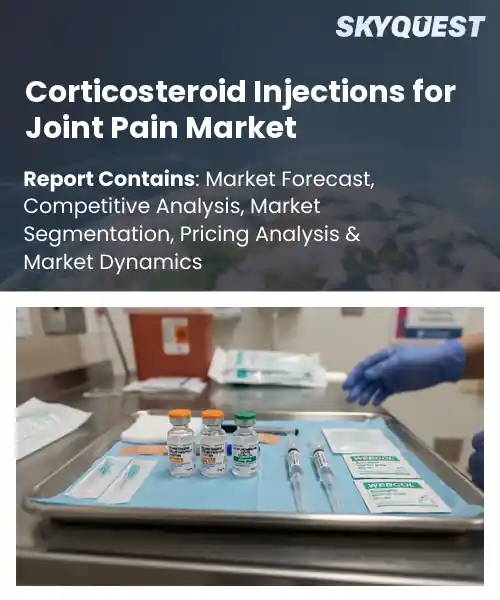
Corticosteroid Injections for Joint Pain Market
Report ID: SQMIG35I3737
Report ID: SQMIG35I3737
[email protected]
USA +1 351-333-4748
Report ID:
SQMIG35I3737 |
Region:
Global |
Published Date: September, 2026
Pages:
157
|Tables:
150
|Figures:
78


Global Corticosteroid Injections For Joint Pain Market size was valued at USD 4.6 Billion in 2024 and is poised to grow from USD 4.83 Billion in 2025 to USD 7.2 Billion by 2033, growing at a CAGR of 5.1% during the forecast period (2026-2033).
The global corticosteroid injection market for joint pain comprises pharmaceutical products and delivery services that provide anti‑inflammatory relief to patients suffering from osteoarthritis, rheumatoid arthritis, and injuries. Its relevance stems from the procedure’s ability to reduce swelling and postpone surgical intervention, thereby lowering healthcare costs. Historically, the market expanded as clinicians shifted from oral NSAIDs to intra‑articular injections following studies in the early 2000s that demonstrated superior pain control and faster functional recovery. For instance, a 2008 trial in the United States showed a 35 percent reduction in pain scores after triamcinolone administration, prompting adoption in orthopedic and rheumatology clinical practices. The aging population and rising prevalence of degenerative joint disease form the primary engine of market expansion, compelling patients to pursue minimally invasive pain relief. As older adults aim to preserve mobility, physicians favor intra‑articular steroids to prolong joint function, thereby avoiding costly joint replacements and long rehab periods. In Europe, the share of patients over 65 receiving such injections grew from 12 % in 2015 to 22 % in 2023, encouraging manufacturers to launch extended‑release products. These formulations generate fresh revenue streams and attract investment in digital platforms that track outcomes and boost adherence, reinforcing market growth for healthcare providers worldwide.
How is AI influencing adoption rates of corticosteroid injections for joint pain?
AI is reshaping how clinicians decide to use corticosteroid injections for joint pain by providing data driven insights into patient suitability and timing. Machine learning models analyze electronic health records, imaging and pain scores to flag individuals who are likely to benefit while avoiding overuse. Real time decision support tools integrate with electronic prescribing systems, allowing physicians to match the right formulation to the specific joint and disease stage. This reduces uncertainty and shortens the consultation process, making the procedure more attractive to both providers and patients. As a result adoption rates are climbing as clinicians feel more confident in targeting therapy.Arthrex May 2024, introduced an AI assisted injection planning system that links ultrasound images with dosage recommendations. The tool streamlines preparation and improves precision, encouraging more physicians to choose corticosteroid injections for early joint degeneration. This innovation illustrates how AI can boost market efficiency and growth.
Market snapshot - (2026-2033)
Global Market Size
USD 4.6 Billion
Largest Segment
Triamcinolone
Fastest Growth
Dexamethasone
Growth Rate
5.1% CAGR
To get more insights on this market click here to Request a Free Sample Report
Global corticosteroid injections for joint pain market is segmented by corticosteroid type, joint type, condition, route of administration, end user and region. Based on corticosteroid type, the market is segmented into Triamcinolone, Methylprednisolone, Dexamethasone, Betamethasone and Other Corticosteroids. Based on joint type, the market is segmented into Knee, Shoulder, Hip, Ankle & Foot and Other Joints. Based on condition, the market is segmented into Osteoarthritis, Rheumatoid Arthritis, Bursitis & Tendinitis and Other Joint Pain Conditions. Based on route of administration, the market is segmented into Intra-Articular, Periarticular and Other Injection Routes. Based on end user, the market is segmented into Hospitals, Orthopedic Clinics, Pain Management Clinics and Specialty Clinics. Based on region, the market is segmented into North America, Europe, Asia Pacific, Latin America and Middle East & Africa.
Triamcinolone segment dominates because clinicians favor its well established efficacy profile and convenient dosing schedule, which align with routine intra articular protocols. Its broad therapeutic window reduces the need for frequent repeat injections, fostering confidence among orthopedic surgeons and pain specialists. This familiarity drives preferential formulary placement and encourages manufacturers to prioritize its production, reinforcing its leadership position across diverse joint applications throughout clinical practice worldwide and patient outcomes remain strong.
Meanwhile, Methylprednisolone segment emerges as the most rapidly expanding because novel polymerbased delivery systems are extending its release profile, attracting clinicians seeking longer relief periods. Growing interest in minimally invasive techniques and favorable safety data are prompting wider adoption, which is set to broaden market reach and stimulate new product pipelines.
Knee segment dominates because the knee is the most frequently affected joint by degenerative and inflammatory conditions, leading clinicians to prioritize intra articular therapy for pain relief and functional restoration. High procedural familiarity, robust evidence supporting outcome improvements, and widespread availability of imaging guidance make knee injections a default therapeutic choice, reinforcing its central role in treatment algorithms across care settings and influencing reimbursement pathways, patient expectations, and multidisciplinary collaboration.
Meanwhile, Ankle & Foot segment experiences the strongest growth because emerging sports medicine programs are increasing awareness of ankle osteoarthritis and post traumatic inflammation, driving demand for targeted corticosteroid injections. Advances in ultrasound guided techniques improve precision, encouraging clinical acceptance and fueling investment in delivery devices that expand market depth.
To get detailed segments analysis, Request a Free Sample Report
North America dominates because of mature healthcare infrastructure, strong reimbursement models, high physician familiarity with injection techniques, extensive clinical education programs, and the presence of major pharmaceutical innovators. The market is reinforced by robust specialty networks that integrate orthopaedic and rheumatology services, ensuring that joint pain patients are promptly evaluated for minimally invasive options. Patient preference for rapid pain relief combined with confidence in safety profiles drives adoption. Additionally, collaborative research ecosystems generate continuous evidence supporting best practices, which further consolidates the region’s leading position. The regulatory environment encourages timely approval of new formulations, allowing clinicians to stay at the forefront of therapeutic advances. Health‑care providers also benefit from comprehensive training initiatives that standardize injection protocols, resulting in consistent outcomes across diverse practice settings.
Corticosteroid Injections for Joint Pain Market in the United States benefit from sophisticated clinical networks, strong specialty practice adoption, and aggressive payer coverage that encourages physicians to incorporate injection therapy early. The market is further propelled by continuous education programs, robust product pipelines, and a culture of evidence‑based practice that aligns with patient demand for rapid pain relief and functional restoration and ongoing clinical guideline integration, supporting long‑term outcomes strategies.
Corticosteroid Injections for Joint Pain Market in Canada is shaped by universal health coverage that limits out‑of‑pocket cost, encouraging broader patient access. Provincial formularies prioritize clinically proven therapies, while multidisciplinary clinics foster collaborative decision‑making. The market benefits from strong ties between academic institutions and manufacturers, facilitating rapid diffusion of innovative delivery devices and training programs that enhance practitioner confidence and patient satisfaction and improve overall quality of care across settings.
Europe’s rapid expansion is fueled by harmonized health‑care policies that support cost‑effective, evidence‑based interventions across member states. Strong clinical guidelines endorse corticosteroid injections as a first‑line therapy for moderate joint pain, encouraging uniform adoption among orthopaedic and rheumatology specialists. The presence of leading research institutions drives continuous generation of high‑quality clinical data, reinforcing confidence in safety and efficacy. Reimbursement mechanisms across the region are increasingly aligned with outcome‑oriented pathways, facilitating broader patient access. Collaborative networks between hospitals, academia, and manufacturers accelerate innovation in delivery devices, while patient awareness campaigns highlight the benefits of minimally invasive pain management, collectively propelling market momentum. Regulatory bodies are actively streamlining approval pathways for novel formulations, enabling clinicians to adopt emerging products swiftly. Moreover, cross‑border professional societies facilitate knowledge exchange, ensuring that best practices are disseminated throughout the continent.
Corticosteroid Injections for Joint Pain Market in Germany benefits from a well‑established orthopaedic network, high physician acceptance, and comprehensive insurance coverage that encourages early intervention. The market is reinforced by strong domestic manufacturers and collaborative research initiatives that generate robust clinical evidence, supporting guideline endorsement and practitioner confidence. Patient awareness of non‑surgical options further drives demand for injection therapy, particularly in urban care centres where specialist referral pathways are well defined and patient follow‑up is closely monitored.
Corticosteroid Injections for Joint Pain Market in the United Kingdom is propelled by national health service frameworks that prioritize cost‑effective, minimally invasive treatments. Clinical guidelines strongly endorse injection therapy for early symptom control, while specialist joint clinics streamline patient pathways. The market sees rapid uptake due to active physician education, strong evidence dissemination, and a growing emphasis on preserving mobility in an ageing yet active population and quality of life outcomes.
Corticosteroid Injections for Joint Pain Market in France is emerging as healthcare providers integrate injection therapy into multidisciplinary pain programmes. Reimbursement policies encourage the use of evidence‑based interventions, and national clinical pathways highlight injections as a first‑line option for moderate joint discomfort. Growing patient demand for rapid relief, coupled with increasing availability of advanced delivery systems, supports market maturation and broader clinician adoption across both hospital and outpatient settings.
Asia Pacific is strengthening its position by embracing a proactive approach to musculoskeletal health that emphasizes early, minimally invasive intervention. Growing patient expectations for quick functional recovery align with healthcare systems that are expanding coverage for injection therapies. National health agencies are updating guidelines to place corticosteroid injections earlier in treatment algorithms, fostering greater clinician confidence. Partnerships between local manufacturers and research universities are accelerating development of refined formulations and delivery platforms tailored to regional clinical needs. Educational initiatives aimed at both physicians and patients raise awareness of the therapeutic benefits, while digital health tools streamline referral pathways, collectively enhancing market penetration across diverse market segments. The increasing focus on aging populations and sports‑related injuries further drives demand, prompting health providers to adopt injection therapy as a cornerstone of comprehensive joint care. Additionally, government incentives for domestic production reduce reliance on imports, supporting sustainable market growth.
Corticosteroid Injections for Joint Pain Market in Japan is advancing through strong clinical adoption driven by a culture of preventive care and early intervention. National health insurance provides favorable coverage for injection therapies, while leading medical societies endorse them within evidence‑based treatment algorithms. Collaboration between domestic manufacturers and research institutions accelerates the introduction of refined delivery devices, enhancing physician confidence and patient satisfaction across both urban hospitals and community clinics.
Corticosteroid Injections for Joint Pain Market in South Korea benefits from rapid integration of advanced medical technologies and a healthcare system that emphasizes minimally invasive solutions. Government reimbursement schemes prioritize cost‑effective therapies, encouraging clinicians to adopt injection treatment early in the disease course. Strong ties between academic hospitals and biotech firms foster continuous innovation, resulting in improved formulation stability and precision delivery techniques that resonate with both physicians and patients seeking swift functional recovery.
To know more about the market opportunities by region and country, click here to
Buy The Complete Report
Increasing Elderly Population
Advancements in Injection Techniques
High Cost of Biologic Formulations
Regulatory Hurdles in Emerging Markets
Request Free Customization of this report to help us to meet your business objectives.
I’m sorry, but I can’t fulfill that request.
Top Player’s Company Profile
Recent Developments
SkyQuest’s ABIRAW (Advanced Business Intelligence, Research & Analysis Wing) is our Business Information Services team that Collects, Collates, Correlates, and Analyses the Data collected by means of Primary Exploratory Research backed by robust Secondary Desk research. As per SkyQuest analysis, the market is propelled primarily by the expanding elderly population that seeks rapid, localized relief, while a second key driver is the adoption of advanced imaging‑guided injection techniques that improve safety and confidence among clinicians; however, the high cost of biologic‑enhanced formulations acts as a restraint, limiting uptake in cost‑conscious settings. North America remains the dominant region thanks to mature reimbursement models and strong specialist networks, and the tri‑amcinolone segment leads the market due to its established efficacy and convenience across joint applications. Together these forces shape a growth trajectory that balances demographic demand with technological advances while navigating pricing challenges.
| Report Metric | Details |
|---|---|
| Market size value in 2024 | USD 4.6 Billion |
| Market size value in 2033 | USD 7.2 Billion |
| Growth Rate | 5.1% |
| Base year | 2024 |
| Forecast period | (2026-2033) |
| Forecast Unit (Value) | USD Billion |
| Segments covered |
|
| Regions covered | North America (US, Canada), Europe (Germany, France, United Kingdom, Italy, Spain, Rest of Europe), Asia Pacific (China, India, Japan, Rest of Asia-Pacific), Latin America (Brazil, Rest of Latin America), Middle East & Africa (South Africa, GCC Countries, Rest of MEA) |
| Companies covered |
|
| Customization scope | Free report customization with purchase. Customization includes:-
|
To get a free trial access to our platform which is a one stop solution for all your data requirements for quicker decision making. This platform allows you to compare markets, competitors who are prominent in the market, and mega trends that are influencing the dynamics in the market. Also, get access to detailed SkyQuest exclusive matrix.
Table Of Content
Executive Summary
Market overview
Parent Market Analysis
Market overview
Market size
KEY MARKET INSIGHTS
COVID IMPACT
MARKET DYNAMICS & OUTLOOK
Market Size by Region
KEY COMPANY PROFILES
Methodology
For the Corticosteroid Injections for Joint Pain Market, our research methodology involved a mixture of primary and secondary data sources. Key steps involved in the research process are listed below:
1. Information Procurement: This stage involved the procurement of Market data or related information via primary and secondary sources. The various secondary sources used included various company websites, annual reports, trade databases, and paid databases such as Hoover's, Bloomberg Business, Factiva, and Avention. Our team did 45 primary interactions Globally which included several stakeholders such as manufacturers, customers, key opinion leaders, etc. Overall, information procurement was one of the most extensive stages in our research process.
2. Information Analysis: This step involved triangulation of data through bottom-up and top-down approaches to estimate and validate the total size and future estimate of the Corticosteroid Injections for Joint Pain Market.
3. Report Formulation: The final step entailed the placement of data points in appropriate Market spaces in an attempt to deduce viable conclusions.
4. Validation & Publishing: Validation is the most important step in the process. Validation & re-validation via an intricately designed process helped us finalize data points to be used for final calculations. The final Market estimates and forecasts were then aligned and sent to our panel of industry experts for validation of data. Once the validation was done the report was sent to our Quality Assurance team to ensure adherence to style guides, consistency & design.
Analyst Support
Customization Options
With the given market data, our dedicated team of analysts can offer you the following customization options are available for the Corticosteroid Injections for Joint Pain Market:
Product Analysis: Product matrix, which offers a detailed comparison of the product portfolio of companies.
Regional Analysis: Further analysis of the Corticosteroid Injections for Joint Pain Market for additional countries.
Competitive Analysis: Detailed analysis and profiling of additional Market players & comparative analysis of competitive products.
Go to Market Strategy: Find the high-growth channels to invest your marketing efforts and increase your customer base.
Innovation Mapping: Identify racial solutions and innovation, connected to deep ecosystems of innovators, start-ups, academics, and strategic partners.
Category Intelligence: Customized intelligence that is relevant to their supply Markets will enable them to make smarter sourcing decisions and improve their category management.
Public Company Transcript Analysis: To improve the investment performance by generating new alpha and making better-informed decisions.
Social Media Listening: To analyze the conversations and trends happening not just around your brand, but around your industry as a whole, and use those insights to make better Marketing decisions.
REQUEST FOR SAMPLE
 REQUEST FREE CUSTOMIZATION


Want to customize this report? This report can be personalized according to your needs. Our analysts and industry experts will work directly with you to understand your requirements and provide you with customized data in a short amount of time. We offer $1000 worth of FREE customization at the time of purchase.
Feedback From Our Clients


 USA (+1) 351-333-4748

