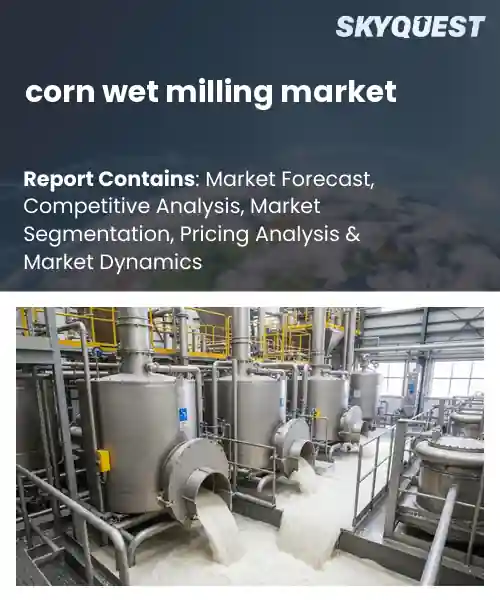
corn wet milling market
Report ID: SQMIG30I3013
Report ID: SQMIG30I3013
[email protected]
USA +1 351-333-4748
Report ID:
SQMIG30I3013 |
Region:
Global |
Published Date: July, 2026
Pages:
157
|Tables:
150
|Figures:
78


Global Corn Wet Milling Market size was valued at USD 92.5 Billion in 2024 and is poised to grow from USD 97.31 Billion in 2025 to USD 145.98 Billion by 2033, growing at a CAGR of 5.2% during the forecast period (2026-2033).
The global corn wet‑milling market includes plant operations that split corn kernels into starch, gluten, oil, and fiber, mostly via steeping, then grinding, and then the centrifugation stage. Its importance comes from how adaptable those outputs are, like they end up feeding food and drink, plus biofuel, and even pharmaceutical use.
Now, there’s also this upswing in demand for renewable chemicals, which is another major driver behind the corn wet milling market growth, because some producers are turning corn starch into bioplastics, ethanol, and biodegradable detergents. This change can give corn processors better margins. For instance, a U.S. site that rolled in a polylactic acid line at about 30‑million‑tonne‑per‑year said it saw a 12% profit jump within two years. At the same time, stricter carbon regulation rules in Europe push manufacturers to swap petroleum‑derived polymers for corn-based substitutes. That makes a straight incentive chain, regulation then investment then expansion. So capital flows into wet‑milling upgrades get faster, and then opportunities open up for joint‑venture financing and technology licensing in places like Asia and Africa, not only here and there but also across the wider globe.
AI-driven automation is altering corn wet milling market outlook by connecting sensors, machine learning models, plus robotic controls across the full production line. Real time readings from grinding, steeping, and the separation step feed algorithms that forecast ideal temperature, moisture and residence time, cutting energy waste and also tightening product consistency. Plant teams, they increasingly lean on predictive alerts instead of doing manual readjustments, this can trim downtime, and it may reduce water usage as well. On top of that, the setup supports stronger inventory governance, so feedstock delivery tracks actual demand, and less extra stock sits around. As sustainability targets grow stricter, mills adopting these systems tend to build a competitive edge, while delivering starch and protein streams that are cleaner and more dependable.
Market snapshot - (2026-2033)
Global Market Size
USD 92.5 Billion
Largest Segment
Starch
Fastest Growth
Ethanol
Growth Rate
5.2% CAGR
To get more insights on this market click here to Request a Free Sample Report
The global corn wet milling market is segmented by product type, application, process type, source, distribution channel and region. Based on product type, the market is segmented into Starch, Sweeteners, Ethanol, Corn Gluten Meal, Corn Gluten Feed, Corn Oil and Others. Based on application, the market is segmented into Food & Beverages, Animal Feed, Biofuels, Pharmaceuticals, Paper & Packaging and Others. Based on process type, the market is segmented into Starch Processing, Sweetener Processing, Ethanol Production and Co-Product Processing. Based on source, the market is segmented into Conventional Corn and Non-GMO Corn. Based on distribution channel, the market is segmented into Direct Sales and Distributors & Traders. Based on region, the market is segmented into North America, Europe, Asia Pacific, Latin America and Middle East & Africa.
As per the corn wet milling market analysis, the Corn oil segment leads since it brings in the most revenue per ton and also rides on strong demand across food plus industrial uses. It stays scalable in practice because it works in multiple ways, as a cooking oil, a part of processed foods, and even as feedstock for biodiesel. Processors tend to pick corn oil extraction, not because it is only easy, but because the tech is already established, waste is kept low and it fits with sustainability initiatives. All that together keeps its top position firm in the wet milling arena.
However, the starch segment is showing the fastest growth push right now, mainly because demand for biodegradable packaging and clean-label components is going higher. Applications are expanding as more functional starch innovations show up, plus starches are getting more integrated into food recipes. These developments help the market keep growing, and they give processors a reason to diversify, so they can grab new consumer shifts in a more direct way.
According to the corn wet milling market forecast, the Food & beverages segment dominates here because it takes the biggest chunk of wet milled ingredients, and it keeps asking for dependable starches, sweeteners, and corn oil. Manufacturers want steady functional results, plus strong safety standards and reasonable cost control. So processors are investing in upgraded extrusion and purification technologies, even when margins get tight. On top of that, clean label expectations and non-GMO positioning also make this application central to keeping overall market activity moving.
Meanwhile, the pharmaceuticals segment is becoming a notable high-growth area because bio-based excipients and drug delivery carriers sourced from corn starch are getting more regulatory comfort. With more money flowing into biodegradable medical materials and with pharma solutions demand rising, expansion is speeding up. So it opens up additional revenue streams for wet milling facilities, which is why everyone keeps watching it.
To get detailed segments analysis, Request a Free Sample Report
As per the corn wet milling market regional forecast, North America’s leadership comes from overlap between plentiful corn harvests, very integrated processing setups, and a deep‑seated know-how in derivative technologies. The area also has mature logistics routes that link farms to mills, and then to the folks who actually use the ingredients, all smooth. Strong research organizations plus real industry teaming up keep nudging improvements in process yields and product development. Being close to big food, beverage, and bio‑fuel customers means companies can pivot fast when demand changes, and the capital markets being “open” helps pay for newer equipment and sustainability projects. All of this together builds a durable network that supports dominance in scale, standard, and tech progress.
United States corn wet milling market
The United States corn wet milling industry tends to lean on large corn acreage plus a supply chain that’s already well‑tested, delivering raw material with consistent quality. Better process engineering , plus a mindset of experimentation, helps produce higher value co‑products that can serve many needs, from food and pharma to renewable sectors too. Joint research initiatives and strong regional industry clusters make the whole thing more competitive, so the United States stays ahead in process efficiency and in diversifying what it can produce.
Canada corn wet milling market
The Canadian corn wet milling sector sits on a strategic geographic advantage, it connects Midwestern grain supply with export pathways going toward the Atlantic and Pacific. A noticeable emphasis on eco‑responsible operations and newer renewable product lines matches national sustainability priorities. Partnerships between processors and universities also matter here, because they speed up tech transfer, so yield improvements and specialty ingredient development happen quicker. In practice, that blend of transport benefits and innovation focus makes Canada an important player inside the North American corn wet milling scene.
Europe is expanding its corn wet milling market share quickly because consumers want ingredients that feel healthier, plus sustainably sourced. At the same time, the regulatory climate pushes bio‑based solutions, so companies have an incentive to shift. The food and beverage segment wants flexible corn derivatives for functional use, while the renewable fuel agenda boosts interest in cleaner, higher‑purity starch and protein streams. Industry and academia working together helps speed up process upgrades and new product launches, which strengthens Europe’s standing around quality and safety. Also, certain programs aimed at using more local grain, rather than leaning on imported feedstock, help stabilize the supply chain and sharpen the region’s value‑added processing edge.
Germany corn wet milling market
The German corn wet milling market has a strong manufacturing base and an engineering culture that keeps process upgrades moving. There’s an extra focus on precision and consistent quality, which supports production of high‑purity starches and proteins, especially for specialized food and pharmaceutical use. Cooperation with downstream industries, plus sustainability commitments, encourages the development of renewable co‑products, which keeps Germany positioned as a leading hub across Europe.
United Kingdom corn wet milling market
The United Kingdom corn wet milling market is shaped by quick uptake of advanced processing technologies that allow flexible product mixes. Clean‑label expectations and functional food trends nudge demand toward protein isolates and refined starches, while research collaborations help accelerate innovation. A clear strategy for low‑carbon manufacturing, along with alignment with renewable energy rules, keeps pushing expansion, so the United Kingdom becomes one of the major growth drivers across Europe.
France corn wet milling market
The French corn wet milling market penetration is rising due to a mix of culinary heritage and the rising curiosity around plant‑based ingredients. Innovative processors are looking at specialty starches and protein fractions to capture smaller, higher‑value niches in gourmet markets and health‑focused segments. Support for agrifood research from the government, combined with a commitment to sustainable operations, makes corn wet milling look more attractive as a dependable source of versatile and more environmentally responsible ingredients. This gives France a promising position within the wider European market.
Asia Pacific is slowly strengthening its stance by leaning into growing appetite for functional foods, bioplastics, and renewable chemical streams across fast moving economies. A lot of focus goes on putting money into upgraded milling plants, plus using newer bioprocessing approaches, and it helps with efficiency and steadier product quality, which matches the regional sustainability mind set. Also strategic alliances— between local processors and overseas technology providers, help speed up knowledge exchange and make it easier to tap into higher‑value co products. On top of that, government moves that push agricultural value addition and cut back dependency on imports, keep nudging domestic corn utilization, so Asia Pacific can play an increasingly relevant role in the wider global corn wet milling ecosystem.
Japan corn wet milling market
In Japan, the corn wet milling market leans toward high purity starches and protein isolates that are made for more sophisticated food producers as well as advanced material builders. There is an emphasis on precision handling and strict quality rules, that support niche ingredients for health oriented, and also environmentally aware use cases. There are also collaborative projects with research groups, which move innovation forward in enzyme-related methods and process intensification, so the sector keeps a strong reputation for technical sharpness.
South Korea corn wet milling market
For South Korea, the corn wet milling market stresses agile production, so it can react quickly to changing consumer demand for functional options and plant based products. Smart manufacturing and process tuning are integrated, this boosts yield, while lowering waste, and it fits the country's sustainability directions. Partnerships with biotech companies add momentum too, helping develop specialty co products, and that expands the footprint into newer applications such as biodegradable polymers, and high value nutraceutical ingredients.
To know more about the market opportunities by region and country, click here to
Buy The Complete Report
Rising Demand for Food Ingredients
Advancements in Process Efficiency
Volatile Raw Material Prices
Stringent Environmental Regulations
Request Free Customization of this report to help us to meet your business objectives.
The global corn wet milling market competitive landscape is basically carved out by tough rivalry between long standing processors and newer technology firms, where market share moves come from strategic mergers and acquisitions, joint work arrangements, and a steady stream of process improvements. Like, recent activity includes a seed funding arrangement spearheaded by Innova Memphis Inc. that helps a startup push ahead on proprietary wet milling enzymes , plus early stage capital boosts that speed up how fast tech gets adopted across the whole sector.
Top Player’s Company Profile
Recent Developments in the Corn Wet Milling Market
SkyQuest’s ABIRAW (Advanced Business Intelligence, Research & Analysis Wing) is our Business Information Services team that Collects, Collates, Correlates, and Analyses the Data collected by means of Primary Exploratory Research backed by robust Secondary Desk research.
As per SkyQuest analysis, the global corn wet‑milling market is pushed forward mainly by stronger demand for corn derived food ingredients, this in turn keeps expanding starch, sweetener, and oil production. Another big catalyst is the quick uptake of advanced process efficiency tools including high gravity centrifugation, enzyme enhanced extraction and AI driven automation, these boost yields while lowering energy and water consumption. Still, the market’s top revenue driver is corn oil, because it’s known for high earnings per ton and a wide range of uses in food , industrial settings and biodiesel applications. North America keeps leading the scene due to plentiful corn inputs, well connected infrastructure, and that long standing know-how. But there’s a noticeable restraint from volatile corn commodity prices, causing cost uncertainty that can slow down investment and limit capacity expansion.
| Report Metric | Details |
|---|---|
| Market size value in 2024 | USD 92.5 Billion |
| Market size value in 2033 | USD 145.98 Billion |
| Growth Rate | 5.2% |
| Base year | 2024 |
| Forecast period | (2026-2033) |
| Forecast Unit (Value) | USD Billion |
| Segments covered |
|
| Regions covered | North America (US, Canada), Europe (Germany, France, United Kingdom, Italy, Spain, Rest of Europe), Asia Pacific (China, India, Japan, Rest of Asia-Pacific), Latin America (Brazil, Rest of Latin America), Middle East & Africa (South Africa, GCC Countries, Rest of MEA) |
| Companies covered |
|
| Customization scope | Free report customization with purchase. Customization includes:-
|
To get a free trial access to our platform which is a one stop solution for all your data requirements for quicker decision making. This platform allows you to compare markets, competitors who are prominent in the market, and mega trends that are influencing the dynamics in the market. Also, get access to detailed SkyQuest exclusive matrix.
Table Of Content
Executive Summary
Market overview
Parent Market Analysis
Market overview
Market size
KEY MARKET INSIGHTS
COVID IMPACT
MARKET DYNAMICS & OUTLOOK
Market Size by Region
KEY COMPANY PROFILES
Methodology
For the corn wet milling market, our research methodology involved a mixture of primary and secondary data sources. Key steps involved in the research process are listed below:
1. Information Procurement: This stage involved the procurement of Market data or related information via primary and secondary sources. The various secondary sources used included various company websites, annual reports, trade databases, and paid databases such as Hoover's, Bloomberg Business, Factiva, and Avention. Our team did 45 primary interactions Globally which included several stakeholders such as manufacturers, customers, key opinion leaders, etc. Overall, information procurement was one of the most extensive stages in our research process.
2. Information Analysis: This step involved triangulation of data through bottom-up and top-down approaches to estimate and validate the total size and future estimate of the corn wet milling market.
3. Report Formulation: The final step entailed the placement of data points in appropriate Market spaces in an attempt to deduce viable conclusions.
4. Validation & Publishing: Validation is the most important step in the process. Validation & re-validation via an intricately designed process helped us finalize data points to be used for final calculations. The final Market estimates and forecasts were then aligned and sent to our panel of industry experts for validation of data. Once the validation was done the report was sent to our Quality Assurance team to ensure adherence to style guides, consistency & design.
Analyst Support
Customization Options
With the given market data, our dedicated team of analysts can offer you the following customization options are available for the corn wet milling market:
Product Analysis: Product matrix, which offers a detailed comparison of the product portfolio of companies.
Regional Analysis: Further analysis of the corn wet milling market for additional countries.
Competitive Analysis: Detailed analysis and profiling of additional Market players & comparative analysis of competitive products.
Go to Market Strategy: Find the high-growth channels to invest your marketing efforts and increase your customer base.
Innovation Mapping: Identify racial solutions and innovation, connected to deep ecosystems of innovators, start-ups, academics, and strategic partners.
Category Intelligence: Customized intelligence that is relevant to their supply Markets will enable them to make smarter sourcing decisions and improve their category management.
Public Company Transcript Analysis: To improve the investment performance by generating new alpha and making better-informed decisions.
Social Media Listening: To analyze the conversations and trends happening not just around your brand, but around your industry as a whole, and use those insights to make better Marketing decisions.
REQUEST FOR SAMPLE
 REQUEST FREE CUSTOMIZATION
Global Corn Wet Milling Market size was valued at USD 92.5 Billion in 2024 and is poised to grow from USD 97.31 Billion in 2025 to USD 145.98 Billion by 2033, growing at a CAGR of 5.2% during the forecast period (2026-2033).
The competitive landscape of the global corn wet milling market is shaped by intense rivalry among established processors and emerging technology firms, with market share gains driven by strategic M&A, collaborative partnerships, and advanced process innovations. Recent examples include a seed‑funding partnership led by Innova Memphis Inc. that fuels a startup’s development of proprietary wet‑milling enzymes, and early‑stage capital surges that accelerate technology adoption across the sector. 'Archer Daniels Midland Company (ADM)', 'Ingredion Incorporated', 'Cargill, Incorporated', 'Tate & Lyle plc', 'AGRANA Beteiligungs-AG', 'Roquette Frères', 'Tereos SCA', 'Grain Processing Corporation', 'Global Bio-Chem Technology Group Company Limited', 'COFCO Biochemical (Anhui) Co., Ltd.', 'Gulshan Polyols Limited', 'Zhucheng Xingmao Corn Developing Co., Ltd.', 'Shandong Fuyang Biotechnology Co., Ltd.', 'Luzhou Bio-Chem Technology Co., Ltd.', 'China Agri-Industries Holdings Limited', 'Changchun Dacheng Group Co., Ltd.', 'Daesang Corporation', 'Samyang Corporation', 'Showa Sangyo Co., Ltd.', 'HL Agro Products Pvt. Ltd.'
Consumers worldwide are shifting toward healthier diets that rely on corn‑derived products such as corn syrup, starch, and protein isolates. This shift fuels continuous expansion of the wet‑milling sector as manufacturers scale operations to meet the need for functional ingredients in beverages, snacks, and processed foods. The focus on clean‑label formulations further encourages processors to adopt wet‑milling techniques that preserve nutritional quality, thereby reinforcing the ever‑expanding market growth through sustained demand for diversified corn‑based commodities across food and beverage global supply chains.
Plant‑Based Protein Surge: Consumers are increasingly seeking plant‑based alternatives for health and sustainability reasons, prompting food manufacturers to expand corn‑derived protein ingredients such as corn gluten meal and corn protein concentrates. This shift is driving R&D investments in functionalization, taste enhancement, and clean‑label formulations, while encouraging partnerships between corn wet‑milling processors and protein‑focused brands. The resulting demand diversification reduces reliance on traditional starch applications and opens new revenue streams across snack, dairy‑free, and meat‑analog markets, enhancing supply chain resilience and fostering sustainable growth.
Why does North America Dominate the Global corn wet milling market? |@12


Want to customize this report? This report can be personalized according to your needs. Our analysts and industry experts will work directly with you to understand your requirements and provide you with customized data in a short amount of time. We offer $1000 worth of FREE customization at the time of purchase.
Feedback From Our Clients


 USA (+1) 351-333-4748

