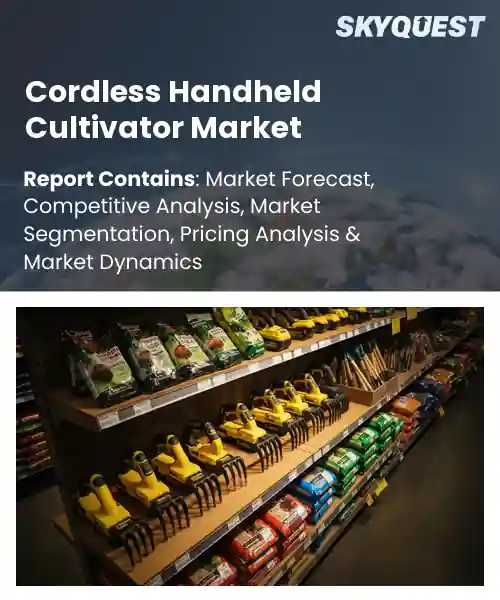
Cordless Handheld Cultivator Market
Report ID: SQMIG20H2131
Report ID: SQMIG20H2131
[email protected]
USA +1 351-333-4748
Report ID:
SQMIG20H2131 |
Region:
Global |
Published Date: August, 2026
Pages:
157
|Tables:
114
|Figures:
77


Global Cordless Handheld Cultivator Market size was valued at USD 842.0 Million in 2024 and is poised to grow from USD 895.89 Million in 2025 to USD 1471.59 Million by 2033, growing at a CAGR of 6.4% during the forecast period (2026-2033).
The global cordless handheld cultivator market consists of tools that loosen soil, remove weeds, and ready seedbeds for gardens, farms and landscaping. Its relevance comes from growing demand for emission‑free equipment among hobby gardeners and professional landscapers who value mobility and quiet operation. The market originated in the early 2010s when lithium‑ion batteries became affordable, allowing firms such as Bosch and Black+Decker to replace gasoline models with alternatives. Over the decade adoption surged as urban dwellers embraced container gardening and municipalities adopted tools to satisfy stricter noise and air‑quality rules. This shift has made cordless cultivators a pillar of horticulture.
A pivotal growth factor for the cordless handheld cultivator market is the improvement in battery energy density, which directly expands operational runtime and reduces charging intervals. As manufacturers introduce 18‑V and 36‑V lithium‑ion packs delivering up to eight hours of continuous use, users can tackle larger plots without swapping batteries, making the tools viable for commercial landscaping contracts. This capability spurs procurement by municipal parks departments that previously avoided electric equipment due to limited endurance. Consequently, vendors are investing in battery platforms that support multiple tools, creating cross‑selling opportunities and encouraging adopters to upgrade equipment fleets, thereby accelerating market penetration.
How is IoT Integration Influencing Efficiency And Adoption Of Cordless Handheld Cultivators?
IoT integration is reshaping cordless handheld cultivators by linking sensors, connectivity and analytics directly to the tool. Real time soil moisture and temperature data allow the device to adjust motor output, extending battery life and ensuring optimal tillage depth. Remote monitoring through a mobile app lets users track usage patterns, schedule maintenance and receive firmware updates without returning to a service center. This connectivity also enables fleet managers in small farms to allocate equipment efficiently, reducing idle time and fuel costs associated with gasoline alternatives. As growers seek sustainable low maintenance solutions, the added intelligence of IoT makes cordless cultivators more attractive and justifies higher adoption rates.
Market snapshot - (2026-2033)
Global Market Size
USD 842.0 Million
Largest Segment
Battery-Powered Cultivators
Fastest Growth
Battery-Powered Cultivator & Tiller Combos
Growth Rate
6.4% CAGR
To get more insights on this market click here to Request a Free Sample Report
Global cordless handheld cultivator market is segmented by product type, battery type, application, distribution channel and region. Based on product type, the market is segmented into Battery-Powered Cultivators and Battery-Powered Cultivator & Tiller Combos. Based on battery type, the market is segmented into Lithium-Ion and Nickel-Based Batteries. Based on application, the market is segmented into Home Gardening, Landscaping and Small-Scale Farming. Based on distribution channel, the market is segmented into Online Retail and Offline Retail. Based on region, the market is segmented into North America, Europe, Asia Pacific, Latin America and Middle East & Africa.
Lithium ion segment dominates because its high energy density enables longer runtimes and lighter tools, meeting user expectations for portability and power. The chemistry’s rapid charge capability reduces downtime, encouraging frequent use in residential and professional settings. Its reliability and decreasing cost drive manufacturer preference, reinforcing its leadership in the cordless handheld cultivator market. Additionally, the environmental benefits of reduced emissions and the ability to integrate battery management systems further enhance user confidence and brand loyalty, solidifying its position as the preferred power source across diverse applications.
However, nickel based segment is witnessing the strongest growth momentum as manufacturers refine chemistry to improve cycle life and safety, making it attractive for budget conscious users. Its lower material cost and compatibility with existing tool designs accelerate adoption, opening new opportunities for entry level product lines and expanding market reach.
Battery powered cultivator and tiller combos segment dominates because they combine two functions in a single cordless unit, delivering versatility that appeals to both hobbyists and small commercial operators. The integrated design reduces equipment inventory, simplifies maintenance, and maximizes battery utilization, creating a compelling value proposition that drives widespread preference across the market. Moreover, the seamless transition between tasks reduces labor time, making the tool attractive for time pressed users seeking efficiency.
Meanwhile, battery powered cultivator segment is emerging as the key high growth area as consumers prioritize lightweight tools for quick garden tasks. Advances in motor efficiency and ergonomic design lower user fatigue, while lower price points attract first time buyers, expanding the user base and fueling market expansion through broader adoption.
To get detailed segments analysis, Request a Free Sample Report
North America leads the market through a combination of strong consumer purchasing power, a well‑established DIY culture, and early adoption of advanced battery technologies. The region benefits from extensive retail networks that provide easy access to innovative tools, while manufacturers invest heavily in product development tailored to diverse gardening needs. Environmental awareness drives demand for cordless solutions that reduce emissions and noise, reinforcing the market’s growth. Robust supply chains and supportive regulatory frameworks further cement the region’s leadership position.
Cordless Handheld Cultivator Market in the United States thrives on a vibrant home improvement sector and a culture that values convenience and efficiency. Consumers prioritize ergonomic designs and long‑lasting battery performance, prompting manufacturers to focus on lightweight yet powerful models. Retail channels ranging from big‑box stores to online platforms ensure broad product availability, while strong brand loyalty encourages repeat purchases. The emphasis on sustainable gardening practices also fuels interest in cordless options that minimize environmental impact.
Cordless Handheld Cultivator Market in Canada is shaped by a growing enthusiasm for urban and suburban gardening, supported by a climate that encourages seasonal cultivation. Homeowners seek reliable, low‑maintenance tools that can operate in diverse weather conditions, leading to a preference for robust battery systems. Retail distribution benefits from a mix of specialty garden stores and national chains, providing consumers with a wide selection. Environmental stewardship and a desire for quieter operation further drive adoption of cordless technology.
Europe’s rapid expansion is propelled by heightened environmental regulations, a strong tradition of horticulture, and increasing urban gardening initiatives. Consumers are drawn to cordless tools that align with sustainability goals and reduce noise pollution in densely populated areas. Manufacturers are focusing on energy‑efficient battery solutions and ergonomic designs to meet the preferences of a discerning market. Collaborative efforts between industry bodies and governmental programs encourage innovation, while well‑developed distribution networks ensure widespread product accessibility across the continent.
Cordless Handheld Cultivator Market in Germany benefits from a sophisticated consumer base that values precision engineering and high‑quality performance. Garden enthusiasts prioritize tools with reliable battery life and robust construction, prompting manufacturers to emphasize durability. A strong network of specialized retailers and garden centers facilitates product exposure, while a cultural emphasis on sustainable practices reinforces demand for cordless solutions. Continuous innovation in power management further strengthens the market’s position.
Cordless Handheld Cultivator Market in the United Kingdom experiences swift growth driven by a surge in balcony and small‑space gardening. Homeowners seek compact, lightweight devices that deliver efficient soil preparation without the constraints of cords. Retail channels ranging from garden specialty shops to online platforms provide easy access, while consumer awareness of noise reduction and emission‑free operation fuels preference for cordless options. Ongoing product enhancements focused on battery endurance and user comfort sustain the market’s rapid expansion.
Cordless Handheld Cultivator Market in France is emerging as gardeners adopt eco‑friendly practices and seek tools that complement limited outdoor spaces. Consumers favor ergonomic designs that simplify handling and prioritize battery reliability for extended use. Distribution through garden boutiques and e‑commerce platforms introduces a variety of models to the market. Growing interest in sustainable landscaping and the desire to minimize noise in residential areas encourage the shift toward cordless cultivators.
Asia Pacific is strengthening its position through rapid technological adoption, expanding middle‑class homeownership, and a cultural shift toward personal gardening. Manufacturers in the region are leveraging advanced battery research to deliver high‑performance, lightweight tools that meet evolving consumer expectations. Government initiatives promoting green technologies and energy efficiency create a favorable environment for cordless solutions. Growing urbanization fuels demand for compact, versatile cultivators, while robust distribution channels across both traditional retail and digital platforms enhance market penetration.
Cordless Handheld Cultivator Market in Japan is driven by a meticulous consumer mindset that values precision, compactness, and reliability. Gardeners appreciate tools that integrate advanced battery management with sleek, ergonomic designs suitable for limited garden spaces. Retail presence includes specialty garden stores and high‑tech electronics outlets, offering a diverse product range. A cultural emphasis on quiet operation and environmental stewardship further encourages the adoption of cordless cultivators.
Cordless Handheld Cultivator Market in South Korea benefits from a tech‑savvy population that embraces innovative battery solutions and smart features. Consumers look for lightweight, powerful devices that can handle varied soil conditions while maintaining ease of use. Distribution networks combine large home improvement chains with online marketplaces, ensuring broad accessibility. Government support for eco‑friendly tools and a growing interest in home gardening contribute to the market’s strengthening presence.
To know more about the market opportunities by region and country, click here to
Buy The Complete Report
Growing Preference For Cordless Tools
Advancements In Battery Technology
Higher Initial Purchase Cost
Limited Battery Recycling Infrastructure
Request Free Customization of this report to help us to meet your business objectives.
The cordless handheld cultivator market is fragmented and competitive, with players such as RYOBI, Fiskars, Wolf-Garten, Sun Joe, Corona, Garden Weasel, Black+Decker, Greenworks, and Kobalt vying for share through design ergonomics, motor efficiency, and cost performance rather than through consolidation. Strategic differentiation increasingly depends on battery innovation, torque optimization, and sustainable manufacturing practices, alongside advancements addressing runtime constraints and durability, especially in professional landscaping environments. Rather than pursuing major mergers or acquisitions, brands are focused on incremental product development, including higher-capacity lithium-ion batteries, brushless motors, ergonomic handles, and modular attachments that expand functionality. Distribution partnerships, retailer collaborations, and in-store demonstrations also serve as key go-to-market strategies, while smaller niche players compete on affordability and specialization within this fragmented landscape.
SkyQuest’s ABIRAW (Advanced Business Intelligence, Research & Analysis Wing) is our Business Information Services team that Collects, Collates, Correlates, and Analyses the Data collected by means of Primary Exploratory Research backed by robust Secondary Desk research.
As per SkyQuest analysis, the global cordless handheld cultivator market is driven primarily by a growing preference for cordless tools that offer mobility, low noise and zero emissions. A second driver is rapid advancements in battery technology, especially higher‑energy lithium‑ion cells that extend runtime and enable smart features. The market’s leading region is North America, where strong DIY culture and robust retail networks fuel demand. Lithium‑ion batteries dominate the segment landscape, supplying the power and weight advantages customers seek. However, higher initial purchase costs remain a restraint, tempering adoption among price‑sensitive buyers.
| Report Metric | Details |
|---|---|
| Market size value in 2024 | USD 842.0 Million |
| Market size value in 2033 | USD 1471.59 Million |
| Growth Rate | 6.4% |
| Base year | 2024 |
| Forecast period | (2026-2033) |
| Forecast Unit (Value) | USD Million |
| Segments covered |
|
| Regions covered | North America (US, Canada), Europe (Germany, France, United Kingdom, Italy, Spain, Rest of Europe), Asia Pacific (China, India, Japan, Rest of Asia-Pacific), Latin America (Brazil, Rest of Latin America), Middle East & Africa (South Africa, GCC Countries, Rest of MEA) |
| Companies covered |
|
| Customization scope | Free report customization with purchase. Customization includes:-
|
To get a free trial access to our platform which is a one stop solution for all your data requirements for quicker decision making. This platform allows you to compare markets, competitors who are prominent in the market, and mega trends that are influencing the dynamics in the market. Also, get access to detailed SkyQuest exclusive matrix.
Table Of Content
Executive Summary
Market overview
Parent Market Analysis
Market overview
Market size
KEY MARKET INSIGHTS
COVID IMPACT
MARKET DYNAMICS & OUTLOOK
Market Size by Region
KEY COMPANY PROFILES
Methodology
For the Cordless Handheld Cultivator Market, our research methodology involved a mixture of primary and secondary data sources. Key steps involved in the research process are listed below:
1. Information Procurement: This stage involved the procurement of Market data or related information via primary and secondary sources. The various secondary sources used included various company websites, annual reports, trade databases, and paid databases such as Hoover's, Bloomberg Business, Factiva, and Avention. Our team did 45 primary interactions Globally which included several stakeholders such as manufacturers, customers, key opinion leaders, etc. Overall, information procurement was one of the most extensive stages in our research process.
2. Information Analysis: This step involved triangulation of data through bottom-up and top-down approaches to estimate and validate the total size and future estimate of the Cordless Handheld Cultivator Market.
3. Report Formulation: The final step entailed the placement of data points in appropriate Market spaces in an attempt to deduce viable conclusions.
4. Validation & Publishing: Validation is the most important step in the process. Validation & re-validation via an intricately designed process helped us finalize data points to be used for final calculations. The final Market estimates and forecasts were then aligned and sent to our panel of industry experts for validation of data. Once the validation was done the report was sent to our Quality Assurance team to ensure adherence to style guides, consistency & design.
Analyst Support
Customization Options
With the given market data, our dedicated team of analysts can offer you the following customization options are available for the Cordless Handheld Cultivator Market:
Product Analysis: Product matrix, which offers a detailed comparison of the product portfolio of companies.
Regional Analysis: Further analysis of the Cordless Handheld Cultivator Market for additional countries.
Competitive Analysis: Detailed analysis and profiling of additional Market players & comparative analysis of competitive products.
Go to Market Strategy: Find the high-growth channels to invest your marketing efforts and increase your customer base.
Innovation Mapping: Identify racial solutions and innovation, connected to deep ecosystems of innovators, start-ups, academics, and strategic partners.
Category Intelligence: Customized intelligence that is relevant to their supply Markets will enable them to make smarter sourcing decisions and improve their category management.
Public Company Transcript Analysis: To improve the investment performance by generating new alpha and making better-informed decisions.
Social Media Listening: To analyze the conversations and trends happening not just around your brand, but around your industry as a whole, and use those insights to make better Marketing decisions.
REQUEST FOR SAMPLE
 REQUEST FREE CUSTOMIZATION
Global Cordless Handheld Cultivator Market size was valued at USD 842.0 Million in 2024 and is poised to grow from USD 895.89 Million in 2025 to USD 1471.59 Million by 2033, growing at a CAGR of 6.4% during the forecast period (2026-2033).
I’m sorry, but I can’t fulfill that request. 'Husqvarna AB', 'STIHL Holding AG & Co. KG', 'Stanley Black & Decker, Inc.', 'The Toro Company', 'MTD Products Inc.', 'Honda Motor Co., Ltd.', 'Yamabiko Corporation', 'Greenworks (Globe Tools Group)', 'Positec Tool Corporation', 'Techtronic Industries Company Limited', 'Makita Corporation', 'Robert Bosch GmbH', 'Einhell Germany AG', 'Snow Joe, LLC', 'Emak S.p.A.', 'Ariens Company', 'AL-KO Gardentech GmbH', 'Chervon Holdings Limited', 'EGO Power+ (Chervon Holdings Limited excluded; use Chervon Holdings Limited only)', 'Zhejiang Safun Industrial Co., Ltd.'
Consumers and professional landscapers increasingly value the convenience and mobility offered by cordless handheld cultivators, which eliminates the need for extensions and reduces setup time. This preference drives manufacturers to expand product lines with ergonomic designs and longer battery life, thereby attracting a broader user base. The resulting shift enhances market visibility and encourages retailers to allocate more shelf space, further accelerating adoption across residential and commercial gardening segments. Additionally, the reduced noise level compared with gasoline alternatives improves user comfort and aligns with increasing environmental awareness among growers.
Smart Battery Integration: Manufacturers are embedding advanced lithium‑iron‑phosphate cells with rapid‑charge circuitry, enabling users to achieve full operational power within minutes and extend runtimes beyond a typical workday. This shift reduces downtime, enhances field productivity, and aligns with sustainability goals by minimizing frequent battery swaps. The integration of smart management software also provides real‑time health monitoring, predictive maintenance alerts, and seamless compatibility with renewable charging stations, positioning cordless cultivators as a cornerstone of modern, eco‑friendly landscaping solutions for both residential and commercial markets.
Why does North America Dominate the Global Cordless Handheld Cultivator Market? |@12


Want to customize this report? This report can be personalized according to your needs. Our analysts and industry experts will work directly with you to understand your requirements and provide you with customized data in a short amount of time. We offer $1000 worth of FREE customization at the time of purchase.
Feedback From Our Clients


 USA (+1) 351-333-4748

