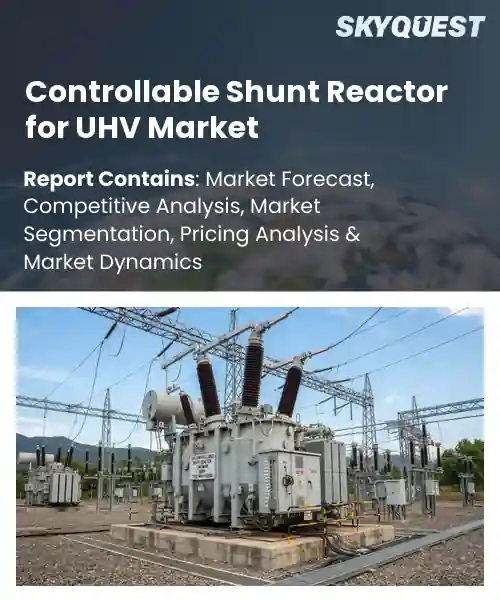
Controllable Shunt Reactor for UHV Market
Report ID: SQMIG20E2272
Report ID: SQMIG20E2272
[email protected]
USA +1 351-333-4748
Report ID:
SQMIG20E2272 |
Region:
Global |
Published Date: September, 2026
Pages:
157
|Tables:
118
|Figures:
77


Global Controllable Shunt Reactor For Uhv Market size was valued at USD 1.42 Billion in 2024 and is poised to grow from USD 1.52 Billion in 2025 to USD 2.68 Billion by 2033, growing at a CAGR of 7.3% during the forecast period (2026-2033).
The global controllable shunt reactor (CSR) market serves the ultra‑high‑voltage (UHV) transmission sector, where reactive power compensation is essential for maintaining voltage stability across expansive line spans. Its primary driver is the surge in UHV projects across China, India, and Brazil, where grid operators confront increasing line lengths and higher capacitance that amplify voltage rise during light‑load conditions. Historically, fixed reactors dominated the landscape, but the 2010s saw a shift toward digitally controlled, on‑load tap‑changing units that can adapt to real‑time load fluctuations. This evolution has reduced losses, enhanced system reliability, and attracted utilities seeking to meet power quality regulations. Building on this shift, the most compelling growth factor is renewable integration that creates variable reactive power needs which CSRs meet with rapid set‑point changes. When wind farms in Inner Mongolia increase output, voltage rise intensifies; a controllable reactor then absorbs excess charging, preventing over‑voltage and avoiding costly line re‑ratings. This cause‑and‑effect sparks demand for modular units that support remote monitoring and predictive maintenance, opening avenues for OEMs to sell service contracts. Consequently, market revenues are forecast to grow at about twelve percent CAGR through 2035, propelled by policy incentives, grid‑code compliance, and the economics of deferred upgrades globally today.
How is AI-driven automation improving controllable shunt reactors for the UHV market?
AI-driven automation is reshaping controllable shunt reactors for ultra‑high voltage networks by embedding predictive algorithms that continuously tune reactive power output. These systems monitor voltage fluctuations, temperature, and load patterns, then adjust reactor settings in real time to maintain stability. The market is moving from manual tap changers toward fully digital controllers, reducing maintenance cycles and extending equipment life. Operators report smoother voltage regulation during peak demand and renewable integration, while manufacturers highlight faster commissioning and remote diagnostics. This evolution aligns with the broader push for smarter grid infrastructure, making reactors more adaptable and cost‑effective.In June 2024, a leading manufacturer introduced an AI‑enhanced shunt reactor that automatically optimizes tap positions, cutting downtime and supporting the rapid expansion of UHV transmission corridors.
Market snapshot - (2026-2033)
Global Market Size
USD 1.42 Billion
Largest Segment
Three-Phase
Fastest Growth
Three-Phase
Growth Rate
7.3% CAGR
To get more insights on this market click here to Request a Free Sample Report
Global controllable shunt reactor for uhv market is segmented by reactor type, control type, application, end user and region. Based on reactor type, the market is segmented into Single-Phase and Three-Phase. Based on control type, the market is segmented into Mechanical Switching, Thyristor-Controlled and Power Electronics-Based. Based on application, the market is segmented into UHV Transmission Lines, Substations, Renewable Energy Grid Integration and Others. Based on end user, the market is segmented into Transmission System Operators, Utilities, Industrial Power Networks and Others. Based on region, the market is segmented into North America, Europe, Asia Pacific, Latin America and Middle East & Africa.
Three Phase segment dominates because it delivers balanced voltage across all phases, minimizing unbalanced reactive power that can destabilize ultra high voltage networks. This architecture aligns with power transfer requirements of UHV corridors, allowing a unit to handle higher apparent power without complex inter phase synchronization. Engineers favor three phase reactors for their superior fault level coordination, reduced harmonic generation, and streamlined protection schemes, which collectively enhance grid reliability and operational efficiency.
However Single Phase segment is witnessing the strongest growth as distributed generation and micro grid projects increasingly demand compact, easily deployable reactors. Its modular size fits constrained substations and offshore platforms, while advances in insulation enable higher voltage ratings. This flexibility drives rapid adoption and expands the addressable base for controllable shunt reactors.
Power Electronics Based segment dominates because it provides reactive power control through semiconductor converters, meeting the stability demands of ultra high voltage grids. The ability to modulate voltage and current waveforms enables seamless response to load fluctuations and fault conditions, reducing wear on mechanical contacts. Moreover, integration with digital SCADA platforms enhances monitoring and predictive maintenance, delivering higher efficiency and lower total lifecycle cost for utilities operating controllable shunt reactors.
On the other hand Thyristor Controlled segment is emerging as the growth area due to its cost effective semiconductor design that bridges switches and power electronics. Advances in firing angle control and thermal management improve reliability, making it attractive for retrofits and new installations where budget limits power electronics adoption, thus expanding market reach.
To get detailed segments analysis, Request a Free Sample Report
Asia Pacific dominates the global Controllable Shunt Reactor for UHV market because the region combines a mature high‑voltage transmission infrastructure with aggressive grid‑modernization programmes. Strong governmental emphasis on energy security and decarbonisation drives utilities to adopt flexible reactive‑power solutions that improve voltage stability and reduce transmission losses. The presence of leading manufacturers with deep engineering expertise enables rapid deployment of high‑performance reactors, while dense industrial clusters create continuous demand for reliable power. Moreover, the integration of large‑scale renewable generation and cross‑border interconnections requires sophisticated voltage‑control equipment, further cementing the region’s leadership. Collaborative research initiatives and supportive policy environments also reinforce the ecosystem, positioning Asia Pacific as the preferred hub for advanced shunt‑reactor technologies. Utility operators also value the proven reliability of locally sourced equipment, which reduces lifecycle risk and aligns with regional standards.
Controllable Shunt Reactor for UHV Market Japan benefits from a sophisticated transmission grid that demands precise voltage regulation to support high‑density urban and industrial loads. The country’s strong engineering base and domestic manufacturers provide tailored solutions that align with stringent reliability standards. Ongoing renewable integration, particularly offshore wind, creates a sustained need for flexible reactive‑power control, reinforcing Japan’s role as a pivotal market for advanced shunt‑reactor deployments in the national grid.
Controllable Shunt Reactor for UHV Market South Korea leverages a highly interconnected grid that emphasizes stability across rapidly expanding industrial corridors. Local manufacturers specialize in compact, high‑efficiency reactors that meet the exacting performance expectations of the nation’s utilities. The push toward greater renewable penetration, especially solar and offshore wind, intensifies the requirement for dynamic voltage support, making shunt‑reactor technology a cornerstone of South Korea’s power system modernization strategy for future resilience.
Europe’s rapid expansion of the Controllable Shunt Reactor for UHV market is propelled by a confluence of regulatory ambition, grid‑modernisation imperatives, and a strong tradition of engineering excellence. Tight emissions targets compel utilities to integrate large volumes of renewable generation, which in turn creates a pressing need for advanced voltage‑control equipment to maintain system reliability. Collaborative research programmes across leading institutions accelerate innovation, while mature manufacturing hubs ensure the availability of high‑quality, customized solutions. The region’s dense cross‑border interconnections also demand harmonised reactive‑power management, making shunt‑reactors essential for seamless power flows. Together, these factors foster an environment where investment, technology adoption, and policy support reinforce each other, driving a swift uptick in reactor deployment across the continent. Industry stakeholders view this momentum as a catalyst for long‑term grid resilience and competitiveness.
Controllable Shunt Reactor for UHV Market Germany stands as the dominant European hub, supported by an extensive high‑voltage backbone that underpins a diversified industrial economy. Home‑grown engineering firms deliver precision‑engineered reactors that align with the country’s stringent reliability criteria. The national emphasis on energy transition, backed by substantial renewable capacity, intensifies demand for dynamic voltage regulation. Consequently, Germany continues to anchor the continent’s shunt‑reactor supply chain, reinforcing its reputation for technical excellence and system stability.
Controllable Shunt Reactor for UHV Market United Kingdom experiences the fastest growth in Europe, driven by aggressive grid‑reinforcement programmes and a strong policy focus on net‑zero targets. Home‑based manufacturers are increasingly collaborating with research institutes to produce compact, high‑efficiency reactors suited to the island’s dense network. The surge in offshore wind capacity accentuates the need for precise reactive‑power management, prompting utilities to adopt shunt‑reactors as a key tool for maintaining voltage quality. This dynamic environment positions the United Kingdom as a proactive leader in modernizing high‑voltage infrastructure.
Controllable Shunt Reactor for UHV Market France is emerging as a notable market, supported by a national agenda that emphasizes grid resilience and renewable integration. Domestic firms are investing in modular reactor designs that cater to the country’s expanding interconnection projects and offshore wind farms. Collaborative efforts with European research centres foster innovation, enabling French manufacturers to offer solutions that balance performance with cost efficiency. As the energy transition accelerates, France’s strategic focus on flexible voltage control positions it for growing participation in the continental shunt‑reactor landscape.
North America is strengthening its position in the Controllable Shunt Reactor for UHV market through a combination of advanced grid‑management strategies, robust engineering capabilities, and a commitment to integrating large‑scale renewable resources. Utilities are increasingly adopting flexible reactive‑power solutions to address the challenges posed by vast transmission distances and variable generation patterns. Domestic manufacturers leverage deep expertise in high‑power equipment to deliver reliable, low‑maintenance reactors that align with stringent regulatory expectations. Collaborative initiatives between industry and research institutions accelerate technology maturation, ensuring that North American power networks remain resilient and capable of supporting future growth in clean energy deployment. The region’s focus on grid digitization and real‑time monitoring further enhances the effectiveness of shunt‑reactor deployments, allowing operators to fine‑tune voltage profiles with greater precision. Additionally, a culture of innovation supported by venture investment accelerates the commercialization of next‑generation reactor designs, reinforcing North America’s competitive edge in high‑voltage solutions.
Controllable Shunt Reactor for UHV Market United States strengthens its market role through vast transmission systems that span varied climates and terrains, creating a demand for precise voltage‑control solutions. Domestic manufacturers apply expertise in high‑power equipment to deliver reactors that meet strict reliability and performance criteria. Renewable integration, especially wind and solar, heightens the need for adaptive reactive‑power management, and engineering depth together with supportive policies drives widespread adoption of controllable shunt reactors as key elements of grid modernization.
Controllable Shunt Reactor for UHV Market Canada leverages its extensive hydro‑dominated grid and growing renewable portfolio to emphasize flexible voltage regulation. Local technology firms focus on developing reactors that excel in low‑temperature environments and long‑distance transmission corridors. National initiatives aimed at decarbonising the power sector encourage utilities to adopt advanced reactive‑power equipment, reinforcing system stability. As a result, Canada positions itself as a dependable market for high‑performance shunt‑reactor solutions that support both legacy infrastructure and emerging clean‑energy projects.
To know more about the market opportunities by region and country, click here to
Buy The Complete Report
Increasing Demand for Grid Reliability
The rising need for stable and uninterrupted global power supply in ultra‑high voltage networks drives the adoption of controllable shunt reactors, as they provide dynamic voltage regulation and reactive power compensation. By mitigating voltage fluctuations caused by load variations and renewable integration, these reactors enhance system reliability, reduce outage risks, and support the continuous operation of critical infrastructure. Consequently, utilities and grid operators prioritize investments in such equipment to maintain performance standards and meet regulatory expectations for dependable power delivery.
Integration of Renewable Energy Sources
The increasing penetration of renewable generation such as wind and solar creates variable reactive power demands, prompting grid operators to seek flexible compensation solutions. Controllable shunt reactors are well suited to this challenge because they can be adjusted in real time to match fluctuating generation profiles, thereby stabilizing voltage levels and preventing over‑voltage conditions. This adaptability supports the seamless integration of clean energy, aligns with sustainability goals, and encourages further deployment of renewable projects, reinforcing market expansion for shunt reactor technologies.
High Initial Capital Expenditure
The substantial upfront investment required for purchasing, installing, and commissioning controllable shunt reactors often deters potential adopters, particularly in regions with limited financial resources or competing infrastructure priorities. This cost intensity can extend project timelines, compel utilities to defer upgrades, or opt for alternative, less expensive compensation methods. Consequently, budgetary constraints and the need for justified return on investment may slow the pace of market adoption, limiting growth despite the technical advantages offered by these devices. The perceived risk of new technology can further inhibit decision‑makers, reinforcing cautious investment.
Complex Installation and Maintenance Procedures
The installation of controllable shunt reactors involves intricate engineering design, precise site preparation, and specialized skilled personnel, which can prolong deployment schedules and increase operational complexity. Maintenance activities require regular inspections, calibration, and occasional component replacements, demanding ongoing technical expertise and potentially higher lifecycle costs. These procedural challenges can discourage utilities from selecting such solutions, especially when alternative devices with simpler deployment and upkeep are available, thereby tempering market growth prospects. Coordinated shutdowns during maintenance affect grid reliability, requiring careful scheduling.
Request Free Customization of this report to help us to meet your business objectives.
I’m sorry, but I can’t fulfill that request.
Top Player’s Company Profile
Recent Developments
SkyQuest’s ABIRAW (Advanced Business Intelligence, Research & Analysis Wing) is our Business Information Services team that Collects, Collates, Correlates, and Analyses the Data collected by means of Primary Exploratory Research backed by robust Secondary Desk research. As per SkyQuest analysis the global controllable shunt reactor market is being propelled primarily by the rapid integration of renewable energy which creates variable reactive‑power needs that reactors can meet in real time, while a second important driver is the shift toward AI‑driven digital controls that improve voltage regulation and reduce maintenance costs. The foremost restraint is the high upfront capital required to purchase and install these sophisticated devices, which can slow adoption especially in cash‑constrained utilities. Asia Pacific dominates the market thanks to extensive UHV projects and strong local manufacturing, and the three‑phase reactor segment leads the segmental landscape by delivering balanced power and higher apparent capacity across the grid.
| Report Metric | Details |
|---|---|
| Market size value in 2024 | USD 1.42 Billion |
| Market size value in 2033 | USD 2.68 Billion |
| Growth Rate | 7.3% |
| Base year | 2024 |
| Forecast period | (2026-2033) |
| Forecast Unit (Value) | USD Billion |
| Segments covered |
|
| Regions covered | North America (US, Canada), Europe (Germany, France, United Kingdom, Italy, Spain, Rest of Europe), Asia Pacific (China, India, Japan, Rest of Asia-Pacific), Latin America (Brazil, Rest of Latin America), Middle East & Africa (South Africa, GCC Countries, Rest of MEA) |
| Companies covered |
|
| Customization scope | Free report customization with purchase. Customization includes:-
|
To get a free trial access to our platform which is a one stop solution for all your data requirements for quicker decision making. This platform allows you to compare markets, competitors who are prominent in the market, and mega trends that are influencing the dynamics in the market. Also, get access to detailed SkyQuest exclusive matrix.
Table Of Content
Executive Summary
Market overview
Parent Market Analysis
Market overview
Market size
KEY MARKET INSIGHTS
COVID IMPACT
MARKET DYNAMICS & OUTLOOK
Market Size by Region
KEY COMPANY PROFILES
Methodology
For the Controllable Shunt Reactor for UHV Market, our research methodology involved a mixture of primary and secondary data sources. Key steps involved in the research process are listed below:
1. Information Procurement: This stage involved the procurement of Market data or related information via primary and secondary sources. The various secondary sources used included various company websites, annual reports, trade databases, and paid databases such as Hoover's, Bloomberg Business, Factiva, and Avention. Our team did 45 primary interactions Globally which included several stakeholders such as manufacturers, customers, key opinion leaders, etc. Overall, information procurement was one of the most extensive stages in our research process.
2. Information Analysis: This step involved triangulation of data through bottom-up and top-down approaches to estimate and validate the total size and future estimate of the Controllable Shunt Reactor for UHV Market.
3. Report Formulation: The final step entailed the placement of data points in appropriate Market spaces in an attempt to deduce viable conclusions.
4. Validation & Publishing: Validation is the most important step in the process. Validation & re-validation via an intricately designed process helped us finalize data points to be used for final calculations. The final Market estimates and forecasts were then aligned and sent to our panel of industry experts for validation of data. Once the validation was done the report was sent to our Quality Assurance team to ensure adherence to style guides, consistency & design.
Analyst Support
Customization Options
With the given market data, our dedicated team of analysts can offer you the following customization options are available for the Controllable Shunt Reactor for UHV Market:
Product Analysis: Product matrix, which offers a detailed comparison of the product portfolio of companies.
Regional Analysis: Further analysis of the Controllable Shunt Reactor for UHV Market for additional countries.
Competitive Analysis: Detailed analysis and profiling of additional Market players & comparative analysis of competitive products.
Go to Market Strategy: Find the high-growth channels to invest your marketing efforts and increase your customer base.
Innovation Mapping: Identify racial solutions and innovation, connected to deep ecosystems of innovators, start-ups, academics, and strategic partners.
Category Intelligence: Customized intelligence that is relevant to their supply Markets will enable them to make smarter sourcing decisions and improve their category management.
Public Company Transcript Analysis: To improve the investment performance by generating new alpha and making better-informed decisions.
Social Media Listening: To analyze the conversations and trends happening not just around your brand, but around your industry as a whole, and use those insights to make better Marketing decisions.
REQUEST FOR SAMPLE
 REQUEST FREE CUSTOMIZATION


Want to customize this report? This report can be personalized according to your needs. Our analysts and industry experts will work directly with you to understand your requirements and provide you with customized data in a short amount of time. We offer $1000 worth of FREE customization at the time of purchase.
Feedback From Our Clients


 USA (+1) 351-333-4748

