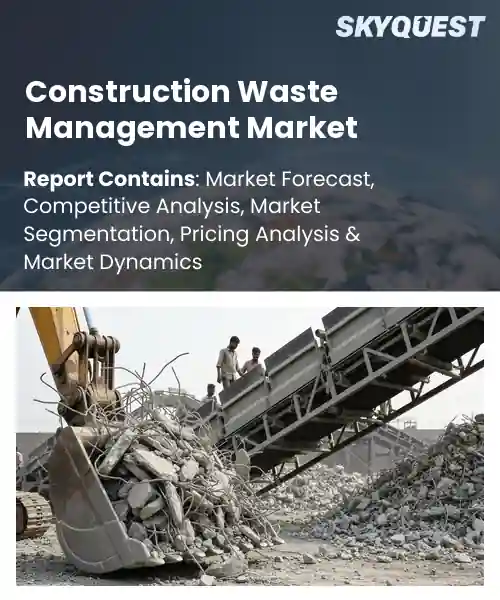
Construction Waste Management Market
Report ID: SQMIG20L2092
Report ID: SQMIG20L2092
[email protected]
USA +1 351-333-4748
Report ID:
SQMIG20L2092 |
Region:
Global |
Published Date: June, 2026
Pages:
157
|Tables:
93
|Figures:
76


Global Construction Waste Management Market size was valued at USD 239.5 Billion in 2024 and is poised to grow from USD 252.19 Billion in 2025 to USD 381.21 Billion by 2033, growing at a CAGR of 5.3% during the forecast period (2026-2033).
Regulations regarding waste at construction sites and the demand for sustainability have made construction waste management's initial focus of being just a regulatory issue be a higher priority for all stakeholders within the construction industry. Construction waste management is collecting, sorting out and a recycling/waste diversion effort of demolition and construction debris. The benefits associated with construction waste management include a reduction in landfill use, lower material costs, and decreased environmental impacts.
The construction waste management industry has developed over time from a focus on landfill diversion to one that includes a wide range of integrated services due to the introduction by governments of regulations such as the EU Landfill Directive and the implementation of construction waste management policies by countries such as China. Furthermore, construction firms have implemented several initiatives, such as on-site sorting for reuse, utilization of prefabrication, and development of products through circular procurement to assist with meeting post-consumer and sustainable building targets, while simultaneously creating green credentials for their companies.
The primary economic influence driving the global construction waste management market is increasing prices of materials coupled with improvements in recycling technology, and development of tracking systems using digital methods. As material prices continue to increase, contractors will be incentivized to recover existing materials resulting in an increased investment in mobile sorting facilities and separation of materials on the construction site for disposal so that they can reduce disposal costs and utilize recycled aggregates when creating new concrete for future projects. The development of mobile sorting facilities and improved technology for sorting and processing materials at construction sites has already begun to see considerable interest and success within the UK and many areas throughout Asia.
How is AI improving construction waste management efficiency?
Efficiency is achieved through the use of AI technology within the construction waste management process. It drives efficiency by identifying materials needed for projects, routing loads from sites to the plant and measuring outcomes on projects. Some of the key improvements AI provides within the construction industry include materials are automatically recognised on site or at a plant using cameras; predictive scheduling of dumpster placement and pick up; and streamlined reporting to meet regulatory compliance. The current market is focused on optimizing tools that create circular economies and reduce the number of materials sent to landfill, as contractors want better visibility of available materials and less costs associated with the disposal of their materials.
On-site cameras that identify and flag mixed waste so crews can successfully sort mixed materials; AI-assisted sorting at transfer stations, improving the percentage of recovered reusable materials; and analytics platforms that convert site data into actionable waste reduction methodologies for contractors themselves.
In May 2026, Samsara launched their Waste Intelligence Solution that provides contractors and hauliers with real time visibility through an AI-based multi-camera network, allowing for the identification and optimal sorting and routing of waste materials and expedited reporting to improve market efficiencies and support growth.
Market snapshot - (2026-2033)
Global Market Size
USD 239.5 Billion
Largest Segment
Bricks & Masonry
Fastest Growth
Structural Metals
Growth Rate
5.3% CAGR
To get more insights on this market click here to Request a Free Sample Report
Global construction waste management market is segmented by material stream, service component, origin source and region. Based on material stream, the market is segmented into Concrete, Sand & Soil, Bricks & Masonry, Wood & Timber Products, Structural Metals, Drywall & Plasterboard and Others. Based on service component, the market is segmented into On-Site Segregation & Collection, Logistics & Hauling Services and Processing & Recycling Facilities. Based on origin source, the market is segmented into New Construction Projects and Renovation & Remodeling Projects. Based on region, the market is segmented into North America, Europe, Asia Pacific, Latin America and Middle East & Africa.
As per construction waste management market outlook, concrete segment dominates because concrete constitutes the largest and most structurally integral waste output from construction projects, driving primary focus on its recovery and reuse. Its volumetric bulk and consistent material properties create predictable processing pathways that favor crushing, screening and reuse as aggregate, which reduces disposal needs and supports circular supply chains. The economic viability of repurposing concrete and strong industry demand for recycled aggregates further reinforce investments in handling and treatment infrastructure.
As per construction waste management market forecast, bricks & masonry is emerging as the fastest growing area due to increasing salvage practices and demand for reclaimed units in sustainable construction projects. Improved deconstruction techniques and certification for reused masonry are driving market adoption, creating new value chains for collection, refurbishment and resale that accelerate circular construction material economies.
Logistics & hauling services segment dominates with large construction waste management market share because it provides the essential backbone for moving diverse construction materials from sites to processing or disposal points, enabling continuous workflows across projects. Efficient routing, fleet specialization and integrated scheduling reduce on-site accumulation and facilitate timely segregation, which lowers contamination and handling costs. Close collaboration with contractors and waste brokers creates predictable demand for hauling capacity, encouraging investment in equipment and service networks that sustain market leadership.
As per construction waste management market analysis, processing & recycling facilities are the fastest growing area as technological innovation and regulatory incentives push onsite outputs towards value recovery. Advances in modular processing units and enhanced separation technologies increase throughput and material quality, stimulating investment. This growth expands local recycling capacity and creates downstream markets for recycled aggregates, unlocking new revenue opportunities.
To get detailed segments analysis, Request a Free Sample Report
As per construction waste management market regional outlook, Asia Pacific dominates in this market. This is due to a convergence of governmental focus, technology improvement and integrated industrial capabilities that supports large scale waste management solutions. Governments and business in important markets are focusing on circular economy principles and strong regulation that encourages compliance and innovation. Strong manufacturing ecosystems support adoption of advanced sorting, recycling and recovery technologies while contractors embrace off-site building and prefabrication processes that minimize and better manage waste streams. Public and private investment in infrastructure, with partnership models between municipalities and commercial operators, produces effective logistics for the recovery and reuse of materials. The high level of urban redevelopment and need for resource efficiency further strengthens the market environment, where supply chain integration and continuous improvement in waste management are prioritized, maintaining the leadership in the market.
As per construction waste management market regional forecast, Japan is marked by mature regulatory frameworks, broad adoption of modern recycling technologies and a strong culture of contractor compliance. The municipalities and private companies work together to create efficient collection and material recovery systems. The industry investment is fostering innovation in on-site sorting and waste-to-energy solutions. Prefabrication and precision construction processes reduce on-site waste output, and circular economy initiatives create markets for recycled materials and industrial symbiosis across construction supply chains.
South Korea benefits from proactive government policy, technology led waste tracking and rigorous construction standards that prioritize resource efficiency. Urban renewal programs and dense construction activity create demand for sophisticated deconstruction and material recovery services. Public procurement criteria and industry incentives support recycled content use, while digital platforms enhance logistics and traceability. Strong collaboration between municipalities, contractors and technology providers accelerates deployment of smart sorting, processing and reuse solutions across the construction sector.
As per construction waste management industry analysis, rapid rise in Europe is fueled by strict environmental legislation, a robust governmental focus on circularity, and a market culture that incentivizes sustainable building methods. The regulatory structure in the region supports the waste hierarchy, encouraging reuse, recycling and recovery and discouraging landfill. Renovation and retrofit activity produces known quantities of recoverable materials, driving specialized service providers and technology inventors. Public funding mechanisms and voluntary certification schemes are promoting industry use of building waste management systems. There is partnership between local authorities, trash operators, contractors and material processors in providing strong infrastructure for sorting and treatment. Growing customer demand for ecologically responsible supply chains and transparent reporting further support market dynamics, with both accelerating investment in capacity and capabilities across the European market.
Germany is underpinned by an established regulatory environment and a sophisticated recycling industry that prioritizes material recovery. Strong integration between waste processors, engineering firms and building contractors enables efficient sorting and circular use of recovered materials. Procurement practices and building codes encourage reuse and high quality recycling, while technology providers supply innovative solutions for processing complex waste streams. The market benefits from mature logistics and a culture of environmental stewardship that supports long term investment in waste management infrastructure.
United Kingdom is characterized by dynamic growth driven by refurbishment activity and policy encouragement for lifecycle resource efficiency. The market shows strong uptake of modular construction, deconstruction practices and digital tools for waste tracking. Local authority initiatives, contractor innovation and funding mechanisms support development of recycling capacity and reuse networks. Demand for sustainable procurement and transparent supply chains prompts wider adoption of advanced sorting and material recovery services, creating new commercial pathways for recycled construction materials.
France is emerging through a combination of regulatory impetus and targeted pilot projects that promote material reuse and recycling. Regional initiatives and public private partnerships foster experimentation with circular construction models and reuse centers. The market benefits from growing integration of renovation programs and sustainability criteria in procurement, stimulating demand for services that manage demolition and refurbishment waste. Innovation in material verification and recovery methods supports the gradual expansion of domestic processing capabilities and supply chains for recycled materials.
North America is deepening its participation with a mix of corporate sector leadership, legislative efforts and technical innovation that jointly improve waste management across construction value chains. Landfill diversion, deconstruction and material salvage are important tactics, according to market operators, boosted by increased investment in recycling infrastructure and mobile processing solutions. Green building certification and corporate sustainability goals create demand for accurate waste reporting and recycled material. Digital tools improve waste tracking and logistical efficiency. Municipalities, industrial associations and service providers cooperate to strengthen regional networks for material reuse and secondary markets. Cross border commerce of recovered materials and increased emphasis on supply chain circularity further consolidates skills, making the region an advanced player in global construction waste management market.
United States is shaped by a diverse regulatory landscape and strong private sector engagement that drives innovative service models and technology adoption. Large scale redevelopment and infrastructure projects create demand for deconstruction, salvage and sophisticated waste processing services. Municipal programs and corporate sustainability initiatives support infrastructure investment, while digital platforms enable improved traceability and optimization of logistics. The market benefits from an active network of recyclers, material brokers and contractors pursuing circular supply chain opportunities and value recovery from construction waste streams.
Canada is influenced by provincial policy leadership, community engagement and a focus on landfill diversion strategies that promote material recovery. Municipal procurement and regional recycling hubs support the development of reuse markets, while partnerships with indigenous communities and local stakeholders advance inclusive approaches to waste management. The market emphasizes sustainable materials, regional processing capacity and innovation in reuse practices, with growing collaboration among contractors, waste operators and certification bodies to strengthen circularity in construction projects.
To know more about the market opportunities by region and country, click here to
Buy The Complete Report
Stringent Environmental Regulations
Urbanization And Construction Activity
High Initial Infrastructure Costs
Fragmented Regulatory Frameworks
Request Free Customization of this report to help us to meet your business objectives.
The competitive landscape in global construction waste management industry is consolidating as incumbents pursue acquisitions and corporate venturing while buyers demand circular supply chains. Recent M&A and divestments among major waste firms have reshaped regional footprints, while corporate venture arms and strategic partnerships with startups accelerate sensor and AI adoption. Examples include the Veolia Suez combination, startup pilots with Ragn Sells, and Cemex Ventures scouting AI recycling tech.
SkyQuest’s ABIRAW (Advanced Business Intelligence, Research & Analysis Wing) is our Business Information Services team that Collects, Collates, Correlates, and Analyses the Data collected by means of Primary Exploratory Research backed by robust Secondary Desk research.
As per SkyQuest analysis, the global construction waste management market growth is being propelled primarily by stringent environmental regulations and sustainability commitments that elevate waste reduction and recycling to business priorities. The concrete material stream remains dominant due to its volume and predictable reuse pathways while Asia Pacific leads regionally because of strong policy support, manufacturing capacity and rapid urban redevelopment. A secondary driver is rising material costs combined with advances in recycling and digital tracking technologies that unlock value from recoverable materials. A key restraint is the high initial infrastructure costs for advanced sorting and recycling facilities, which can slow widespread adoption despite clear market incentives. The global construction waste management market trend is driven by rising infrastructure redevelopment, stricter environmental regulations and increasing adoption of circular economy practices that encourage recycling and reuse of construction and demolition debris across residential, commercial and industrial projects.
| Report Metric | Details |
|---|---|
| Market size value in 2024 | USD 239.5 Billion |
| Market size value in 2033 | USD 381.21 Billion |
| Growth Rate | 5.3% |
| Base year | 2024 |
| Forecast period | (2026-2033) |
| Forecast Unit (Value) | USD Billion |
| Segments covered |
|
| Regions covered | North America (US, Canada), Europe (Germany, France, United Kingdom, Italy, Spain, Rest of Europe), Asia Pacific (China, India, Japan, Rest of Asia-Pacific), Latin America (Brazil, Rest of Latin America), Middle East & Africa (South Africa, GCC Countries, Rest of MEA) |
| Companies covered |
|
| Customization scope | Free report customization with purchase. Customization includes:-
|
To get a free trial access to our platform which is a one stop solution for all your data requirements for quicker decision making. This platform allows you to compare markets, competitors who are prominent in the market, and mega trends that are influencing the dynamics in the market. Also, get access to detailed SkyQuest exclusive matrix.
Table Of Content
Executive Summary
Market overview
Parent Market Analysis
Market overview
Market size
KEY MARKET INSIGHTS
COVID IMPACT
MARKET DYNAMICS & OUTLOOK
Market Size by Region
KEY COMPANY PROFILES
Methodology
For the Construction Waste Management Market, our research methodology involved a mixture of primary and secondary data sources. Key steps involved in the research process are listed below:
1. Information Procurement: This stage involved the procurement of Market data or related information via primary and secondary sources. The various secondary sources used included various company websites, annual reports, trade databases, and paid databases such as Hoover's, Bloomberg Business, Factiva, and Avention. Our team did 45 primary interactions Globally which included several stakeholders such as manufacturers, customers, key opinion leaders, etc. Overall, information procurement was one of the most extensive stages in our research process.
2. Information Analysis: This step involved triangulation of data through bottom-up and top-down approaches to estimate and validate the total size and future estimate of the Construction Waste Management Market.
3. Report Formulation: The final step entailed the placement of data points in appropriate Market spaces in an attempt to deduce viable conclusions.
4. Validation & Publishing: Validation is the most important step in the process. Validation & re-validation via an intricately designed process helped us finalize data points to be used for final calculations. The final Market estimates and forecasts were then aligned and sent to our panel of industry experts for validation of data. Once the validation was done the report was sent to our Quality Assurance team to ensure adherence to style guides, consistency & design.
Analyst Support
Customization Options
With the given market data, our dedicated team of analysts can offer you the following customization options are available for the Construction Waste Management Market:
Product Analysis: Product matrix, which offers a detailed comparison of the product portfolio of companies.
Regional Analysis: Further analysis of the Construction Waste Management Market for additional countries.
Competitive Analysis: Detailed analysis and profiling of additional Market players & comparative analysis of competitive products.
Go to Market Strategy: Find the high-growth channels to invest your marketing efforts and increase your customer base.
Innovation Mapping: Identify racial solutions and innovation, connected to deep ecosystems of innovators, start-ups, academics, and strategic partners.
Category Intelligence: Customized intelligence that is relevant to their supply Markets will enable them to make smarter sourcing decisions and improve their category management.
Public Company Transcript Analysis: To improve the investment performance by generating new alpha and making better-informed decisions.
Social Media Listening: To analyze the conversations and trends happening not just around your brand, but around your industry as a whole, and use those insights to make better Marketing decisions.
REQUEST FOR SAMPLE
 REQUEST FREE CUSTOMIZATION
Global Construction Waste Management Market size was valued at USD 239.5 Billion in 2024 and is poised to grow from USD 252.19 Billion in 2025 to USD 381.21 Billion by 2033, growing at a CAGR of 5.3% during the forecast period (2026-2033).
The competitive landscape in global construction waste management is consolidating as incumbents pursue acquisitions and corporate venturing while buyers demand circular supply chains. Recent M&A and divestments among major waste firms have reshaped regional footprints, while corporate venture arms and strategic partnerships with startups accelerate sensor and AI adoption. Examples include the Veolia Suez combination, startup pilots with Ragn Sells, and Cemex Ventures scouting AI recycling tech. 'Waste Management', 'Republic Services', 'Clean Harbors', 'Waste Connections', 'Suez SA', 'Veolia Environnement', 'Remondis SE', 'Alba Group', 'Biffa', 'FCC Environment', 'Renewi', 'Covanta Holding Corporation', 'Stericycle', 'Casella Waste Systems', 'Advanced Disposal Services', 'Rumpke Waste & Recycling', 'GFL Environmental', 'Recology', 'Texas Disposal Systems', 'Harrison Industries'
Circular Materials Integration: Design for deconstruction, material passports, and supplier takeback models are driving deeper integration of reclaimed and recycled construction materials into mainstream projects. Developers, contractors, and material suppliers are collaborating to specify reusable components and standardized connection methods that facilitate recovery. This shift encourages durable product design, creates predictable streams of secondary materials, and elevates the market value of processed waste. Greater trust in material quality and transparent provenance supports circular procurement policies and opens new commercial opportunities across supply chains.
Why does Asia Pacific Dominate the Global Construction Waste Management Market? |@12


Want to customize this report? This report can be personalized according to your needs. Our analysts and industry experts will work directly with you to understand your requirements and provide you with customized data in a short amount of time. We offer $1000 worth of FREE customization at the time of purchase.
Feedback From Our Clients


 USA (+1) 351-333-4748

