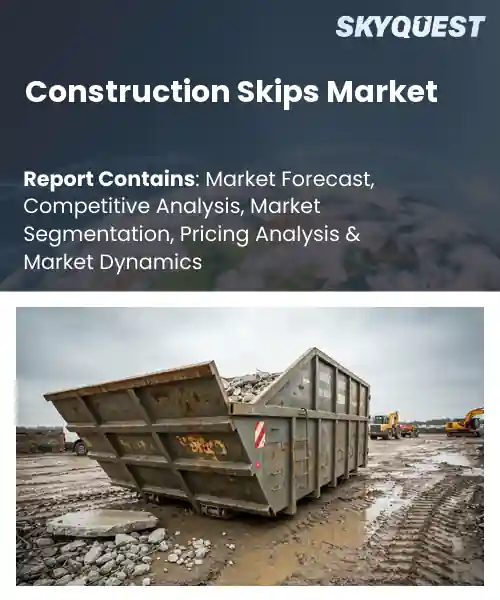
Construction Skips Market
Report ID: SQMIG20C2327
Report ID: SQMIG20C2327
[email protected]
USA +1 351-333-4748
Report ID:
SQMIG20C2327 |
Region:
Global |
Published Date: August, 2026
Pages:
157
|Tables:
172
|Figures:
79


Global Construction Skips Market size was valued at USD 624.7 Million in 2024 and is poised to grow from USD 666.55 Million in 2025 to USD 1119.83 Million by 2033, growing at a CAGR of 6.7% during the forecast period (2026-2033).
The global construction skips market is characterized by the rent and sales of bulk containers, which serve the purpose of collecting demolition wastes, excess soil, and recyclables from construction sites. The main reason behind its growth is increased urban construction activities resulting from expansion of cities and infrastructural development. In the last decade, the introduction of tougher waste diversion regulations in Europe led companies to resort to skips for effective disposal of waste, while rapid growth in skyscrapers across Asia created a need for waste management on-site. Digital tracking technology has now emerged as a key factor shaping the global construction skips market.
Real‑time GPS sensors let operators monitor fill levels, routing and recycling rates, which reduces unnecessary trips and lowers fuel use. A UK demolition firm added sensor‑enabled skips and cut collection mileage by 22 percent, delivering carbon‑footprint reductions and cost savings. As sustainability standards tighten and clients require transparent waste reporting, manufacturers embed IoT modules in skips, creating a new revenue stream from data services. This blend of technology and accountability expands market size while opening partnerships with waste‑processing plants that need precise input volumes.
How is AI-powered IoT Automation Transforming the Construction Skips Market?
AI powered IoT automation is reshaping how construction skips are tracked, filled and emptied. Sensors now monitor weight, location and fill level in real time, sending data to cloud platforms where machine learning predicts optimal collection routes and prevents over‑filling. Contractors gain visibility into waste streams, reduce unnecessary trips and lower fuel consumption. Integration with project management software aligns skip usage with schedule milestones, helping sites stay on budget and meet environmental targets. Early adopters report smoother coordination between suppliers and haulers, fewer downtime incidents and improved safety as crews are alerted before skips become unstable. The technology is moving from pilot projects to standard practice across large construction firms.
Market snapshot - (2026-2033)
Global Market Size
USD 624.7 Million
Largest Segment
Enclosed Skips
Fastest Growth
Roll-On Roll-Off Skips
Growth Rate
6.7% CAGR
To get more insights on this market click here to Request a Free Sample Report
Global construction skips market is segmented by product type, capacity, material, application, end user, sales channel and region. Based on product type, the market is segmented into Open Skips, Enclosed Skips, Roll-On Roll-Off Skips and Others. Based on capacity, the market is segmented into Up to 5 yd³, 6–15 yd³ and Above 15 yd³. Based on material, the market is segmented into Steel, Aluminum and Others. Based on application, the market is segmented into Construction Waste, Demolition Waste, Industrial Waste and Others. Based on end user, the market is segmented into Contractors, Waste Management Companies and Municipalities. Based on sales channel, the market is segmented into Direct Sales and Dealers. Based on region, the market is segmented into North America, Europe, Asia Pacific, Latin America and Middle East & Africa.
Open Skips segment dominates because they provide the simplest, most cost effective solution for routine construction waste removal, allowing quick loading and unloading without the need for additional handling equipment. Their universal fit across most site conditions, ease of placement, and low maintenance requirements drive widespread preference among contractors. This practicality aligns with the market’s emphasis on operational efficiency and budget sensitivity, reinforcing their leading position in daily project cycles.
However, Enclosed Skips segment is witnessing the strongest growth momentum because rising health and safety regulations, along with increasing demand for dust containment on urban sites, push firms toward sealed solutions. Their ability to protect recyclable materials and reduce environmental complaints creates new revenue streams and expands market opportunities for manufacturers.
6–15 yd³ segment dominates because it balances volume and maneuverability, fitting the majority of medium scale projects that require frequent waste pickups without overloading site access points. This size offers sufficient capacity to reduce trip frequency while remaining compatible with standard truck chassis, which lowers transport costs. Its versatility satisfies diverse contractor preferences, making it the default choice for routine project scheduling and resource allocation throughout the construction season everywhere.
Meanwhile, Above 15 yd³ segment emerges as a high growth area because large infrastructure and modular projects require greater volume to cut handling trips. The quest for bulk removal and cost efficiencies pushes operators toward oversized skips, encouraging manufacturers to develop stronger frames. This shift creates new service models and larger rental contracts, expanding market potential.
To get detailed segments analysis, Request a Free Sample Report
North America is leading in the Construction Skips Market due to its combination of advanced construction ecosystem and high safety & environmental standards. Extensive use of prefabrication in construction and effective material handling techniques increase the demand for efficient skips. Well-established supply chain system and availability of manufacturers of skips facilitate the delivery of the products within time. In addition to this, strict regulations on waste management and active involvement in sustainable practices require constructors to incorporate the use of skips in their projects. United States derives advantages from the large number of commercial and residential construction projects, whereas Canada gains an edge due to its green buildings practices.
Construction Skips Market in United States is characterized by integration into commercial developments and infrastructure upgrades. Customers prioritize durability and modular designs that align with fast‑track project schedules. Manufacturers respond with a diversified portfolio that accommodates diverse waste streams, from demolition debris to recycling material. Industry cooperation with regulatory bodies promotes compliance with waste diversion goals, while innovation in lightweight aluminum and composite skips supports operational efficiency across the sector.
Construction Skips Market in Canada reflects an emphasis on responsible construction practices and project diversity. Providers tailor skip solutions to accommodate cold‑climate material handling and remote site logistics, ensuring reliable performance throughout seasonal challenges. Collaboration with provincial waste‑management agencies drives adoption of reusable and recyclable skip designs. Market participants invest in modular engineering that simplifies transport and reduces footprint, aligning with sustainability goals while supporting residential expansions and industrial development national.
The European construction skips market is fueled by a consistent focus on sustainability, strong waste management norms, and an evolving circular economy approach. The government policies in favor of adopting skips for effective material segregation and recycling processes and less dependence on landfills prevail in the entire region. The growing trend of prefabrication in the construction business and high costs of labor make it necessary to adopt reusable skips for efficient logistical operations on-site. Germany serves as the leading country with advanced production technologies and strong industry standards in place, whereas the rapid rise of skips in the UK is due to stringent green building standards and innovative funding solutions. France is another emerging country, which has begun to recognize the need for environmental accountability in utilizing skips in construction operations.
Construction Skips Market in Germany benefits from an engineering ecosystem and rigorous environmental compliance standards. Suppliers deliver high‑precision aluminum and steel skips that align with strict segregation protocols, facilitating material recovery. Collaboration between manufacturers and construction firms drives product improvement, emphasizing durability and ease of handling. Government incentives for resource efficiency reinforce market demand, while rail and road networks enable efficient distribution to diverse project sites across the country national.
Construction Skips Market in United Kingdom is accelerated by ambitious sustainability targets and a proactive approach to construction. The market favours lightweight, reusable skip systems that integrate seamlessly with modular building processes, reducing on‑site waste handling time. Industry partnerships with green financing bodies encourage adoption of skips that support material recycling and carbon‑footprint reduction. Growing awareness among contractors about waste solutions further fuels market momentum across residential and commercial sectors.
Construction Skips Market in France is emerging as awareness gains traction among developers and municipal authorities. Providers introduce versatile skip designs that handle waste types from demolition debris to recyclable material, aligning with France’s evolving waste‑reduction policies. Collaborative initiatives between construction firms and recycling agencies promote skips as integral components of sustainable project planning. This growing acceptance is gradually expanding market reach into urban renewal projects and large‑scale infrastructure programmes.
Asia Pacific is enhancing its construction skips through fast-paced urbanization, greater awareness regarding minimizing waste, and the use of advanced manufacturing processes. The countries of Japan and South Korea are concerned about maximizing the efficiency of materials for the development of highly populated cities and complex construction projects. The government supports the adoption of construction skips through incentive programs, which help build circular economy by recycling reusable skips through smart city waste management systems. The manufacturers in this region take advantage of their precision engineering and alloys to design skips in accordance with the safety and environmental requirements. There is an increasing trend of collaboration between construction companies and technology companies that lead to the development of skip optimization solutions.
Construction Skips Market in Japan is shaped by urban projects and a cultural emphasis on site organization. Suppliers offer skips designed for narrow streets and multi‑story construction sites, ensuring efficient material collection without disrupting pedestrian flow. Integration with waste‑tracking systems enables monitoring of fill levels, supporting Japan’s recycling targets. Collaboration between manufacturers and construction firms drives refinement of skip designs, emphasizing durability, ease of transport, and alignment with safety regulations.
The Driving Forces behind Construction Skips Market in South Korea include infrastructure development and efficiency. The construction skips manufactured by local manufacturers cater to demolition wastes and fit into the limitations of Korean urban areas. Integration with waste management software ensures monitoring of skips, increasing recycling and decreasing dependency on landfills. Collaboration between businesses and IT companies creates innovative solutions with high durability and eco-friendliness.
To know more about the market opportunities by region and country, click here to
Buy The Complete Report
Rising Demand for Sustainable Construction
Technological Advancements in Skip Design
High Initial Investment Costs
Regulatory Variability Across Regions
Request Free Customization of this report to help us to meet your business objectives.
Competition within the industry stems from cutthroat competition between incumbent skip hire companies and innovative waste management startups, resulting in faster adaptation of online booking systems, sustainable skip design, and mergers for increased geographical spread. Examples of recent merger deals like those involving the acquisition of a regional skip company by a major construction company highlight efforts to expand geographical presence. Collaboration between skip suppliers and recycling companies will lead to the development of circular economy-based solutions, while new players focusing on technology are using IoT-enabled skips for real-time fill level monitoring.
SkyQuest’s ABIRAW (Advanced Business Intelligence, Research & Analysis Wing) is our Business Information Services team that Collects, Collates, Correlates, and Analyses the Data collected by means of Primary Exploratory Research backed by robust Secondary Desk research.
As per SkyQuest analysis the global construction skips market is being propelled primarily by the rising demand for sustainable construction which pushes contractors toward reusable recyclable skips while a second strong driver is the rapid adoption of digital tracking and IoT‑enabled designs that cut fuel use and improve waste‑stream visibility. The open skips segment remains the dominant choice because of its low cost and ease of handling and North America continues to lead the market thanks to mature logistics stringent environmental rules and high project volumes. However the high initial investment required for advanced skip containers and related technology acts as a notable restraint limiting faster adoption among smaller firms.
| Report Metric | Details |
|---|---|
| Market size value in 2024 | USD 624.7 Million |
| Market size value in 2033 | USD 1119.83 Million |
| Growth Rate | 6.7% |
| Base year | 2024 |
| Forecast period | (2026-2033) |
| Forecast Unit (Value) | USD Million |
| Segments covered |
|
| Regions covered | North America (US, Canada), Europe (Germany, France, United Kingdom, Italy, Spain, Rest of Europe), Asia Pacific (China, India, Japan, Rest of Asia-Pacific), Latin America (Brazil, Rest of Latin America), Middle East & Africa (South Africa, GCC Countries, Rest of MEA) |
| Companies covered |
|
| Customization scope | Free report customization with purchase. Customization includes:-
|
To get a free trial access to our platform which is a one stop solution for all your data requirements for quicker decision making. This platform allows you to compare markets, competitors who are prominent in the market, and mega trends that are influencing the dynamics in the market. Also, get access to detailed SkyQuest exclusive matrix.
Table Of Content
Executive Summary
Market overview
Parent Market Analysis
Market overview
Market size
KEY MARKET INSIGHTS
COVID IMPACT
MARKET DYNAMICS & OUTLOOK
Market Size by Region
KEY COMPANY PROFILES
Methodology
For the Construction Skips Market, our research methodology involved a mixture of primary and secondary data sources. Key steps involved in the research process are listed below:
1. Information Procurement: This stage involved the procurement of Market data or related information via primary and secondary sources. The various secondary sources used included various company websites, annual reports, trade databases, and paid databases such as Hoover's, Bloomberg Business, Factiva, and Avention. Our team did 45 primary interactions Globally which included several stakeholders such as manufacturers, customers, key opinion leaders, etc. Overall, information procurement was one of the most extensive stages in our research process.
2. Information Analysis: This step involved triangulation of data through bottom-up and top-down approaches to estimate and validate the total size and future estimate of the Construction Skips Market.
3. Report Formulation: The final step entailed the placement of data points in appropriate Market spaces in an attempt to deduce viable conclusions.
4. Validation & Publishing: Validation is the most important step in the process. Validation & re-validation via an intricately designed process helped us finalize data points to be used for final calculations. The final Market estimates and forecasts were then aligned and sent to our panel of industry experts for validation of data. Once the validation was done the report was sent to our Quality Assurance team to ensure adherence to style guides, consistency & design.
Analyst Support
Customization Options
With the given market data, our dedicated team of analysts can offer you the following customization options are available for the Construction Skips Market:
Product Analysis: Product matrix, which offers a detailed comparison of the product portfolio of companies.
Regional Analysis: Further analysis of the Construction Skips Market for additional countries.
Competitive Analysis: Detailed analysis and profiling of additional Market players & comparative analysis of competitive products.
Go to Market Strategy: Find the high-growth channels to invest your marketing efforts and increase your customer base.
Innovation Mapping: Identify racial solutions and innovation, connected to deep ecosystems of innovators, start-ups, academics, and strategic partners.
Category Intelligence: Customized intelligence that is relevant to their supply Markets will enable them to make smarter sourcing decisions and improve their category management.
Public Company Transcript Analysis: To improve the investment performance by generating new alpha and making better-informed decisions.
Social Media Listening: To analyze the conversations and trends happening not just around your brand, but around your industry as a whole, and use those insights to make better Marketing decisions.
REQUEST FOR SAMPLE
 REQUEST FREE CUSTOMIZATION
Global Construction Skips Market size was valued at USD 624.7 Million in 2024 and is poised to grow from USD 666.55 Million in 2025 to USD 1119.83 Million by 2033, growing at a CAGR of 6.7% during the forecast period (2026-2033).
The competitive landscape is shaped by intense rivalry among established skip‑hire firms and emerging waste‑management innovators, driving accelerated adoption of digital booking platforms, eco‑friendly skip designs, and strategic acquisitions to broaden service footprints. Recent M&A activity, such as the acquisition of a regional skip provider by a leading construction services group, illustrates consolidation aimed at enhancing geographic reach. Partnerships between skip manufacturers and recycling firms are enabling integrated circular‑economy solutions, while technology‑focused entrants are deploying IoT‑enabled skips for real‑time fill‑level monitoring, optimizing route efficiency and reducing operational costs. 'SSI Schaefer Group', 'Barker & Sons Ltd.', 'Biffa plc', 'WM Waste Management Services', 'MGB Plastics', 'Hardox Wearparts', 'Rollpak Corporation', 'MHM UK Ltd.', 'Skips International', 'Marrel SAS', 'M&K Engineering Ltd.', 'McCarthy Commercials', 'Container Components Europe Ltd.', 'BTE West BV', 'Maco Corporation', 'A-Ward Ltd.', 'EMR Group', 'Veolia Environnement S.A.', 'SUEZ S.A.', 'Wastequip, LLC'
The growing emphasis on environmentally responsible building practices is prompting contractors to adopt reusable skip containers that facilitate efficient waste segregation and recycling, thereby reducing landfill dependence and enhancing project sustainability credentials, which in turn drives broader acceptance of skip solutions across diverse construction segments and encourages manufacturers to expand product offerings aligned with green standards. These developments also improve supply chain resilience by standardizing waste handling protocols and fostering collaborative relationships between suppliers and construction firms, ultimately accelerating market penetration and fostering long‑term growth.
Sustainable Material Adoption: Construction firms are increasingly prioritizing environmentally friendly skip solutions, opting for recyclable plastics, biodegradable liners, and low‑emission manufacturing processes. This shift is driven by client demand for greener projects, corporate sustainability commitments, and emerging green procurement policies. Suppliers respond by developing circular‑economy product lines that reduce landfill waste and improve asset lifespan. As a result, market participants that integrate sustainable materials gain competitive advantage, foster brand reputation, and align with broader industry moves toward carbon neutrality in the construction sector.
Why does North America Dominate the Global Construction Skips Market? |@12


Want to customize this report? This report can be personalized according to your needs. Our analysts and industry experts will work directly with you to understand your requirements and provide you with customized data in a short amount of time. We offer $1000 worth of FREE customization at the time of purchase.
Feedback From Our Clients


 USA (+1) 351-333-4748

