Construction Robots Market
Report ID: SQMIG20C2290
Report ID: SQMIG20C2290
[email protected]
USA +1 351-333-4748
Report ID:
SQMIG20C2290 |
Region:
Global |
Published Date: July, 2026
Pages:
157
|Tables:
179
|Figures:
79


Global Construction Robots Market size was valued at USD 1.9 Billion in 2024 and is poised to grow from USD 2.22 Billion in 2025 to USD 7.69 Billion by 2033, growing at a CAGR of 16.8% during the forecast period (2026-2033).
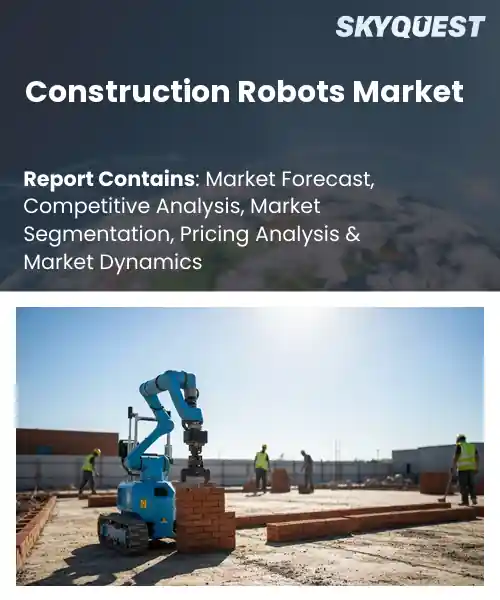
The global construction robots market refers to the robots that can be used to carry out automation of construction works which tend to involve intensive labor force, repetitiveness and dangers to health and safety such as laying bricks, demolition, material handling, 3D concrete printing, inspections and surveying. Construction robots make work easier and more efficient, increase accuracy and contribute towards overcoming the challenges associated with shortage of workforce in the construction industry. The construction robots' market is showing tremendous growth due to urbanization, usage of BIM, developments in artificial intelligence (AI), machine vision, and autonomous navigation technology. The increasing focus on digitalization and sustainable construction further contributes to the growth of the construction robots market.
The platform of labor reduction enables integration, with intelligence and connectivity being key to the growth of robots. Intelligence is responsible for the planning of routes for the excavators, enabling changes in the angle of the blade to cater for variations in the soil and cutting energy consumption by a maximum of fifteen percent as demonstrated by Built Robotics on the Texas Highway. There are cloud platforms which aggregate data from sensors to make maintenance models which increase the longevity of the equipment. The government has incentive packages for construction, and therefore robots can be used to provide insulation to cut down on waste.
How is AI-driven Automation Shaping Efficiency in the Construction Robots Market?
AI powered automation uses machine learning perception and robotics actuation to simplify construction processes. The technology allows machines to map their surroundings, generate paths, and act in response to them without any human intervention. At present, there are autonomous excavators, brick laying robot arms, and unmanned survey drones in the market which can work non-stop without making mistakes. This technology helps in saving manpower and avoiding mistakes which leads to rework while improving safety on the construction site. The market is fueled by the shortage of skilled laborers as well as the increasing demand for timely completion of projects. By using sensor data, cloud analytics, and real-time control, manufacturers produce equipment which can learn from changing situations and maintain project deadlines.
Market snapshot - (2026-2033)
Global Market Size
USD 1.9 Billion
Largest Segment
Robotic Arms
Fastest Growth
Concrete & 3D Printing Robots
Growth Rate
16.8% CAGR
To get more insights on this market click here to Request a Free Sample Report
Global construction robots market is segmented by robot type, automation type, application, technology, end user, deployment and region. Based on robot type, the market is segmented into Demolition Robots, Bricklaying Robots, Concrete & 3D Printing Robots, Autonomous Construction Vehicles, Robotic Arms, Inspection & Surveillance Robots and Others. Based on automation type, the market is segmented into Semi-Autonomous Robots and Fully Autonomous Robots. Based on application, the market is segmented into Material Handling, Demolition, Bricklaying & Masonry, Concrete Finishing, Inspection & Monitoring and Others. Based on technology, the market is segmented into AI & Machine Learning, Computer Vision, IoT & Connected Robotics, GPS & Navigation Systems and Others. Based on end user, the market is segmented into Construction Companies, Infrastructure Developers, Mining & Tunneling Companies and Industrial Construction Firms. Based on deployment, the market is segmented into Indoor Construction and Outdoor Construction. Based on region, the market is segmented into North America, Europe, Asia Pacific, Latin America and Middle East & Africa.
The bricklaying robots category leads the way since they solve the problems related to labor shortage and growing requirements towards speedier and high-quality construction. Precision of the process minimizes waste and increases the building process speed, thus making contractors invest in automation instead of traditional bricklaying. Connection to digital blueprints and real-time control ensures better performance and helps bricklaying robots become the basis for productivity improvements in this sector.
Autonomous construction vehicles category becomes the leading high-growth category thanks to increasing need for logistics services at construction sites and desire to make the entire process fully automated. The possibility to transport materials independently from human operators not only facilitates logistics but also offers new applications of robot ecosystems in big projects.
The AI & Machine Learning segment is distinguished by its ability to enable inspection and surveillance robots to detect anomalies and defects in predictive ways. This capability helps to make data analysis more proactive and decreases both inspection cycles and human presence at dangerous locations, making the installation of advanced algorithms a key selling point for developers.
IoT & Connected Robotics segment is currently the one showing the most vigorous growth. Manufacturers equip their inspection devices with telemetry that work in real time and allow them to be integrated into cloud-based systems, which allows for smooth data exchange and opens revenue opportunities for this segment.
To get detailed segments analysis, Request a Free Sample Report
This area has a number of advantages because of the intersection of well-developed construction industry, a rich environment for research, and a tendency to implement innovations early on. Strong ties among top universities and forward-thinking companies facilitate constant improvement of robotics technologies. Favorable venture ecosystems and availability of funds promote product development and commercialization. Moreover, there is a qualified labor force capable of working with digital technologies that can be easily integrated into operations at the construction sites. All these elements form a virtuous cycle which ensures that North America will continue to lead the robotics in construction field.
Construction Robots Market in the US Market grows due to the complex ecosystem of technology clusters, which include venture capital investments and research organizations that help create innovations. The industry companies enjoy access to a skilled workforce who knows software engineering, mechanics, and data analysis, allowing them to develop robotic devices faster. Robust demand for such products in both commercial and residential construction industries stimulates their purchase in advance, forming the cycle of improvement. What is more, governmental initiatives to enhance safety and productivity further boost the use of robotic devices.
Canada's Construction Robots Market thrives in an environment that emphasizes cooperation in the sense that there is a synergy of support from government institutions and engineering prowess. Sustainable construction practices are encouraged through the use of precise robotic technology, which helps minimize wastage and increases efficiency. Through regional research clusters, knowledge is shared, and this makes it easier for advanced sensors and Artificial Intelligence-powered control systems to be adopted into the construction robots.
The growth of Europe is enabled by the combination of very strict sustainability objectives and the long history of excellence in engineering. Cooperation programs among member countries enable the undertaking of collaborative projects involving the development of robotics, thereby increasing the level of interoperability of these robots. There is increased pressure from governments for productivity improvement in construction industry markets that have reached maturity because of labor constraints and increased safety on the construction sites. It creates a favorable climate for investments due to government support for sustainable building methods and technology advancement.
Market for Construction Robots in Germany is greatly influenced by the tradition of precision engineering and a developed industry. Cooperation between the companies and the research institutions makes it possible to fast implementation of new technologies in robots. The market gains support from the development of flexible, powerful, and complex systems to deal with complicated engineering tasks. High quality of vocational education results in a highly qualified labor force that can work with sophisticated machinery.
The Construction Robots Market in the United Kingdom is seeing rapid adoption due to the aggressive plans for productivity and safety. Public-private collaborations have provided funding for pilot projects that demonstrate the real value of automation in the field. A bustling ecosystem of fintech and technology companies is helping in the proliferation of construction start-ups that are using AI-powered technology. The policy environment that promotes digital innovation and skills training provides more impetus to adopt robots in construction.
The Construction Robots Market in France is becoming an attractive field due to its rich history of architectural developments. State-sponsored projects aimed at digitalization of the construction industry led to the quick adoption of robots for activities such as masonry and concrete pouring. The scientific community provides the state with innovative solutions in perception and control algorithm design. An increased focus on efficiency and sustainability makes businesses try out new technologies, making France a growing market for robotization.
Asia Pacific promotes itself using a combination of production capabilities, technological drive, and favorable policies. The region boasts of well-developed networks that allow for low-cost, high-quality manufacture of robotics parts, and the large-scale urban development projects provide testing grounds for robotics technology. The governments favor the development of smart cities and robotics integration in the construction processes, creating a nurturing environment for the development of new innovations. The willingness to embrace technology on a cultural level facilitates the acceptance of robots, and highly skilled engineering personnel comes from a well-educated engineering population.
Japan Construction Robots Market relies on the advanced precision manufacturing skills possessed by the country. The teamwork between the robotics companies and construction companies ensures that reliable robots that are equipped with various sensors are introduced in the construction process within the crowded cities of the country. The government’s policies focusing on building disaster-proof infrastructures help introduce robots that can work in tough conditions. The habit of continuous improvement helps improve the efficiency and safety of robots.
South Korean Construction Robots Industry is fueled by an energetic tech industry and active government promotion of digital construction solutions. An intense focus on developing AI and robotics ensures highly advanced robots built for the construction sector. Large-scale construction projects act as test sites for enhancing system reliability. Cooperation between electronics companies and construction companies ensures fast dissemination of robotic technologies in the market.
To know more about the market opportunities by region and country, click here to
Buy The Complete Report
Increasing Labor Shortages Drive Adoption
Shortage of skilled manpower is an ongoing issue within the construction sector, compelling organizations to explore automation options that would keep their productivity constant. Robots are reliable, fatigue-free machines that ensure that projects are completed within schedule even when there is a shortage of manpower. Through filling the labor shortage gaps, robots increase efficiency at the work site, allowing firms to deploy human personnel in areas that require more skill.
Advanced Sensor Integration Enhances Capability
Robots equipped with advanced sensors like LiDAR, computer vision, and force feedback gain enhanced situational awareness that enables their work side-by-side with human crews in safety. Such a combination of technologies minimizes the danger of any mishap and increases accuracy of performing tasks such as bricklaying and concrete spraying. With growing perception of reliability and safety, all interested parties become more open to investing in robots.
High Initial Investment Limits Adoption
The cost involved in buying, designing, and installation of construction robots is relatively high, and thus it acts as a major economic hurdle to the uptake of these robots by many construction companies. This means that contractors have to incur high costs up front before they can reap any profits, which is why the uptake rate of construction robots is slow among other reasons.
Regulatory Compliance Increases Project Complexity
Construction projects have strict safety requirements and building codes, which do not provide clear directives on the use of robots. This adds an extra level of bureaucracy in terms of paperwork and inspections to the construction process, hence delaying the completion time and increasing the cost of the project. Such uncertainties about compliance prevent some companies from adopting robots.
Request Free Customization of this report to help us to meet your business objectives.
The competitive environment within the global construction robots market is marked by fierce competition as firms compete for market share in light of increasing adoption resulting from labor shortage and need for higher productivity. Players within the market have adopted strategies of merger and acquisition and integration of technology in order to achieve competitive edge.
AI-driven Site Automation: Construction companies are using AI-enabled robots that can move around by themselves through complicated site setups, make sense of the sensor information in real time, and change what they are doing on their own. Such systems use machine learning programs along with sophisticated perception technology to perform efficient material manipulation, welding, and concrete. Through such automation, construction companies can reduce dependence on human efforts, making the work safer and faster while also improving accuracy of implementing designs.
Modular Robotics Integration: The use of modular robotic platforms is increasing because of the flexibility of their tools, which can be changed depending on construction needs. Design for assembly concepts makes it possible to change parts like brick-laying arms, demolition grips, or surveying systems on one platform, thus saving money on machinery and avoiding downtimes. Customization and scalability capabilities are inherent in these solutions, which match lean construction approaches. Therefore, changes in the designs can be handled easily by contractors.
SkyQuest’s ABIRAW (Advanced Business Intelligence, Research & Analysis Wing) is our Business Information Services team that Collects, Collates, Correlates, and Analyses the Data collected by means of Primary Exploratory Research backed by robust Secondary Desk research.
As per SkyQuest analysis, the key growth drivers in the global construction robot market are the labor shortages, which drive the companies towards automation, while the cost factor works as the major barrier to the market growth. North America dominates in the construction robot market owing to its developed construction industry, robust research environment and availability of venture capital. In the construction robot segment hierarchy, bricklaying robots have been identified as the market leaders due to their contribution in terms of improving efficiency and minimizing waste. Another major growth driver for the construction robot market is the incorporation of AI technologies.
| Report Metric | Details |
|---|---|
| Market size value in 2024 | USD 1.9 Billion |
| Market size value in 2033 | USD 7.69 Billion |
| Growth Rate | 16.8% |
| Base year | 2024 |
| Forecast period | (2026-2033) |
| Forecast Unit (Value) | USD Billion |
| Segments covered |
|
| Regions covered | North America (US, Canada), Europe (Germany, France, United Kingdom, Italy, Spain, Rest of Europe), Asia Pacific (China, India, Japan, Rest of Asia-Pacific), Latin America (Brazil, Rest of Latin America), Middle East & Africa (South Africa, GCC Countries, Rest of MEA) |
| Companies covered |
|
| Customization scope | Free report customization with purchase. Customization includes:-
|
To get a free trial access to our platform which is a one stop solution for all your data requirements for quicker decision making. This platform allows you to compare markets, competitors who are prominent in the market, and mega trends that are influencing the dynamics in the market. Also, get access to detailed SkyQuest exclusive matrix.
Table Of Content
Executive Summary
Market overview
Parent Market Analysis
Market overview
Market size
KEY MARKET INSIGHTS
COVID IMPACT
MARKET DYNAMICS & OUTLOOK
Market Size by Region
KEY COMPANY PROFILES
Methodology
For the Construction Robots Market, our research methodology involved a mixture of primary and secondary data sources. Key steps involved in the research process are listed below:
1. Information Procurement: This stage involved the procurement of Market data or related information via primary and secondary sources. The various secondary sources used included various company websites, annual reports, trade databases, and paid databases such as Hoover's, Bloomberg Business, Factiva, and Avention. Our team did 45 primary interactions Globally which included several stakeholders such as manufacturers, customers, key opinion leaders, etc. Overall, information procurement was one of the most extensive stages in our research process.
2. Information Analysis: This step involved triangulation of data through bottom-up and top-down approaches to estimate and validate the total size and future estimate of the Construction Robots Market.
3. Report Formulation: The final step entailed the placement of data points in appropriate Market spaces in an attempt to deduce viable conclusions.
4. Validation & Publishing: Validation is the most important step in the process. Validation & re-validation via an intricately designed process helped us finalize data points to be used for final calculations. The final Market estimates and forecasts were then aligned and sent to our panel of industry experts for validation of data. Once the validation was done the report was sent to our Quality Assurance team to ensure adherence to style guides, consistency & design.
Analyst Support
Customization Options
With the given market data, our dedicated team of analysts can offer you the following customization options are available for the Construction Robots Market:
Product Analysis: Product matrix, which offers a detailed comparison of the product portfolio of companies.
Regional Analysis: Further analysis of the Construction Robots Market for additional countries.
Competitive Analysis: Detailed analysis and profiling of additional Market players & comparative analysis of competitive products.
Go to Market Strategy: Find the high-growth channels to invest your marketing efforts and increase your customer base.
Innovation Mapping: Identify racial solutions and innovation, connected to deep ecosystems of innovators, start-ups, academics, and strategic partners.
Category Intelligence: Customized intelligence that is relevant to their supply Markets will enable them to make smarter sourcing decisions and improve their category management.
Public Company Transcript Analysis: To improve the investment performance by generating new alpha and making better-informed decisions.
Social Media Listening: To analyze the conversations and trends happening not just around your brand, but around your industry as a whole, and use those insights to make better Marketing decisions.
REQUEST FOR SAMPLE
 REQUEST FREE CUSTOMIZATION
Global Construction Robots Market size was valued at USD 1.9 Billion in 2024 and is poised to grow from USD 2.22 Billion in 2025 to USD 7.69 Billion by 2033, growing at a CAGR of 16.8% during the forecast period (2026-2033).
The competitive landscape in the global construction robots market is shaped by intense rivalry as manufacturers vie for market share amid rapid adoption driven by labor shortages and productivity demands. Companies are pursuing strategic moves such as mergers, joint ventures, and technology integration to differentiate offerings, accelerate innovation cycles, and expand geographic presence, intensifying the contest for leadership. 'Caterpillar', 'Komatsu', 'ABB', 'Husqvarna Group', 'Brokk', 'Fujita Corporation', 'Shimizu Corporation', 'Kajima Corporation', 'Takenaka Corporation', 'Built Robotics', 'Construction Robotics', 'Okibo', 'Dusty Robotics', 'Canvas', 'CyBe Construction', 'Advanced Construction Robotics', 'Ekso Bionics', 'Sarcos Technology and Robotics Corporation', 'HP Inc.', 'FBR'
Ai‑Driven Site Automation: Construction firms are increasingly deploying AI‑driven robots that can autonomously navigate complex site layouts, interpret real‑time sensor data, and adjust tasks without human intervention. These systems combine machine‑learning algorithms with advanced perception technologies to optimize material handling, welding, and concrete placement. By reducing reliance on manual labor, they improve safety, accelerate project timelines, and enable more precise execution of design intent. The shift toward intelligent autonomy is reshaping workforce structures and prompting manufacturers to prioritize software upgrades alongside hardware durability.
Why does North America Dominate the Global Construction Robots Market? |@12


Want to customize this report? This report can be personalized according to your needs. Our analysts and industry experts will work directly with you to understand your requirements and provide you with customized data in a short amount of time. We offer $1000 worth of FREE customization at the time of purchase.
Feedback From Our Clients


 USA (+1) 351-333-4748

