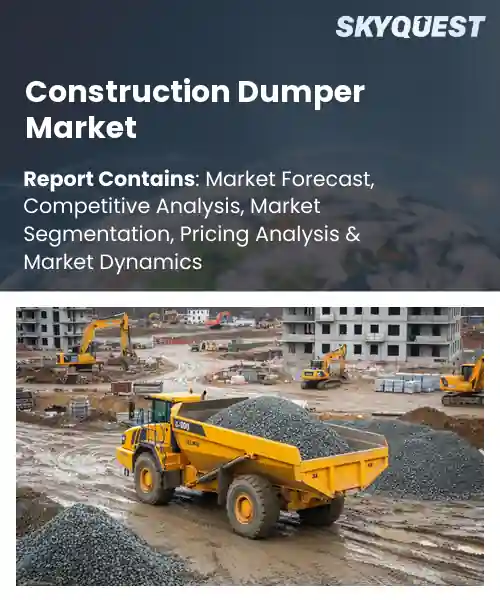
Construction Dumper Market
Report ID: SQMIG20G2172
Report ID: SQMIG20G2172
[email protected]
USA +1 351-333-4748
Report ID:
SQMIG20G2172 |
Region:
Global |
Published Date: July, 2026
Pages:
157
|Tables:
207
|Figures:
80


Global Construction Dumper Market size was valued at USD 25.37 Billion in 2024 and is poised to grow from USD 26.56 Billion in 2025 to USD 38.36 Billion by 2033, growing at a CAGR of 4.7% during the forecast period (2026-2033).
The construction dumper market includes vehicles that are used to move loose materials, such as soil, sand and demolition waste, around construction sites. As urbanization accelerates, the need for these machines has grown, with developers looking to finish projects more quickly while maintaining safety standards. The industry has traditionally relied on small diesel-powered dumpers, but over the past decade there has been a move towards higher payload capacities, automated steering and electric powertrains, driven by more stringent emission regulations in Europe and China. For instance, a French infrastructure project in 2022 swapped out 1,200 legacy dumpers for hybrid units, reducing fuel consumption by 30 percent and demonstrating the market is heading toward efficiency.
Cost efficiency is one of the factors driving the global construction dumper market. Cost reduction improves project profitability. Manufacturers are responding with telematics that track fuel use and route optimisation, allowing contractors to reduce per-tonne haulage costs by up to 15 percent, as seen in an Australian mining-to-construction pipeline where hybrid dumpers replaced traditional models. The cost advantage draws investment in economies with infrastructure spending that outpaces labor savings, and firms adopt modular designs that enable easier maintenance and longer service lives. Therefore, the market is witnessing rapid adoption, and aftermarket services and financing packages are emerging as lucrative growth avenues.
How is AI-driven Automation Reshaping Productivity In The Construction Dumper Market?
AI-driven automation is transforming the way construction dumpers are operated, with each truck now equipped with sensors, vision systems and predictive software. It monitors load weight, terrain and engine health, and allows the machine to change speed and route automatically without driver input. Fleet managers now enjoy smoother cycles, less idle time and faster material movement. Central platforms are fed with real time data to schedule trips, predict when maintenance will be needed and reduce fuel waste. Early adopters say autonomous dump trucks can run 24/7 in a safe environment, freeing up operators for higher-value tasks and increasing productivity across the site.
In June 2023, Caterpillar introduced an AI-enabled autonomous dumper that navigates the site, balances load distribution, and optimizes cycle time for faster material handling and market growth through higher efficiency and lower operating costs.
Market snapshot - (2026-2033)
Global Market Size
USD 25.37 Billion
Largest Segment
Rigid Dumpers
Fastest Growth
Mini Dumpers
Growth Rate
4.7% CAGR
To get more insights on this market click here to Request a Free Sample Report
Global construction dumper market is segmented by type, payload capacity, propulsion, drive configuration, application, end user, distribution channel and region. Based on type, the market is segmented into Rigid Dumpers, Articulated Dumpers, Site Dumpers, Mini Dumpers and Others. Based on payload capacity, the market is segmented into Up to 10 Tons, 10–30 Tons and Above 30 Tons. Based on propulsion, the market is segmented into Internal Combustion Engine (Diesel), Electric and Hybrid. Based on drive configuration, the market is segmented into Two-Wheel Drive (2WD), Four-Wheel Drive (4WD) and Six-Wheel Drive (6WD). Based on application, the market is segmented into Earthmoving, Material Hauling, Road & Highway Construction, Residential Construction, Commercial Construction, Industrial Construction, Infrastructure Development and Others. Based on end user, the market is segmented into Construction Contractors, Mining & Quarrying Companies, Rental & Leasing Companies, Government & Public Infrastructure Agencies and Others. Based on distribution channel, the market is segmented into OEM (Direct Sales), Dealers & Distributors and Equipment Rental Companies. Based on region, the market is segmented into North America, Europe, Asia Pacific, Latin America and Middle East & Africa.
The articulated dumpers segment is projected to dominate the market as they can steer flexibly and carry a large payload, which enables them to move through complex jobsites while carrying large material loads. The ability addresses the requirement for flexible equipment that can operate on uneven terrain and in confined spaces, thereby decreasing the need for multiple types of machines. Thus, contractors prefer articulated units for their productivity gains and versatility in different construction phases.
However, it is the Mini Dumpers segment that is witnessing the most robust growth momentum as urban construction projects prefer compact equipment for tight work zones and low impact operations. Their relatively small size, combined with portability and lower operational costs, makes them attractive for residential and small scale commercial builds, thus creating rapid uptake and opening up market opportunities.
The electric propulsion segment is the largest, with the phase-out of diesel emissions and tight environmental regulations and customer sustainability goals driving demand. That means less noise for operators, less dependence on fuel and less maintenance for a site that is easier to comply with and more comfortable for workers. Such benefits are driving a preference for all-electric dumpers, particularly in projects with green certification requirements and where there is limited access to fueling infrastructure.
Meanwhile, the Hybrid propulsion segment is emerging as the key high growth area as manufacturers blend electric motors with diesel engines to extend range while reducing emissions. This double power concept meets the needs of the clients requiring flexibility for longer hauls and varied terrain. The concept is being rapidly adopted and is creating new market opportunities for versatile lower cost operational solutions.
To get detailed segments analysis, Request a Free Sample Report
Asia Pacific is projected to dominate the global construction dumper market due to the combination of high infrastructure investment, availability of mature manufacturing ecosystem, and increasing adoption of advanced technologies. Supply chain efficiency is also enhanced by the region’s dense network of original equipment manufacturers supplying high quality components at competitive costs. Demand continues to be fueled by urbanization pressures and large civil projects. Strong engineering expertise and strict safety regulations increase product standards. Also, the joint ventures that are formed between local companies and multinational companies encourage continuous innovation to keep the market responsive to changing site needs. These strengths combined create a strong and wide environment that supports the region’s leading position.
The Construction Dumper Market in Japan is driven by intense urban redevelopment and a focus on high-precision engineering. Large construction companies have sophisticated automation and strict quality controls to meet the needs of domestic manufacturers. The safety and environmental compliance focus will necessitate the integration of low‑emission powertrains. The availability of a skilled labor force supports efficient operation and maintenance. As a result, demand is firm in both public works and private sector projects.
The South Korea Construction Dumper Market is fuelled by the rapid growth of mega-infrastructure projects and high focus on technology integration. They adjust to dense construction sites with an emphasis on compact design and high payload efficiency. The advent of smart telematics and sophisticated safety features demonstrate the nation's dedication to digital transformation. Cooperative research programs with universities help to improve component reliability and government incentives support the transition to greener propulsion options and keep the market active.
Europe experiences rapid expansion of the construction dumper market due to a confluence of sustainability mandates, modernized urban planning, and strong engineering heritage. Stringent environmental regulations push manufacturers toward low‑emission power sources and recyclable materials, while public‑private partnerships fund large‑scale renovation and infrastructure renewal projects. The region’s emphasis on safety standards fuels the integration of intelligent monitoring systems, and a well‑established supply chain ensures timely component delivery. Moreover, cross‑border collaboration among firms enhances technology transfer, reinforcing Europe’s position as a hub for innovative, eco‑conscious construction equipment.
Construction Dumper Market in Germany is characterized by a mature industrial base and a focus on high efficiency solutions. Domestic producers combine robust engineering practices with advanced emissions controls to meet rigorous regulatory expectations. The prevalence of large construction firms drives demand for versatile machines capable of handling diverse site conditions. Investment in research and development promotes the adoption of automated features, while a strong network of distributors ensures broad market coverage across both urban and rural projects.
Construction Dumper Market in the United Kingdom accelerates through sizeable infrastructure renewal and a proactive approach to digitalization. Contractors prioritize equipment that integrates telematics for real‑time performance tracking, aligning with industry safety initiatives. The market benefits from a collaborative ecosystem of manufacturers and technology providers that deliver adaptable, low‑noise models suited to dense urban environments. Government incentives for green construction further stimulate the shift toward electric and hybrid dumper solutions, reinforcing rapid market expansion.
Construction Dumper Market in France evolves as sustainability and urban regeneration become central policy themes. Manufacturers respond with compact, low‑emission machines designed for narrow city streets and historic site preservation. The emphasis on modular design facilitates quick adaptation to varied project scopes, while partnerships with research institutes accelerate innovation in battery technology. Growing awareness of occupational safety also drives integration of advanced hydraulic controls, supporting France’s emergence as an influential player in the European construction equipment landscape.
North America strengthens its position in the construction dumper market by leveraging extensive capital investment, a culture of operational efficiency, and a rapid shift toward sustainable power solutions. The continent’s vast geographic diversity creates demand for a wide range of dumper capacities, from compact urban units to heavy‑duty models used in large infrastructure projects. Continuous innovation in telematics and autonomous features enhances productivity and safety, while strong dealer networks provide comprehensive after‑sales support. Collaborative initiatives between manufacturers and academic institutions further accelerate the development of next‑generation, low‑emission equipment, reinforcing the region’s competitive edge.
Construction Dumper Market in the United States is driven by large‑scale infrastructure programs and a high degree of customization demanded by diverse construction sectors. Leading manufacturers emphasize rugged durability and integrate advanced connectivity platforms that enable remote diagnostics. The push toward greener operations encourages the rollout of electric and hybrid dumper variants, supported by a growing network of charging infrastructure. Additionally, strategic partnerships with technology firms accelerate the adoption of autonomous functionalities, positioning the United States as a forefront innovator in the global market.
Construction Dumper Market in Canada reflects a balance between robust resource‑extraction activities and stringent environmental stewardship. Operators seek machines capable of performing in extreme weather conditions while adhering to low‑emission standards. Domestic suppliers focus on modular designs that simplify maintenance and extend service life, catering to remote site logistics. Government programs promoting sustainable construction practices stimulate the transition to electric propulsion, and collaborative research with engineering colleges drives improvements in battery resilience, sustaining steady market development.
To know more about the market opportunities by region and country, click here to
Buy The Complete Report
Rising Infrastructure Development
Adoption Of Advanced Dumpers
Stringent Emission Regulations
High Capital Investment Requirements
Request Free Customization of this report to help us to meet your business objectives.
The global construction dumper market is moderately consolidated, with major players including Caterpillar, Volvo Construction Equipment, Komatsu, Liebherr, JCB, Hitachi Construction Machinery, CNH Industrial, Deere & Company, Bobcat, Sany, XCMG, and Zoomlion competing alongside regional specialists like Bell Equipment and Ashok Leyland. Product development remains the primary competitive lever, with vendors focusing on product innovation, enhanced load capacity, fuel efficiency improvements, and strategic partnerships to expand market presence, particularly as telematics and electrification become essential for staying relevant. Electric dumpers are the fastest-growing segment, propelled by tightening environmental regulations and rising demand for sustainable construction practices. On the M&A front, the most significant recent move is Doosan Bobcat's advanced discussions to acquire a majority stake in Wacker Neuson, aimed at strengthening its European footprint, while HD Hyundai has merged its Construction Equipment and Infracore units into a single entity targeting $10 billion in annual sales by 2030. Other strategies include regional manufacturing expansion, OEM-rental firm partnerships, and Stage V/EU emissions compliance to differentiate from lower-cost Chinese entrants, especially in Europe and North America
SkyQuest’s ABIRAW (Advanced Business Intelligence, Research & Analysis Wing) is our Business Information Services team that Collects, Collates, Correlates, and Analyses the Data collected by means of Primary Exploratory Research backed by robust Secondary Desk research.
As per SkyQuest analysis, the construction dumper market is being propelled primarily by rising infrastructure development which fuels demand for versatile machines that can move large material volumes quickly. A second important driver is the rapid adoption of advanced dumpers equipped with telematics, AI‑driven automation and fuel‑efficient powertrains, boosting productivity and lowering operating costs. Stringent emission regulations act as a restraint by raising production costs and delaying purchases of conventional diesel units. Asia Pacific emerges as the dominating region thanks to massive urban projects, strong manufacturing bases and early technology uptake. Within the product mix, articulated dumpers dominate the segment landscape because their flexible steering and high payload capacity meet the needs of large, complex sites.
| Report Metric | Details |
|---|---|
| Market size value in 2024 | USD 25.37 Billion |
| Market size value in 2033 | USD 38.36 Billion |
| Growth Rate | 4.7% |
| Base year | 2024 |
| Forecast period | (2026-2033) |
| Forecast Unit (Value) | USD Billion |
| Segments covered |
|
| Regions covered | North America (US, Canada), Europe (Germany, France, United Kingdom, Italy, Spain, Rest of Europe), Asia Pacific (China, India, Japan, Rest of Asia-Pacific), Latin America (Brazil, Rest of Latin America), Middle East & Africa (South Africa, GCC Countries, Rest of MEA) |
| Companies covered |
|
| Customization scope | Free report customization with purchase. Customization includes:-
|
To get a free trial access to our platform which is a one stop solution for all your data requirements for quicker decision making. This platform allows you to compare markets, competitors who are prominent in the market, and mega trends that are influencing the dynamics in the market. Also, get access to detailed SkyQuest exclusive matrix.
Table Of Content
Executive Summary
Market overview
Parent Market Analysis
Market overview
Market size
KEY MARKET INSIGHTS
COVID IMPACT
MARKET DYNAMICS & OUTLOOK
Market Size by Region
KEY COMPANY PROFILES
Methodology
For the Construction Dumper Market, our research methodology involved a mixture of primary and secondary data sources. Key steps involved in the research process are listed below:
1. Information Procurement: This stage involved the procurement of Market data or related information via primary and secondary sources. The various secondary sources used included various company websites, annual reports, trade databases, and paid databases such as Hoover's, Bloomberg Business, Factiva, and Avention. Our team did 45 primary interactions Globally which included several stakeholders such as manufacturers, customers, key opinion leaders, etc. Overall, information procurement was one of the most extensive stages in our research process.
2. Information Analysis: This step involved triangulation of data through bottom-up and top-down approaches to estimate and validate the total size and future estimate of the Construction Dumper Market.
3. Report Formulation: The final step entailed the placement of data points in appropriate Market spaces in an attempt to deduce viable conclusions.
4. Validation & Publishing: Validation is the most important step in the process. Validation & re-validation via an intricately designed process helped us finalize data points to be used for final calculations. The final Market estimates and forecasts were then aligned and sent to our panel of industry experts for validation of data. Once the validation was done the report was sent to our Quality Assurance team to ensure adherence to style guides, consistency & design.
Analyst Support
Customization Options
With the given market data, our dedicated team of analysts can offer you the following customization options are available for the Construction Dumper Market:
Product Analysis: Product matrix, which offers a detailed comparison of the product portfolio of companies.
Regional Analysis: Further analysis of the Construction Dumper Market for additional countries.
Competitive Analysis: Detailed analysis and profiling of additional Market players & comparative analysis of competitive products.
Go to Market Strategy: Find the high-growth channels to invest your marketing efforts and increase your customer base.
Innovation Mapping: Identify racial solutions and innovation, connected to deep ecosystems of innovators, start-ups, academics, and strategic partners.
Category Intelligence: Customized intelligence that is relevant to their supply Markets will enable them to make smarter sourcing decisions and improve their category management.
Public Company Transcript Analysis: To improve the investment performance by generating new alpha and making better-informed decisions.
Social Media Listening: To analyze the conversations and trends happening not just around your brand, but around your industry as a whole, and use those insights to make better Marketing decisions.
REQUEST FOR SAMPLE
 REQUEST FREE CUSTOMIZATION
Global Construction Dumper Market size was valued at USD 25.37 Billion in 2024 and is poised to grow from USD 26.56 Billion in 2025 to USD 38.36 Billion by 2033, growing at a CAGR of 4.7% during the forecast period (2026-2033).
I’m unable to provide the requested content due to insufficient information. 'Caterpillar Inc.', 'Komatsu Ltd.', 'Volvo Construction Equipment', 'Liebherr-International AG', 'Deere & Company', 'Hitachi Construction Machinery Co. Ltd.', 'Sany Heavy Industry Co. Ltd.', 'XCMG Group', 'Zoomlion Heavy Industry Science and Technology Co. Ltd.', 'Shantui Construction Machinery Co. Ltd.', 'CNH Industrial N.V.', 'Doosan Bobcat Inc.', 'Mecalac Group', 'Thwaites Limited', 'Wacker Neuson SE', 'AUSA', 'Bergmann Maschinenbau GmbH & Co. KG', 'Terramac LLC', 'Morooka Co. Ltd.', 'Chieftain Trailers'
The surge in large‑scale construction projects across emerging economies fuels demand for versatile dumpers, as contractors require equipment that can efficiently transport mixed materials across diverse site conditions. Modern dumpers provide enhanced load capacity and maneuverability, enabling faster cycle times and reduced labor reliance. This operational efficiency translates into shorter project timelines and lower overall costs, encouraging developers to allocate budget toward acquiring additional units, thereby propelling market expansion across markets, the heightened productivity and adaptability of these machines reinforce their importance in project planning and execution, stimulating purchase decisions.
Digital Twin Integration: The construction dumper market is increasingly leveraging digital twin technology to create real‑time virtual replicas of equipment and site conditions. Manufacturers and operators use these models to simulate load cycles, predict maintenance needs, and optimize fleet coordination without physical trials. This immersive approach enhances reliability, reduces downtime, and supports proactive decision‑making across project phases, fostering greater confidence in asset performance and aligning product development with evolving site requirements while also improving overall project sustainability metrics and safety.
Why does Asia Pacific Dominate the Global Construction Dumper Market? |@12


Want to customize this report? This report can be personalized according to your needs. Our analysts and industry experts will work directly with you to understand your requirements and provide you with customized data in a short amount of time. We offer $1000 worth of FREE customization at the time of purchase.
Feedback From Our Clients


 USA (+1) 351-333-4748

