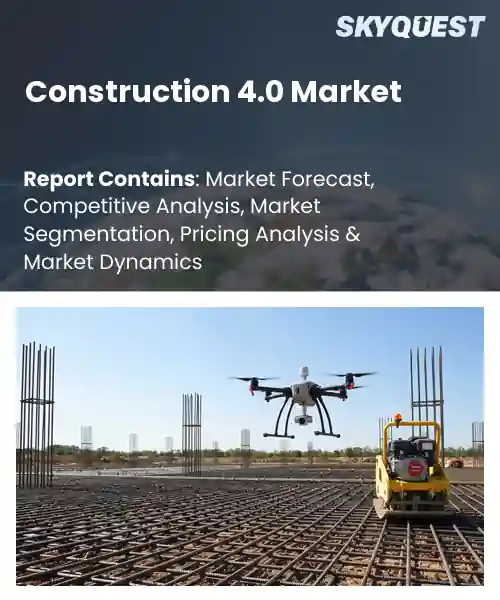
Construction 4.0 Market
Report ID: SQMIG20I2856
Report ID: SQMIG20I2856
[email protected]
USA +1 351-333-4748
Report ID:
SQMIG20I2856 |
Region:
Global |
Published Date: April, 2026
Pages:
157
|Tables:
118
|Figures:
77


Global Construction 4.0 Market size was valued at USD 22.37 Billion in 2024 and is poised to grow from USD 26.96 Billion in 2025 to USD 22.7 Billion by 2033, growing at a CAGR of 20.5% during the forecast period (2026-2033).
Primary driver of the Construction 4.0 market is the urgent need to digitize the built environment lifecycle to close chronic productivity gaps, raise safety standards, and achieve sustainability goals. Construction 4.0 describes convergence of building information modeling, drones for site surveys, Internet of Things sensors, prefabrication, robotic assembly, and digital twins that replace fragmented practices with data-driven workflows. The market matters because construction underpins urban growth while historically lagging other industries in automation. During the past decade adoption progressed from BIM pilots to enterprise platforms on major projects; examples include drone-enabled earthworks monitoring and sensor-based asset management for smart infrastructure.Interoperability of data systems is the key factor accelerating Construction 4.0 because integrated information creates actionable insights that reduce cost and risk, which in turn attracts investment and broader adoption. When BIM models feed real-time IoT telemetry into cloud analytics, project teams can predict structural performance, shorten schedules through prefabrication, and reduce rework; for example, digital twins on transit projects enable condition-based maintenance and extend asset life. Labor shortages and tighter sustainability rules cause contractors to adopt modular construction and robotics, producing faster, greener builds. Consequently software platforms, sensor networks, offsite factories, and services represent the clearest growth opportunities globally.
How is AI enabling predictive maintenance in the Construction 4.0 market?
AI enables predictive maintenance in Construction 4.0 by turning sensor driven signals from machines and structures into actionable forecasts through machine learning models. Key aspects are telematics data, vibration and thermal imaging analytics, digital twin models and cloud based asset management that prioritize interventions and spare parts. The current state is rapid adoption of pilots and integrated platforms that move teams from reactive repairs to condition based servicing. Practical instances include AI detecting abnormal vibration on excavators or forecasting hydraulic issues on cranes and then triggering guided maintenance workflows to keep sites safer and equipment available.Caterpillar March 2026, introduced the Cat AI Assistant that unifies telematics, manuals and maintenance records to deliver predictive alerts and guided troubleshooting. This innovation reduces manual inspections, speeds repairs and helps contractors scale data driven maintenance across fleets and sites.
Market snapshot - (2026-2033)
Global Market Size
USD 22.37 Billion
Largest Segment
Building Information Modeling (BIM) & Digital Twins
Fastest Growth
Autonomous Construction Machinery & Robotics
Growth Rate
20.5% CAGR
To get more insights on this market click here to Request a Free Sample Report
Global construction 4.0 market is segmented by technology framework (core logic), advanced construction methods, application vertical, end-user segment and region. Based on technology framework (core logic), the market is segmented into Building Information Modeling (BIM) & Digital Twins, IoT & Connected Jobsite Sensors, Autonomous Construction Machinery & Robotics and AR/VR for Site Inspection & Safety Training. Based on advanced construction methods, the market is segmented into Prefabrication & Modular (Off-site) Construction and 3D Concrete Printing. Based on application vertical, the market is segmented into Residential Building Projects, Commercial & Industrial Infrastructure and Public Infrastructure (Bridges, Roads, Smart Cities). Based on end-user segment, the market is segmented into Large Construction & EPC Firms and Architecture & Engineering Design Studios. Based on region, the market is segmented into North America, Europe, Asia Pacific, Latin America and Middle East & Africa.
Building Information Modeling (BIM) & Digital Twins segment dominates because it provides a unified virtual representation that coordinates design, construction, and lifecycle activities, enabling stakeholders to validate sequences and detect clashes before field execution. Its emphasis on interoperability and standardized data flows reduces rework and contractual friction, attracting owners and contractors seeking predictable outcomes and driving ecosystem adoption of analytics, compliance, and downstream operational workflows.
However, IoT & Connected Jobsite Sensors are witnessing the strongest growth because falling hardware costs and demand for real-time site intelligence drive rapid deployment. They feed operational telemetry for safety, environmental control, and equipment monitoring, enabling predictive maintenance and novel service offerings that create new commercial models and broaden technology uptake.
Prefabrication & Modular (Off-site) Construction segment dominates because factory based production standardizes quality, shortens construction schedules, and shifts complex assembly away from variable site conditions, improving predictability for owners and contractors. Centralized manufacturing streamlines labor deployment and supply chain coordination, allowing digital planning and repeatable workflows to scale across building programs while reducing weather-related delays and enabling tighter integration with procurement and project financing models.
However, 3D Concrete Printing is the most rapidly expanding area as material advances and improved printers enable complex structures with minimal formwork and localized production. By addressing labor shortages and waste reduction while unlocking bespoke geometries, it creates new construction workflows and business models that attract investment and accelerate adoption across projects and technology providers.
To get detailed segments analysis, Request a Free Sample Report
Asia Pacific dominates due to a convergence of structural and strategic advantages. Rapid urbanization, large-scale infrastructure renewal, and a strong manufacturing ecosystem create demand and supply for digital construction solutions. Established technology suppliers and agile startups collaborate with contractors to pilot automation, robotics, prefabrication, and digital twins. Governments and metropolitan authorities promote smart-city agendas and regulatory frameworks that encourage data-driven delivery and safety standards. Cost competitiveness, dense supply chains, and skilled technical talent enable scaling of pilots into broad adoption. Regional centers of excellence, active academic–industry partnerships, and integrated supply networks accelerate commercialization, positioning Asia Pacific as the primary hub for next-generation construction innovation and ecosystem development.
Construction 4.0 Market in Japan is characterized by advanced robotics integration, high levels of digital engineering adoption, and a focus on safety and productivity improvements. Strong coordination among technology suppliers, large contractors, and municipal programs enables pilot projects to move toward mainstream implementation. Emphasis on modularization, on-site automation, and legacy equipment modernization drives a pragmatic approach that balances innovation with regulatory and labor considerations, and supply chain digitalization advance steadily.
Construction 4.0 Market in South Korea emphasizes integration of automation, advanced sensors, and building information modeling to support project execution and quality control. Major contractors collaborate with technology firms and equipment manufacturers to pilot offsite construction, autonomous equipment, and connected site platforms. Public sector initiatives for urban renewal and smart infrastructure create demand for interoperable systems. A strong electronics manufacturing base fosters scalable solutions that align innovation with construction delivery.
Rapid expansion in North America is driven by an interplay of industry demand, technological readiness, and institutional support. Major contractors and project owners push for digital tools to address productivity challenges, workforce constraints, and heightened safety expectations, creating a market pull for automation, robotics, and cloud-based project platforms. A mature technology ecosystem, active investment community, and strong research institutions accelerate commercialization and provide tested solutions for complex projects. Sustainability and resilience mandates encourage adoption of prefabrication, sensors, and integrated data workflows to optimize lifecycle performance. Standardization efforts and interoperable data standards facilitate cross-industry deployment, while partnerships between technology vendors and construction firms enable pilots to scale into established operational practices across the region. Procurement approaches in both public and private sectors increasingly reward digital capability, prompting firms to incorporate telematics, asset tracking, and predictive maintenance into operations. This convergence of demand and supply propels broader ecosystem development.
Construction 4.0 Market in United States is characterized by strong private sector adoption, deep technology investment, and active collaboration between contractors and software vendors. Large infrastructure programs and institutional owners demand data-driven delivery, driving uptake of BIM, digital twins, and connected field systems. Focus on productivity gains, safety improvements, and lifecycle performance encourages integration of prefabrication and telematics. A vibrant startup scene supports prototyping and industrialization of new site technologies.
Construction 4.0 Market in Canada emphasizes remote-site automation, modular construction methods, and integration of sustainability criteria into procurement. Collaboration among contractors, technology providers, and research centers supports adoption of sensors and digital project management platforms. Focus on workforce upskilling drives acceptance of automation and monitoring systems. Public procurement priorities for resilient infrastructure and reduced environmental impact create a favorable environment for pilots to mature into practice across regions at scale.
Europe is strengthening its position through a combination of regulatory emphasis on sustainability, coordinated standards work, and robust industrial capabilities. Policymakers and procurement authorities promote low-carbon construction and circular economy principles, creating market incentives for digital approaches that improve resource efficiency and lifecycle management. Leading engineering and contracting firms, together with research institutions, drive development of interoperable platforms, modular systems, and safety-focused automation. Cross-border collaboration and clustered industrial ecosystems enable faster maturation of technologies, while public procurement pilots and pilot cities provide testbeds for scalable solutions. Small and medium enterprises are increasingly supported by digital hubs and accelerator programs that tailor solutions to local needs. Public and private financing instruments reduce risk for pilots and help bridge the gap between prototypes and industrial deployment.
Construction 4.0 Market in Germany is anchored by advanced engineering firms and strong automation suppliers that enable industrialized building methods. Emphasis on standards, vocational training, and integration of production and construction processes supports modularization and prefabrication. Contractors work closely with machine makers and digital vendors to integrate planning systems, sensors, and quality controls. A policy environment that values energy efficiency and lifecycle performance encourages deployment of interoperable digital tools nationally.
Construction 4.0 Market in United Kingdom is driven by strong innovation clusters and active engagement between industry and academic institutions. Emphasis on digitally enabled delivery, offsite manufacturing, and lifecycle carbon reduction shapes contractor and client strategies. Standardization efforts and collaborative procurement models promote platform interoperability and safer, more efficient sites. Investment in skills development and pilot programs helps translate research into commercial solutions, enabling adoption among contractors of varying size.
Construction 4.0 Market in France is shaped by a strong focus on renovation, energy performance, and industrial strategy that supports digitalization. Contractors and technology firms collaborate on modular solutions, digital modeling, and site automation to improve quality and sustainability. Public procurement programs and innovation clusters offer platforms for testing interoperable systems. Emphasis on skills development helps small and medium construction firms adopt digital tools that improve productivity and asset performance.
To know more about the market opportunities by region and country, click here to
Buy The Complete Report
Automation Enhances Project Efficiency
Digital Twin Improves Collaboration
High Capital Investment Requirements
Fragmented Industry Standards Persist
Request Free Customization of this report to help us to meet your business objectives.
The competitive landscape for Global Construction 4.0 is centered on platform consolidation, AI enabled differentiation, and field automation, driving rivals to pursue targeted M&A, strategic alliances, and deeper product integration. For example, Procore expanded materials and asset capabilities through acquisitions including Intelliwave, Trimble partnered with Microsoft to build an Azure based Construction Cloud, and Nemetschek teamed with Hexagon to commercialize a horizontal digital twin platform.
Top Player’s Company Profile
Recent Developments
SkyQuest’s ABIRAW (Advanced Business Intelligence, Research & Analysis Wing) is our Business Information Services team that Collects, Collates, Correlates, and Analyses the Data collected by means of Primary Exploratory Research backed by robust Secondary Desk research. As per SkyQuest analysis, the Global Construction 4.0 market is propelled by the key driver of urgent digitization of the built environment to close productivity gaps, improve safety and meet sustainability targets, while a second driver is interoperability of data systems that turns BIM, IoT and analytics into actionable insights. A restraint is the high upfront capital required for advanced equipment, integrated software and skilled personnel, which slows adoption among smaller firms. The dominating region is Asia Pacific, supported by rapid urbanization and robust manufacturing ecosystems, and the dominating segment is Building Information Modeling and Digital Twins, which reduce rework and improve lifecycle coordination.
| Report Metric | Details |
|---|---|
| Market size value in 2024 | USD 22.37 Billion |
| Market size value in 2033 | USD 22.7 Billion |
| Growth Rate | 20.5% |
| Base year | 2024 |
| Forecast period | (2026-2033) |
| Forecast Unit (Value) | USD Billion |
| Segments covered |
|
| Regions covered | North America (US, Canada), Europe (Germany, France, United Kingdom, Italy, Spain, Rest of Europe), Asia Pacific (China, India, Japan, Rest of Asia-Pacific), Latin America (Brazil, Rest of Latin America), Middle East & Africa (South Africa, GCC Countries, Rest of MEA) |
| Companies covered |
|
| Customization scope | Free report customization with purchase. Customization includes:-
|
To get a free trial access to our platform which is a one stop solution for all your data requirements for quicker decision making. This platform allows you to compare markets, competitors who are prominent in the market, and mega trends that are influencing the dynamics in the market. Also, get access to detailed SkyQuest exclusive matrix.
Table Of Content
Executive Summary
Market overview
Parent Market Analysis
Market overview
Market size
KEY MARKET INSIGHTS
COVID IMPACT
MARKET DYNAMICS & OUTLOOK
Market Size by Region
KEY COMPANY PROFILES
Methodology
For the Construction 4.0 Market, our research methodology involved a mixture of primary and secondary data sources. Key steps involved in the research process are listed below:
1. Information Procurement: This stage involved the procurement of Market data or related information via primary and secondary sources. The various secondary sources used included various company websites, annual reports, trade databases, and paid databases such as Hoover's, Bloomberg Business, Factiva, and Avention. Our team did 45 primary interactions Globally which included several stakeholders such as manufacturers, customers, key opinion leaders, etc. Overall, information procurement was one of the most extensive stages in our research process.
2. Information Analysis: This step involved triangulation of data through bottom-up and top-down approaches to estimate and validate the total size and future estimate of the Construction 4.0 Market.
3. Report Formulation: The final step entailed the placement of data points in appropriate Market spaces in an attempt to deduce viable conclusions.
4. Validation & Publishing: Validation is the most important step in the process. Validation & re-validation via an intricately designed process helped us finalize data points to be used for final calculations. The final Market estimates and forecasts were then aligned and sent to our panel of industry experts for validation of data. Once the validation was done the report was sent to our Quality Assurance team to ensure adherence to style guides, consistency & design.
Analyst Support
Customization Options
With the given market data, our dedicated team of analysts can offer you the following customization options are available for the Construction 4.0 Market:
Product Analysis: Product matrix, which offers a detailed comparison of the product portfolio of companies.
Regional Analysis: Further analysis of the Construction 4.0 Market for additional countries.
Competitive Analysis: Detailed analysis and profiling of additional Market players & comparative analysis of competitive products.
Go to Market Strategy: Find the high-growth channels to invest your marketing efforts and increase your customer base.
Innovation Mapping: Identify racial solutions and innovation, connected to deep ecosystems of innovators, start-ups, academics, and strategic partners.
Category Intelligence: Customized intelligence that is relevant to their supply Markets will enable them to make smarter sourcing decisions and improve their category management.
Public Company Transcript Analysis: To improve the investment performance by generating new alpha and making better-informed decisions.
Social Media Listening: To analyze the conversations and trends happening not just around your brand, but around your industry as a whole, and use those insights to make better Marketing decisions.
REQUEST FOR SAMPLE
 REQUEST FREE CUSTOMIZATION


Want to customize this report? This report can be personalized according to your needs. Our analysts and industry experts will work directly with you to understand your requirements and provide you with customized data in a short amount of time. We offer $1000 worth of FREE customization at the time of purchase.
Feedback From Our Clients


 USA (+1) 351-333-4748

