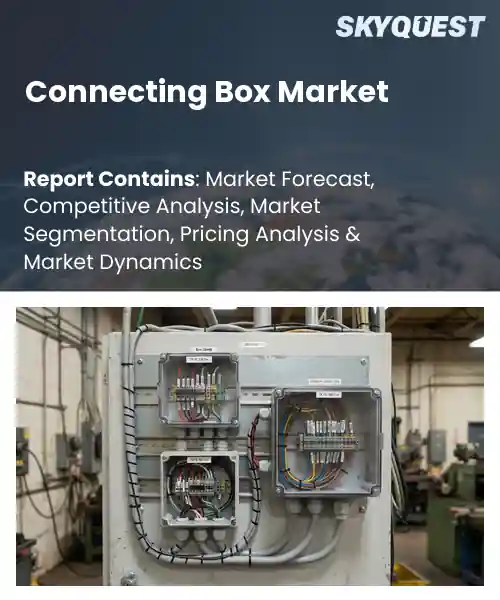
Connecting Box Market
Report ID: SQMIG45K2434
Report ID: SQMIG45K2434
[email protected]
USA +1 351-333-4748
Report ID:
SQMIG45K2434 |
Region:
Global |
Published Date: August, 2026
Pages:
157
|Tables:
176
|Figures:
79


Global Connecting Box Market size was valued at USD 5.87 Billion in 2024 and is poised to grow from USD 6.2 Billion in 2025 to USD 9.59 Billion by 2033, growing at a CAGR of 5.6% during the forecast period (2026-2033).
The connecting box market, encompassing modular electrical junctions, signal distribution panels, and interfaces, has become a cornerstone of infrastructure because it enables rapid, reliable integration of power and data across residential, commercial, and industrial settings. Its significance stems from escalating demand for compact, high‑density wiring solutions supporting IoT devices and renewable‑energy systems. Historically, the sector evolved from simple copper conduit assemblies in the 1970s to sophisticated housings today, driven by the proliferation of broadband connectivity and the need for scalable networks. For example, the adoption of PLC‑compatible boxes in smart‑grid projects illustrates how streamlined interconnection fuels efficiency and reduces downtime. One pivotal factor shaping the global connecting box market is the expansion of data‑center edge deployments, which compel operators to consolidate power distribution and network routing within footprints. As edge nodes proliferate to meet applications such as autonomous vehicles, demand for multifunctional boxes that embed power‑over‑ethernet, thermal management, and remote monitoring rises. This creates opportunities for manufacturers to integrate smart sensors that trigger predictive maintenance, reducing unplanned outages and operational costs. For instance, a leading telecom provider retrofitted its 5G micro‑sites with intelligent connecting boxes, achieving a 15 % significant drop in downtime and unlocking new service‑level agreements leveraging real‑time analytics.
How is AI driving IoT integration in the Connecting Box market?
AI is turning the Connecting Box market into a smarter hub for device communication. By embedding machine‑learning models at the edge, boxes can interpret sensor streams in real time, trigger alerts, and adjust power or bandwidth without human input. This reduces latency and eases the burden on central servers, making large‑scale IoT deployments more reliable. Vendors are adding firmware that learns usage patterns, enabling predictive maintenance that prevents failures before they occur. The market is expanding as manufacturers bundle AI chips with traditional enclosure designs, offering plug‑and‑play solutions that simplify integration for industrial and residential applications. Growing demand for seamless connectivity drives investment in AI‑enabled hardware that can manage diverse protocols and scale across complex networks.In June 2026, a leading North American manufacturer announced an AI‑powered Connecting Box, improving integration efficiency and supporting market growth.
Market snapshot - (2026-2033)
Global Market Size
USD 5.87 Billion
Largest Segment
Electrical Junction Boxes
Fastest Growth
Communication Connection Boxes
Growth Rate
5.6% CAGR
To get more insights on this market click here to Request a Free Sample Report
Global connecting box market is segmented by product type, material, mounting type, application, protection rating, distribution channel and region. Based on product type, the market is segmented into Electrical Junction Boxes, Communication Connection Boxes, Terminal Connection Boxes and Others. Based on material, the market is segmented into Plastic, Metal, Composite and Others. Based on mounting type, the market is segmented into Surface Mounted, Flush Mounted, Pole Mounted and Others. Based on application, the market is segmented into Residential Buildings, Commercial Buildings, Industrial Facilities and Others. Based on protection rating, the market is segmented into Indoor, Weatherproof, Explosion-Proof and Others. Based on distribution channel, the market is segmented into Direct Sales, Electrical Distributors and Others. Based on region, the market is segmented into North America, Europe, Asia Pacific, Latin America and Middle East & Africa.
Plastic segment dominates because its low cost, ease of molding, and widespread availability make it the default choice for mass‑produced connecting boxes. Manufacturers prioritize plastic for residential and commercial installations where aesthetic flexibility and lightweight handling are essential. This material’s resistance to corrosion and compatibility with automated injection processes streamline supply chains, reinforcing its leading position in the overall market. Additionally, regulatory acceptance of plastic for indoor use further entrenches its market share.
However, composite segment emerges as the key high‑growth area because its superior strength‑to‑weight ratio and enhanced fire‑rating enable adoption in industrial facilities and explosion‑prone zones. Innovations in fiber reinforcement are expanding design possibilities, driving demand and positioning composites to accelerate future market expansion across multiple product lines, offering manufacturers a versatile solution for emerging safety standards.
Weatherproof segment dominates because it provides reliable protection against moisture, dust, and temperature fluctuations, essential for outdoor and semi‑indoor installations. Designers favor weatherproof enclosures to meet durability expectations and reduce maintenance cycles. Its proven sealing technologies and compliance with international ingress standards assure long‑term performance, making it the preferred choice for a broad range of applications across the market. Furthermore, the ability to integrate corrosion‑resistant hardware enhances its suitability for coastal and humid zones.
Meanwhile, explosion‑proof segment emerges as the fastest expanding area because stringent safety regulations in oil‑gas and chemical plants drive demand for certified enclosures. Advances in pressure‑balanced designs reduce weight while maintaining compliance, opening new opportunities in hazardous‑area projects and propelling market growth. These developments also encourage OEMs to adopt modular solutions, further accelerating adoption cycles.
To get detailed segments analysis, Request a Free Sample Report
North America’s dominance in the Connecting Box market stems from a mature technology ecosystem, robust supply chain networks, and sustained investment in advanced manufacturing capabilities. The region benefits from deep collaboration between leading semiconductor firms, system integrators and research institutions, fostering rapid product development and standardisation. Regulatory frameworks that support interoperability and security further reinforce market confidence. Strong customer demand across data centre, telecommunications and industrial sectors drives continuous innovation, while an extensive service infrastructure ensures reliable after‑sales support. This combination of technical leadership, ecosystem cohesion and customer focus consolidates North America’s leading position globally. Additionally, the region’s deep talent pool in engineering and software development fuels continuous improvement in device functionality and integration capabilities. Ongoing venture capital activity encourages start‑ups to bring niche solutions that complement established offerings, enhancing overall market breadth. The convergence of these factors creates a resilient ecosystem that consistently outpaces competing regions.
Connecting Box Market in the United States benefits from a concentrated cluster of technology innovators and a well‑established standards body that drives product compatibility. Close proximity between hardware manufacturers and software developers accelerates time‑to‑market for new solutions, while a sophisticated logistics network ensures rapid distribution across key industrial hubs. End‑user confidence is reinforced by rigorous testing protocols and extensive field support services, fostering long‑term adoption across multiple verticals in the broader market.
Connecting Box Market in Canada leverages strong governmental encouragement for digital infrastructure upgrades and a collaborative research environment linking universities with industry partners. The emphasis on secure, interoperable solutions aligns with national priorities on data sovereignty, prompting adoption among telecom providers and public‑sector entities. A responsive supply chain backed by cross‑border trade agreements facilitates access to cutting‑edge components, while localized technical support nurtures customer confidence and drives steady market expansion.
Europe’s Connecting Box market accelerates rapidly due to a harmonious blend of regulatory alignment, industry collaboration and a pronounced commitment to sustainability. Harmonised standards across the continent simplify cross‑border deployment, encouraging manufacturers to design interoperable devices that meet stringent security and environmental criteria. Collaborative ecosystems linking automotive, energy and telecommunications sectors foster innovative use cases, while government incentives promote digital transformation in critical infrastructure. A mature engineering talent pool combined with a culture of precision engineering underpins continual product refinement. Additionally, the emphasis on circular economy practices drives manufacturers to integrate modular designs and recyclable materials, resonating with environmentally conscious customers. These converging forces create a fertile environment for swift market expansion across Europe’s diverse economies. The region’s focus on data privacy further augments trust, encouraging broader adoption among enterprises seeking compliant connectivity solutions.
Connecting Box Market in Germany reflects its role as benchmark for engineering excellence and standardisation within Europe. Strong collaboration between OEMs, research institutes and standards bodies leads to reliable, secure devices that serve automotive, industrial automation and renewable energy sectors. The nation’s emphasis on precision manufacturing ensures rigorous quality controls, while extensive testing facilities accelerate certification processes. This combination of rigour and proactive policy support sustains Germany’s dominant market position across continent.
Connecting Box Market in the United Kingdom is propelled by a startup ecosystem and digital infrastructure programmes. Close ties between academia and industry accelerate innovation in edge connectivity and network virtualization, positioning the UK as a hub for advanced solutions. Government initiatives that prioritize broadband and smart city deployments create fertile demand across public and private sectors. Combined with a skilled workforce and supportive regulatory environment, these factors drive the country’s rapid market expansion.
Connecting Box Market in France is emerging as a focal point for interoperability initiatives and green technology adoption. National strategies that encourage smart grid integration and renewable energy networking stimulate demand for adaptable connectivity solutions. Collaborative consortia linking telecom operators, energy firms and software developers foster tailored applications for industry 4.0 environments. A growing emphasis on modular design and lifecycle management aligns with the country’s sustainability objectives, gradually expanding market presence.
Asia Pacific strengthens its position in the Connecting Box market through a synergistic blend of manufacturing scale, rapid technology adoption and proactive policy support. The region hosts a dense network of component producers, enabling cost‑effective supply chains that feed both domestic demand and export markets. Nations prioritize smart infrastructure projects, integrating connectivity solutions into telecommunications, transportation and renewable energy systems, which accelerates product rollout. Collaborative research initiatives between universities and industry accelerate advancement in low‑latency and high‑security designs, catering to the region’s burgeoning data‑intensive applications. Additionally, a focus on sustainability drives the development of energy‑efficient modules and circular‑economy practices. This multifaceted approach, underpinned by skilled engineering talent and supportive regulatory frameworks, elevates Asia Pacific’s influence in the global landscape of connecting technologies.
Connecting Box Market in Japan is characterized by a strong emphasis on precision engineering and integration with high‑performance communication standards. Close collaboration between device manufacturers and leading telecommunication operators facilitates seamless rollout of next‑generation connectivity across urban and industrial settings. Governmental focus on Society 5.0 initiatives propels adoption of smart manufacturing and IoT solutions, driving demand for reliable, low‑latency boxes. The country’s dedication to rigorous testing and quality assurance ensures that products meet stringent reliability criteria, reinforcing confidence among domestic and international customers.
Connecting Box Market in South Korea benefits from a dynamic ecosystem where leading semiconductor firms and networking companies co‑develop advanced connectivity platforms. The nation’s aggressive rollout of ultra‑fast broadband and 5G infrastructure creates a fertile environment for deploying sophisticated box solutions in both consumer and industrial domains. Strong governmental incentives for smart city and autonomous vehicle projects stimulate demand for high‑throughput, secure devices. Coupled with a culture of rapid prototyping and rigorous standards compliance, South Korea maintains a competitive edge in delivering cutting‑edge connectivity hardware.
To know more about the market opportunities by region and country, click here to
Buy The Complete Report
Growing Demand For Smart Infrastructure
Adoption Of Edge Computing Solutions
High Initial Capital Expenditure
Regulatory Compliance Challenges
Request Free Customization of this report to help us to meet your business objectives.
The global Connecting Box market is shaped by intense rivalry as manufacturers pursue strategic M&A, forge distribution partnerships, and accelerate tech innovation such as edge‑AI integration; for example, Plug and Play’s backing of 64 rounds in H1 2026 spurred multiple hardware collaborations, while Y Combinator‑backed Bay Area firms are rapidly scaling through joint product development and cross‑border alliances.
Top Player’s Company Profile
Recent Developments
SkyQuest’s ABIRAW (Advanced Business Intelligence, Research & Analysis Wing) is our Business Information Services team that Collects, Collates, Correlates, and Analyses the Data collected by means of Primary Exploratory Research backed by robust Secondary Desk research. As per SkyQuest analysis, the global connecting‑box market is being propelled primarily by the growing demand for smart infrastructure, which fuels investment in modular wiring solutions for cities and industrial sites. A second strong catalyst is the rapid adoption of edge‑computing architectures that require compact, locally intelligent boxes to cut latency and bandwidth use. The market is led by North America, where mature supply chains and tech ecosystems drive adoption, and the plastic segment remains the dominant material choice because of its low cost and ease of molding. However, high initial capital expenditure poses a significant restraint, slowing uptake among smaller firms and extending procurement cycles.
| Report Metric | Details |
|---|---|
| Market size value in 2024 | USD 5.87 Billion |
| Market size value in 2033 | USD 9.59 Billion |
| Growth Rate | 5.6% |
| Base year | 2024 |
| Forecast period | (2026-2033) |
| Forecast Unit (Value) | USD Billion |
| Segments covered |
|
| Regions covered | North America (US, Canada), Europe (Germany, France, United Kingdom, Italy, Spain, Rest of Europe), Asia Pacific (China, India, Japan, Rest of Asia-Pacific), Latin America (Brazil, Rest of Latin America), Middle East & Africa (South Africa, GCC Countries, Rest of MEA) |
| Companies covered |
|
| Customization scope | Free report customization with purchase. Customization includes:-
|
To get a free trial access to our platform which is a one stop solution for all your data requirements for quicker decision making. This platform allows you to compare markets, competitors who are prominent in the market, and mega trends that are influencing the dynamics in the market. Also, get access to detailed SkyQuest exclusive matrix.
Table Of Content
Executive Summary
Market overview
Parent Market Analysis
Market overview
Market size
KEY MARKET INSIGHTS
COVID IMPACT
MARKET DYNAMICS & OUTLOOK
Market Size by Region
KEY COMPANY PROFILES
Methodology
For the Connecting Box Market, our research methodology involved a mixture of primary and secondary data sources. Key steps involved in the research process are listed below:
1. Information Procurement: This stage involved the procurement of Market data or related information via primary and secondary sources. The various secondary sources used included various company websites, annual reports, trade databases, and paid databases such as Hoover's, Bloomberg Business, Factiva, and Avention. Our team did 45 primary interactions Globally which included several stakeholders such as manufacturers, customers, key opinion leaders, etc. Overall, information procurement was one of the most extensive stages in our research process.
2. Information Analysis: This step involved triangulation of data through bottom-up and top-down approaches to estimate and validate the total size and future estimate of the Connecting Box Market.
3. Report Formulation: The final step entailed the placement of data points in appropriate Market spaces in an attempt to deduce viable conclusions.
4. Validation & Publishing: Validation is the most important step in the process. Validation & re-validation via an intricately designed process helped us finalize data points to be used for final calculations. The final Market estimates and forecasts were then aligned and sent to our panel of industry experts for validation of data. Once the validation was done the report was sent to our Quality Assurance team to ensure adherence to style guides, consistency & design.
Analyst Support
Customization Options
With the given market data, our dedicated team of analysts can offer you the following customization options are available for the Connecting Box Market:
Product Analysis: Product matrix, which offers a detailed comparison of the product portfolio of companies.
Regional Analysis: Further analysis of the Connecting Box Market for additional countries.
Competitive Analysis: Detailed analysis and profiling of additional Market players & comparative analysis of competitive products.
Go to Market Strategy: Find the high-growth channels to invest your marketing efforts and increase your customer base.
Innovation Mapping: Identify racial solutions and innovation, connected to deep ecosystems of innovators, start-ups, academics, and strategic partners.
Category Intelligence: Customized intelligence that is relevant to their supply Markets will enable them to make smarter sourcing decisions and improve their category management.
Public Company Transcript Analysis: To improve the investment performance by generating new alpha and making better-informed decisions.
Social Media Listening: To analyze the conversations and trends happening not just around your brand, but around your industry as a whole, and use those insights to make better Marketing decisions.
REQUEST FOR SAMPLE
 REQUEST FREE CUSTOMIZATION


Want to customize this report? This report can be personalized according to your needs. Our analysts and industry experts will work directly with you to understand your requirements and provide you with customized data in a short amount of time. We offer $1000 worth of FREE customization at the time of purchase.
Feedback From Our Clients


 USA (+1) 351-333-4748

