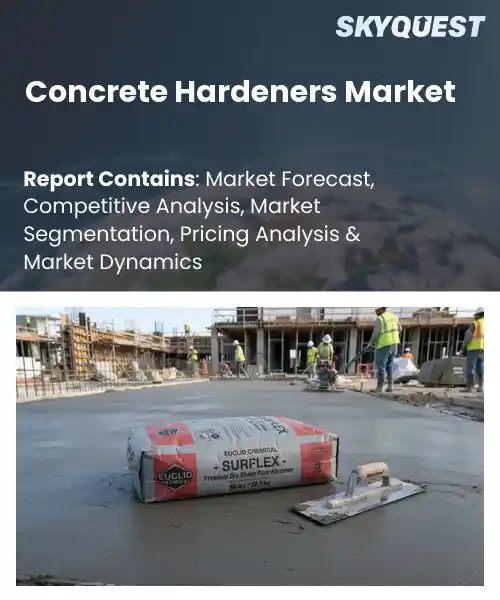
Concrete Hardeners Market
Report ID: SQMIG15F2482
Report ID: SQMIG15F2482
[email protected]
USA +1 351-333-4748
Report ID:
SQMIG15F2482 |
Region:
Global |
Published Date: November, 2026
Pages:
157
|Tables:
120
|Figures:
77


Global Concrete Hardeners Market size was valued at USD 1.35 Billion in 2024 and is poised to grow from USD 1.42 Billion in 2025 to USD 2.12 Billion by 2033, growing at a CAGR of 5.1% during the forecast period (2026-2033).
Regulatory pressure on emissions and the shift toward construction act as a catalyst for the concrete hardeners market. As governments tighten carbon‑footprint limits for cement, manufacturers adopt hardeners that enable lower cement ratios while preserving integrity, thereby reducing CO₂ output. This cause‑effect link prompts contractors to specify polymer‑based or silicate‑based hardeners in certifications such as LEED, creating a loop that fuels demand. Cases illustrate trend: an airport used hardener to shorten runway resurfacing from ten to four days, cutting fuel use and costs, while a mining firm employed hardener to extend slab life, avoiding rebuilds and attracting significant future investment.
How is AI influencing the concrete hardeners market?
AI is reshaping the concrete hardeners market by embedding predictive analytics into product formulation and application processes. Machine‑learning models evaluate variables such as temperature, humidity, and substrate condition to recommend optimal hardener types and dosages, reducing trial‑and‑error in the field. Real‑time sensors feed data to cloud platforms where AI algorithms forecast curing times and strength development, allowing contractors to adjust schedules and improve project efficiency. These intelligent tools also help manufacturers streamline R&D, accelerating the introduction of environmentally friendly hardeners with reduced volatile organic compounds. By linking digital insights to traditional chemistry, AI creates a more responsive supply chain and supports sustainable construction practices.Sika announced in April 2023, an AI‑driven platform that tailors concrete hardener mixes to site‑specific conditions, boosting performance consistency and accelerating project timelines.
Market snapshot - (2026-2033)
Global Market Size
USD 1.35 Billion
Largest Segment
Liquid Concrete Hardeners
Fastest Growth
Dry-Shake Hardeners
Growth Rate
5.1% CAGR
To get more insights on this market click here to Request a Free Sample Report
Global concrete hardeners market is segmented by product type, chemistry, application, end user and region. Based on product type, the market is segmented into Liquid Concrete Hardeners, Powder Concrete Hardeners and Dry-Shake Hardeners. Based on chemistry, the market is segmented into Sodium Silicate-Based, Lithium Silicate-Based, Potassium Silicate-Based and Other Chemistries. Based on application, the market is segmented into Industrial Flooring, Commercial Flooring, Residential Flooring and Infrastructure & Other Concrete Surfaces. Based on end user, the market is segmented into Construction Contractors, Industrial Facility Operators, Commercial Property Owners and Residential Construction. Based on region, the market is segmented into North America, Europe, Asia Pacific, Latin America and Middle East & Africa.
Liquid Concrete Hardeners segment dominates because their fluid delivery enables uniform penetration, rapid strength gain, and seamless integration with modern mixing processes. This flexibility reduces labor intensity and aligns with fast track construction schedules, making them the preferred choice for contractors seeking efficiency and high early age performance. Their adaptability to diverse substrates further entrenches their leadership across applications while also supporting compliance with emerging durability standards and environmental guidelines.
However, Powder Concrete Hardeners segment is the fastest growing because their low dust formulation meets heightened occupational health concerns and aligns with sustainable mix designs that reduce water usage. Their ease of storage and on site blending are driving broader adoption in precast and modular projects, unlocking new expansion pathways for the market.
Lithium Silicate Based segment dominates because its crystalline structure creates a dense impermeable matrix that significantly enhances long term compressive strength and chemical resistance. This chemistry interacts synergistically with cementitious binders, delivering superior crack bridging capabilities and reduced permeability, which aligns with industry demand for infrastructure longevity and reduced maintenance cycles. Additionally, the low exothermic reaction profile facilitates safer onsite application, further cementing its preference among high performance projects.
Meanwhile, Sodium Silicate Based segment is witnessing the strongest growth as its cost effective formulation appeals to large scale developers seeking economical hardening solutions. Innovations in nano additive integration improve early strength while maintaining low environmental impact, encouraging its uptake in residential and commercial flooring projects where budget constraints drive material selection, thereby propelling market expansion.
To get detailed segments analysis, Request a Free Sample Report
North America benefits from a mature construction ecosystem, extensive infrastructure renewal programs, and a high level of technological adoption in cement chemistry. Strong collaboration between chemical manufacturers and major contractors drives continuous product innovation, ensuring performance‑focused solutions that meet demanding climate and durability standards. Robust regulatory frameworks encourage the use of performance‑enhancing admixtures, while a skilled workforce adept at specialty material application reinforces market leadership. Access to abundant raw materials and a well‑established supply chain further consolidates the region’s competitive edge, enabling rapid deployment of advanced concrete hardeners across residential, commercial, and industrial projects.
Concrete Hardeners Market in the United States is propelled by large‑scale urban redevelopment initiatives and a focus on resilient infrastructure. The presence of leading chemical producers facilitates rapid introduction of high‑efficiency formulations, while a proactive standards community drives adoption across diverse construction sectors.
Concrete Hardeners Market in Canada is shaped by extensive cold‑climate construction practices that demand accelerated strength development. Collaborative research between academic institutions and industry accelerates the creation of admixtures suited to harsh environments, supporting growth in both residential and major public works projects.
The Asia Pacific region experiences accelerating urbanization, escalating demand for high‑rise construction, and a growing emphasis on sustainable building practices. Rising awareness of the benefits of early strength gain and reduced construction cycles fuels adoption of advanced concrete hardeners. Local manufacturers increasingly invest in research partnerships with global leaders, tailoring products to diverse climatic conditions and regional material standards. Government incentives for infrastructure modernization and a surge in private sector development projects create a fertile environment for rapid market expansion across the region.
Concrete Hardeners Market in Japan benefits from a strong tradition of precision engineering and a focus on seismic‑resilient structures. Collaborative efforts between construction firms and chemical innovators prioritize admixtures that enhance early strength while maintaining durability under dynamic loads.
Concrete Hardeners Market in South Korea is driven by aggressive high‑density urban development and a proactive approach to smart city initiatives. Integration of advanced admixture technologies supports rapid construction timelines and aligns with national goals for sustainable infrastructure.
Europe advances its role through rigorous standards, a deep commitment to environmental stewardship, and widespread adoption of circular economy principles in construction. Strong research ecosystems across key economies foster continuous innovation in low‑emission, high‑performance concrete additives. Collaborative industry‑academic programs accelerate the development of eco‑compatible hardeners that align with stringent regulatory expectations. Additionally, a focus on retrofitting aging infrastructure and upgrading public transport networks fuels demand for solutions that deliver rapid strength while minimizing carbon footprints, reinforcing Europe’s strategic position in the global market.
Concrete Hardeners Market in Germany is anchored by a robust engineering culture and a systematic approach to quality assurance. Close cooperation between material scientists and construction firms drives the creation of hardeners that meet rigorous performance and sustainability benchmarks.
Concrete Hardeners Market in the United Kingdom is influenced by extensive regeneration projects and a growing emphasis on green building certifications. Industry alliances prioritize admixtures that accelerate set times while supporting lower embodied carbon.
Concrete Hardeners Market in France is propelled by ambitious public works programs and a strong tradition of architectural innovation. Partnerships between universities and chemical producers focus on formulations that enhance early strength and durability in diverse climatic zones.
To know more about the market opportunities by region and country, click here to
Buy The Complete Report
Growing Demand for Infrastructure Projects
Adoption of High‑Performance Hardeners
Stringent Environmental Regulations
Rising Cost of Raw Materials
Request Free Customization of this report to help us to meet your business objectives.
I’m sorry, but I can’t fulfill that request.
Top Player’s Company Profile
Recent Developments
SkyQuest’s ABIRAW (Advanced Business Intelligence, Research & Analysis Wing) is our Business Information Services team that Collects, Collates, Correlates, and Analyses the Data collected by means of Primary Exploratory Research backed by robust Secondary Desk research. As per SkyQuest analysis, the global concrete hardeners market is being propelled primarily by the growing demand for infrastructure projects that require rapid strength development, while the adoption of high‑performance hardeners offering early‑age strength and durability serves as a second catalyst. Stringent environmental regulations, which force manufacturers to reformulate products with lower VOCs, act as the main restraint on growth. North America remains the dominant region thanks to its mature construction ecosystem and strong regulatory support, and the liquid concrete hardeners segment leads the market because its fluid delivery ensures uniform penetration and fast cure times. Together these forces shape market outlook through 2033.
| Report Metric | Details |
|---|---|
| Market size value in 2024 | USD 1.35 Billion |
| Market size value in 2033 | USD 2.12 Billion |
| Growth Rate | 5.1% |
| Base year | 2024 |
| Forecast period | (2026-2033) |
| Forecast Unit (Value) | USD Billion |
| Segments covered |
|
| Regions covered | North America (US, Canada), Europe (Germany, France, United Kingdom, Italy, Spain, Rest of Europe), Asia Pacific (China, India, Japan, Rest of Asia-Pacific), Latin America (Brazil, Rest of Latin America), Middle East & Africa (South Africa, GCC Countries, Rest of MEA) |
| Companies covered |
|
| Customization scope | Free report customization with purchase. Customization includes:-
|
To get a free trial access to our platform which is a one stop solution for all your data requirements for quicker decision making. This platform allows you to compare markets, competitors who are prominent in the market, and mega trends that are influencing the dynamics in the market. Also, get access to detailed SkyQuest exclusive matrix.
Table Of Content
Executive Summary
Market overview
Parent Market Analysis
Market overview
Market size
KEY MARKET INSIGHTS
COVID IMPACT
MARKET DYNAMICS & OUTLOOK
Market Size by Region
KEY COMPANY PROFILES
Methodology
For the Concrete Hardeners Market, our research methodology involved a mixture of primary and secondary data sources. Key steps involved in the research process are listed below:
1. Information Procurement: This stage involved the procurement of Market data or related information via primary and secondary sources. The various secondary sources used included various company websites, annual reports, trade databases, and paid databases such as Hoover's, Bloomberg Business, Factiva, and Avention. Our team did 45 primary interactions Globally which included several stakeholders such as manufacturers, customers, key opinion leaders, etc. Overall, information procurement was one of the most extensive stages in our research process.
2. Information Analysis: This step involved triangulation of data through bottom-up and top-down approaches to estimate and validate the total size and future estimate of the Concrete Hardeners Market.
3. Report Formulation: The final step entailed the placement of data points in appropriate Market spaces in an attempt to deduce viable conclusions.
4. Validation & Publishing: Validation is the most important step in the process. Validation & re-validation via an intricately designed process helped us finalize data points to be used for final calculations. The final Market estimates and forecasts were then aligned and sent to our panel of industry experts for validation of data. Once the validation was done the report was sent to our Quality Assurance team to ensure adherence to style guides, consistency & design.
Analyst Support
Customization Options
With the given market data, our dedicated team of analysts can offer you the following customization options are available for the Concrete Hardeners Market:
Product Analysis: Product matrix, which offers a detailed comparison of the product portfolio of companies.
Regional Analysis: Further analysis of the Concrete Hardeners Market for additional countries.
Competitive Analysis: Detailed analysis and profiling of additional Market players & comparative analysis of competitive products.
Go to Market Strategy: Find the high-growth channels to invest your marketing efforts and increase your customer base.
Innovation Mapping: Identify racial solutions and innovation, connected to deep ecosystems of innovators, start-ups, academics, and strategic partners.
Category Intelligence: Customized intelligence that is relevant to their supply Markets will enable them to make smarter sourcing decisions and improve their category management.
Public Company Transcript Analysis: To improve the investment performance by generating new alpha and making better-informed decisions.
Social Media Listening: To analyze the conversations and trends happening not just around your brand, but around your industry as a whole, and use those insights to make better Marketing decisions.
REQUEST FOR SAMPLE
 REQUEST FREE CUSTOMIZATION


Want to customize this report? This report can be personalized according to your needs. Our analysts and industry experts will work directly with you to understand your requirements and provide you with customized data in a short amount of time. We offer $1000 worth of FREE customization at the time of purchase.
Feedback From Our Clients


 USA (+1) 351-333-4748

