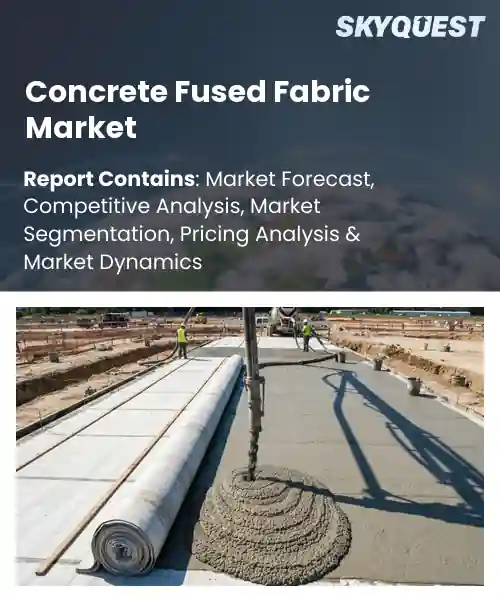
Concrete Fused Fabric Market
Report ID: SQMIG15F2411
Report ID: SQMIG15F2411
[email protected]
USA +1 351-333-4748
Report ID:
SQMIG15F2411 |
Region:
Global |
Published Date: July, 2026
Pages:
157
|Tables:
145
|Figures:
78


Global Concrete Fused Fabric Market size was valued at USD 842.7 Million in 2024 and is poised to grow from USD 905.06 Million in 2025 to USD 1602.18 Million by 2033, growing at a CAGR of 7.4% during the forecast period (2026-2033).
The concrete fused fabric (CFF) market revolves around a composite material that bonds high‑strength fabric with cementitious slurry, producing panels that combine tensile flexibility with fire‑resistant rigidity. Its relevance stems from the construction sector’s demand for lightweight, prefabricated components that reduce labor costs while meeting stringent safety codes. Originating in the early 2000s as a niche solution for modular housing, the technology gained traction after a 2014 European pilot project demonstrated a 30 % reduction in wall‑assembly time compared with traditional concrete blocks. Subsequent adoption by disaster‑relief NGOs and fast‑track urban developers has accelerated the market’s growth trajectory globally by 2030. A growth factor for the CFF market is its alignment with sustainability mandates that push the industry toward sustainable envelopes. Because the fabric core can be made from polyester or basalt fibers, energy of a CFF panel drops up to 40 % versus conventional precast concrete, prompting architects to specify it in LEED projects. Deployments such as the 2022 “Green Tower” in Dubai, where CFF façades cut HVAC demand by 15 %, show how the material turns environmental compliance into operational savings. Consequently, manufacturers are expanding capacity in Asia‑Pacific, where incentives for green construction create a pipeline of collaborations and accelerate penetration.
How are AI and IoT driving innovation in the concrete fused fabric market?
AI is reshaping concrete fused fabric design by processing sensor data to predict optimal fiber‑matrix ratios, reducing trial‑and‑error cycles and cutting material waste. IoT‑enabled fabrics embed temperature, humidity and strain probes that stream real‑time conditions to cloud platforms, allowing manufacturers to adjust curing cycles on the fly. Together these technologies create digital twins of production lines, improving quality control and enabling predictive maintenance of weaving equipment. The result is faster product launches, higher consistency and lower carbon footprints, which aligns with the industry’s push toward greener, more efficient construction solutions.Credence Research April 2026, announced an AI‑driven monitoring system for concrete fused fabrics that integrates IoT sensors to automate quality checks, accelerating production throughput and supporting market growth.
Market snapshot - (2026-2033)
Global Market Size
USD 842.7 Million
Largest Segment
Concrete Canvas
Fastest Growth
Concrete Fabric Mats
Growth Rate
7.4% CAGR
To get more insights on this market click here to Request a Free Sample Report
Global concrete fused fabric market is segmented by product type, application, end user, reinforcement material, installation method and region. Based on product type, the market is segmented into Concrete Canvas, Concrete Cloth Rolls and Concrete Fabric Mats. Based on application, the market is segmented into Channel Lining, Slope Protection, Ditch Lining, Mining and Military Infrastructure. Based on end user, the market is segmented into Construction, Mining, Defense and Utilities. Based on reinforcement material, the market is segmented into Fiber Reinforced and Geotextile Reinforced. Based on installation method, the market is segmented into Manual Installation and Mechanized Installation. Based on region, the market is segmented into North America, Europe, Asia Pacific, Latin America and Middle East & Africa.
Concrete Canvas segment dominates because it offers a seamless monolithic barrier that integrates structural strength with hydraulic stability, making it ideal for high flow environments. Its ability to conform to irregular surfaces reduces joint leakage, while the cured concrete surface resists erosion and chemical attack. These functional advantages align with industry demand for durable low maintenance solutions, driving widespread adoption across infrastructure projects. Additionally its low carbon footprint relative to traditional liner systems appeals to green construction initiatives.
However Concrete Fabric Mats are witnessing the strongest growth momentum as modular production enables rapid on site deployment, especially in temporary or phased projects. Their flexible form factor allows easy transport and storage, while advances in polymer concrete bonding enhance durability, opening new opportunities in fast track construction and disaster relief applications.
Channel Lining segment dominates because it provides a robust leak proof solution that protects hydraulic conduits from abrasion, chemical corrosion, and infiltration. The fused concrete surface creates a hard wearing barrier that extends service life while minimizing maintenance interruptions. Engineers favor this approach for critical water and sewer networks, where reliability and long term performance are paramount, reinforcing its preeminence in the market. Additionally its compatibility with existing pipe diameters reduces retrofit complexity and project lead times.
On the other hand Mining is emerging as the key high growth area as the need for durable corrosion resistant walling in underground excavations rises. Innovative formulations improve resistance to heavy loads and underground water, prompting adoption in new ore extraction sites and extending the market’s reach beyond traditional civil projects.
To get detailed segments analysis, Request a Free Sample Report
The dominance of Asia Pacific stems from a convergence of advanced manufacturing capabilities, strong infrastructural development, and early adoption of high‑performance composites. Regional producers leverage sophisticated textile engineering and cement technologies to create lightweight, durable panels that meet demanding construction standards. Government incentives for sustainable building practices encourage the integration of concrete fused fabric in residential and commercial projects. Moreover, a robust supply chain for raw materials and a skilled workforce accelerate innovation and cost‑effective scaling. Collaborative research between universities and industry leaders further propels product differentiation, positioning the region as a benchmark for quality and application versatility across global markets.
Concrete Fused Fabric Market activity in Japan is driven by a rigorous focus on seismic‑resilient construction and a cultural emphasis on longevity. Leading manufacturers integrate precision textile weaving with high‑grade cement, producing panels that combine flexibility with strength. Industry collaborations with research institutes foster continuous improvement in material performance, while government building codes that favor energy‑efficient solutions accelerate market uptake. The result is a mature ecosystem that supports both large‑scale infrastructure projects and niche residential applications.
Concrete Fused Fabric Market growth in South Korea benefits from a dynamic construction sector that prioritizes rapid urban development and innovative design. The country’s strong textile engineering base merges seamlessly with advanced cement processing, creating composites that address space constraints and sustainability goals. Public‑private partnerships fund pilot projects that showcase the material’s fire resistance and acoustic properties. This environment encourages adoption across high‑rise developments and retrofit initiatives, reinforcing South Korea’s role as a leading creator of next‑generation building solutions.
North America’s rapid expansion is fueled by a heightened demand for sustainable construction methods and an industry-wide shift toward modular building techniques. The market benefits from extensive research investment that refines composite performance, particularly in fire safety and thermal efficiency. Builders and architects value the material’s ability to reduce structural weight while maintaining durability, enabling faster erection times and lower labor costs. Regulatory frameworks that encourage reduced carbon footprints further incentivize the adoption of concrete fused fabric. Strong collaboration between material suppliers, construction firms, and design firms creates a feedback loop that accelerates product refinement and broadens application across residential, commercial, and institutional projects.
Concrete Fused Fabric Market momentum in the United States is anchored by a large construction base that embraces innovative, cost‑effective solutions. Leading firms integrate the material into prefabricated wall systems, capitalizing on its lightweight nature to streamline logistics. Sustainability mandates from federal and state agencies drive adoption in green building certifications, while academic institutions contribute cutting‑edge research on durability and environmental impact. These factors collectively nurture a vibrant ecosystem that supports widespread use across diverse project types.
Concrete Fused Fabric Market in Canada is shaped by cold‑climate engineering requirements and a strong emphasis on energy‑efficient construction. The material’s insulating properties and resistance to moisture make it well suited for residential and commercial projects in harsh environments. Collaborative initiatives between material manufacturers and provincial building bodies promote standards that incorporate concrete fused fabric into building codes. This synergy encourages architects to specify the composite for retrofit and new build projects, reinforcing its role in the nation’s sustainable construction agenda.
Europe strengthens its position through a combination of rigorous regulatory standards, a commitment to circular economy principles, and a collaborative research landscape. The region’s emphasis on low‑carbon building materials aligns with the intrinsic sustainability of concrete fused fabric, prompting integration into both new construction and historic building retrofits. Cross‑border partnerships among universities, industry associations, and technology incubators accelerate the development of high‑performance variants tailored to diverse climatic conditions. Additionally, strong design cultures that value aesthetic flexibility and structural innovation drive demand across residential, commercial, and public infrastructure projects, solidifying Europe’s reputation as a hub for advanced composite construction.
Concrete Fused Fabric Market activity in Germany is propelled by a tradition of engineering excellence and stringent energy‑efficiency regulations. Manufacturers combine precision textile processes with high‑grade cement to produce panels that meet rigorous thermal performance criteria. Collaborative research programs focus on enhancing durability and recyclability, aligning with the nation’s circular construction goals. Architects leverage the material’s versatility to achieve sleek, sustainable designs, reinforcing Germany’s leadership in eco‑conscious building solutions.
Concrete Fused Fabric Market development in the United Kingdom is influenced by a robust push toward net‑zero construction and modular building methods. Policy frameworks encourage the use of low‑embodied‑carbon materials, positioning concrete fused fabric as a preferred option for off‑site production. Industry consortia bring together textile manufacturers and cement producers to refine composite properties for fire safety and acoustic performance. This collaborative environment accelerates adoption across residential housing schemes and public sector projects.
Concrete Fused Fabric Market growth in France is driven by a strong emphasis on heritage preservation and sustainable urban renewal. The material’s lightweight yet resilient characteristics enable delicate retrofitting of historic structures while meeting modern energy standards. National research institutions partner with commercial producers to tailor composites for the country’s varied climate zones, enhancing moisture resistance and thermal efficiency. Designers increasingly specify concrete fused fabric for innovative façades and interior solutions, underscoring France’s commitment to marrying tradition with cutting‑edge construction technology.
To know more about the market opportunities by region and country, click here to
Buy The Complete Report
Increasing Demand For Lightweight Structures
Advancements In Manufacturing Techniques
High Material Cost Compared
Limited Technical Knowledge Among Engineers
Request Free Customization of this report to help us to meet your business objectives.
The market is shaped by intense rivalry as firms race to secure sustainable supply chains and differentiate through proprietary fabric‑reinforced concrete systems; competition drives rapid adoption of carbon‑reduction technologies, while strategic moves such as Fortera’s partnership with a leading ready‑mix distributor and C3 Materials’ recent acquisition of a mineral‑binder plant illustrate how M&A, collaborations and tech‑focused innovation are accelerating market penetration.
Top Player’s Company Profile
Recent Developments
SkyQuest’s ABIRAW (Advanced Business Intelligence, Research & Analysis Wing) is our Business Information Services team that Collects, Collates, Correlates, and Analyses the Data collected by means of Primary Exploratory Research backed by robust Secondary Desk research. As per SkyQuest analysis the global concrete fused fabric market is propelled by rising demand for lightweight structures that lower transportation and labor costs while meeting green building standards, and a second boost comes from advanced manufacturing techniques including AI‑driven design and IoT‑enabled quality control that accelerate production and improve consistency. The dominant segment is concrete canvas, valued for its seamless barrier and low carbon footprint, and Asia‑Pacific leads the market thanks to strong manufacturing bases, supportive sustainability policies and rapid infrastructure growth. However, the premium cost of raw cementitious matrices and specialty fibers remains a restraint, slowing adoption in price‑sensitive projects.
| Report Metric | Details |
|---|---|
| Market size value in 2024 | USD 842.7 Million |
| Market size value in 2033 | USD 1602.18 Million |
| Growth Rate | 7.4% |
| Base year | 2024 |
| Forecast period | (2026-2033) |
| Forecast Unit (Value) | USD Million |
| Segments covered |
|
| Regions covered | North America (US, Canada), Europe (Germany, France, United Kingdom, Italy, Spain, Rest of Europe), Asia Pacific (China, India, Japan, Rest of Asia-Pacific), Latin America (Brazil, Rest of Latin America), Middle East & Africa (South Africa, GCC Countries, Rest of MEA) |
| Companies covered |
|
| Customization scope | Free report customization with purchase. Customization includes:-
|
To get a free trial access to our platform which is a one stop solution for all your data requirements for quicker decision making. This platform allows you to compare markets, competitors who are prominent in the market, and mega trends that are influencing the dynamics in the market. Also, get access to detailed SkyQuest exclusive matrix.
Table Of Content
Executive Summary
Market overview
Parent Market Analysis
Market overview
Market size
KEY MARKET INSIGHTS
COVID IMPACT
MARKET DYNAMICS & OUTLOOK
Market Size by Region
KEY COMPANY PROFILES
Methodology
For the Concrete Fused Fabric Market, our research methodology involved a mixture of primary and secondary data sources. Key steps involved in the research process are listed below:
1. Information Procurement: This stage involved the procurement of Market data or related information via primary and secondary sources. The various secondary sources used included various company websites, annual reports, trade databases, and paid databases such as Hoover's, Bloomberg Business, Factiva, and Avention. Our team did 45 primary interactions Globally which included several stakeholders such as manufacturers, customers, key opinion leaders, etc. Overall, information procurement was one of the most extensive stages in our research process.
2. Information Analysis: This step involved triangulation of data through bottom-up and top-down approaches to estimate and validate the total size and future estimate of the Concrete Fused Fabric Market.
3. Report Formulation: The final step entailed the placement of data points in appropriate Market spaces in an attempt to deduce viable conclusions.
4. Validation & Publishing: Validation is the most important step in the process. Validation & re-validation via an intricately designed process helped us finalize data points to be used for final calculations. The final Market estimates and forecasts were then aligned and sent to our panel of industry experts for validation of data. Once the validation was done the report was sent to our Quality Assurance team to ensure adherence to style guides, consistency & design.
Analyst Support
Customization Options
With the given market data, our dedicated team of analysts can offer you the following customization options are available for the Concrete Fused Fabric Market:
Product Analysis: Product matrix, which offers a detailed comparison of the product portfolio of companies.
Regional Analysis: Further analysis of the Concrete Fused Fabric Market for additional countries.
Competitive Analysis: Detailed analysis and profiling of additional Market players & comparative analysis of competitive products.
Go to Market Strategy: Find the high-growth channels to invest your marketing efforts and increase your customer base.
Innovation Mapping: Identify racial solutions and innovation, connected to deep ecosystems of innovators, start-ups, academics, and strategic partners.
Category Intelligence: Customized intelligence that is relevant to their supply Markets will enable them to make smarter sourcing decisions and improve their category management.
Public Company Transcript Analysis: To improve the investment performance by generating new alpha and making better-informed decisions.
Social Media Listening: To analyze the conversations and trends happening not just around your brand, but around your industry as a whole, and use those insights to make better Marketing decisions.
REQUEST FOR SAMPLE
 REQUEST FREE CUSTOMIZATION


Want to customize this report? This report can be personalized according to your needs. Our analysts and industry experts will work directly with you to understand your requirements and provide you with customized data in a short amount of time. We offer $1000 worth of FREE customization at the time of purchase.
Feedback From Our Clients


 USA (+1) 351-333-4748

