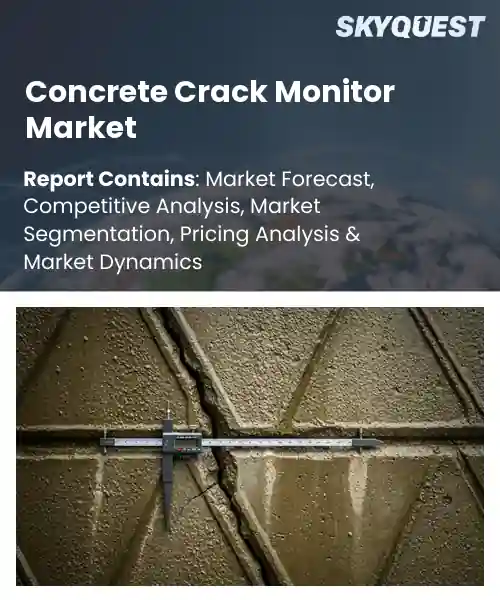
Concrete Crack Monitor Market
Report ID: SQMIG45J2692
Report ID: SQMIG45J2692
[email protected]
USA +1 351-333-4748
Report ID:
SQMIG45J2692 |
Region:
Global |
Published Date: July, 2026
Pages:
157
|Tables:
143
|Figures:
78


Global Concrete Crack Monitor Market size was valued at USD 164.9 Million in 2024 and is poised to grow from USD 175.62 Million in 2025 to USD 290.65 Million by 2033, growing at a CAGR of 6.5% during the forecast period (2026-2033).
The global concrete crack monitor market supplies sensors, data loggers and analytics software that detect and quantify crack growth in bridges, tunnels and structures. Its importance has risen as infrastructure failures incur economic losses and regulators demand safety measures. Early monitoring relied on periodic visual checks, yet the early 2000s introduced fiber‑optic and wireless sensor networks, reducing inspection intervals and enabling real‑time alerts. A notable case occurred in 2014 when the Port of Rotterdam deployed an acoustic‑emission system, cutting unplanned downtime by 30 percent and extending asset lifespan. These shifts have propelled market revenues past $500 million, establishing capability as a driver. The primary growth catalyst for the global concrete crack monitor market is the escalating demand for digital twins of civil infrastructure, which require precise deformation data to synchronize virtual models with reality. As owners adopt asset‑management platforms, sensors deliver crack metrics to algorithms, enabling crews to schedule repairs before safety thresholds are breached. This cause‑and‑effect chain appears in a partnership between a European railway operator and a sensor vendor, where real‑time crack alerts cut track‑work interruptions by 40 percent and lowered lifecycle costs. Consequently, manufacturers expand portfolios to include AI‑driven analytics, opening opportunities in emerging markets where aging bridges dominate the built environment.
How is AI-driven IoT improving accuracy in the concrete crack monitoring market?
AI-driven IoT is reshaping concrete crack monitoring by linking smart sensors with cloud based analytics. Sensors embedded in structures now stream vibration and strain data in real time, while machine learning models filter noise and predict crack propagation with far greater precision. The market reflects a shift from periodic visual inspections to continuous digital watch, reducing human error and accelerating maintenance cycles. Projects across bridges, tunnels and high rise buildings increasingly rely on these networks, creating a feedback loop that improves model training as more structures are observed. This convergence of hardware and software is raising confidence in early warning systems.In June 2026, MDPI released a study that demonstrated a mobile ground robot equipped with AI enabled IoT sensors, delivering far tighter crack detection and reducing false alarms, a step that is driving wider adoption and reinforcing market momentum. The field trial across several bridge projects showed measurable improvement in data reliability and faster maintenance decisions.
Market snapshot - (2026-2033)
Global Market Size
USD 164.9 Million
Largest Segment
Mechanical Crack Monitors
Fastest Growth
Wireless Crack Monitoring Systems
Growth Rate
6.5% CAGR
To get more insights on this market click here to Request a Free Sample Report
Global concrete crack monitor market is segmented by product type, installation, application, end user, monitoring mode and region. Based on product type, the market is segmented into Mechanical Crack Monitors, Digital Crack Monitors and Wireless Crack Monitoring Systems. Based on installation, the market is segmented into Surface Mounted and Embedded. Based on application, the market is segmented into Buildings, Bridges, Tunnels and Dams. Based on end user, the market is segmented into Construction Companies, Infrastructure Operators and Inspection & Testing Agencies. Based on monitoring mode, the market is segmented into Manual and Continuous Remote Monitoring. Based on region, the market is segmented into North America, Europe, Asia Pacific, Latin America and Middle East & Africa.
Digital crack monitors segment dominates because they combine high resolution data capture with user friendly interfaces, allowing engineers to quickly assess crack propagation. Their ability to integrate with existing structural health platforms reduces deployment friction, while robust sensor technology ensures reliability in harsh environments. Consequently, project teams favor them for accuracy and ease of interpretation, driving widespread adoption across new construction and retrofit projects and long term asset management strategies.
However, mechanical crack monitors are witnessing the strongest growth momentum because they require minimal power and have low upfront costs, making them attractive for budget conscious projects. Their simple installation and proven durability in remote sites encourage adoption where digital infrastructure is limited, expanding market reach and creating new opportunities.
Surface mounted installation segment leads because it offers rapid deployment and easy maintenance, allowing engineers to affix sensors without interrupting ongoing construction activities. The visibility of devices simplifies routine inspections and calibration, which reduces downtime. This approach aligns with standard site access protocols, delivering cost efficiencies and fostering confidence among project owners, thereby securing its preeminence in the market and making it the preferred choice for large scale infrastructure upgrades.
On the other hand, embedded installation is emerging as a high growth area because it protects sensors within structural elements, enhancing longevity and data reliability. This method aligns with modern construction techniques that integrate monitoring devices during casting, reducing future disruption. As sustainability standards prioritize embedded health monitoring, demand accelerates, opening new avenues for market expansion.
To get detailed segments analysis, Request a Free Sample Report
North America maintains a leading position through a blend of advanced research institutions, robust manufacturing ecosystems, and early adoption of digital inspection technologies. The region benefits from strong collaboration between academia, equipment suppliers, and infrastructure owners, fostering continuous innovation in sensor integration and data analytics. Regulatory frameworks emphasize safety and longevity of civil structures, encouraging proactive monitoring solutions. Additionally, significant investment in large‑scale construction projects creates consistent demand, while a mature market of service providers ensures rapid deployment and support. These combined factors reinforce North America’s reputation as the benchmark for reliability and technological sophistication in concrete crack monitoring.
Concrete Crack Monitor Market in the United States thrives on a culture of technological entrepreneurship and extensive funding for infrastructure resilience. Industry leaders collaborate with university laboratories to refine detection algorithms, while federal and state agencies promote adoption through safety mandates. The presence of major construction firms and specialized service providers accelerates market penetration, offering end‑to‑end solutions that integrate hardware, software, and consulting expertise. This ecosystem nurtures a proactive approach to maintenance, positioning the United States at the forefront of innovation and implementation.
Concrete Crack Monitor Market in Canada benefits from a strong emphasis on sustainability and asset integrity across its expansive transportation network. Government programs prioritize preventative maintenance, encouraging the uptake of advanced monitoring tools. Collaboration between engineering firms and research institutes drives adaptation of sensor technologies to cold‑climate conditions, enhancing reliability. The market is supported by a network of skilled technicians and service companies that provide customized monitoring solutions, reinforcing Canada’s role as a key contributor to regional best practices.
Europe experiences vigorous growth fueled by stringent safety regulations, a commitment to extending the lifespan of aging infrastructure, and a collaborative research environment across member states. The region’s focus on digital transformation in construction encourages integration of smart monitoring systems into existing asset management frameworks. Strong public‑private partnerships fund pilot projects that showcase the benefits of early crack detection, prompting wider acceptance. Additionally, the presence of leading sensor manufacturers and specialized service providers creates a fertile ground for technology diffusion, positioning Europe as a dynamic hub for innovation and market expansion.
Concrete Crack Monitor Market in Germany is anchored by a tradition of engineering excellence and a dense network of research institutions dedicated to structural health monitoring. National standards emphasize preventive maintenance, driving adoption of sophisticated monitoring solutions across highways, bridges, and industrial facilities. Collaboration between manufacturers and consulting firms results in highly integrated systems that combine sensor hardware with predictive analytics. This ecosystem supports a proactive maintenance culture, reinforcing Germany’s dominant stature in the European market.
Concrete Crack Monitor Market in the United Kingdom is propelled by ambitious infrastructure renewal programs and a regulatory climate that prizes safety and durability. Early adoption of digital inspection tools aligns with government initiatives to modernize construction practices. Universities and technology hubs contribute cutting‑edge research, fostering rapid commercialization of innovative monitoring platforms. Service providers offering turnkey solutions enable swift deployment across transport corridors and urban projects, positioning the United Kingdom as a leading growth engine within Europe.
Concrete Crack Monitor Market in France is emerging as a focal point for sustainable infrastructure management. National policies encourage the integration of smart monitoring to reduce lifecycle costs and environmental impact. Partnerships between engineering firms and research laboratories facilitate the development of cost‑effective sensor technologies tailored to historic structures. Growing awareness among asset owners about the benefits of early defect detection spurs gradual market uptake, marking France as an emerging player in the European landscape.
Asia Pacific advances its market presence through rapid urbanization, expansive infrastructure development, and heightened awareness of structural safety. The region’s governments are increasingly prioritizing the incorporation of intelligent monitoring into large‑scale construction projects, recognizing its role in mitigating risk and extending asset life. Strong manufacturing capabilities enable localized production of sensors and data platforms, reducing costs and fostering adoption. Collaborative initiatives between technology firms and academic institutions accelerate innovation, while a growing cadre of specialized service providers offers tailored solutions that address diverse climatic and regulatory environments across the region.
Concrete Crack Monitor Market in Japan benefits from a culture of precision engineering and a proactive stance toward disaster resilience. Investment in high‑frequency monitoring technologies aligns with national efforts to safeguard infrastructure against seismic activity. Partnerships between leading electronics manufacturers and civil engineering firms produce compact, high‑resolution sensors suited to dense urban environments. A robust network of consultants and maintenance specialists ensures seamless integration of monitoring data into asset management strategies, reinforcing Japan’s leadership in the region.
Concrete Crack Monitor Market in South Korea is driven by ambitious smart city initiatives and a commitment to modernizing legacy infrastructure. Government incentives promote the deployment of integrated monitoring systems across transportation and industrial sectors. Collaboration between automotive sensor manufacturers and construction firms yields innovative, scalable solutions. A growing pool of technical expertise supports rapid implementation and data interpretation, positioning South Korea as a dynamic contributor to the Asia Pacific market expansion.
To know more about the market opportunities by region and country, click here to
Buy The Complete Report
Increasing Infrastructure Development
Advancements In Sensor Technologies
High Initial Capital Expenditure
Limited Technical Expertise Adoption
Request Free Customization of this report to help us to meet your business objectives.
The competitive landscape of the Global Concrete Crack Monitor market is shaped by established players expanding product portfolios and forging strategic collaborations to address rising infrastructure safety demands. Gilson introduced a new fiber‑optic sensor line, Humboldt’s concrete crack monitors enable precise determination of repair thresholds, and Test Mark Industries broadened its service offering through a partnership with a leading engineering consultancy, intensifying market rivalry.
Top Player’s Company Profile
Recent Developments
SkyQuest’s ABIRAW (Advanced Business Intelligence, Research & Analysis Wing) is our Business Information Services team that Collects, Collates, Correlates, and Analyses the Data collected by means of Primary Exploratory Research backed by robust Secondary Desk research. As per SkyQuest analysis, the global concrete crack monitor market is being propelled primarily by the surge in infrastructure development that pushes owners to adopt real‑time crack detection for safety and cost efficiency, while rapid advancements in sensor technology provide more accurate, low‑maintenance solutions that broaden appeal. The digital crack monitor segment leads the market thanks to its high‑resolution data and easy integration, and North America remains the dominant region due to its strong research base, regulatory support and large project pipelines. However, high initial capital expenditure continues to restrain adoption, especially among smaller firms, tempering overall growth. Nevertheless, ongoing training programs aim to lower the skills barrier and spur wider deployment.
| Report Metric | Details |
|---|---|
| Market size value in 2024 | USD 164.9 Million |
| Market size value in 2033 | USD 290.65 Million |
| Growth Rate | 6.5% |
| Base year | 2024 |
| Forecast period | (2026-2033) |
| Forecast Unit (Value) | USD Million |
| Segments covered |
|
| Regions covered | North America (US, Canada), Europe (Germany, France, United Kingdom, Italy, Spain, Rest of Europe), Asia Pacific (China, India, Japan, Rest of Asia-Pacific), Latin America (Brazil, Rest of Latin America), Middle East & Africa (South Africa, GCC Countries, Rest of MEA) |
| Companies covered |
|
| Customization scope | Free report customization with purchase. Customization includes:-
|
To get a free trial access to our platform which is a one stop solution for all your data requirements for quicker decision making. This platform allows you to compare markets, competitors who are prominent in the market, and mega trends that are influencing the dynamics in the market. Also, get access to detailed SkyQuest exclusive matrix.
Table Of Content
Executive Summary
Market overview
Parent Market Analysis
Market overview
Market size
KEY MARKET INSIGHTS
COVID IMPACT
MARKET DYNAMICS & OUTLOOK
Market Size by Region
KEY COMPANY PROFILES
Methodology
For the Concrete Crack Monitor Market, our research methodology involved a mixture of primary and secondary data sources. Key steps involved in the research process are listed below:
1. Information Procurement: This stage involved the procurement of Market data or related information via primary and secondary sources. The various secondary sources used included various company websites, annual reports, trade databases, and paid databases such as Hoover's, Bloomberg Business, Factiva, and Avention. Our team did 45 primary interactions Globally which included several stakeholders such as manufacturers, customers, key opinion leaders, etc. Overall, information procurement was one of the most extensive stages in our research process.
2. Information Analysis: This step involved triangulation of data through bottom-up and top-down approaches to estimate and validate the total size and future estimate of the Concrete Crack Monitor Market.
3. Report Formulation: The final step entailed the placement of data points in appropriate Market spaces in an attempt to deduce viable conclusions.
4. Validation & Publishing: Validation is the most important step in the process. Validation & re-validation via an intricately designed process helped us finalize data points to be used for final calculations. The final Market estimates and forecasts were then aligned and sent to our panel of industry experts for validation of data. Once the validation was done the report was sent to our Quality Assurance team to ensure adherence to style guides, consistency & design.
Analyst Support
Customization Options
With the given market data, our dedicated team of analysts can offer you the following customization options are available for the Concrete Crack Monitor Market:
Product Analysis: Product matrix, which offers a detailed comparison of the product portfolio of companies.
Regional Analysis: Further analysis of the Concrete Crack Monitor Market for additional countries.
Competitive Analysis: Detailed analysis and profiling of additional Market players & comparative analysis of competitive products.
Go to Market Strategy: Find the high-growth channels to invest your marketing efforts and increase your customer base.
Innovation Mapping: Identify racial solutions and innovation, connected to deep ecosystems of innovators, start-ups, academics, and strategic partners.
Category Intelligence: Customized intelligence that is relevant to their supply Markets will enable them to make smarter sourcing decisions and improve their category management.
Public Company Transcript Analysis: To improve the investment performance by generating new alpha and making better-informed decisions.
Social Media Listening: To analyze the conversations and trends happening not just around your brand, but around your industry as a whole, and use those insights to make better Marketing decisions.
REQUEST FOR SAMPLE
 REQUEST FREE CUSTOMIZATION


Want to customize this report? This report can be personalized according to your needs. Our analysts and industry experts will work directly with you to understand your requirements and provide you with customized data in a short amount of time. We offer $1000 worth of FREE customization at the time of purchase.
Feedback From Our Clients


 USA (+1) 351-333-4748

