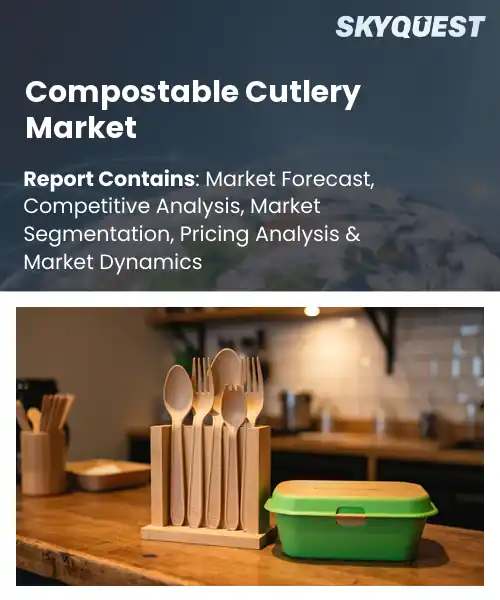
Compostable Cutlery Market
Report ID: SQMIG15E4074
Report ID: SQMIG15E4074
[email protected]
USA +1 351-333-4748
Report ID:
SQMIG15E4074 |
Region:
Global |
Published Date: July, 2026
Pages:
157
|Tables:
152
|Figures:
78


Global Compostable Cutlery Market size was valued at USD 1.8 Billion in 2024 and is poised to grow from USD 1.97 Billion in 2025 to USD 4.04 Billion by 2033, growing at a CAGR of 9.4% during the forecast period (2026-2033).
The global compostable cutlery market consists of utensils made from biodegradable polymers such as polylactic acid, bagasse or wheat‑straw, intended to replace plastic forks, knives and spoons in hospitality, catering and retail. Its significance stems from pressure to reduce plastic waste that clogs landfills and oceans. The primary driver is regulatory action; bans on conventional plastic cutlery introduced across the European Union, Canada and several Asian cities have forced businesses to seek compliant alternatives. Since the 2010s, manufacturers have scaled production, illustrated by the 2015 launch of a PLA fork line that captured 12 % of U.S. orders in three years.
Building on the regulatory impetus, the surge in consumer consciousness about sustainability fuels demand for compostable cutlery across channels. As food‑service chains pledge targets, they procure bulk quantities of PLA and bagasse utensils that decompose within 90 days, enabling certification under standards such as DIN 68 509. This creates an opportunity for manufacturers to diversify product lines, exemplified by a European firm that introduced colored, microwave‑safe spoons, capturing contracts with catering services seeking compliant options. Growth in e‑commerce packaging drives retailers to bundle biodegradable cutlery with meal kits, reinforcing a loop where visibility accelerates adoption and investment in bio‑polymer production capacity.
How is AI Driving Sustainability in the Compostable Cutlery Market?
Artificial intelligence is reshaping the compostable cutlery sector by turning data into actionable insight. Machine learning models evaluate plant fiber characteristics to recommend blends that decompose faster while maintaining strength. Computer vision guides precision cutting, lowering material scrap and energy use. Real time demand forecasting aligns production with restaurant orders, preventing overstock and waste. Predictive maintenance alerts equipment operators before failures, extending machine life and reducing downtime. Together these AI tools create a tighter loop between design, manufacturing and distribution, making the supply chain more resilient and the product more sustainable.
In April 2024, Eco Products introduced an AI optimized material formulation platform enhancing waste reduction and production efficiency and supporting market growth. The system uses sensor data to fine tune polymer ratios, cutting trial cycles and enabling faster market entry for new designs.
Market snapshot - (2026-2033)
Global Market Size
USD 1.8 Billion
Largest Segment
Wood
Fastest Growth
Bagasse
Growth Rate
9.4% CAGR
To get more insights on this market click here to Request a Free Sample Report
Global compostable cutlery market is segmented by material type, product type, end user, distribution channel, application and region. Based on material type, the market is segmented into wood, bamboo, bagasse, polylactic acid (PLA), paper and others. Based on product type, the market is segmented into forks, knives, spoons, sporks and cutlery sets. Based on end user, the market is segmented into foodservice, household and institutional. Based on distribution channel, the market is segmented into online retail, supermarkets & hypermarkets, specialty stores and distributors & wholesalers. Based on application, the market is segmented into restaurants & cafés, catering services, hotels, events & parties and takeaway & food delivery. Based on region, the market is segmented into North America, Europe, Asia Pacific, Latin America and Middle East & Africa.
Based on the global compostable cutlery market growth, bamboo segment dominates because its natural strength, rapid renewability, and aesthetic appeal meet consumer demand for premium yet eco friendly cutlery. Manufacturers favor bamboo for its biodegradable profile, minimal processing, and ability to be molded into sturdy utensils, which aligns with sustainability narratives and brand differentiation. This convergence of functional performance and green credentials fuels its leadership in the market. Its appeal resonates across global markets, reinforcing its position.
Meanwhile, bagasse segment emerges as the fastest growing because waste sugarcane fiber offers a low cost, zero waste feedstock that appeals to cost sensitive operators and regulators pushing circular economy standards. Innovation in molding techniques expands its product range, and rising adoption by scale foodservice firms accelerates market expansion and opens distribution opportunities.
Spork segment leads because it merges fork and spoon functions, simplifying inventory and reducing waste for providers seeking minimalist solutions. Its versatile design matches on the go consumption habits, and manufacturers can produce it from a single material stream, streamlining supply chains and strengthening sustainability messaging. This multifunctional advantage secures its prominent position among product choices. By delivering comparable performance to traditional metal cutlery while maintaining compostability, it appeals to environmentally conscious brands.
On the other hand, spoon segment is witnessing the strongest growth momentum because rising demand for dessert and beverage consumption drives need for biodegradable scoops. Advances in PLA formulations enable thinner, heat resistant spoons, attracting chains and home users. This innovation propels rapid adoption, expanding market footprint and stimulating downstream packaging synergies.
To get detailed segments analysis, Request a Free Sample Report
As per the global compostable cutlery market share, Asia Pacific benefits from a convergence of extensive manufacturing capabilities, strong governmental emphasis on reducing single‑use plastic waste, and a culturally embedded appreciation for sustainable lifestyles. Large‑scale producers leverage advanced biopolymer technologies, enabling cost‑effective scaling that serves both domestic consumption and export demand. Policy frameworks across the region encourage adoption of compostable alternatives through incentives and clear regulatory pathways, while rising consumer awareness fuels demand in urban centers. Together, these factors create a resilient supply chain, robust innovation ecosystem, and market momentum that position Asia Pacific as the leading contributor to global compostable cutlery growth.
Japan Compostable Cutlery Market
Compostable cutlery market in Japan is propelled by sophisticated waste‑segregation infrastructure and a long‑standing commitment to environmental stewardship. Retailers and food service operators increasingly integrate compostable options into premium and everyday menus, reflecting consumer expectations for eco‑friendly dining experiences. Collaborative research between universities and material manufacturers drives continuous improvement in performance and biodegradability, reinforcing Japan’s reputation as a hub for high‑quality sustainable products.
South Korea Compostable Cutlery Market
Compostable cutlery market in South Korea thrives on proactive government policies that prioritize circular economy principles and strict plastic reduction targets. Rapid urbanization and a tech‑savvy consumer base accelerate acceptance of innovative biodegradable materials. Partnerships between large food service chains and local bioplastic firms enhance distribution reach, while public education campaigns reinforce the environmental benefits, creating a fertile environment for sustained market expansion.
Based on global compostable cutlery regional forecast, Europe’s expansion is driven by stringent regulatory agendas that phase out conventional plastics, coupled with a deep-rooted culture of environmental responsibility. Consumer demand for transparent, sustainable packaging fuels continuous product refinement, while multinational foodservice brands adopt continent‑wide standards that prioritize compostable cutlery. Collaborative platforms among industry stakeholders, research institutions, and policy makers accelerate material innovation, ensuring performance meets culinary expectations. Additionally, the region’s mature logistics networks facilitate efficient distribution, reinforcing Europe’s position as a catalyst for market growth across diverse consumer segments.
Germany Compostable Cutlery Market
Compostable cutlery market in Germany benefits from robust environmental legislation that mandates reduction of plastic waste and supports renewable material sourcing. Leading manufacturers invest heavily in research to improve strength and degradation rates, aligning products with the exacting standards of German hospitality and retail sectors. Consumer confidence in locally produced sustainable goods further consolidates market adoption, reinforcing Germany’s leadership role.
United Kingdom Compostable Cutlery Market
Compostable cutlery market in United Kingdom experiences rapid adoption driven by ambitious waste‑reduction strategies and heightened public advocacy for greener alternatives. Major restaurant chains and campus catering services integrate compostable options to meet corporate sustainability pledges, while innovative start‑ups introduce novel biopolymer blends that resonate with a market eager for cutting‑edge eco‑solutions. Collaborative efforts between government agencies and industry accelerate guideline development, propelling swift market uptake.
France Compostable Cutlery Market
Compostable cutlery market in France is emerging through a blend of culinary tradition and progressive environmental policy. Artisanal food venues and larger hospitality groups alike seek compostable solutions that complement French gastronomy without compromising functionality. Government incentives for biodegradable material development encourage local manufacturers to expand capacity, while consumer awareness campaigns highlight the ecological impact of single‑use plastics, fostering a growing preference for compostable alternatives.
As per global compostable cutlery regional outlook, North America advances its industry position through a combination of proactive corporate sustainability commitments, evolving consumer preferences, and supportive legislative frameworks that encourage alternatives to conventional plastics. Leading foodservice operators embed compostable cutlery into their supply chains to align with brand values and meet rising demand for responsible packaging. Innovation ecosystems in key research hubs accelerate material performance enhancements, while cross‑border trade facilitates broader distribution. Educational initiatives and public‑private partnerships further embed compostable solutions into mainstream market channels, reinforcing North America’s growing influence.
United States Compostable Cutlery Market
Compostable cutlery market in United States is shaped by a dynamic mix of corporate sustainability agendas and a consumer base increasingly attentive to environmental impact. National retail chains and large‑scale foodservice providers adopt compostable options to fulfill green procurement policies, while startups introduce advanced bioplastic formulations that address performance expectations. Collaborative research initiatives across universities and industry accelerate product refinement, supporting broader market integration.
Canada Compostable Cutlery Market
Compostable cutlery market in Canada benefits from strong governmental emphasis on waste diversion and a culturally ingrained respect for natural resources. Provincial initiatives encourage foodservice establishments to transition to compostable alternatives, while local manufacturers respond with tailored biopolymer solutions suited to Canadian climate and usage patterns. Consumer advocacy groups play a pivotal role in raising awareness, driving demand across both urban and rural markets.
To know more about the market opportunities by region and country, click here to
Buy The Complete Report
Growing Consumer Preference for Sustainability
Adoption Of Biodegradable Materials
Limited Material Cost Competitiveness
Inconsistent Composting Infrastructure
Request Free Customization of this report to help us to meet your business objectives.
The global compostable cutlery market outlook is sharpening as firms accelerate mergers, forge distribution partnerships with major food‑service operators, and invest in bio‑polymer processing technology to meet rising demand for zero‑waste dining solutions. Recent moves such as Arbor’s seed‑funding‑driven scale‑up of plant‑based utensil production and a European manufacturer’s joint venture with a leading restaurant chain illustrate how strategic collaborations and tech innovation are being leveraged to capture market share.
Top Player’s Company Profile
Recent Developments
SkyQuest’s ABIRAW (Advanced Business Intelligence, Research & Analysis Wing) is our Business Information Services team that Collects, Collates, Correlates, and Analyses the Data collected by means of Primary Exploratory Research backed by robust Secondary Desk research.
As per SkyQuest analysis the global compostable cutlery industry is being propelled primarily by growing consumer preference for sustainability which pushes restaurants and foodservice brands to replace plastic utensils with eco‑friendly options, a second important catalyst is the rapid adoption of biodegradable plant‑based materials that deliver performance comparable to conventional plastics and satisfy tightening regulations, the market is led by the bamboo segment whose natural strength and aesthetic appeal make it the top material choice and Asia Pacific dominates overall due to its manufacturing capacity, supportive policies and rising eco‑conscious demand, however higher production costs relative to plastic remain a restraint that can slow adoption in price‑sensitive channels.
| Report Metric | Details |
|---|---|
| Market size value in 2024 | USD 1.8 Billion |
| Market size value in 2033 | USD 4.04 Billion |
| Growth Rate | 9.4% |
| Base year | 2024 |
| Forecast period | (2026-2033) |
| Forecast Unit (Value) | USD Billion |
| Segments covered |
|
| Regions covered | North America (US, Canada), Europe (Germany, France, United Kingdom, Italy, Spain, Rest of Europe), Asia Pacific (China, India, Japan, Rest of Asia-Pacific), Latin America (Brazil, Rest of Latin America), Middle East & Africa (South Africa, GCC Countries, Rest of MEA) |
| Companies covered |
|
| Customization scope | Free report customization with purchase. Customization includes:-
|
To get a free trial access to our platform which is a one stop solution for all your data requirements for quicker decision making. This platform allows you to compare markets, competitors who are prominent in the market, and mega trends that are influencing the dynamics in the market. Also, get access to detailed SkyQuest exclusive matrix.
Table Of Content
Executive Summary
Market overview
Parent Market Analysis
Market overview
Market size
KEY MARKET INSIGHTS
COVID IMPACT
MARKET DYNAMICS & OUTLOOK
Market Size by Region
KEY COMPANY PROFILES
Methodology
For the Compostable Cutlery Market, our research methodology involved a mixture of primary and secondary data sources. Key steps involved in the research process are listed below:
1. Information Procurement: This stage involved the procurement of Market data or related information via primary and secondary sources. The various secondary sources used included various company websites, annual reports, trade databases, and paid databases such as Hoover's, Bloomberg Business, Factiva, and Avention. Our team did 45 primary interactions Globally which included several stakeholders such as manufacturers, customers, key opinion leaders, etc. Overall, information procurement was one of the most extensive stages in our research process.
2. Information Analysis: This step involved triangulation of data through bottom-up and top-down approaches to estimate and validate the total size and future estimate of the Compostable Cutlery Market.
3. Report Formulation: The final step entailed the placement of data points in appropriate Market spaces in an attempt to deduce viable conclusions.
4. Validation & Publishing: Validation is the most important step in the process. Validation & re-validation via an intricately designed process helped us finalize data points to be used for final calculations. The final Market estimates and forecasts were then aligned and sent to our panel of industry experts for validation of data. Once the validation was done the report was sent to our Quality Assurance team to ensure adherence to style guides, consistency & design.
Analyst Support
Customization Options
With the given market data, our dedicated team of analysts can offer you the following customization options are available for the Compostable Cutlery Market:
Product Analysis: Product matrix, which offers a detailed comparison of the product portfolio of companies.
Regional Analysis: Further analysis of the Compostable Cutlery Market for additional countries.
Competitive Analysis: Detailed analysis and profiling of additional Market players & comparative analysis of competitive products.
Go to Market Strategy: Find the high-growth channels to invest your marketing efforts and increase your customer base.
Innovation Mapping: Identify racial solutions and innovation, connected to deep ecosystems of innovators, start-ups, academics, and strategic partners.
Category Intelligence: Customized intelligence that is relevant to their supply Markets will enable them to make smarter sourcing decisions and improve their category management.
Public Company Transcript Analysis: To improve the investment performance by generating new alpha and making better-informed decisions.
Social Media Listening: To analyze the conversations and trends happening not just around your brand, but around your industry as a whole, and use those insights to make better Marketing decisions.
REQUEST FOR SAMPLE
 REQUEST FREE CUSTOMIZATION
Global Compostable Cutlery Market size was valued at USD 1.8 Billion in 2024 and is poised to grow from USD 1.97 Billion in 2025 to USD 4.04 Billion by 2033, growing at a CAGR of 9.4% during the forecast period (2026-2033).
The compostable cutlery market is sharpening as firms accelerate mergers, forge distribution partnerships with major food‑service operators, and invest in bio‑polymer processing technology to meet rising demand for zero‑waste dining solutions. Recent moves such as Arbor’s seed‑funding‑driven scale‑up of plant‑based utensil production and a European manufacturer’s joint venture with a leading restaurant chain illustrate how strategic collaborations and tech innovation are being leveraged to capture market share. 'Huhtamäki Oyj', 'Genpak, LLC', 'Pactiv Evergreen Inc.', 'Dart Container Corporation', 'Biopak Pty Ltd', 'Vegware Ltd', 'Duni AB', 'Lollicup USA Inc.', 'Better Earth LLC', 'Eco-Products, Inc.', 'Good Start Packaging', 'World Centric', 'Bionatic GmbH & Co. KG', 'Natural Tableware', 'Ecoware Solutions Private Limited', 'GreenGood USA', 'Fuling Global Inc.', 'Solia USA', 'Papstar GmbH', 'Ancheng International Group Co., Ltd.'
Increasing awareness of environmental impacts drives restaurants and food service providers to replace traditional plastic utensils with compostable alternatives, as diners actively seek products that align with sustainable lifestyles. This shift encourages manufacturers to expand their product portfolio, invest in innovative materials, and enhance supply chain capabilities. Consequently, market visibility rises, fostering broader acceptance across hospitality segments and reinforcing the positive feedback loop between consumer expectations and supplier offerings. The overall momentum also influences brand positioning, prompting companies to communicate eco‑friendly credentials as core value propositions.
Sustainable Packaging Integration: Sustainable packaging integration is reshaping the procurement strategies of restaurants, airlines, and event venues. Companies are aligning compostable cutlery with recyclable containers, bioplastic films, and plant‑based wrappers to present a unified eco‑friendly narrative. This holistic approach reduces the perceived trade‑off between functionality and environmental responsibility, encouraging higher adoption rates. Brands leverage the consistency of a full sustainable offering to differentiate themselves, build consumer trust, and meet increasingly stringent corporate social responsibility mandates, driving steady market expansion across global supply chains throughout the industry.
Why does Asia Pacific Dominate the Global Compostable Cutlery Market? |@12


Want to customize this report? This report can be personalized according to your needs. Our analysts and industry experts will work directly with you to understand your requirements and provide you with customized data in a short amount of time. We offer $1000 worth of FREE customization at the time of purchase.
Feedback From Our Clients


 USA (+1) 351-333-4748

