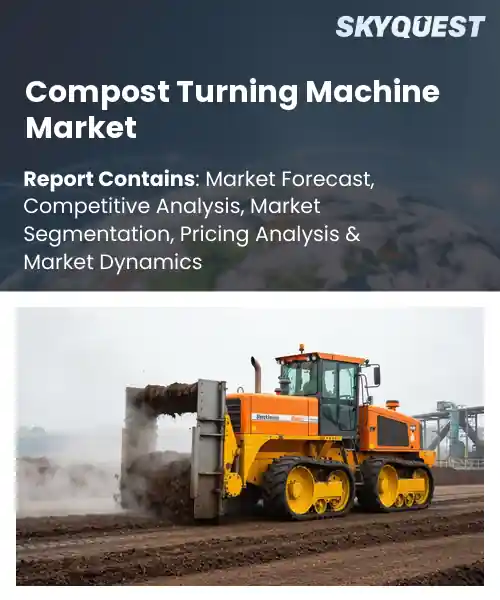
Compost Turning Machine Market
Report ID: SQMIG20H2105
Report ID: SQMIG20H2105
[email protected]
USA +1 351-333-4748
Report ID:
SQMIG20H2105 |
Region:
Global |
Published Date: July, 2026
Pages:
157
|Tables:
147
|Figures:
78


Global Compost Turning Machine Market size was valued at USD 340.5 Million in 2024 and is poised to grow from USD 360.42 Million in 2025 to USD 567.98 Million by 2033, growing at a CAGR of 5.85% during the forecast period (2026-2033).
The global compost turning machine market trends provides equipment that accelerates aerobic decomposition by mechanically turning organic waste in windrows, static piles or in-vessel reactors. Its significance stems from the need for municipalities and agribusinesses to divert waste from landfills, cut greenhouse-gas emissions and create soil amendments. The driver is regulation that sets targets for recycling and waste‑reduction, such as the EU Circular Economy Action Plan and California’s Organic Waste Ordinance Since the 2000s, turners have moved from manual to GPS-guided, a change that has been seen on New Zealand dairy farms using 30-tonne turners, taking the market from a niche to a billion-dollar segment.
As the compost turning machine market growth approaches the billion-dollar segment, it will be the demand for high-throughput machines that will determine. Hybrid electric-hydraulic turners are replacing traditional units to process larger volumes with less fuel consumption, reducing operating costs and aligning with corporate ESG policies for sustainability benchmarks. Manufacturers are working on modular designs that let farms add capacity by swapping attachments rather than buying new equipment. This flexibility opens possibilities in developing economies where smallholder cooperatives can share a unit, as shown by a Kenyan tea consortium which cut down composting time by 40 % with a turner. This creates productivity gains that draw in more capital, which in turn reinforces market growth.
How is AI-driven Automation Enhancing Efficiency in the Compost Turning Machine Market?
AI-powered automation is changing compost turning machine market share by embedding sensors that constantly monitor temperature, moisture and oxygen levels. The real-time data drives predictive algorithms that automatically modulate turning frequency and speed to optimize microbial activity and minimize the need for manual oversight. As the learning cycles progress, the cycle timing improves and the energy consumption is reduced. Integrated cloud platforms enable operators to remotely operate a number of units, quickly identify anomalies and schedule maintenance before failures are experienced. This blend of precision control and foresight not only speeds up decomposition but also enhances the consistency of the final compost, making operations more dependable and economical.
In March 2024, a top manufacturer introduced an AI-powered turning system that dynamically modifies rotation according to real-time moisture data, boosting processing speed and lowering labor while propelling the market growth path.
Market snapshot - (2026-2033)
Global Market Size
USD 340.5 Million
Largest Segment
Self-Propelled Turners
Fastest Growth
Elevating Face Turners
Growth Rate
5.85% CAGR
To get more insights on this market click here to Request a Free Sample Report
Global compost turning machine market is segmented by equipment form factor, propulsion system type, turning blade mechanism, waste material stream, end user category and region. Based on equipment form factor, the market is segmented into tow-behind turners, self-propelled turners, elevating face turners and side-discharge turners. Based on propulsion system type, the market is segmented into tractor power take-off driven, diesel engine driven and electric motor driven. Based on turning blade mechanism, the market is segmented into drum systems and paddle systems. Based on waste material stream, the market is segmented into agricultural residues, livestock manure, municipal solid waste, green organic waste and industrial sludge. Based on end user category, the market is segmented into commercial composting facilities, large-scale farms, municipalities and landscaping providers. Based on region, the market is segmented into North America, Europe, Asia Pacific, Latin America and Middle East & Africa.
The segment of tow-behind turners is leading as operators prefer the simplicity of attaching the machine to existing tractors, which reduces capital outlay and training requirements. This form factor utilizes standard farm equipment and allows for quick deployment on diverse compost piles. Its mechanical reliability and ease of maintenance build confidence, which has led to wide spread preference among both small and medium scale composting operations throughout the market, supporting seasonal scaling and reducing downtime during high volume periods.
Self-propelled turners are seeing the most growth, however, as they offer power and mobility without the need for an external tractor. The autonomy increases operational flexibility e.g. continuous turning in large piles, and remote sites. The growing demand for larger, high throughput composting facilities is driving investment in these machines, creating new business opportunities for both manufacturers and service providers.
The diesel-driven segment is leading, as it offers the high torque and proven reliability necessary for the dense organic masses. The fuel flexibility, the ability to run continuously without the need for external power sources, is liked by operators. This confidence translates into wider acceptance in commercial facilities and farms where uptime and rugged performance are critical. And the current service network for diesel equipment makes for easier maintenance, encouraging more investment from operators seeking long-term operational stability.
Meanwhile, electric motor driven propulsion is becoming the key high growth area meeting sustainability mandates and reducing emissions at compost sites. Longer run times and lower operating costs from advances in battery technology appeal to conscious facilities. That change is forcing manufacturers to broaden their lines of electric products, speeding up market diversification and unlocking sources of income.
To get detailed segments analysis, Request a Free Sample Report
North America is dominating the global compost turning machine market due to its developed waste management infrastructure, robust government policies for promoting organic recycling, and ample financial resources for acquiring advanced machinery. The region has a well established network of agricultural processors and municipal composting facilities that readily take on mechanised turning solutions. And the culture of sustainability that creates demand in both public and private sectors, along with a close collaboration between equipment manufacturers and research institutions, fosters continuous innovation." Furthermore, the abundance of large-scale streams of organic waste offers a reliable feedstock, bolstering the business case for efficient conversion technology. High-efficiency machinery is also traded across borders, further expanding market reach as manufacturers take advantage of export opportunities into neighboring markets. Policy incentives that reward reduced greenhouse-gas emissions and support circular-economy initiatives assist investment decisions. Together, these factors create a resilient ecosystem that keeps it in the leadership position in the compost turning machine space.
Compost turning machine market outlook in United States exhibits a broad adoption across municipal waste programs and large agricultural operations. Strong emphasis on circular‑economy goals drives procurement of automated turners that enhance process efficiency and product quality. The presence of multiple domestic manufacturers enables rapid customization to meet diverse climatic and feedstock conditions. Government initiatives that recognize organic waste as a valuable resource further accelerate investment, fostering a vibrant ecosystem of suppliers and end‑users.
Compost turning machine market forecast in Canada benefits from coordinated provincial waste‑management strategies that prioritize organic diversion. Collaborative projects between municipalities and technology providers facilitate pilot deployments that showcase the operational benefits of mechanised turning. A focus on renewable energy integration encourages the use of compost for bio‑energy generation, reinforcing demand for efficient machines. Local engineering expertise supports adaptations for colder climates, ensuring reliable performance throughout the seasonal cycle and long‑term sustainability.
Europe's compost turning machine market is experiencing rapid expansion, driven by strict waste diversion laws and a continent-wide push for circular economy practices. The case for mechanised composting as a cost-effective way of meeting civic obligations is strengthened by policy frameworks that set ambitious recycling targets. Strong research networks across the region are promoting the continued development of more energy efficient, lower emission machine designs. The demand for soil health and sustainable food production is driven by a diverse set of customers, including municipal services and private agricultural enterprises. Financial mechanisms, such as green investment funds, lower adoption barriers and the distribution of equipment is facilitated by mature logistics infrastructures. All these factors combine to make Europe a hotbed for advanced compost turning technology.
Compost turning machine market regional outlook in Germany reflects a strong engineering heritage that underpins the production of high‑precision turning equipment. Domestic manufacturers leverage advanced automation and robotics expertise to deliver machines capable of handling diverse organic streams with minimal labor input. National policies that reward organic waste recycling reinforce market uptake, while collaborative projects between research institutes and industry accelerate technology transfer. The emphasis on sustainability in agricultural practices ensures a steady demand for efficient compost turning solutions across both large‑scale farms and municipal facilities.
Compost turning machine market regional forecast in United Kingdom showcases the fastest_growing adoption of automated turning solutions across municipal and private sectors. Strategic government initiatives that set ambitious organic waste reduction goals stimulate investment in modern composting infrastructure. The presence of innovative start‑ups focusing on smart‑controlled machinery drives rapid product evolution, enhancing operational efficiency and data integration. Academic collaborations with agricultural colleges provide a pipeline of expertise, supporting tailored solutions for varied farm sizes. Market enthusiasm is further reinforced by public campaigns that highlight the environmental benefits of compost utilization.
Compost turning machine market analysis in France is emerging as a notable arena for mechanised compost turning due to increasing municipal recycling programs and growing awareness of soil amendment benefits. Incentive schemes that subsidize equipment acquisition encourage small and medium‑sized operators to transition from manual methods. Partnerships between local manufacturers and research bodies focus on adapting machines to diverse climatic zones across the national landscape, ensuring reliable performance. Educational outreach to farmers highlights the role of compost in reducing chemical fertilizer dependence, driving gradual market expansion.
Asia Pacific is increasing its share of compost turning machine market due to growing generation of organic waste and active government support for sustainable waste management. Countries in the region are giving priority to the conversion of agricultural residues into valuable compost which has resulted in the demand for efficient mechanised turning technologies. The R&D investments are aimed at low energy consumption and the ability to adapt to different feedstock compositions. Digital monitoring and IoT capabilities are being incorporated into smart-agriculture initiatives for increased operational transparency. Market momentum is also driven by the increasing public awareness of environmental responsibility, which makes the region a potential leader in advanced compost processing solutions.
Compost turning machine market penetration in Japan leverages its reputation for precision engineering to deliver highly reliable turning equipment tailored for complex organic streams. Domestic producers focus on compact designs that accommodate limited space in urban composting facilities while maintaining high throughput. Collaborative projects with agricultural research institutes drive innovations that reduce energy usage and improve microbial activity control. Government policies that encourage circular‑economy practices provide a supportive environment for technology adoption across municipal and private sectors. The convergence of technical excellence and policy backing sustains steady demand for sophisticated compost turning solutions.
Compost turning machine industry in South Korea advances its market stance by integrating smart‑technology features into turning machines that enable real‑time performance analytics. Strong emphasis on smart‑farm initiatives encourages the deployment of automated composting systems within intensive horticultural operations. Local manufacturers benefit from a robust supply chain of electronic components, facilitating rapid incorporation of sensor‑based controls. National waste‑management strategies that set ambitious organic diversion targets create incentives for upgrading traditional composting methods. This blend of technological innovation and regulatory encouragement fuels expanding utilization of advanced compost turning machinery across the country.
To know more about the market opportunities by region and country, click here to
Buy The Complete Report
Increasing Organic Waste Management
Adoption Of Advanced Turning Technology
High Initial Capital Expenditure
Limited Technical Expertise Availability
Request Free Customization of this report to help us to meet your business objectives.
The compost turner market is characterized by increasing competition as established equipment manufacturers expand their portfolios through continuous product innovation, automation, and sustainable waste processing technologies. Companies are investing in fuel-efficient machinery, intelligent process monitoring, and improved aeration technologies to enhance compost quality and operational productivity while supporting stricter environmental regulations. Strategic collaborations with municipal waste processors, agricultural organizations, and commercial composting operators are also encouraging manufacturers to develop customized composting solutions that improve throughput, reduce operating costs, and support circular economy initiatives.
Top Player’s Company Profile
Recent Developments in the Compost Turning Machine Market
SkyQuest’s ABIRAW (Advanced Business Intelligence, Research & Analysis Wing) is our Business Information Services team that Collects, Collates, Correlates, and Analyses the Data collected by means of Primary Exploratory Research backed by robust Secondary Desk research. As per SkyQuest analysis the global compost turning machine market is being propelled by the growing need to manage organic waste which pushes municipalities and farms toward mechanised turning solutions, while the rise of sensor‑driven automation that delivers real‑time moisture and temperature control acts as a second driver enhancing efficiency and product consistency. The market is led by North America where mature waste‑management infrastructure and strong regulatory incentives create steady demand, and the tow‑behind turner segment commands the largest share thanks to its simplicity and low entry cost. However high initial capital expenditure remains a key restraint limiting adoption among smaller operators.
| Report Metric | Details |
|---|---|
| Market size value in 2024 | USD 340.5 Million |
| Market size value in 2033 | USD 567.98 Million |
| Growth Rate | 5.85% |
| Base year | 2024 |
| Forecast period | (2026-2033) |
| Forecast Unit (Value) | USD Million |
| Segments covered |
|
| Regions covered | North America (US, Canada), Europe (Germany, France, United Kingdom, Italy, Spain, Rest of Europe), Asia Pacific (China, India, Japan, Rest of Asia-Pacific), Latin America (Brazil, Rest of Latin America), Middle East & Africa (South Africa, GCC Countries, Rest of MEA) |
| Companies covered |
|
| Customization scope | Free report customization with purchase. Customization includes:-
|
To get a free trial access to our platform which is a one stop solution for all your data requirements for quicker decision making. This platform allows you to compare markets, competitors who are prominent in the market, and mega trends that are influencing the dynamics in the market. Also, get access to detailed SkyQuest exclusive matrix.
Table Of Content
Executive Summary
Market overview
Parent Market Analysis
Market overview
Market size
KEY MARKET INSIGHTS
COVID IMPACT
MARKET DYNAMICS & OUTLOOK
Market Size by Region
KEY COMPANY PROFILES
Methodology
For the Compost Turning Machine Market, our research methodology involved a mixture of primary and secondary data sources. Key steps involved in the research process are listed below:
1. Information Procurement: This stage involved the procurement of Market data or related information via primary and secondary sources. The various secondary sources used included various company websites, annual reports, trade databases, and paid databases such as Hoover's, Bloomberg Business, Factiva, and Avention. Our team did 45 primary interactions Globally which included several stakeholders such as manufacturers, customers, key opinion leaders, etc. Overall, information procurement was one of the most extensive stages in our research process.
2. Information Analysis: This step involved triangulation of data through bottom-up and top-down approaches to estimate and validate the total size and future estimate of the Compost Turning Machine Market.
3. Report Formulation: The final step entailed the placement of data points in appropriate Market spaces in an attempt to deduce viable conclusions.
4. Validation & Publishing: Validation is the most important step in the process. Validation & re-validation via an intricately designed process helped us finalize data points to be used for final calculations. The final Market estimates and forecasts were then aligned and sent to our panel of industry experts for validation of data. Once the validation was done the report was sent to our Quality Assurance team to ensure adherence to style guides, consistency & design.
Analyst Support
Customization Options
With the given market data, our dedicated team of analysts can offer you the following customization options are available for the Compost Turning Machine Market:
Product Analysis: Product matrix, which offers a detailed comparison of the product portfolio of companies.
Regional Analysis: Further analysis of the Compost Turning Machine Market for additional countries.
Competitive Analysis: Detailed analysis and profiling of additional Market players & comparative analysis of competitive products.
Go to Market Strategy: Find the high-growth channels to invest your marketing efforts and increase your customer base.
Innovation Mapping: Identify racial solutions and innovation, connected to deep ecosystems of innovators, start-ups, academics, and strategic partners.
Category Intelligence: Customized intelligence that is relevant to their supply Markets will enable them to make smarter sourcing decisions and improve their category management.
Public Company Transcript Analysis: To improve the investment performance by generating new alpha and making better-informed decisions.
Social Media Listening: To analyze the conversations and trends happening not just around your brand, but around your industry as a whole, and use those insights to make better Marketing decisions.
REQUEST FOR SAMPLE
 REQUEST FREE CUSTOMIZATION
Global Compost Turning Machine Market size was valued at USD 340.5 Million in 2024 and is poised to grow from USD 360.42 Million in 2025 to USD 567.98 Million by 2033, growing at a CAGR of 5.85% during the forecast period (2026-2033).
The competitive landscape is shaped by intensified collaboration and technology adoption, as industry players leverage partnerships such as the US Composting Council’s Emerging Composter Challenge to accelerate innovative compost turning solutions. Leading manufacturers are forming joint ventures with municipal waste agencies to expand mechanized processing capacity, while integrating advanced sensor and automation technologies to improve efficiency and meet stricter environmental regulations. 'Vermeer Corporation', 'Eggersmann Anlagenbau GmbH', 'Komptech GmbH', 'Scarab Manufacturing', 'Allu Group Inc.', 'Pronar Sp. z o.o.', 'Eggersmann Group', 'Menart SAS', 'Pezzolato S.p.A.', 'Remu Oy', 'Brown Bear Corporation', 'Midwest Bio-Systems', 'EZ OverComposter', 'Ecovantage', 'Zhengzhou Heavy Industry Machinery Co., Ltd.', 'Henan Fote Heavy Machinery Co., Ltd.', 'Willibald GmbH', 'Foresz AG', 'Resource Innovation', 'Terex Corporation'
Growing awareness of sustainable practices drives municipalities and commercial farms to seek efficient composting solutions, and compost turning machines provide rapid aeration and temperature control that accelerate organic decomposition. By enhancing nutrient retention and reducing odor, these machines enable operators to meet regulatory expectations while delivering higher quality soil amendments. The operational efficiency gained through mechanized turning also lowers labor requirements, allowing businesses to allocate resources toward expansion and further environmental initiatives, thereby reinforcing market expansion across emerging regions worldwide markets.
Circular Economy Integration: The compost turning machine sector is increasingly being positioned as a core component of circular economy frameworks, where organic waste is systematically converted into valuable soil amendments. Organizations are prioritizing closed-loop processes that reduce landfill dependency and enhance resource efficiency. By embedding turning equipment within municipal and industrial waste streams, stakeholders create synergies with recycling initiatives, achieve regulatory compliance, and build brand credibility around sustainability. This holistic approach drives demand for versatile, high‑throughput machines capable of handling diverse feedstocks globally.
Why does North America Dominate the Global Compost Turning Machine Market? |@12


Want to customize this report? This report can be personalized according to your needs. Our analysts and industry experts will work directly with you to understand your requirements and provide you with customized data in a short amount of time. We offer $1000 worth of FREE customization at the time of purchase.
Feedback From Our Clients


 USA (+1) 351-333-4748

