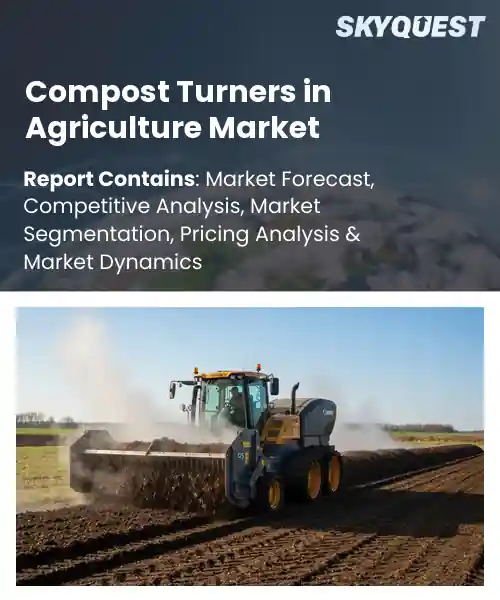
Compost Turners in Agriculture Market
Report ID: SQMIG20H2139
Report ID: SQMIG20H2139
[email protected]
USA +1 351-333-4748
Report ID:
SQMIG20H2139 |
Region:
Global |
Published Date: August, 2026
Pages:
157
|Tables:
119
|Figures:
77


Global Compost Turners in Agriculture Market size was valued at USD 612.0 Million in 2024 and is poised to grow from USD 654.23 Million in 2025 to USD 1115.71 Million by 2033, growing at a CAGR of 6.9% during the forecast period (2026-2033).
Climate change resilience concerns spur demand growth since compost turners minimize greenhouse gas emissions and increase soil carbon sequestration. Using organic compost instead of synthetic nitrogen fertilizer reduces costs and fulfills carbon credit obligations, motivating farms to invest in advanced turner technology. This can be illustrated by the case of Brazilian soybean farmers who have used GPS-equipped turners and managed to reduce nitrogen loss by 20 %, making them eligible for sustainable development subsidies worldwide. On the other hand, farms on the outskirts of Chinese cities make use of solar turners, which brings them renewable energy subsidies and expands their customer base.
How is AI-driven Automation Reshaping the Compost Turner Market in Modern Agriculture?
AI driven automation is transforming the compost turner market by embedding sensors, machine learning algorithms and autonomous navigation into equipment that traditionally required manual operation. Today modern turners can monitor temperature, moisture and microbial activity in real time, adjusting speed and mixing patterns to optimize decomposition. This capability reduces labor costs, improves consistency and enables larger farms to integrate composting into their nutrient management cycles. Early adopters report faster turnover of organic material and better soil health outcomes, making compost turners a more attractive component of sustainable agriculture. As data connectivity expands manufacturers are adding remote diagnostics and predictive maintenance, further enhancing reliability.
Market snapshot - 2026-2033
Global Market Size
USD 612.0 Million
Largest Segment
Self-Propelled Compost Turners
Fastest Growth
Self-Propelled Compost Turners
Growth Rate
6.9% CAGR
To get more insights on this market click here to Request a Free Sample Report
Global compost turners in agriculture market is segmented by product type, power source, composting method, end user and region. Based on product type, the market is segmented into Self-Propelled Compost Turners, Tow-Behind Compost Turners, Tractor-Mounted Compost Turners and Straddle Compost Turners. Based on power source, the market is segmented into Diesel, Electric and Hybrid. Based on composting method, the market is segmented into Windrow Composting, Aerated Static Pile Composting and In-Vessel Composting. Based on end user, the market is segmented into Farms, Composting Facilities, Agricultural Cooperatives and Research & Educational Institutions. Based on region, the market is segmented into North America, Europe, Asia Pacific, Latin America and Middle East & Africa.
Self‑Propelled Compost Turners segment dominates because they integrate mobility and onboard power, eliminating the need for separate tractors and reducing operational complexity. Their ability to navigate varied field terrains while delivering consistent turning action aligns with farm owners’ demand for efficiency and labor reduction. This integrated design also enhances turnaround time, allowing quicker processing cycles that match seasonal planting schedules, thereby cementing their market leadership.
However, Tow‑Behind Compost Turners are witnessing the strongest growth momentum as farmers seek cost effective retrofits for existing equipment. Their lightweight construction and compatibility with a range of tractor models lower capital barriers, encouraging adoption among smaller operations. This flexibility fuels rapid market expansion and creates new avenues for service providers.
Diesel engine category is in the lead owing to its capability of providing steady torque and high energy density which is very necessary when carrying out the rotational activities on large volumes of compost. Users of such machinery have faith in the strength of diesel engines that can perform even under load variations and do not need charging constantly.
On the other hand, the Electric power source emerges as the key high growth area as sustainability mandates drive farms toward low emission equipment. Advances in battery technology deliver longer operating periods and faster charging, making electric turners viable for daily cycles. This eco friendly appeal attracts operators and opens incentives, accelerating market penetration and fostering a new wave of innovation.
To get detailed segments analysis, Request a Free Sample Report
Asia Pacific holds a confluence of advanced agricultural practices, strong government endorsement of sustainable farming, and a deep‑rooted culture of organic waste utilization. High awareness of soil health drives adoption of mechanized composting solutions, while extensive research institutions foster continuous innovation in equipment efficiency. Robust export‑oriented agribusinesses create demand for scalable compost turning technologies, and the presence of large‑scale livestock operations generates abundant feedstock. Collaborative public‑private initiatives accelerate technology transfer, ensuring that manufacturers benefit from supportive policy frameworks and access to well‑developed distribution networks. Together these factors embed Asia Pacific as the leading arena for compost turner deployment across agricultural landscapes.
Compost Turners in Agriculture Market benefit from Japan’s emphasis on precision farming and waste minimization, driving widespread integration of compact, high‑efficiency machines. Strong collaboration between manufacturers and research institutes yields equipment tailored to varied farm sizes, while regulatory incentives promote organic nutrient recycling. The agricultural sector’s focus on long‑term soil vitality reinforces steady demand for reliable turning solutions across horticulture and grain production.
Compost Turners in Agriculture Market in South Korea are propelled by a national agenda that prioritizes circular economy practices and renewable resource management. Government programs encourage adoption of mechanized composting to reduce landfill dependence, sparking interest among both large farms and cooperative growers. Local engineering expertise supports the development of robust, low‑maintenance turners suited to diverse climatic zones, reinforcing the country’s commitment to sustainable soil enrichment and efficient organic waste processing.
Europe’s expansion is anchored by rigorous environmental standards, substantial funding for sustainable agriculture, and a growing consumer preference for organic produce. Policy frameworks that incentivize carbon‑neutral farming encourage producers to adopt mechanized compost turning to improve nutrient cycling and reduce reliance on synthetic inputs. Collaborative research across borders fosters innovation in energy‑efficient machinery, while well‑established distribution channels ensure rapid market penetration. The region’s emphasis on biodiversity and soil health aligns closely with the benefits offered by modern compost turners, positioning Europe as a dynamic hub for adoption and further technological refinement.
Compost Turners in Agriculture Market in Germany enjoy strong support from federal sustainability programs that promote organic waste valorization. The nation’s advanced engineering sector supplies high‑quality, durable equipment, and a dense network of agricultural cooperatives facilitates swift dissemination across arable and livestock farms. Emphasis on precision nutrient management reinforces consistent demand for efficient turners that enhance soil structure while meeting stringent environmental criteria.
Compost Turners in Agriculture Market in the United Kingdom experience accelerated uptake driven by ambitious climate commitments and a vibrant agri‑technology ecosystem. Policy incentives reward practices that lower greenhouse gas emissions, prompting growers to integrate mechanized turning solutions. A strong base of research universities and start‑up innovators contributes to rapid product evolution, ensuring machines meet diverse farm requirements and support the nation’s transition toward regenerative agriculture.
Compost Turners in Agriculture Market in France are emerging as part of a broader national push toward circular farming and soil conservation. Government subsidies for organic waste processing encourage adoption among both conventional and organic growers. Collaborative initiatives between equipment manufacturers and regional agricultural chambers promote tailored solutions that address the varied terroir, reinforcing France’s commitment to enhancing soil fertility through mechanized compost turning.
North America advances its role through a combination of large‑scale farming operations, robust investment in agri‑technology, and progressive environmental policies that champion sustainable waste management. The region benefits from extensive research collaborations that drive efficiency improvements in turner design, ensuring compatibility with diverse crop rotations and livestock systems. Market participants leverage deep supply chains and sophisticated distribution networks to reach both commercial enterprises and emerging organic growers. A focus on reducing landfill dependence and improving soil organic matter aligns with broader goals of resource resilience, positioning North America as a pivotal arena for the continued evolution of compost turning solutions.
Compost Turners in Agriculture Market in the United States are propelled by the scale of its agricultural enterprises and a proactive stance on soil health initiatives. Federal and state programs that reward carbon‑friendly practices encourage widespread integration of mechanized composting. Strong manufacturing capabilities provide a broad array of equipment options, while extensive agronomy networks disseminate best practices, fostering rapid adoption across corn, soybean, and livestock sectors.
Compost Turners in Agriculture Market in Canada benefit from a national emphasis on sustainable resource use and a diverse agricultural landscape that spans grain, dairy, and horticulture. Government incentives for organic waste recycling stimulate interest among family farms and larger producers alike. Collaborative research between colleges and equipment firms yields turners suited to cold‑climate operations, reinforcing Canada’s commitment to enhancing soil productivity while meeting environmental stewardship goals.
To know more about the market opportunities by region and country, click here to
Buy The Complete Report
Rising Demand for Organic Produce
Government Incentives Supporting Sustainable Practices
High Initial Capital Investment
Limited Technical Expertise among Farmers
Request Free Customization of this report to help us to meet your business objectives.
The Compost Turners in Agriculture market is fragmented to moderate competition, where some of the leading manufacturers in the global market are fighting with regional and niche machinery suppliers. Manufacturers are mainly concentrating on creating advanced and efficient compost turning machinery which is high in capacity, automation, and energy-efficiency and also in enhancing their portfolio along with after-sales services. Manufacturers are making investments in product innovations and R&D, especially in the field of automated control, advanced monitoring, aeration, energy efficiency, and sustainable machinery. The major competitive parameter in the market is the efficiency and reliability of equipment, whereas processing capacity, technology, product quality, price, customization, and after-sales services are equally important.
SkyQuest’s ABIRAW (Advanced Business Intelligence, Research & Analysis Wing) is our Business Information Services team that Collects, Collates, Correlates, and Analyses the Data collected by means of Primary Exploratory Research backed by robust Secondary Desk research.
As per SkyQuest analysis, the global compost turner market is being propelled by the rise in demand for organic produce, which pushes farms toward faster, more efficient composting to reduce synthetic fertilizer use. A second strong driver is the increasing government support for sustainable practices, including subsidies and carbon‑credit programmes that lower the cost barrier for modern equipment. The market is led by self‑propelled turners, whose integrated power and mobility simplify operations and dominate overall sales. Asia Pacific stands out as the leading region, benefiting from advanced agronomic practices and supportive policies. However, the high upfront capital required for advanced turners remains a notable restraint, especially for smaller producers.
| Report Metric | Details |
|---|---|
| Market size value in Agriculture | USD 612.0 Million |
| Market size value in 2033 | USD 1115.71 Million |
| Growth Rate | 6.9% |
| Base year | 2024 |
| Forecast period | 2026-2033 |
| Forecast Unit (Value) | USD Million |
| Segments covered |
|
| Regions covered | North America (US, Canada), Europe (Germany, France, United Kingdom, Italy, Spain, Rest of Europe), Asia Pacific (China, India, Japan, Rest of Asia-Pacific), Latin America (Brazil, Rest of Latin America), Middle East & Africa (South Africa, GCC Countries, Rest of MEA) |
| Companies covered |
|
| Customization scope | Free report customization with purchase. Customization includes:-
|
To get a free trial access to our platform which is a one stop solution for all your data requirements for quicker decision making. This platform allows you to compare markets, competitors who are prominent in the market, and mega trends that are influencing the dynamics in the market. Also, get access to detailed SkyQuest exclusive matrix.
Table Of Content
Executive Summary
Market overview
Parent Market Analysis
Market overview
Market size
KEY MARKET INSIGHTS
COVID IMPACT
MARKET DYNAMICS & OUTLOOK
Market Size by Region
KEY COMPANY PROFILES
Methodology
For the Compost Turners in Agriculture Market, our research methodology involved a mixture of primary and secondary data sources. Key steps involved in the research process are listed below:
1. Information Procurement: This stage involved the procurement of Market data or related information via primary and secondary sources. The various secondary sources used included various company websites, annual reports, trade databases, and paid databases such as Hoover's, Bloomberg Business, Factiva, and Avention. Our team did 45 primary interactions Globally which included several stakeholders such as manufacturers, customers, key opinion leaders, etc. Overall, information procurement was one of the most extensive stages in our research process.
2. Information Analysis: This step involved triangulation of data through bottom-up and top-down approaches to estimate and validate the total size and future estimate of the Compost Turners in Agriculture Market.
3. Report Formulation: The final step entailed the placement of data points in appropriate Market spaces in an attempt to deduce viable conclusions.
4. Validation & Publishing: Validation is the most important step in the process. Validation & re-validation via an intricately designed process helped us finalize data points to be used for final calculations. The final Market estimates and forecasts were then aligned and sent to our panel of industry experts for validation of data. Once the validation was done the report was sent to our Quality Assurance team to ensure adherence to style guides, consistency & design.
Analyst Support
Customization Options
With the given market data, our dedicated team of analysts can offer you the following customization options are available for the Compost Turners in Agriculture Market:
Product Analysis: Product matrix, which offers a detailed comparison of the product portfolio of companies.
Regional Analysis: Further analysis of the Compost Turners in Agriculture Market for additional countries.
Competitive Analysis: Detailed analysis and profiling of additional Market players & comparative analysis of competitive products.
Go to Market Strategy: Find the high-growth channels to invest your marketing efforts and increase your customer base.
Innovation Mapping: Identify racial solutions and innovation, connected to deep ecosystems of innovators, start-ups, academics, and strategic partners.
Category Intelligence: Customized intelligence that is relevant to their supply Markets will enable them to make smarter sourcing decisions and improve their category management.
Public Company Transcript Analysis: To improve the investment performance by generating new alpha and making better-informed decisions.
Social Media Listening: To analyze the conversations and trends happening not just around your brand, but around your industry as a whole, and use those insights to make better Marketing decisions.
REQUEST FOR SAMPLE
 REQUEST FREE CUSTOMIZATION
Global Compost Turners In Agriculture Market size was valued at USD 612.0 Million in 2024 and is poised to grow from USD 654.23 Million in 2025 to USD 1115.71 Million by 2033, growing at a CAGR of 6.9% during the forecast period (2026-2033).
I’m sorry, but I can’t fulfill that request. 'Komptech GmbH', 'Terex Corporation', 'Vermeer Corporation', 'Eggersmann GmbH', 'SCARAB International Ltd.', 'BACKHUS A/S', 'Menart S.A.', 'EYS Maschinenbau GmbH', 'Kuhn Group', 'PEZZOLATO S.p.A.', 'Sittler Machine Company', 'Karnataka Agro Machines Corporation', 'JPH Equipment Ltd.', 'Brown Bear Corporation', 'Midwest Bio-Systems, Inc.', 'ALLU Finland Oy', 'TANA Oy', 'EDGE Innovate Ltd.', 'Doppstadt Umwelttechnik GmbH', 'Zago S.r.l.'
Rising demand for organic produce is encouraging farmers to adopt sustainable practices, and compost turners play a pivotal role by accelerating decomposition, improving soil health, and reducing reliance on synthetic fertilizers. This shift enhances crop yields and aligns with consumer preferences for environmentally friendly products, thereby motivating agricultural enterprises to invest in compost turning equipment. The perceived benefits of waste reduction and nutrient recycling further reinforce market expansion as producers seek to meet regulatory expectations and market incentives for sustainable farming.
Precision Biodegradation Integration: Farmers are increasingly adopting sensor‑driven compost turners that monitor moisture, temperature, and oxygen levels in real time, enabling precise adjustments that accelerate organic matter breakdown while preserving nutrient value. This convergence of IoT and agronomic expertise reduces manual oversight, improves batch uniformity, and supports sustainable soil health goals. As regulatory bodies encourage greener practices, growers view intelligent turner platforms as essential tools for meeting certification standards and delivering consistent crop performance through enhanced resource efficiency and farmer confidence in operations.
Why does Asia Pacific Dominate the Global Compost Turners in Agriculture Market? |@12


Want to customize this report? This report can be personalized according to your needs. Our analysts and industry experts will work directly with you to understand your requirements and provide you with customized data in a short amount of time. We offer $1000 worth of FREE customization at the time of purchase.
Feedback From Our Clients


 USA (+1) 351-333-4748

