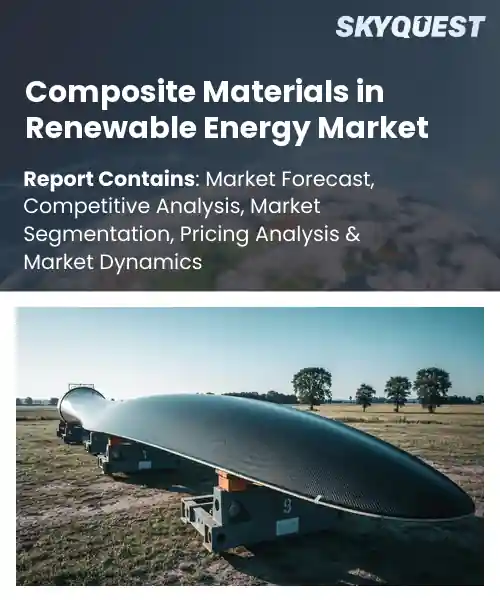
Composite Materials in Renewable Energy Market
Report ID: SQMIG15F2372
Report ID: SQMIG15F2372
[email protected]
USA +1 351-333-4748
Report ID:
SQMIG15F2372 |
Region:
Global |
Published Date: June, 2026
Pages:
157
|Tables:
174
|Figures:
79


Global Composite Materials In Renewable Energy Market size was valued at USD 12.80 Billion in 2024 and is poised to grow from USD 14.05 Billion in 2025 to USD 29.70 Billion by 2033, growing at a CAGR of 9.8% during the forecast period (2026-2033).
The market for composite materials in renewable energy market trends is largely driven by the requirement for lightweight, high-strength elements that ultimately reduce costs and improve efficiency of systems. After the scaling of wind turbines, solar cells, and offshore platforms traditional metallic structures have an additional weight and risk of corrosion which results in the manufacturers turning towards using carbon fiber and glass fiber composites.
In the past as the composite materials in renewable energy market growth developed, it was primarily utilized for aerospace applications, then, during the last decade, wind energy blades moved quickly into use as capacity factors of large wind turbines increased; and wind turbine hubs grew to diameters of 150m. This change in manufacturing methods reduced blade quantities by approximately 30% and extended blade lifespan, which has resulted in composites becoming an absolute necessity for future global market development. As a second driving force of market growth composites have also had significant attention from investors' driven by the regulatory requirements put in place by governments for power generation which has led developers to use materials which reduce the cost of power generation. When government put feed-in tariffs or carbon pricing in place, project are evaluated based on the technologies which have the capacity to produce the most energy per square foot of installation (location); that is composites will allow larger blades and stiffer towers that are capable of producing more energy.
Therefore, composite materials in renewable energy market share will allow developers to reduce the cost of a project significantly. An example of this is a 13-MW offshore wind turbine installed in Denmark. The carbon fiber mast sections on that turbine reduced the overall weight of the turbine by 40% and allowed the height of the hub to be raised by 7-meters, which provided a 15% improvement in power production; thus creating an example of the cause-and-effect relationship between incentive programs and the growth of the composite material industry.
How is AI Driving the Adoption of Composite Materials in the Renewable Energy Market?
The selection and use of composite materials in renewable energy industry is evolving. By analyzing enormous datasets of materials with machine learning, engineers can make informed decisions about the type of materials (e.g., carbon fiber vs. glass fiber) they should use based on desired performance characteristics (e.g., turbine or storage type) and characteristics of the finished part. Engineers also use generative design software to create lattice structures that allow for weight savings while maintaining the strength required for the application, reducing throughout times for prototypes.
Additionally, real-time monitoring algorithms assess stress and fatigue of the composite materials used in wind turbine blades, allowing engineers to schedule predictive maintenance before material failure happens. Ultimately, by creating a connection between simulation and manufacturing, artificial intelligence (AI) enables cheaper, faster production of lightweight composite materials that have become an important component of clean energy systems.
In March 2026, Volkswagen launched the AI-optimized composite battery enclosures that meet weight and thermal management specifications to create larger renewable energy storage deployments. The AI-optimized designs significantly reduce the development timeline and improve overall efficiency in the design of composite materials, accelerating the trend toward using high-performance, lightweight renewable energy solutions.
Market snapshot - (2026-2033)
Global Market Size
USD 12.8 Billion
Largest Segment
Fastest Growth
Growth Rate
9.8% CAGR
To get more insights on this market click here to Request a Free Sample Report
Global composite materials in renewable energy market is segmented by material type, resin type, renewable energy application, manufacturing process, end user, distribution channel and region. Based on material type, the market is segmented into carbon fiber composites, glass fiber composites, natural fiber composites, aramid fiber composites, and hybrid composites. Based on resin type, the market is segmented into epoxy resins, polyester resins, vinyl ester resins, polyurethane resins, bio-based resins, and others. Based on renewable energy application, the market is segmented into wind energy, solar energy, hydropower, tidal & wave energy, and geothermal energy. Based on manufacturing process, the market is segmented into resin transfer molding (RTM), vacuum infusion process, filament winding, pultrusion, compression molding, and hand lay-up. Based on end user, the market is segmented into renewable energy equipment manufacturers, energy utilities & power producers, EPC contractors, renewable energy project developers, and research & engineering organizations. Based on distribution channel, the market is segmented into direct sales, distributors & suppliers, and online procurement platforms. Based on region, the market is segmented into North America, Europe, Asia Pacific, Latin America and Middle East & Africa.
The carbon fiber component is leading the industry due to its superior specific strength and specific rigidity when compared to alternatives. Lighter turbine blades and wind tower parts allow for more efficient energy capture. Designers are very focused on using carbon fiber because it will help them meet performance requirements while using less material, which reduces the cost of transportation and installation. Furthermore, because of carbon fiber’s ability to withstand cyclic loading for long periods of time, OEMs have more confidence in their ability to operate carbon fiber products, leading them to use this material for all of their projects. The result is that industry investors are putting money into the development of carbon fiber and developing a more robust supply chain.
The glass fiber component is a segment that is rapidly growing because manufacturers are using the material to take advantage of its lower cost and ease of processing in order to meet the needs of the rapidly expanding offshore wind foundation and solar tracker frame markets. There are also improvements to the surface treatment processes used to process glass fiber, which have improved the performance characteristics of glass fiber, thereby attracting design professionals to use glass fiber because of its reasonable cost and robust performance. Therefore, the glass fiber segment will continue to grow within the industry.
The segment using epoxy resin continues to have the largest market share due to its proven ability to bond fiber to fiber within turbine blades and hydro turbine housings through superior adhesion, chemical resistance, and mechanical integrity. Engineers depend on epoxy's reliable curing mechanism to provide consistent structural performance in very harsh environmental conditions. The durability of epoxy against moisture and temperature fluctuations minimizes the frequency of maintenance that OEMs need to perform and has encouraged manufacturers to create standardized epoxy systems for all of their projects. The combination of this assurance will drive developers to increase their capital investment in expanding their epoxy production capacity.
Conversely, the bio-based resin segment will continue to grow because manufacturers are under increasing pressure from sustainability regulations mandating that they replace petroleum-derived binders with bio-based feed stocks. Research developments in applying phenomenally productive chemistries based on both lignin and plant oils have produced "high-performance" materials suitable for making wind blade cores and solar panel frames. The availability of these bio-based materials will lead to many new contracts and will help to accelerate the penetration of bio-based materials into the market.
To get detailed segments analysis, Request a Free Sample Report
A confluence of strong manufacturing ecosystems, advanced research entities, and government policies promoting the integration of renewable energy resources creates opportunities for growth in areas such as the use of high-performance composite materials as substitutes for traditional materials in constructing wind turbine blades, solar panel frames, and new energy storage solutions. Existing supply chains and an array of Tier 1 original equipment manufacturers provide speed and efficiency to scaling these products. Partnerships between academia and industry enhance innovation through collaborative efforts. Also, the region's marine renewable and offshore wind focus maximizes its deep-water expertise, which further embeds composite materials in future energy infrastructure designs.
Composite materials in renewable energy market outlook in Japan are propelled by a long‑standing tradition of precision engineering and a national agenda that prioritizes offshore wind development. Research collaborations between leading universities and manufacturers accelerate the adoption of lightweight, corrosion‑resistant composites, enhancing turbine efficiency in challenging marine conditions. The domestic supply base, supported by government‑backed innovation funds, ensures a steady flow of advanced fiber technologies, fostering a resilient ecosystem for renewable infrastructure growth.
Composite materials in renewable energy market forecast in South Korea are driven by a rapid transition toward green energy and a strong emphasis on high‑tech manufacturing. Government programs incentivize the integration of composites in solar tracking structures and next‑generation wind turbines, while leading conglomerates invest heavily in fiber‑reinforced polymer research. Close ties between industry and research institutes accelerate material performance improvements, positioning the country as a hub for cutting‑edge composite solutions within the regional renewable landscape.
The drive behind the expansion of renewable energy in Europe is based on aggressive decarbonisation goals, an abundance of offshore wind projects, as well as existing governmental regulations that promote the use of sustainable materials. Innovative development within high-strength/low-weight composite materials is encouraged through strong public-private partnerships by taking advantage of Europe's large number of existing wind farms and solar plant assets. In addition, Europe has a rich history of having aerospace and automotive companies that have developed an extensive pool of talent (i.e., engineers, scientists) and have advanced manufacturing capabilities. As a result, technology can easily be transferred between different industries. In addition, Europe's strict environmental standards will create a increased level of demand for recyclable and durable composite materials, thus making it possible for Europe to maintain its position as the leader in renewable energy infrastructures.
Composite materials in renewable energy market penetration in Germany are anchored by its engineering excellence and a comprehensive renewable energy roadmap that emphasizes offshore wind. Leading research institutes collaborate closely with manufacturers to develop high‑performance carbon fiber solutions, enhancing turbine blade durability and performance. Robust supply chains and a culture of precision manufacturing ensure that composite components meet stringent quality criteria, supporting the nation’s expansive wind farm projects and reinforcing its dominance in the European market.
Composite materials in renewable energy market regional outlook in United Kingdom are experiencing the fastest growth due to substantial offshore wind investments and supportive policy incentives. The country’s maritime heritage combined with cutting‑edge composite research accelerates the deployment of larger, lighter turbine blades that improve energy capture. Collaborative ecosystems linking universities, startups, and established firms foster rapid prototyping and scale‑up, positioning the United Kingdom as a dynamic hub for innovative composite applications in renewable energy.
Composite materials in renewable energy market regional forecast in France are emerging through focused government programs that target offshore wind and solar infrastructure modernization. Partnerships between research laboratories and niche composite manufacturers drive the development of corrosion‑resistant, lightweight materials suitable for coastal installations. Growing expertise in resin transfer molding and advanced fiber technologies enables French firms to supply tailored solutions, gradually expanding their footprint in the broader European renewable energy supply chain.
North America utilizes its enormous industrial base, ongoing capital investments, and innovative energy policy framework to strengthen its position within the composite materials market place. The aerospace and automotive industries in both the U.S. and Canada have robustly developed specialized expertise that allows for rapid transfer of technology into renewable energy-related applications (i.e., wind turbine blades, solar support structures). In addition, the rapid acceleration of material performance improvements is facilitated by collaborative research consortia as well as government-funded innovation grants. The venture capital community has also played an integral role in supporting the growth development of new, emerging composite start-up companies. Collectively, these resources and underlying policy support strengthen the resilience of the marketplace and propel continued growth throughout North America.
Composite materials in renewable energy market analysis in United States are propelled by large‑scale wind farm developments and a vibrant ecosystem of research institutions and industrial partners. Federal incentives and state‑level renewable mandates encourage the replacement of metallic components with high‑strength composites, improving turbine efficiency and reducing maintenance. The presence of major fiber manufacturers and advanced tooling capabilities ensures a dependable supply chain, fostering rapid adoption across diverse renewable projects.
Composite materials in renewable energy market penetartion in Canada are shaped by abundant renewable resources and a national commitment to clean energy transition. Focus on offshore wind and remote solar installations drives demand for lightweight, weather‑resistant composites that can endure harsh climates. Collaborative initiatives between Canadian universities and composite specialists promote material innovations tailored to the country’s unique geographic challenges, strengthening its role in the North American renewable energy landscape.
To know more about the market opportunities by region and country, click here to
Buy The Complete Report
Rising Adoption of Advanced Composites
Policy Incentives Supporting Green Materials
High Production Costs of Composites
Limited Recycling Infrastructure
Request Free Customization of this report to help us to meet your business objectives.
The competitive landscape is shaped by rapid consolidation, strategic partnerships, and breakthrough material innovations, with leading firms accelerating M&A to secure bio‑based resin portfolios and collaborating with aerospace and defense partners to scale high‑performance composites for wind turbine blades and solar‑panel frames. Recent examples include a Lockheed Martin investment in a composite‑manufacturing startup and joint ventures between major wind turbine OEMs and polymer innovators to reduce weight and improve recyclability.
Top Player’s Company Profile
Recent Developments in the Composite Materials in Renewable Energy Market
SkyQuest’s ABIRAW (Advanced Business Intelligence, Research & Analysis Wing) is our Business Information Services team that Collects, Collates, Correlates, and Analyses the Data collected by means of Primary Exploratory Research backed by robust Secondary Desk research. As per SkyQuest analysis, the market is accelerating because developers are seeking lighter, high‑strength components that cut system cost and boost efficiency, while supportive government policies and tax incentives further spur adoption, and a second driver is the rapid integration of AI‑assisted design which shortens development cycles and improves performance. High production costs remain the chief restraint, limiting budget‑conscious projects. Asia Pacific leads the market, leveraging robust manufacturing ecosystems and strong renewable targets. Within the market, carbon‑fiber composites dominate the material segment, reflecting their superior specific strength and stiffness. The trend also encourages investment in recyclable resin systems, further expanding opportunities.
| Report Metric | Details |
|---|---|
| Market size value in 2024 | USD 12.8 Billion |
| Market size value in 2033 | USD 29.7 Billion |
| Growth Rate | 9.8% |
| Base year | 2024 |
| Forecast period | (2026-2033) |
| Forecast Unit (Value) | USD Billion |
| Segments covered |
|
| Regions covered | North America (US, Canada), Europe (Germany, France, United Kingdom, Italy, Spain, Rest of Europe), Asia Pacific (China, India, Japan, Rest of Asia-Pacific), Latin America (Brazil, Rest of Latin America), Middle East & Africa (South Africa, GCC Countries, Rest of MEA) |
| Companies covered |
|
| Customization scope | Free report customization with purchase. Customization includes:-
|
To get a free trial access to our platform which is a one stop solution for all your data requirements for quicker decision making. This platform allows you to compare markets, competitors who are prominent in the market, and mega trends that are influencing the dynamics in the market. Also, get access to detailed SkyQuest exclusive matrix.
Table Of Content
Executive Summary
Market overview
Parent Market Analysis
Market overview
Market size
KEY MARKET INSIGHTS
COVID IMPACT
MARKET DYNAMICS & OUTLOOK
Market Size by Region
KEY COMPANY PROFILES
Methodology
For the Composite Materials in Renewable Energy Market, our research methodology involved a mixture of primary and secondary data sources. Key steps involved in the research process are listed below:
1. Information Procurement: This stage involved the procurement of Market data or related information via primary and secondary sources. The various secondary sources used included various company websites, annual reports, trade databases, and paid databases such as Hoover's, Bloomberg Business, Factiva, and Avention. Our team did 45 primary interactions Globally which included several stakeholders such as manufacturers, customers, key opinion leaders, etc. Overall, information procurement was one of the most extensive stages in our research process.
2. Information Analysis: This step involved triangulation of data through bottom-up and top-down approaches to estimate and validate the total size and future estimate of the Composite Materials in Renewable Energy Market.
3. Report Formulation: The final step entailed the placement of data points in appropriate Market spaces in an attempt to deduce viable conclusions.
4. Validation & Publishing: Validation is the most important step in the process. Validation & re-validation via an intricately designed process helped us finalize data points to be used for final calculations. The final Market estimates and forecasts were then aligned and sent to our panel of industry experts for validation of data. Once the validation was done the report was sent to our Quality Assurance team to ensure adherence to style guides, consistency & design.
Analyst Support
Customization Options
With the given market data, our dedicated team of analysts can offer you the following customization options are available for the Composite Materials in Renewable Energy Market:
Product Analysis: Product matrix, which offers a detailed comparison of the product portfolio of companies.
Regional Analysis: Further analysis of the Composite Materials in Renewable Energy Market for additional countries.
Competitive Analysis: Detailed analysis and profiling of additional Market players & comparative analysis of competitive products.
Go to Market Strategy: Find the high-growth channels to invest your marketing efforts and increase your customer base.
Innovation Mapping: Identify racial solutions and innovation, connected to deep ecosystems of innovators, start-ups, academics, and strategic partners.
Category Intelligence: Customized intelligence that is relevant to their supply Markets will enable them to make smarter sourcing decisions and improve their category management.
Public Company Transcript Analysis: To improve the investment performance by generating new alpha and making better-informed decisions.
Social Media Listening: To analyze the conversations and trends happening not just around your brand, but around your industry as a whole, and use those insights to make better Marketing decisions.
REQUEST FOR SAMPLE
 REQUEST FREE CUSTOMIZATION
Global Composite Materials In Renewable Energy Market size was valued at USD 12.8 Billion in 2024 and is poised to grow from USD 14.05 Billion in 2025 to USD 29.7 Billion by 2033, growing at a CAGR of 9.8% during the forecast period (2026-2033).
The competitive landscape is shaped by rapid consolidation, strategic partnerships, and breakthrough material innovations, with leading firms accelerating M&A to secure bio‑based resin portfolios and collaborating with aerospace and defense partners to scale high‑performance composites for wind turbine blades and solar‑panel frames. Recent examples include a Lockheed Martin investment in a composite‑manufacturing startup and joint ventures between major wind turbine OEMs and polymer innovators to reduce weight and improve recyclability. 'Owens Corning', 'Jushi Co., Ltd.', 'China Beihai Fiberglass Co., Ltd.', 'Chongqing Polycomp International Corp.', 'Toray Industries, Inc.', 'Teijin Limited', 'SGL Carbon SE', 'Hexcel Corporation', 'Gurit Holding AG', 'TPI Composites, Inc.', 'Avient Corporation', 'Mitsubishi Chemical Group Corporation', 'Solvay SA', 'Syensqo SA', 'Huntsman Corporation', 'Johns Manville Corporation', '3B-the fibreglass company', 'Saertex GmbH & Co. KG', 'AOC LLC', 'Arkema S.A.'
Advanced Fiber Integration: The renewable sector increasingly adopts high‑performance carbon and glass fiber composites to extend turbine blade lifespans and reduce weight, enabling larger rotor diameters and higher energy capture. Manufacturers are partnering with specialty fiber producers to co‑develop resin systems that tolerate harsh marine environments while simplifying lay‑up processes. This collaborative approach accelerates certification pathways, fosters modular design concepts, and positions composites as a preferred solution for offshore wind projects seeking superior durability and operational efficiency throughout operation periods.
Why does Asia Pacific Dominate the Global Composite Materials in Renewable Energy Market? |@12


Want to customize this report? This report can be personalized according to your needs. Our analysts and industry experts will work directly with you to understand your requirements and provide you with customized data in a short amount of time. We offer $1000 worth of FREE customization at the time of purchase.
Feedback From Our Clients


 USA (+1) 351-333-4748

