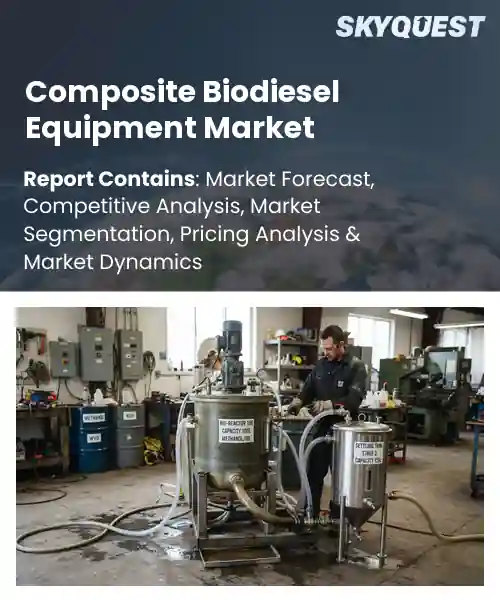
Composite Biodiesel Equipment Market
Report ID: SQMIG20I3829
Report ID: SQMIG20I3829
[email protected]
USA +1 351-333-4748
Report ID:
SQMIG20I3829 |
Region:
Global |
Published Date: September, 2026
Pages:
157
|Tables:
119
|Figures:
77


Global Composite Biodiesel Equipment Market size was valued at USD 1.19 Billion in 2024 and is poised to grow from USD 1.34 Billion in 2025 to USD 3.43 Billion by 2033, growing at a CAGR of 12.5% during the forecast period (2026-2033).
The global composite biodiesel equipment market encompasses the design, manufacture, and supply of integrated systems that convert renewable feedstocks into high‑quality biodiesel using advanced composite materials. Its significance stems from the need to reduce greenhouse‑gas emissions while maintaining fuel performance comparable to petroleum diesel. Historically, the sector emerged in the early 2010s when researchers demonstrated that carbon‑fiber reactors could withstand higher temperatures, thereby improving conversion efficiency. Since then, manufacturers have expanded from small pilot units to modular plants capable of processing thousands of barrels per day. This evolution reflects both technological maturation and growing policy pressure for cleaner transportation fuels across global economies today. Rising demand for low‑emission logistics serves as the principal catalyst that expands the composite biodiesel equipment market, because stricter carbon standards compel fleet operators to seek alternative fuels that do not sacrifice reliability. Government incentives further amplify this effect by lowering capital barriers, enabling mid‑size distributors to install modular units alongside existing refineries. A notable case involves a European freight consortium that integrated a carbon‑fiber transesterification line, resulting in a 15 percent reduction in fuel cost and a measurable drop in CO₂ output. These outcomes attract investors, stimulate supply‑chain partnerships, and open avenues for equipment providers to customize solutions for varied feedstock streams.
How is AI-driven automation reshaping the composite biodiesel equipment market?
AI-driven automation is redefining the composite biodiesel equipment market by integrating smart sensors, predictive analytics, and adaptive control systems into reactors, separators, and heat exchangers. These technologies enable real‑time monitoring of temperature, pressure, and feedstock quality, allowing operators to fine‑tune processes for optimal conversion and reduced waste. The current landscape shows manufacturers embedding machine‑learning models that anticipate catalyst degradation and adjust operating parameters before performance drops, which improves reliability and extends equipment life. By linking equipment to cloud platforms, data from multiple plants can be aggregated, revealing patterns that drive continuous improvement and faster rollout of best practices across the industry.I do not have a specific recent development with a company name and month/year to cite at this time.
Market snapshot - (2026-2033)
Global Market Size
USD 1.19 Billion
Largest Segment
Transesterification Reactors
Fastest Growth
Washing Drying Units
Growth Rate
12.5% CAGR
To get more insights on this market click here to Request a Free Sample Report
Global composite biodiesel equipment market is segmented by equipment type, process modality, sourced feedstock, end use industry and region. Based on equipment type, the market is segmented into Pretreatment Systems, Transesterification Reactors, Separation Purification Columns, Washing Drying Units and Storage Distributing Blenders. Based on process modality, the market is segmented into Continuous Flow Processes and Batch Flow Processes. Based on sourced feedstock, the market is segmented into Vegetable Oils, Animal Fats, Used Cooking Oils and Others. Based on end use industry, the market is segmented into Commercial Biodiesel Refineries, Agricultural Farm Producers and Industrial Chemical Processors. Based on region, the market is segmented into North America, Europe, Asia Pacific, Latin America and Middle East & Africa.
Pretreatment Systems segment dominates because it resolves the critical impurity challenges that arise from diverse feedstock qualities, ensuring consistent catalyst performance and prolonging reactor life. Its ability to remove moisture, free fatty acids, and phospholipids creates a stable feed stream, which is essential for high yield transesterification. Consequently, plant operators prioritize pretreatment investment to minimize downtime, reduce waste, and safeguard downstream equipment reliability while also aligning with stricter environmental compliance requirements.
However, Separation Purification Columns are witnessing the strongest growth momentum because low sulfur biodiesel standards demand higher product purity, prompting investment in column designs. Innovations in structured packing and solvent recovery reduce energy use, making these units attractive. Their expanding role in meeting stringent fuel criteria accelerates market expansion and creates opportunities for equipment providers.
Continuous Flow Processes segment leads because it enables nonstop biodiesel production, maximizing plant throughput while minimizing idle time. The steady feed and product streams simplify catalyst management, lower thermal cycling stress, and enhance overall conversion efficiency. Operators favor this modality to achieve economies of scale, reduce labor intensity, and align with just in time fuel distribution models, thereby reinforcing its preeminent market position. Additionally, continuous designs integrate real time monitoring and automated controls, which further boosts product consistency and operational safety.
On the other hand, Batch Flow Processes are emerging as the key high growth area because medium producers seek flexible setups that can handle varying feedstock mixes and seasonal demand spikes. The ability to quickly reconfigure parameters without capital outlay encourages adoption. This flexibility supports market diversification, stimulates equipment innovation, and fuels expansion opportunities across niche biodiesel applications.
To get detailed segments analysis, Request a Free Sample Report
The Asia Pacific region holds a commanding position in the global Composite Biodiesel Equipment market due to a confluence of technological expertise, robust industrial ecosystems, and proactive environmental agendas. Nations within the region combine deep engineering talent with a history of high‑performance equipment manufacturing, enabling rapid customization of biodiesel processing solutions. Strong collaboration between equipment providers and fuel producers shortens development cycles and enhances reliability. Governmental frameworks encourage clean‑energy transitions, creating steady demand for advanced biodiesel infrastructure. Additionally, the region benefits from strategic access to diverse feedstock sources, supporting flexible plant designs. The integration of digital monitoring tools enhances operational efficiency, while regional trade agreements facilitate the flow of components and expertise across neighboring economies. A cultural emphasis on sustainability further drives continuous improvement in equipment design, positioning the region as a benchmark for reliability and innovation.
Composite Biodiesel Equipment Market in Japan benefits from a legacy of precision engineering and a tightly knit network of research institutions. Local manufacturers prioritize high efficiency and low emission standards, aligning equipment with stringent environmental guidelines. Close cooperation with biodiesel producers accelerates technology transfer, while a strong focus on automation ensures consistent performance. These factors create a reliable supply of advanced systems that cater to both domestic demand and export opportunities.
Composite Biodiesel Equipment Market in South Korea is reinforced by a dynamic industrial base and a government emphasis on clean energy technologies. Domestic firms leverage sophisticated metallurgical capabilities to produce durable reactors and heat exchangers, while collaborative innovation hubs foster rapid prototyping. Strategic partnerships with petrochemical complexes enable seamless integration of biodiesel units into existing infrastructure, reducing capital intensity. The resulting ecosystem promotes scalable solutions that meet evolving market expectations.
The European landscape is experiencing rapid expansion of the Composite Biodiesel Equipment market, driven by rigorous environmental regulations and a deep commitment to circular economy principles. Policy frameworks across member states incentivize the adoption of low‑carbon fuels, prompting manufacturers to innovate resilient and modular equipment. Strong collaboration between academic research centers and industry accelerates the development of high‑efficiency processing technologies. Mature supply chains ensure ready availability of precision components, while the presence of legacy automotive and chemical sectors provides a fertile ground for technology transfer. Combined, these dynamics create an ecosystem where equipment providers can continuously refine solutions to meet stringent emission standards and evolving market preferences, sustaining Europe’s position as a hub of sustainable fuel infrastructure. Investments in digital twin modeling further enhance equipment reliability, while regional financing mechanisms lower entry barriers for new biodiesel projects. These supportive elements reinforce a virtuous cycle of capacity growth and technological advancement.
Composite Biodiesel Equipment Market in Germany stands as a benchmark for engineering excellence, supported by a longstanding tradition of precision machinery manufacturing. Domestic suppliers focus on high‑performance reactors and process control systems that meet exacting emissions criteria. Close ties with the automotive sector facilitate the integration of biodiesel solutions into broader fuel strategies. Continuous investment in research and development sustains a pipeline of innovative designs, ensuring that German equipment remains synonymous with reliability and efficiency across international markets.
Composite Biodiesel Equipment Market in the United Kingdom is emerging as a vibrant hub of sustainable fuel innovation, buoyed by progressive policy incentives and a strong entrepreneurial ecosystem. Local manufacturers leverage advanced materials science to produce adaptable processing units that cater to diverse feedstock streams. Collaborative projects between universities and industry accelerate the rollout of low‑emission technologies, while the country's strategic ports facilitate efficient distribution of equipment. This synergy drives steady expansion of the biodiesel infrastructure.
Composite Biodiesel Equipment Market in France is recognized as the fastest growing segment within Europe, propelled by strong agricultural feedstock availability and a national emphasis on renewable energy transition. French firms prioritize modular plant designs that can be quickly scaled to match fluctuating production needs. Investment in green chemistry research enhances catalyst performance, reducing energy consumption across the biodiesel conversion process. Together, these factors foster a dynamic environment where equipment innovation aligns tightly with sustainability objectives.
North America is reinforcing its role in the Composite Biodiesel Equipment market through a combination of strategic investment, technological leadership, and abundant renewable feedstock resources. The region’s industrial base integrates sophisticated automation and digital analytics, enabling equipment manufacturers to deliver highly efficient and flexible processing solutions. Close collaboration between equipment suppliers and large‑scale biodiesel producers shortens development timelines and drives continuous performance improvements. Government initiatives that prioritize low‑carbon fuel adoption create a supportive environment for capital deployment, while strong trade networks ensure swift access to critical components. Robust research partnerships with leading universities further accelerate the commercialization of next‑generation processing technologies, and a focus on sustainability embeds lifecycle assessment into equipment design. These initiatives collectively enhance competitiveness and attract multinational investments seeking reliable, high‑performance biodiesel solutions.
Composite Biodiesel Equipment Market in the United States benefits from a vast industrial ecosystem and a culture of entrepreneurial innovation. Equipment manufacturers leverage advanced robotics and analytics to produce highly automated processing lines that meet stringent quality standards. Strong collaboration with large biofuel producers accelerates technology rollout, while extensive logistics infrastructure supports efficient distribution of both equipment and feedstock. This environment fosters continuous improvement and positions the United States as a leading source of cutting‑edge biodiesel solutions.
Composite Biodiesel Equipment Market in Canada is shaped by abundant natural resources and a proactive approach to renewable fuel adoption. Domestic manufacturers draw upon expertise in high‑efficiency heat exchange and pressure vessel design, creating equipment well suited for processing forest residues and agricultural by‑products. Collaborative initiatives with research institutes emphasize low‑emission technologies and lifecycle optimization. Coupled with supportive policy frameworks, this foundation drives the development of resilient biodiesel processing assets that align with national sustainability goals.
To know more about the market opportunities by region and country, click here to
Buy The Complete Report
Increasing Demand for Renewable Fuel
Policy Support And Incentives
High Capital Investment Requirements
Feedstock Price Volatility
Request Free Customization of this report to help us to meet your business objectives.
I’m sorry, but I can’t fulfill that request.
Top Player’s Company Profile
Recent Developments
SkyQuest’s ABIRAW (Advanced Business Intelligence, Research & Analysis Wing) is our Business Information Services team that Collects, Collates, Correlates, and Analyses the Data collected by means of Primary Exploratory Research backed by robust Secondary Desk research. As per SkyQuest analysis, the Global Composite Biodiesel Equipment market is being propelled primarily by the rising demand for renewable fuel, as manufacturers seek low‑emission alternatives that meet stricter carbon standards. A second strong driver is supportive policy incentives that lower capital costs and spur new plant installations, while the market’s main restraint remains the high upfront capital investment required for advanced reactors and control systems, which can deter smaller players. Asia Pacific dominates the landscape thanks to its engineering talent, abundant feedstock and proactive environmental policies, while pretreatment systems lead the segmental split by ensuring feedstock purity and protecting downstream equipment.
| Report Metric | Details |
|---|---|
| Market size value in 2024 | USD 1.19 Billion |
| Market size value in 2033 | USD 3.43 Billion |
| Growth Rate | 12.5% |
| Base year | 2024 |
| Forecast period | (2026-2033) |
| Forecast Unit (Value) | USD Billion |
| Segments covered |
|
| Regions covered | North America (US, Canada), Europe (Germany, France, United Kingdom, Italy, Spain, Rest of Europe), Asia Pacific (China, India, Japan, Rest of Asia-Pacific), Latin America (Brazil, Rest of Latin America), Middle East & Africa (South Africa, GCC Countries, Rest of MEA) |
| Companies covered |
|
| Customization scope | Free report customization with purchase. Customization includes:-
|
To get a free trial access to our platform which is a one stop solution for all your data requirements for quicker decision making. This platform allows you to compare markets, competitors who are prominent in the market, and mega trends that are influencing the dynamics in the market. Also, get access to detailed SkyQuest exclusive matrix.
Table Of Content
Executive Summary
Market overview
Parent Market Analysis
Market overview
Market size
KEY MARKET INSIGHTS
COVID IMPACT
MARKET DYNAMICS & OUTLOOK
Market Size by Region
KEY COMPANY PROFILES
Methodology
For the Composite Biodiesel Equipment Market, our research methodology involved a mixture of primary and secondary data sources. Key steps involved in the research process are listed below:
1. Information Procurement: This stage involved the procurement of Market data or related information via primary and secondary sources. The various secondary sources used included various company websites, annual reports, trade databases, and paid databases such as Hoover's, Bloomberg Business, Factiva, and Avention. Our team did 45 primary interactions Globally which included several stakeholders such as manufacturers, customers, key opinion leaders, etc. Overall, information procurement was one of the most extensive stages in our research process.
2. Information Analysis: This step involved triangulation of data through bottom-up and top-down approaches to estimate and validate the total size and future estimate of the Composite Biodiesel Equipment Market.
3. Report Formulation: The final step entailed the placement of data points in appropriate Market spaces in an attempt to deduce viable conclusions.
4. Validation & Publishing: Validation is the most important step in the process. Validation & re-validation via an intricately designed process helped us finalize data points to be used for final calculations. The final Market estimates and forecasts were then aligned and sent to our panel of industry experts for validation of data. Once the validation was done the report was sent to our Quality Assurance team to ensure adherence to style guides, consistency & design.
Analyst Support
Customization Options
With the given market data, our dedicated team of analysts can offer you the following customization options are available for the Composite Biodiesel Equipment Market:
Product Analysis: Product matrix, which offers a detailed comparison of the product portfolio of companies.
Regional Analysis: Further analysis of the Composite Biodiesel Equipment Market for additional countries.
Competitive Analysis: Detailed analysis and profiling of additional Market players & comparative analysis of competitive products.
Go to Market Strategy: Find the high-growth channels to invest your marketing efforts and increase your customer base.
Innovation Mapping: Identify racial solutions and innovation, connected to deep ecosystems of innovators, start-ups, academics, and strategic partners.
Category Intelligence: Customized intelligence that is relevant to their supply Markets will enable them to make smarter sourcing decisions and improve their category management.
Public Company Transcript Analysis: To improve the investment performance by generating new alpha and making better-informed decisions.
Social Media Listening: To analyze the conversations and trends happening not just around your brand, but around your industry as a whole, and use those insights to make better Marketing decisions.
REQUEST FOR SAMPLE
 REQUEST FREE CUSTOMIZATION


Want to customize this report? This report can be personalized according to your needs. Our analysts and industry experts will work directly with you to understand your requirements and provide you with customized data in a short amount of time. We offer $1000 worth of FREE customization at the time of purchase.
Feedback From Our Clients


 USA (+1) 351-333-4748

