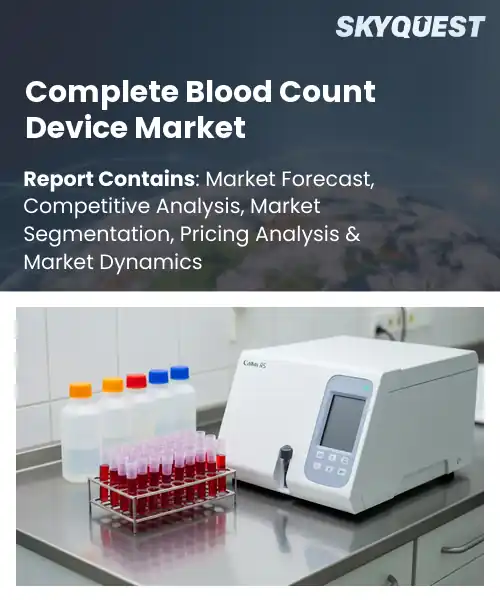
Complete Blood Count Device Market
Report ID: SQMIG35A4054
Report ID: SQMIG35A4054
[email protected]
USA +1 351-333-4748
Report ID:
SQMIG35A4054 |
Region:
Global |
Published Date: July, 2026
Pages:
157
|Tables:
175
|Figures:
79


Global Complete Blood Count Device Market size was valued at USD 4.6 Billion in 2024 and is poised to grow from USD 4.98 Billion in 2025 to USD 9.35 Billion by 2033, growing at a CAGR of 8.2% during the forecast period (2026-2033).
The complete blood count (CBC) device market growth is pushed along by the increasing presence of infectious diseases, anemia, cancer, and long-term chronic disorders that basically need routine hematological testing, for diagnosis and also ongoing treatment monitoring. At the same time, more people are leaning toward early detection and preventive healthcare, so the CBC tests being done in hospitals, diagnostic labs, and even in physician offices keeps going up, and that volume thing is important.
Moreover, there are the technology upgrades, like automated hematology analyzers, AI assisted data interpretation, and smaller point-of-care CBC devices, which end up speeding everything along, improving accuracy ,and making the workflow feel less chaotic. Also, healthcare infrastructure keeps expanding in emerging economies, and governments are putting more money into diagnostic services. That helps the whole market not just survive but grow. On top of that, the global population is aging, health checkups are getting more popular, and emergency care is needing quicker diagnostics, so reliable high-throughput CBC testing devices are still in demand everywhere.
AI is changing the complete blood count device market outlook, mainly by sharpening analytical precision and also by moving laboratory tasks along faster and cleaner. Machine learning models can interpret cell morphology in a more uniform way than manual review so the false classifications get reduced. Real-time data integration helps instruments auto calibrate and highlight unusual patterns, which cuts down on repeat testing . Cloud-based platforms can pull results from multiple locations, then predictive maintenance kicks in which reduces downtime. In practice, this means faster turnaround times, and stronger confidence in diagnostic choices, and that fits the bigger needs of aging populations plus chronic disease management.
Market snapshot - (2026-2033)
Global Market Size
USD 4.6 Billion
Largest Segment
5-Part Differential Hematology Analyzers
Fastest Growth
5-Part Differential Hematology Analyzers
Growth Rate
8.2% CAGR
To get more insights on this market click here to Request a Free Sample Report
The global complete blood count device market is segmented by product type, modality, application, end user, technology, throughput and region. Based on product type, the market is segmented into 3-Part Differential Hematology Analyzers, 5-Part Differential Hematology Analyzers, Point-Of-Care Cbc Devices and Fully Automated Cbc Analyzers. Based on modality, the market is segmented into Benchtop Cbc Devices and Portable Cbc Devices. Based on application, the market is segmented into Routine Hematology Testing, Disease Diagnosis & Monitoring, Preoperative Testing, Emergency & Critical Care Testing and Others. Based on end user, the market is segmented into Hospitals, Diagnostic Laboratories, Physician Offices, Academic & Research Institutes and Others. Based on technology, the market is segmented into Impedance-Based Analyzers, Flow Cytometry-Based Analyzers and Hybrid Technology Analyzers. Based on throughput, the market is segmented into Low Throughput, Medium Throughput and High Throughput. Based on region, the market is segmented into North America, Europe, Asia Pacific, Latin America and Middle East & Africa.
As per the complete blood count device market analysis, the 5‑Part Differential Hematology Analyzers segment stands out because they give a full leukocyte profile, which helps clinicians tease apart small hematologic issues with more precision. They can report five separate white blood cell categories at once, so the diagnostic turnaround feels faster, and it also helps with managing complicated disease pathways. Plus, when they tie into hospital information systems, the whole workflow gets smoother, while the quality control bits stay solid, so the results look more dependable. Because of that, many high‑volume labs end up preferring them for accurate and reproducible outputs.
Meanwhile, the point-of-care CBC devices segment is showing the quickest expansion, mainly because care is getting more decentralized and that makes bedside testing more desired. These devices, being compact with wireless connectivity, push results quickly, so urgent decisions in ambulatory and emergencies can happen without waiting. That momentum lifts market reach too, and it gives manufacturers new chances to grow.
According to the complete blood count device market forecast, benchtop CBC devices are leading because they mix strong analytical daily throughput with automation that actually holds up under routine use, which fits what central labs test for. The platform stays stable, supports larger sample racks, and often uses integrated reagents, so performance stays consistent, and downtime stays minimal. Also, data flow becomes easier when the instruments integrate cleanly with a laboratory information management system, and calibration routines support reproducibility. Overall, they become core tools for facilities that care about accuracy and volume handling, as well as operational efficiency.
Conversely, portable CBC devices are building the strongest growth momentum, since point-of-need testing is expanding across community health settings and mobile clinics. Battery-powered units, paired with rugged designs, allow fast on-site analysis, cutting down the need for patients to travel as much, and enabling earlier decisions. This wave lifts adoption and opens up new revenue channels for manufacturers too.
To get detailed segments analysis, Request a Free Sample Report
As per the complete blood count device market regional forecast, North America leads the market, mainly because its healthcare infrastructure is mature, it has strong regulatory frameworks, and people are adopting advanced diagnostic technologies faster than elsewhere. The region also gets a boost from wide hospital networks and this general mindset of catching illness early, which somehow keeps the demand for accurate hematology instruments steady. On top of that, there’s robust research and development investment , from both established makers and new innovators, and it keeps feeding a stream of next‑generation devices. There are academic institutions working together with industry, that helps validate novel platforms quicker. Then there’s the big role of major medical device distributors, they make market access easier plus they provide after‑sales support and that builds customer confidence. Reimbursement policies in North America are another helpful layer, they push hospitals to upgrade to automated analyzers, and the strong emphasis on data integration supports smoother workflow changes, not only in theory either. All these elements, supportive regulation , plus investment, innovation and operational efficiency , are what keep North America in a dominant position.
United States Complete Blood Count Device Market
The Complete Blood Count Device sector in the United States is thriving off extensive clinical research facilities and a proactive approach to health upkeep. Big hospitals tend to prioritize integration of high‑throughput analyzers, while diagnostic labs lean on sophisticated automation, to speed up turnaround times. There is also strong collaboration between device manufacturers and regulatory bodies, that streamlines product launches. Training programs are solid too, they help ensure skilled operation , which helps sustain demand and ongoing innovation. In a way, this ecosystem keeps momentum across the market and feeds growth at a broader, global level.
Canada Complete Blood Count Device Market
The Complete Blood Count Device industry in Canada benefits from a publicly funded health system that stresses preventive screening , plus rapid diagnostic capability. National health agencies encourage adoption of standardized hematology platforms so interoperability stays consistent across provinces. Partnerships with academic research centers help test emerging technologies, and regulatory pathways are designed to support faster market entry. Continued investment in clinician education also supports proper use of instruments, so health providers can produce accurate blood analyses in an efficient way , without losing consistency.
Europe is seeing rapid complete blood count device market penetration, mostly due to policy encouragement, technological excellence, and a clear focus on patient‑centred diagnostics. Harmonized regulatory frameworks across member states streamline product approvals, so manufacturers can bring unified platforms to market more easily. Health ministries also prioritize modernization of laboratory networks, meaning more investment in high‑precision analyzers that strengthen diagnostic confidence. The research ecosystems across Europe collaborate heavily, and that speeds up validation of new assay techniques. Meanwhile, integration with electronic health records improves data flow, which makes operations feel less “patchy”. Sustainability issues also push adoption of energy‑efficient instruments and reduced consumable waste. Clinicians want quicker turnaround, so laboratories gradually shift toward automated solutions that keep results dependable, with fewer manual steps involved. This overall posture supports market expansion , and it reinforces Europe’s fast growth , with the continued trajectory staying positive.
Germany Complete Blood Count Device Market
The Complete Blood Count Device Market in Germany rests on a network of university hospitals adopting cutting‑edge hematology analyzers. The country places strong emphasis on clinical research , and it encourages early evaluation of innovative platforms. Standardized procurement processes also help, since acquisition can move smoothly across public and private sectors. Partnerships between device manufacturers and diagnostic societies help ensure product development matches real clinical needs. Professional education and competency programs reinforce how the instruments should be used, and that supports Germany’s steady leadership in precise blood analysis.
United Kingdom Complete Blood Count Device Market
The Complete Blood Count Device Market share is rising in the United Kingdom by an ecosystem that values rapid diagnostic turnaround and integration. National health agencies promote automated analyzers , partly to handle outpatient testing volumes without creating bottlenecks. Collaboration between academic institutions and device suppliers helps accelerate technology introduction. There’s also emphasis on training and competency, because laboratory staff need to maximize instrument performance, not just use it. This approach is what drives market expansion , and it reinforces the United Kingdom’s status as a key growth market.
France Complete Blood Count Device Market
The Complete Blood Count Device Market in France is picking up pace, as laboratories adopt automated solutions to meet rising demand for efficient patient care. Government health programs encourage modernization of diagnostic equipment, and that supports acquisition of analyzers designed for clinical settings. Partnerships with research institutes enable trialing hematology platforms, while cost‑effectiveness thinking guides procurement choices. Training initiatives improve operator proficiency, so French facilities can deliver blood count results with reduced turnaround times.
Asia Pacific is getting a stronger foothold in the Complete Blood Count Device market through a mix of strategic investments, quicker uptake of automation, and broader clinical linkages. Lots of governments around the region are putting priority on upgrading lab infrastructure to keep up with the rising population health requirements, so the setting becomes favorable for better hematology analyzers. Also, local producers are working more and more with major technology leaders, so there is technology transfer happening along with cost-effective offerings that match regional practice habits.
At the same time, more chronic illnesses mean labs need fast high-throughput testing, while digital health initiatives push for smooth connection of lab data with wider patient management platforms. And then there is the workforce angle too, specialized training programs are being emphasized, so operators can actually make full use of these sophisticated instruments. Taken together, these moves speed up market entry and make Asia Pacific feel like a key growth engine for complete blood count diagnostics, in general.
Japan Complete Blood Count Device Market
The Complete Blood Count Device Market in Japan is supported by a health system that favors accuracy and efficiency in lab diagnostics. National health policies are encouraging the use of analyzers that can manage sample volumes quickly, with a shorter turnaround time. There is also collaboration between local manufacturers and research universities, which helps with improving assay sensitivity, and keeping instrument reliability on a steadier footing. Training and certification receive strong attention, while integration with electronic health records improves how easy data can be accessed and how decisions are made.
South Korea Complete Blood Count Device Market
The Complete Blood Count Device Market in South Korea grows from an innovation mindset, plus government backing for lab infrastructure. Hospitals and clinics tend to choose automated hematology systems, because it supports faster diagnosis and better accuracy. Partnerships between domestic manufacturers and global R&D centers help in creating compact devices that fit real clinical settings. Education programs lift operator competence, and when results are integrated with health information networks, reporting becomes smoother and patient management becomes more effective, overall.
To know more about the market opportunities by region and country, click here to
Buy The Complete Report
Rising Demand for Preventive Healthcare
Advancements In Point‑of‑Care Technologies
High Initial Capital Investment
Regulatory Compliance Complexity
Request Free Customization of this report to help us to meet your business objectives.
The competitive landscape looks like it’s being driven by older diagnostics companies pushing outward through strategic mergers and alliances , while newer entrants push harder on innovation with AI based platforms and portable analyzers. That whole mix then ramps up pressure on pricing , and also on what features stand out. Some of the most recent collaborations between big diagnostics groups and AI startups show that technology integration is turning into a main market driver , like not a side thing.
Top Player’s Company Profile
Recent Developments in the Complete Blood Count Device Market
SkyQuest’s ABIRAW (Advanced Business Intelligence, Research & Analysis Wing) is our Business Information Services team that Collects, Collates, Correlates, and Analyses the Data collected by means of Primary Exploratory Research backed by robust Secondary Desk research.
As per SkyQuest analysis, the market is propelled by a main force—the rising need for preventive healthcare, which nudges hospitals and laboratories toward more comprehensive CBC devices for earlier disease detection. A second driver comes from quick advancements in point of care technologies, providing compact connected analyzers that broaden access. That expansion is especially visible in ambulatory and remote settings. North America is still leading, backed by mature infrastructure, solid reimbursement, and active innovation pipelines. The 5‑Part Differential Hematology Analyzer portion dominates, because it gives detailed leukocyte profiling and it tends to shorten turnaround times for high volume labs. Still, there’s a restraint, the high upfront capital investment. That can slow adoption among smaller facilities and also in emerging markets.
| Report Metric | Details |
|---|---|
| Market size value in 2024 | USD 4.6 Billion |
| Market size value in 2033 | USD 9.35 Billion |
| Growth Rate | 8.2% |
| Base year | 2024 |
| Forecast period | (2026-2033) |
| Forecast Unit (Value) | USD Billion |
| Segments covered |
|
| Regions covered | North America (US, Canada), Europe (Germany, France, United Kingdom, Italy, Spain, Rest of Europe), Asia Pacific (China, India, Japan, Rest of Asia-Pacific), Latin America (Brazil, Rest of Latin America), Middle East & Africa (South Africa, GCC Countries, Rest of MEA) |
| Companies covered |
|
| Customization scope | Free report customization with purchase. Customization includes:-
|
To get a free trial access to our platform which is a one stop solution for all your data requirements for quicker decision making. This platform allows you to compare markets, competitors who are prominent in the market, and mega trends that are influencing the dynamics in the market. Also, get access to detailed SkyQuest exclusive matrix.
Table Of Content
Executive Summary
Market overview
Parent Market Analysis
Market overview
Market size
KEY MARKET INSIGHTS
COVID IMPACT
MARKET DYNAMICS & OUTLOOK
Market Size by Region
KEY COMPANY PROFILES
Methodology
For the Complete Blood Count Device Market, our research methodology involved a mixture of primary and secondary data sources. Key steps involved in the research process are listed below:
1. Information Procurement: This stage involved the procurement of Market data or related information via primary and secondary sources. The various secondary sources used included various company websites, annual reports, trade databases, and paid databases such as Hoover's, Bloomberg Business, Factiva, and Avention. Our team did 45 primary interactions Globally which included several stakeholders such as manufacturers, customers, key opinion leaders, etc. Overall, information procurement was one of the most extensive stages in our research process.
2. Information Analysis: This step involved triangulation of data through bottom-up and top-down approaches to estimate and validate the total size and future estimate of the Complete Blood Count Device Market.
3. Report Formulation: The final step entailed the placement of data points in appropriate Market spaces in an attempt to deduce viable conclusions.
4. Validation & Publishing: Validation is the most important step in the process. Validation & re-validation via an intricately designed process helped us finalize data points to be used for final calculations. The final Market estimates and forecasts were then aligned and sent to our panel of industry experts for validation of data. Once the validation was done the report was sent to our Quality Assurance team to ensure adherence to style guides, consistency & design.
Analyst Support
Customization Options
With the given market data, our dedicated team of analysts can offer you the following customization options are available for the Complete Blood Count Device Market:
Product Analysis: Product matrix, which offers a detailed comparison of the product portfolio of companies.
Regional Analysis: Further analysis of the Complete Blood Count Device Market for additional countries.
Competitive Analysis: Detailed analysis and profiling of additional Market players & comparative analysis of competitive products.
Go to Market Strategy: Find the high-growth channels to invest your marketing efforts and increase your customer base.
Innovation Mapping: Identify racial solutions and innovation, connected to deep ecosystems of innovators, start-ups, academics, and strategic partners.
Category Intelligence: Customized intelligence that is relevant to their supply Markets will enable them to make smarter sourcing decisions and improve their category management.
Public Company Transcript Analysis: To improve the investment performance by generating new alpha and making better-informed decisions.
Social Media Listening: To analyze the conversations and trends happening not just around your brand, but around your industry as a whole, and use those insights to make better Marketing decisions.
REQUEST FOR SAMPLE
 REQUEST FREE CUSTOMIZATION
Global Complete Blood Count Device Market size was valued at USD 4.6 Billion in 2024 and is poised to grow from USD 4.98 Billion in 2025 to USD 9.35 Billion by 2033, growing at a CAGR of 8.2% during the forecast period (2026-2033).
The competitive landscape is shaped by legacy diagnostics firms expanding through strategic M&A and partnerships while emerging players accelerate innovation with AI‑driven platforms and portable analyzers, intensifying pressure on pricing and feature differentiation; recent collaborations between major diagnostics groups and AI startups illustrate how technology integration is becoming a decisive market driver. 'Sysmex Corporation', 'Danaher Corporation', 'Abbott Laboratories', 'Siemens Healthineers AG', 'HORIBA, Ltd.', 'Mindray Medical International Limited', 'Nihon Kohden Corporation', 'Boule Diagnostics AB', 'Diatron MI Zrt.', 'ERBA Diagnostics Mannheim GmbH', 'Shenzhen Dymind Biotechnology Co., Ltd.', 'DIRUI Industrial Co., Ltd.', 'Rayto Life and Analytical Sciences Co., Ltd.', 'Drawell International Technology Co., Ltd.', 'URIT Medical Electronic Co., Ltd.', 'Orphee SA', 'Analyticon Biotechnologies GmbH', 'EKF Diagnostics Holdings plc', 'Diesse Diagnostica Senese S.p.A.', 'Agappe Diagnostics Ltd.'
Healthcare providers are increasingly prioritizing early detection of hematologic disorders, which drives adoption of comprehensive blood count devices. By enabling rapid, accurate analysis of cell parameters, these instruments support routine screening and risk assessment programs. The emphasis on preventive care encourages clinics and hospitals to integrate such technology into standard practice, fostering steady demand. Consequently, market participants experience expanding opportunities as the clinical focus shifts toward continuous monitoring and timely intervention, reinforcing growth momentum across diverse care settings globally today.
Ai Enabled Diagnostic Automation: Healthcare providers are integrating AI driven algorithms into complete blood count analyzers to streamline result interpretation and reduce manual error. Real time data analytics enable clinicians to receive actionable insights instantly, facilitating faster treatment decisions. This automation also supports remote monitoring platforms, allowing laboratories to operate with reduced staffing while maintaining throughput. As machine learning models mature, they can predict trends in patient health, enhancing preventive care strategies and positioning vendors that offer seamless AI integration as market leaders globally.
Why does North America Dominate the Global Complete Blood Count Device Market? |@12


Want to customize this report? This report can be personalized according to your needs. Our analysts and industry experts will work directly with you to understand your requirements and provide you with customized data in a short amount of time. We offer $1000 worth of FREE customization at the time of purchase.
Feedback From Our Clients


 USA (+1) 351-333-4748

