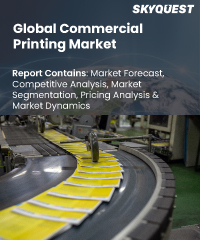
Commercial Printing Market
Report ID: SQMIG20K2010
Report ID: SQMIG20K2010
[email protected]
USA +1 351-333-4748
Report ID:
SQMIG20K2010 |
Region:
Global |
Published Date: July, 2025
Pages:
181
|Tables:
66
|Figures:
67


Global Commercial Printing Market size was valued at USD 509.37 Billion in 2024 and is poised to grow from USD 524.65 Billion in 2025 to USD 664.61 Billion by 2033, growing at a CAGR of 3% in the forecast period (2026–2033).
The global commercial printing market is undergoing significant transformation, influenced by changing consumer preferences and technological advancements. Despite the shift toward digital media, commercial printing remains an essential service for industries such as packaging, publishing, and advertising. The integration of digital technologies has enhanced production efficiency, customization capabilities, and overall print quality, contributing to the market's continued relevance.
One of the key drivers of the commercial printing market is the growing demand for printed packaging materials, particularly driven by the expansion of the e-commerce and retail sectors. As businesses strive to enhance brand visibility and consumer experience, high-quality printed packaging has become a crucial marketing tool. This trend is further supported by the increasing importance of sustainability, pushing companies to innovate eco-friendly printing practices and materials.
Moreover, the implementation of environmentally friendly methods, such as soy ink instead of conventional petroleum-based ink, has reduced the environmental footprint of the printing industry and allowed both consumers and suppliers to reduce carbon emissions. This trend is expected to aid the overall market over the forecast period.
How is AI Transforming Prepress and Workflow Operations?
AI is also revolutionizing quality control within the printing process. Modern commercial presses are now equipped with AI-powered vision systems that detect printing defects in real-time, including color inconsistencies, smudging, or misalignment. This capability ensures higher output quality while minimizing waste and reducing the need for manual inspection.
On the business operations side, AI is enhancing job scheduling and demand forecasting. By analyzing historical and real-time data, AI systems help commercial printers better allocate resources, plan production cycles, and manage inventory. This results in increased efficiency, cost savings, and improved responsiveness to customer demands.
Furthermore, AI is now assisting in the creative side of printing. Generative AI tools are being used to create design templates, layout suggestions, and even marketing content, helping designers and marketers develop campaigns more quickly and at a lower cost. This democratizes creative work and opens new opportunities for small and mid-sized businesses to compete with larger firms.
AI is contributing to sustainability goals within the commercial printing industry. By optimizing ink usage, paper selection, and energy consumption, AI helps reduce environmental impact. In 2024, many commercial printers have implemented AI-powered dashboards to monitor and report on their sustainability metrics, aligning with corporate ESG (Environmental, Social, Governance) initiatives.
Market snapshot - 2026-2033
Global Market Size
USD 494.53 Billion
Largest Segment
Packaging
Fastest Growth
Advertising
Growth Rate
3.0% CAGR
To get more insights on this market click here to Request a Free Sample Report
Global commercial printing market is segmented based on technology, application, print type and region. Based on technology, market is segmented into digital printing, lithography printing, flexographic, screen printing, gravure printing, and others. Based on application, market is segmented into packaging, advertising, and publishing. Based on print type, the market is segmented into image, painting, pattern, and others. Based on Region, the market is segmented as, North America, Asia-Pacific, Europe, Latin America, and the Middle East and Africa.
How is E-commerce Driving Demand for Printed Packaging?
As per global commercial printing market outlook, packaging remains the dominant segment of the industry, owing to its critical role in sectors such as food and beverage, healthcare, and consumer goods. This segment demands a wide range of printing techniques including flexography, offset, and digital printing, each offering distinct advantages in color vibrancy, sharpness, and customization. With the ongoing rise in online shopping and retail activity, the demand for printed packaging continues to surge as businesses seek to enhance the unboxing experience and reinforce brand identity. Additionally, sustainability trends are reshaping packaging practices, with commercial printers increasingly adopting eco-friendly materials, edible inks, and waste-reduction technologies to meet regulatory and consumer expectations.
As per global commercial printing market forecast, advertising is the fastest-growing segment within the commercial printing market. Despite the dominance of digital channels, printed advertising materials such as brochures, flyers, posters, banners, and merchandise remain effective tools for brand promotion and public outreach. Print offers distinct benefits like high visibility, longer shelf life, and greater trust among certain consumer demographics. As marketing shifts toward personalized, hyperlocal campaigns, commercial printers are evolving to support faster, more flexible, and highly customized print solutions.
How does Image Printing Support Brand Communication and Engagement?
As per global commercial printing market forecast, the image segment remains dominant in the market due to its broad application range, consistent demand, and integration across industries. This segment includes high-quality printing of photographs, magazines, books, corporate materials, catalogs, and marketing collateral products that are essential for brand communication, education, and consumer engagement. Unlike niche printing areas, image-based outputs are widely used across sectors such as advertising, publishing, retail, real estate, and education, ensuring sustained volume and variety.
The pattern segment is the fastest growing in the market. The rise of digital textile printing, fueled by trends in fast fashion, interior design, and personalized décor, is driving this commercial printing market growth. Advances in pigment inks, digital workflows, and demand for small-batch customized designs are propelling pattern printing ahead, particularly in the B2C and lifestyle product sectors.
To get detailed segments analysis, Request a Free Sample Report
How is North America Leading Through Technological Innovation in Commercial Printing?
As per regional analysis, North America remains one of the most developed and stable markets in the global commercial printing market. The region benefits from an established base of large print providers, robust demand from sectors like retail, packaging, education, and a growing shift toward sustainability and automation. The region is also witnessing strong adoption of digital and AI-powered print technologies to improve turnaround times and personalization.
Commercial Printing Market in United States
The United States holds the largest market share in the market due to its expansive commercial, retail, and e-commerce sectors. The country hosts industry giants such as Quad and RR Donnelley and is a frontrunner in integrating digital and AI-driven solutions into print workflows. Key demand areas include packaging, promotional materials, photo books, and personalized print. Sustainability is also a growing focus, with increased use of recyclable materials and energy-efficient presses.
Commercial Printing Market in Canada
As per regional outlook, Canada’s commercial printing sector is smaller but steadily growing, supported by demand in packaging, education, and small business marketing. Canadian printers are embracing web-to-print services, environmentally friendly ink technologies, and short-run digital printing to meet the needs of local retailers and publishers. Government incentives for sustainability and clean technology adoption are also accelerating innovation in the sector.
Why is Asia-Pacific the Fastest-Growing Region in the Commercial Printing Industry?
Asia-Pacific is the fastest-growing commercial printing region globally, fueled by its manufacturing capacity, expanding middle class, rapid urbanization, and growth in e-commerce. Demand is surging in areas like flexible packaging, textile printing, education, and industrial applications. The region is also experiencing a significant shift toward automation, digital printing, and hybrid print systems.
Commercial Printing Market in Japan
Japan is known for its sophisticated, high-quality printing technology, especially in industrial, photo, and digital printing. While the overall market is mature and stable, growth is occurring in specialty and on-demand printing, as well as 3D and electronics-related applications. Japanese companies lead in R&D for ink technology, print heads, and compact digital press equipment.
Commercial Printing Market in South Korea
South Korea is a dynamic market driven by technology integration, luxury consumer goods, and smart packaging innovations. With a tech-savvy population and strong e-commerce penetration, the country is increasingly using variable data printing and customized packaging for products. Major printers are investing in automated workflows and eco-friendly print solutions to stay competitive.
How is Europe Driving Sustainability and Specialization in Commercial Printing?
Europe has a well-established commercial printing industry with strong demand across publishing, packaging, advertising, and art. The region is highly regulated in terms of environmental standards, pushing printers to adopt green printing technologies, biodegradable materials, and circular economy practices. Europe's commercial print is also closely tied to creative industries and luxury goods.
Commercial Printing Market in Germany
Germany is the leading commercial printing country in Europe, well known for its high-end packaging, industrial print, and engineering of printing equipment. The German market emphasizes precision and sustainability, with strong investments in waterless offset, digital print automation, and recyclable substrates. Its print machinery is exported globally, powering the world’s pressrooms.
Commercial Printing Market in United Kingdom
The UK is a leading market for marketing-focused commercial printing, including brochures, promotional materials, and event signage. The country has embraced web-to-print and on-demand printing platforms, making it a hotspot for small-run, fast-turnaround services. With the rise of e-commerce and startups, custom packaging and variable data printing are in high demand.
Commercial Printing Market in Italy
As per industry analysis, Italy’s commercial printing industry is closely tied to its luxury, fashion, and design sectors. This drives demand for high-end packaging, textile printing, and decorative prints. The country also has a vibrant art and publishing scene, further fuelling demand for specialty and boutique print solutions. Digital printing is expanding, particularly in textile and interior décor segments.
To know more about the market opportunities by region and country, click here to
Buy The Complete Report
Commercial Printing Market Drivers
Rising Demand for Packaging
Advancements in Digital Printing Technology
Commercial Printing Market Restraints
Shift Toward Digital Media
Environmental and Regulatory Pressures
Request Free Customization of this report to help us to meet your business objectives.
The global commercial printing industry is highly competitive and fragmented, with the presence of numerous players ranging from large multinational corporations to small and medium-sized regional providers. Key players in the industry are continuously innovating to stay ahead, investing in digital printing technologies, sustainable solutions, and automation tools to meet evolving customer demands.
As per market strategies, a notable example in 2024 is the strategic collaboration between Heidelberg Druckmaschinen AG and Fujifilm Corporation, aimed at integrating Heidelberg's offset press systems with Fujifilm’s cutting-edge inkjet technology. This alliance is designed to bridge the gap between traditional and digital printing, enabling hybrid print solutions that deliver both high-speed performance and cost-effective customization.
Startups are playing a vital role in reshaping the commercial printing market, particularly by introducing agile, tech-driven solutions that address evolving customer needs. In 2024, companies like Printess, a Germany-based startup, have emerged as innovators by offering cloud-based, no-code design platforms for web-to-print applications.
Zakeke (Founded: 2017): Zakeke is a cloud-based visual commerce platform that enables 2D, 3D, and augmented reality (AR) product customization for print-on-demand and e-commerce businesses. It integrates with platforms like Shopify, WooCommerce, BigCommerce, and Etsy, allowing customers to personalize products such as apparel, packaging, marketing materials, and merchandise in real-time. Zakeke empowers print providers and online sellers to offer immersive, interactive customization experiences, making it a key player in the personalization trend driving the commercial printing industry.
Printess (Founded: 2020): Printess is a newer startup offering a cloud-based, no-code design editor optimized for web-to-print businesses. Its real-time product customization engine allows e-commerce stores and prints providers to offer on-the-fly personalization of printed items such as labels, packaging, and promotional materials. With an API-first approach and modern UI, Printess is helping transform the personalization workflow, especially for SMEs looking to scale without complex software development.
Top Player’s Company Profiles
Recent Developments in Commercial Printing Market
SkyQuest’s ABIRAW (Advanced Business Intelligence, Research & Analysis Wing) is our Business Information Services team that Collects, Collates, Correlates, and Analyses the Data collected by means of Primary Exploratory Research backed by robust Secondary Desk research.
According to SkyQuest analysis, the market is majorly driven by the retail, financial services, publishing, and food and beverage industries. The demand for packaging, wide-format printing, digital printing, and other promotional materials by the retail and food and beverage industries is a significant driver that aids in commercial printing market development. With the rise in digitization, customers are likely to follow more electronic versions of printed materials, such as e-annual reports, e-vouchers and e-catalogues, or to use more online platforms, such as email, the internet, or websites, rather than printing materials for consumers, which in turn affects the commercial printing market expansion. Investments in artificial intelligence for print workflow automation, together with micro-factory concepts located near consumer hubs, are expected to raise throughput and improve profitability for many participants in the commercial printing market.
| Report Metric | Details |
|---|---|
| Market size value in 2024 | USD 509.37 Billion |
| Market size value in 2033 | USD 664.61 Billion |
| Growth Rate | 3% |
| Base year | 2024 |
| Forecast period | 2026-2033 |
| Forecast Unit (Value) | USD Billion |
| Segments covered |
|
| Regions covered | North America (US, Canada), Europe (Germany, France, United Kingdom, Italy, Spain, Rest of Europe), Asia Pacific (China, India, Japan, Rest of Asia-Pacific), Latin America (Brazil, Rest of Latin America), Middle East & Africa (South Africa, GCC Countries, Rest of MEA) |
| Companies covered |
|
| Customization scope | Free report customization with purchase. Customization includes:-
|
To get a free trial access to our platform which is a one stop solution for all your data requirements for quicker decision making. This platform allows you to compare markets, competitors who are prominent in the market, and mega trends that are influencing the dynamics in the market. Also, get access to detailed SkyQuest exclusive matrix.
Table Of Content
Executive Summary
Market overview
Parent Market Analysis
Market overview
Market size
KEY MARKET INSIGHTS
COVID IMPACT
MARKET DYNAMICS & OUTLOOK
Market Size by Region
KEY COMPANY PROFILES
Methodology
For the Commercial Printing Market, our research methodology involved a mixture of primary and secondary data sources. Key steps involved in the research process are listed below:
1. Information Procurement: This stage involved the procurement of Market data or related information via primary and secondary sources. The various secondary sources used included various company websites, annual reports, trade databases, and paid databases such as Hoover's, Bloomberg Business, Factiva, and Avention. Our team did 45 primary interactions Globally which included several stakeholders such as manufacturers, customers, key opinion leaders, etc. Overall, information procurement was one of the most extensive stages in our research process.
2. Information Analysis: This step involved triangulation of data through bottom-up and top-down approaches to estimate and validate the total size and future estimate of the Commercial Printing Market.
3. Report Formulation: The final step entailed the placement of data points in appropriate Market spaces in an attempt to deduce viable conclusions.
4. Validation & Publishing: Validation is the most important step in the process. Validation & re-validation via an intricately designed process helped us finalize data points to be used for final calculations. The final Market estimates and forecasts were then aligned and sent to our panel of industry experts for validation of data. Once the validation was done the report was sent to our Quality Assurance team to ensure adherence to style guides, consistency & design.
Analyst Support
Customization Options
With the given market data, our dedicated team of analysts can offer you the following customization options are available for the Commercial Printing Market:
Product Analysis: Product matrix, which offers a detailed comparison of the product portfolio of companies.
Regional Analysis: Further analysis of the Commercial Printing Market for additional countries.
Competitive Analysis: Detailed analysis and profiling of additional Market players & comparative analysis of competitive products.
Go to Market Strategy: Find the high-growth channels to invest your marketing efforts and increase your customer base.
Innovation Mapping: Identify racial solutions and innovation, connected to deep ecosystems of innovators, start-ups, academics, and strategic partners.
Category Intelligence: Customized intelligence that is relevant to their supply Markets will enable them to make smarter sourcing decisions and improve their category management.
Public Company Transcript Analysis: To improve the investment performance by generating new alpha and making better-informed decisions.
Social Media Listening: To analyze the conversations and trends happening not just around your brand, but around your industry as a whole, and use those insights to make better Marketing decisions.
REQUEST FOR SAMPLE
 REQUEST FREE CUSTOMIZATION


Want to customize this report? This report can be personalized according to your needs. Our analysts and industry experts will work directly with you to understand your requirements and provide you with customized data in a short amount of time. We offer $1000 worth of FREE customization at the time of purchase.
Feedback From Our Clients


 USA (+1) 351-333-4748

