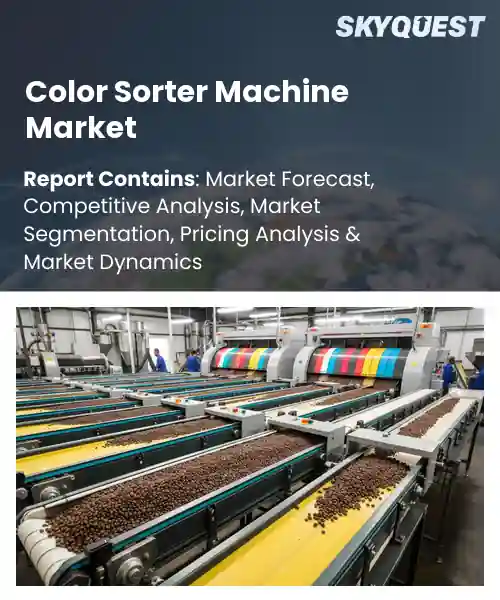
Color Sorter Machine Market
Report ID: SQMIG20D2725
Report ID: SQMIG20D2725
[email protected]
USA +1 351-333-4748
Report ID:
SQMIG20D2725 |
Region:
Global |
Published Date: July, 2026
Pages:
157
|Tables:
183
|Figures:
79


Global Color Sorter Machine Market size was valued at USD 1.50 Billion in 2024 and is poised to grow from USD 1.57 Billion in 2025 to USD 2.29 Billion by 2033, growing at a CAGR of 4.8% during the forecast period (2026-2033).
The main factor driving demand for the color sorter machine market growth is the increasing need for automated quality control solutions in the food, agriculture and recycling industries. A color sorter is a piece of equipment used to classify products by their color and spectral characteristics. There is great value in color sorting in that it decreases contaminants, increases consistency and minimizes labor costs. The primary developments of the color sorter industry have included moving away from manual and mechanical sorting to systems based on CCD technology, then to multi-spectral sensor technology using machine learning properties in order to improve throughput and decrease false reject rates.
For example, rice processors use color sorter machine market trends to sort rice to export quality, while plastic recyclers use spectral sorting technology to improve the purity of their materials; both processes result in considerable operational and economic benefits. With processors and recyclers seeking greater purity and consistency, the rapid evolution of sensor and algorithm capabilities are the most significant contributors to the continued growth of the global color sorter machine market. Enhanced multi-spectral sensors coupled with advanced pattern recognition capabilities allow color sorter machines to detect very small defects and to differentiate between mixed materials, which decreases waste in the downstream processes and increases usable yield for the end user.
Therefore, manufacturers produce modular and upgradable machines that will integrate into existing production lines, thereby creating an opportunity for smallholder aggregation centres, medium-sized food processors and municipal recyclers. In particular, almond and coffee packers that use color sorters are able to utilize fewer manual inspections to obtain their premium grades; and PET reclaimers that use color sorters are able to create a purer flake to justify capital investments to expand their operations.
How is AI Enhancing Accuracy and Throughput in the Color Sorter Machine Market?
AI-enabled color sorter machine market share utilize machine vision systems with high resolution cameras combined with ejection systems to successfully identify good product and reject defective product. AI enhances the accuracy of color sorters since it can learn complex color, shape, and texture patterns to an extent that exceeds basic threshold rules; furthermore, it allows for adaptability to changes in the input flow and to decrease the number of products which are improperly rejected, while also maintaining yield.
The use of AI within color sorters also serves to improve throughput by allowing for more rapid and confident decision-making and smarter lane balancing, thus enabling the color sorter to run at higher speeds. In today’s markets (food processing), recycling, and seed sorting), manufacturers are increasingly choosing AI-enabled optics and sensors to meet the tighter quality and sustainability requirements. For example, rice processors and recyclers have utilized AI-enabled color sorter technology to improve their ability to detect subtle variations in discoloration.
Additionally, TOMRA May 2026 released a new AI-native electronic sorting platform meant to showcase their advanced optical systems using deep learning and improved optics to create a defect detection solution that improves sorting efficiency through improved examination of product characteristics while reducing false rejects and downtime through data-driven optimization, thereby supporting both production efficiencies and competitive market growth.
Market snapshot - (2026-2033)
Global Market Size
USD 1.5 Billion
Largest Segment
Belt Color Sorters
Fastest Growth
Hybrid Color Sorters
Growth Rate
4.8% CAGR
To get more insights on this market click here to Request a Free Sample Report
Global color sorter machine market is segmented by machine type, technology, product type (material sorted), end-use industry, throughput capacity, distribution channel and region. Based on machine type, the market is segmented into chute color sorters, belt color sorters, free-fall color sorters and hybrid color sorters. Based on technology, the market is segmented into camera-based color sorting, laser-based sorting, near-infrared (NIR) sorting, x-ray sorting, hyperspectral sorting and others. Based on product type (material sorted), the market is segmented into grains & cereals, pulses & legumes, rice, coffee & tea, nuts & seeds, fruits & vegetables, plastics, minerals & ores and others. Based on end-use industry, the market is segmented into food processing, recycling & waste management, mining & minerals, industrial manufacturing and others. Based on throughput capacity, the market is segmented into low capacity, medium capacity and high capacity. Based on distribution channel, the market is segmented into direct sales, distributors & dealers and online sales. Based on region, the market is segmented into North America, Europe, Asia Pacific, Latin America and Middle East & Africa.
Chute style sorters are preferred because of the design of their chute style produces a high capacity / high speed / consistent presentation and maximized accuracy of item detection leading to fewer product rejections. The construction of the feed path with proven destacking machines results in minimal maintenance and downtime, increasing the preference of processors, particularly with respect to bulk granular products. The reliability of all these reasons plus compatibility to existing cleaning systems and established vendor support continues its leadership in traditional agricultural grain and seed applications.
However, belt style sorters continue to be the fastest growing segment of color sorting because of their ability to gently, continuously convey products without damaging them for use on fragile items and/or unevenly shaped items. Their inline grading and adaptable take off mechanisms allow for precision sorting of high value crops such as vegetables and nuts, providing processors with less chance of breakage and more product quality.
The market for camera-based color sorting (also known as optical sorting systems) dominates the segment of sorting materials. Camera-based systems have been available for many years, with reliable defect recognition based on the use of high-resolution imaging sensors and established defect detection algorithms. Therefore, many processors have adopted camera-based sorting, as they are relatively inexpensive and can be integrated into existing processing operations without difficulty. Camera-based systems have a large installed base, which continues to improve incrementally through experience, as well as a high level of vendor familiarity. This has led to the preference for procurement of camera-based systems due to their established reputation as the standard optical sorting system for many quality control applications.
On the other hand, hyperspectral sorting is rapidly becoming the fastest growing technology in the sorting market. Hyperspectral sensors have the ability to sort based on subtle chemical differences and internal quality differences, beyond the capability of identifying defects based on visible color alone. As a result, many more applications are being developed for the use of hyperspectral sorting, such as plastic recycling, mining, and high-value food inspection. Through advances in sensor miniaturization, faster processing capabilities, and the ability to create more sophisticated AI sorting models, viable applications for hyperspectral sorting continue to grow and will result in further funding being directed to the installation of the next generation of hyperspectral sorting systems.
To get detailed segments analysis, Request a Free Sample Report
Asia Pacific's dominance results from the convergence of structural (agriculture, high-tech manufacturing) and geographical (large, diverse) advantages in the region. Demand for automated sorting solutions is driven by large, diverse volumes of processed commodities, while regional manufacturers offer locally tailored equipment and service networks at competitive prices. The engineering capabilities of the region in optical systems, sensors, and precision mechanics enable continuous product innovation, and integration with automation and data analytics creates enhanced performance for a wide variety of crops. Modernization of the supply chain, emphasis on food safety and export quality, and collaborative partnerships between manufacturers of equipment and processors stimulate adoption of automation in this region. Local aftermarket support and retrofit program availability also reduce barriers to adoption and enable processors of all types to upgrade operations, achieve productivity and quality improvements. This, in turn, reinforces the region's leadership position.
Color Sorter Machine Market in Japan benefits from advanced manufacturing and precision engineering that translate into highly reliable and sophisticated sorting solutions. Domestic OEMs and component suppliers drive innovation in optics and control systems, while processors in rice, horticulture and specialty food segments demand consistent, high-quality output. Strong collaboration between equipment makers, processors and research institutions supports tailored solutions and continuous improvement. Service networks and aftermarket capabilities facilitate uptime and long-term performance, reinforcing trust among demanding industrial customers.
Color Sorter Machine Market in South Korea is shaped by robust capabilities in electronics, optics and automation that enable compact, high-performance sorting platforms. Local technology firms and integrators focus on delivering solutions with advanced imaging and machine learning components, appealing to processors looking for efficiency and precision. The export orientation of many manufacturers expands regional influence, while partnerships with universities and research centers accelerate product refinement. Comprehensive service and spare part networks support rapid deployment and operational continuity across processing facilities.
The rapid growth of European food processing is getting help from three factors: The regulatory need for an improved level of food safety, consolidation within the industry, and the strong engineering capabilities that have led to customized and high-performance engineering solutions. Processors and co-operatives are investing in automated sorting solutions to improve yields and reduce waste in order to meet very high quality standards within both domestic and export markets. There is a concerted effort by local machine builders and engineering firms to develop retrofit and system integration capabilities as a means of being able to give existing legacy lines new life. Sustainability goals and resource optimization are also helping accelerate the growth of automated sorting technologies, as are the growth of pan-European trade and distribution channels that enable automated sorting technology to be deployed across national boundaries. There is a strong demand for specialist automated sorting technology that has been specifically designed for use with regionally produced commodities and processing modes; thus creating a good opportunity for continued growth and increased penetration into the market.
Color Sorter Machine Market in Germany reflects a dominant position grounded in industrial engineering excellence and a tradition of machine building for food and industrial processors. German suppliers emphasize rugged design, integration capabilities and comprehensive service offerings that meet the needs of large-scale processors and contract manufacturers. Close collaboration between equipment vendors and industrial clients yields solutions that prioritize uptime and seamless integration into automation lines. Export orientation and a well-developed aftermarket ecosystem enhance market resilience and influence.
Color Sorter Machine Market in United Kingdom shows emerging uptake driven by consolidation among processors and heightened focus on food safety and traceability. Distributors and systems integrators play a key role in introducing automation to mid-size packers and processors, while demand from premium food sectors supports investment in advanced sorting capabilities. Flexibility in financing and leasing models helps overcome adoption barriers, and a pragmatic approach to retrofitting supports incremental modernization across diverse processing operations.
Color Sorter Machine Market in France is experiencing rapid growth as processors across grains, seeds and specialty food sectors invest in quality enhancement and waste reduction. Strong domestic demand for high standards in agricultural processing, combined with partnerships between equipment makers and local cooperatives, accelerates deployment of tailored sorting solutions. Focus on sustainability and product quality drives interest in technology upgrades, while a dynamic landscape of service providers and integrators supports fast implementation and scale-up across regional processing hubs.
Technology adoption, service infrastructure development and collaboration between processing equipment manufacturers and large processors are all ways that North America is evolving as a market. The drive to use automation to address the shortage of labour and improve food safety and consistency has caused a large demand for food processing in both commodity and specialty markets. In turn, manufacturers of processing equipment (OEM) have developed a variety of solutions for customers based on the types of crops produced and the harsh nature of the operations. Regional integrators provide local support and perform retrofits for manufacturers, while distributors are able to assist with after-sale service needs. Research partnerships and demonstration centres have also been created to deliver support for integrating advanced imaging and analytics into processing operations. In addition, technology partners who provide aftermarket support services will help ensure that processing equipment operates reliably. Continued cross-border trade and significant industrial investment in supply chain resilience make the North American region more competitive globally and allow it to compete more effectively in terms of product depth and variety.
Color Sorter Machine Market in United States is characterized by strong demand from large-scale processors in grain, nuts, and specialty food industries seeking high throughput and traceability. Vendors focus on scalable solutions and integration with existing automation systems to meet operational demands. Comprehensive service networks and technical support foster rapid deployment and sustained performance, while collaboration with research institutions and integrators drives continuous improvement and adaptation to diverse processing requirements.
Color Sorter Machine Market in Canada reflects a focus on crops such as canola, pulses and cereals and on equipment that can perform reliably under varied climate and handling conditions. Cooperative structures and export-oriented processors seek quality improvements to meet international standards, encouraging adoption of advanced sorting technologies. Local service providers and regional distributors enable responsive maintenance and support, helping processors maintain consistent product specifications for domestic and overseas markets.
To know more about the market opportunities by region and country, click here to
Buy The Complete Report
Advancements In Optical Sorting Technology
Rising Quality Standards In Industries
High Initial Capital Requirements
Limited After Sales Support
Request Free Customization of this report to help us to meet your business objectives.
The competitive landscape of the color sorter machine market is characterized by continuous technological innovation, strategic acquisitions, and increasing adoption of artificial intelligence and advanced sensing technologies. Leading manufacturers such as Satake, Bühler, and TOMRA continue to strengthen their market positions through investments in machine vision, hyperspectral imaging, and automated sorting solutions that improve accuracy, throughput, and operational efficiency. At the same time, emerging technology companies are introducing AI-driven inspection systems and next-generation optical sensing platforms capable of detecting defects beyond conventional color-based sorting methods. Product innovation, global expansion, and enhanced digital capabilities remain key competitive strategies as suppliers seek to address growing quality and food safety requirements across agricultural, food processing, recycling, and industrial applications.
Top Player’s Company Profile
Recent Developments
SkyQuest’s ABIRAW (Advanced Business Intelligence, Research & Analysis Wing) is our Business Information Services team that Collects, Collates, Correlates, and Analyses the Data collected by means of Primary Exploratory Research backed by robust Secondary Desk research. As per SkyQuest analysis, the global color sorter machine market is propelled by the accelerating need for automated quality control across food, agriculture and recycling industries, while a second important driver is rapid advancement in sensors, AI and multispectral analytics that improve detection and throughput. A restraint remains the high initial capital requirement that limits adoption among smaller processors. The market is led by Asia Pacific due to large commodity volumes, local manufacturing and strong aftermarket support, and the chute color sorters segment continues to dominate because its gravity fed design delivers stable presentation, high accuracy and low maintenance. Vendors focusing on modular, upgradable systems stand to gain most.
| Report Metric | Details |
|---|---|
| Market size value in 2024 | USD 1.5 Billion |
| Market size value in 2033 | USD 2.29 Billion |
| Growth Rate | 4.8% |
| Base year | 2024 |
| Forecast period | (2026-2033) |
| Forecast Unit (Value) | USD Billion |
| Segments covered |
|
| Regions covered | North America (US, Canada), Europe (Germany, France, United Kingdom, Italy, Spain, Rest of Europe), Asia Pacific (China, India, Japan, Rest of Asia-Pacific), Latin America (Brazil, Rest of Latin America), Middle East & Africa (South Africa, GCC Countries, Rest of MEA) |
| Companies covered |
|
| Customization scope | Free report customization with purchase. Customization includes:-
|
To get a free trial access to our platform which is a one stop solution for all your data requirements for quicker decision making. This platform allows you to compare markets, competitors who are prominent in the market, and mega trends that are influencing the dynamics in the market. Also, get access to detailed SkyQuest exclusive matrix.
Table Of Content
Executive Summary
Market overview
Parent Market Analysis
Market overview
Market size
KEY MARKET INSIGHTS
COVID IMPACT
MARKET DYNAMICS & OUTLOOK
Market Size by Region
KEY COMPANY PROFILES
Methodology
For the Color Sorter Machine Market, our research methodology involved a mixture of primary and secondary data sources. Key steps involved in the research process are listed below:
1. Information Procurement: This stage involved the procurement of Market data or related information via primary and secondary sources. The various secondary sources used included various company websites, annual reports, trade databases, and paid databases such as Hoover's, Bloomberg Business, Factiva, and Avention. Our team did 45 primary interactions Globally which included several stakeholders such as manufacturers, customers, key opinion leaders, etc. Overall, information procurement was one of the most extensive stages in our research process.
2. Information Analysis: This step involved triangulation of data through bottom-up and top-down approaches to estimate and validate the total size and future estimate of the Color Sorter Machine Market.
3. Report Formulation: The final step entailed the placement of data points in appropriate Market spaces in an attempt to deduce viable conclusions.
4. Validation & Publishing: Validation is the most important step in the process. Validation & re-validation via an intricately designed process helped us finalize data points to be used for final calculations. The final Market estimates and forecasts were then aligned and sent to our panel of industry experts for validation of data. Once the validation was done the report was sent to our Quality Assurance team to ensure adherence to style guides, consistency & design.
Analyst Support
Customization Options
With the given market data, our dedicated team of analysts can offer you the following customization options are available for the Color Sorter Machine Market:
Product Analysis: Product matrix, which offers a detailed comparison of the product portfolio of companies.
Regional Analysis: Further analysis of the Color Sorter Machine Market for additional countries.
Competitive Analysis: Detailed analysis and profiling of additional Market players & comparative analysis of competitive products.
Go to Market Strategy: Find the high-growth channels to invest your marketing efforts and increase your customer base.
Innovation Mapping: Identify racial solutions and innovation, connected to deep ecosystems of innovators, start-ups, academics, and strategic partners.
Category Intelligence: Customized intelligence that is relevant to their supply Markets will enable them to make smarter sourcing decisions and improve their category management.
Public Company Transcript Analysis: To improve the investment performance by generating new alpha and making better-informed decisions.
Social Media Listening: To analyze the conversations and trends happening not just around your brand, but around your industry as a whole, and use those insights to make better Marketing decisions.
REQUEST FOR SAMPLE
 REQUEST FREE CUSTOMIZATION
Global Color Sorter Machine Market size was valued at USD 1.5 Billion in 2024 and is poised to grow from USD 1.57 Billion in 2025 to USD 2.29 Billion by 2033, growing at a CAGR of 4.8% during the forecast period (2026-2033).
Competitive intensity in the global color sorter machine market is driven by consolidation through targeted acquisitions and by tech differentiation using AI and hyperspectral imaging. Leading firms have executed acquisitions to broaden portfolios as seen with TOMRA's Compac and BBC buys, while new entrants and university linked OEMs pursue hyperspectral AI solutions and focused product launches to displace legacy CCD offerings. 'Satake Corporation', 'Bühler AG', 'TOMRA Systems ASA', 'Anhui Jiexun Optoelectronic Technology Co., Ltd.', 'Anhui Zhongke Optic-Electronic Color Sorter Machinery Co., Ltd.', 'Anhui Meyer Optoelectronic Technology Inc.', 'Taiho Co., Ltd.', 'Raytec Vision S.p.A.', 'Newtec A/S', 'Cimbria A/S', 'CP Manufacturing, Inc.', 'Binder+Co AG', 'National Recovery Technologies, LLC', 'SEA S.r.l.', 'Sesotec GmbH', 'Key Technology, Inc.', 'Pellenc ST', 'Taiwan Color Sorter Co., Ltd.', 'Daewon GSI Co., Ltd.', 'Anzai Manufacturing Co., Ltd.'
Improved optical, imaging, and processing capabilities have enhanced the accuracy and speed of color sorter machines, enabling processors to achieve higher product purity and reduce manual inspection. As manufacturers integrate more sophisticated sensors and machine vision algorithms, sorting becomes more reliable across diverse materials and conditions, encouraging adoption by quality-sensitive industries. This technological maturation lowers perceived operational risk, simplifies integration with existing production lines, and supports broader applications, thereby expanding buyer confidence and fueling demand for advanced color sorting solutions.
Automation Driven Quality Uplift: Manufacturers and processors increasingly adopt advanced automation and artificial intelligence within color sorting machines to improve consistency, reduce human error, and accelerate processing cycles. Integration of smarter sensors, adaptive algorithms, and self-learning calibration enhances defect detection and adaptability across diverse crops and materials. This trend raises expectations for uptime, reliability, and seamless integration with upstream and downstream systems, prompting suppliers to prioritize modular designs and serviceable automation layers that support scalable deployment and maintenance predictability.
Why does Asia Pacific Dominate the Global Color Sorter Machine Market? |@12


Want to customize this report? This report can be personalized according to your needs. Our analysts and industry experts will work directly with you to understand your requirements and provide you with customized data in a short amount of time. We offer $1000 worth of FREE customization at the time of purchase.
Feedback From Our Clients


 USA (+1) 351-333-4748

