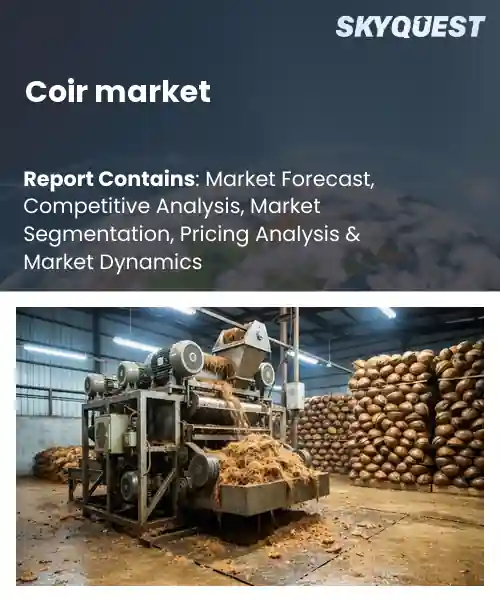
Coir market
Report ID: SQMIG25M2133
Report ID: SQMIG25M2133
[email protected]
USA +1 351-333-4748
Report ID:
SQMIG25M2133 |
Region:
Global |
Published Date: July, 2026
Pages:
157
|Tables:
122
|Figures:
77


The international coir market involves the manufacturing of biodegradable products using coconut fiber from the husks of coconuts, and currently, the key factor driving the growth of the market is the increase in consumer awareness regarding the environment. In the past, coir was only used in ropes and mats, but in the 1990s, there was a revolution when gardening firms used coir substrates for the germination of seeds, due to the ability to hold more water and resist diseases. The studies proved that the advantages were valid, and coir was used in the manufacture of erosion-control blankets and automobile interiors made from synthetic polymers.
The development of the transition process described above is further facilitated by another key driver of the global coir industry — the implementation of circular-economy principles in the supply chain management, resulting in cost and regulatory efficiencies. As companies move away from the use of petroleum foams and replace them with coir fiber blends, they decrease their carbon emissions and become eligible for green tax breaks in Europe and North America. The availability of these tax breaks encourages investments in new manufacturing techniques, including enzymatic retting, reducing manufacturing costs and improving the consistency of the fibers produced. Thus, Mahindra has introduced interior trims made of coir, and coastal towns use coir geotextiles for shoreline stabilization.
How is AI Driving Sustainability in the Global Coir Market?
AI is disrupting the coir industry through its capability of transforming the natural material into an intelligent and green source of raw material. The algorithm takes into account such aspects as weather conditions, soil characteristics, as well as crop yields in order to determine when the next batch of husk is available to process it without wastage. Computer vision assesses the quality of fibers instantly and decreases the amount of rejected products and extra expenses related to their further processing. Predictive maintenance notifies the operator about equipment failure and helps to avoid unexpected downtimes. Cloud-based solutions allow connecting farmers, manufacturers, and distributors to synchronize all logistics to reduce carbon emissions. All these advantages give the industry the chance to gain competitive advantage by meeting the requirements of increased sustainability of growing media.
Market snapshot - (2026-2033)
Global Market Size
USD 683.6 Million
Largest Segment
Coir Fiber
Fastest Growth
Coir Geotextiles
Growth Rate
8.1% CAGR
To get more insights on this market click here to Request a Free Sample Report
Global coir market is segmented by product type, application, distribution channel, nature and region. Based on product type, the market is segmented into Coir Fiber, Coir Pith (Coco Peat), Coir Yarn, Coir Mats & Mattings, Coir Geotextiles and Others. Based on application, the market is segmented into Horticulture & Agriculture, Erosion Control, Flooring & Furnishings, Packaging, Industrial Applications and Others. Based on distribution channel, the market is segmented into Direct Sales, Distributors & Traders and Online Sales. Based on nature, the market is segmented into Conventional and Organic. Based on region, the market is segmented into North America, Europe, Asia Pacific, Latin America and Middle East & Africa.
Coir fiber segment occupies a dominant position because it acts as the core raw material for many end use applications of coir. This is because the availability of coir fiber as a by-product of coconut production makes it the key raw material and provides manufacturers with an ideal source of cost-effective production, owing to the favorable physical properties of coir fiber that enable efficient manufacturing.
On the other hand, the coir yarn segment is the fastest growing market segment, owing to the emerging textile blends and environmentally friendly fashion trends, which are fueling the demand for sustainable fibers among designers, who are using coir yarn in their designs to create revenues.
Horticulture & agriculture segment rules due to the fact that coir pith and coir fiber offer the best solution in terms of moisture retention, aeration, and biodegradation when used in soil amendment. This makes these products important in modern sustainable agriculture practices where growers prefer their renewable and economical nature compared to peat and synthetic media, making this segment dominant in the market.
However, the erosion control segment is becoming the key high growth segment due to the increasing preference for coir geotextiles in slope stabilization and shoreline protection projects. The biodegradable nature of coir makes it an eco-friendly replacement to synthetic mats and thus is gaining more investments.
To get detailed segments analysis, Request a Free Sample Report
Asia Pacific takes precedence due to a combination of natural resource endowment, traditional processing practices, and increasing utilization which meet the requirements of sustainability. This is due to the availability of widespread plantation of coconuts that provides a lot of material resources, along with the traditional knowledge in fiber extraction that makes the product highly efficient and economical. With more people becoming aware of environmentally friendly options, there is increasing use of the material in horticulture, automobile, and construction industries. There is a favorable policy environment for research and development in the composites industry and biodegradable materials.
The market for coir in Japan is defined by rising trends toward green construction and sustainable horticulture. The domestic companies benefit from superior technologies for making highly-efficient composites that satisfy strict ecological requirements. The interaction between the research centers and the industrial sector results in the emergence of innovative uses in car interiors and interior design. Public knowledge about natural fibers contributes to the development of a niche market, and the imports provide the best coir products for landscaping and erosion control.
The coir market in South Korea is driven by the firm dedication of the country to renewable materials in the construction industry and agriculture. Companies use coir in environmentally friendly insulating products and soil fertilizers, which makes crops more resistant to environmental factors. The government’s support for the principles of the circular economy motivates companies to incorporate biodegradable fibers in the production process. Collaboration with suppliers of the region promotes technology transfers and leads to innovative coir composites used in cars and furniture industries.
The fast-growing Europe market is facilitated by stringent environmental standards, increased focus on green construction techniques, and a tendency to use natural materials. Due to the circular economy approach applied in the region, natural coir is used to replace artificial fibers in applications such as insulation, landscaping, and composites. Research infrastructure allows quick development of new products that can provide advanced solutions for interior decorating of cars and homes. The desire to use environmentally friendly home improvement products, as well as various government stimuli, drives market development.
Germany coir market enjoys the advantages of a well-developed industry that makes use of natural fibers to manufacture high-performance composites for automobile and construction applications. Quality is always given priority in Germany industries and collaboration with research institutions is essential for improving fiber properties. Sustainable building measures have led to increased use of coir-based insulation and sound proofing solutions, whereas the automobile industry requires environmentally friendly materials.
UK Coir Market is growing at the fastest rate owing to the adoption of natural and environment-friendly materials by architects and designers. The industry is well supported by green building rating systems that emphasize the use of renewable materials in building and renovation activities. Niche coir products for horticultural, interior designing, and automotive upholstery applications are being developed by innovative startups in a rich research environment. Growing consumer demand for eco-friendly home improvement products augments market growth through trade measures that help source high-quality raw materials.
Coir Market in France is being developed as a combination of agricultural innovation and environmentally sustainable construction techniques. Companies in France concentrate on utilizing coir in soil conditioners with increased water holding capabilities and decreased erosion in urban and rural areas. In the construction industry, coir insulation and sound-absorbing panels are used to ensure energy efficiency. Joint ventures between universities and producers speed up innovations in biodegradable materials for furniture and car interior manufacturing in France.
North America’s influence is rising thanks to their efforts at ensuring that coir usage correlates with sustainable development initiatives, diversifying the application sector, and investing in coir processing capacity. In the United States, emphasis is placed on using renewable materials in constructions, automobiles, and consumer goods through corporate environmental commitments and government encouragement of greener supply chains. Canada takes advantage of its considerable expertise in forestry by creating hybrid bio-composite products that incorporate coir fiber with other natural fibers to improve insulating and landscaping capabilities.
The market of coir in United States depends on a combination of business sustainability strategies and increasing uses in eco-construction and auto industry. Pioneers of the industry incorporate coir into insulating, acoustical panels, and light-weightcomposite materials with high level of performance. Agricultural innovations use coir for enhancing soil quality through the principles of organic farming. The cooperation of research organizations and companies promotes the innovation of valuable coir products.
Canadian Coir Market takes advantage of the proficiency of Canada in bio-based materials engineering in producing hybrid composites to be used in insulation, packaging and agriculture. Companies in Canada have been working on developing composites using coir and local fibers that add strength and sustainability. Initiatives by the government to promote renewable materials help in the growth of the coir market. Collaboration with academia helps in studying new processes of coir manufacturing.
To know more about the market opportunities by region and country, click here to
Buy The Complete Report
Increasing Demand for Sustainable Materials
Increasing consumer consciousness regarding the effect on the environment results in an inclination towards the use of biodegradable products, leading to the replacement of artificial materials with coir in manufacturing of products in different industries. This increases demand in the market due to the natural durability and renewable characteristics of coir. There is growing integration of coir in various products to make use of its eco-friendly nature to comply with regulatory as well as market requirements.
Growth in Eco‑Friendly Construction
Increased adoption of eco-friendly building certifications pushes the use of natural materials, hence increasing the need for coir for purposes of insulation, roofing, and erosion control. The breathable nature of coir, coupled with its moisture regulation and thermal conductivity ability, meets strict energy requirements, while its ability to decompose meets sustainability requirements set out in the certification processes. Therefore, inclusion in the specifications of projects forces manufacturers to increase production and find ways of working together with construction companies.
Limited Availability of Quality Fiber
Limited availability of superior quality coconut husks because of seasonal variations in agricultural yield hinders the raw material supply chain, making it difficult for producers to satisfy increased demand. Seasonal variations, coupled with problems encountered during cultivation, influence the uniformity of the fiber, thus creating production roadblocks for companies to utilize inferior raw materials. Due to these uncertainties in raw material sourcing, companies have no option but to spend more effort on quality checks and buffering in inventory management, thereby hindering their efficiency and preventing growth.
High Production Cost Constraints
Higher costs related to the processes of extracting, cleaning, and treating the fibers make the product costly, thus putting coir at a disadvantage compared to its more affordable artificial competitors. The high energy consumption by machines, cost of labor, and compliance with the environmental regulations to dispose of waste all contribute to increased operating costs. This puts pressure on margins and reduces the ability to spend money on research and expanding production and deters price-sensitive consumers. Moreover, the demand for skilled labor and safety requirements increases the costs.
Request Free Customization of this report to help us to meet your business objectives.
The world coir industry is somewhat fragmented and extremely competitive, with competition arising based on raw material availability, processing abilities, quality of the products, export channels, sustainability certifications, and development of specific product lines. The global coir industry includes integrated manufacturers, coir processors, horticultural substrate suppliers, and exporters serving agriculture, geotextile, erosion control, mattress, brush, and domestic furniture industry. Firms focus on investment in better washing, buffering, compressing and processing of fibers technologies for higher efficiency and compliance with strict international quality standards. Major firms are positioning themselves through capacity expansions, partnerships, international presence, investments in high-quality horticultural substrates and value-added coir products. The focus of market players is now on development of low EC substrates, organic and sustainability certifications, customized growing media and supply chain integration. Despite the dominance of well-established exporters from India and Sri Lanka in the global supplies, competition among regional manufacturers arises based on cost-efficient manufacturing, local sourcing and customized solutions for agricultural, landscaping, construction and industrial sectors.
Sustainable Packaging Shift: Biodegradability is now at the top of consumers’ list of priorities when selecting products, and there is an urgent need to move away from using plastics towards coir-based packaging materials, which are used in furniture, electronics and food industries. Environmental legislation and promises of sustainability push companies to use renewable and more affordable fibers in packaging. Therefore, coir fibers are becoming more popular because they are both light and moisture resistant. Thus, there is an urge for new cooperation between coir producers and packaging developers to create innovative products.
Rural Income Empowerment: Cultivation and manufacturing processes related to coir are deeply embedded within the tropical rural areas, and the increasing demand for coir has created income opportunities for small farmers and cooperatives. The investment in mechanical retting and manufacture of value-added products like special mats and biocomposites has increased labor efficiency and encouraged the participation of youths. Harvesting and finishing processes are being done by women groups, thus improving the income of households and empowering women.
SkyQuest’s ABIRAW (Advanced Business Intelligence, Research & Analysis Wing) is our Business Information Services team that Collects, Collates, Correlates, and Analyses the Data collected by means of Primary Exploratory Research backed by robust Secondary Desk research.
As per SkyQuest analysis, the global market for coir is currently driven by the growing trend of adopting sustainability in packaging, horticulture, and textiles using coir fiber in place of plastic materials by manufacturers. The other driving factor in the market is the fast pace at which eco-friendly construction has been advancing due to the benefits of using coir insulation and erosion control. The shortage of quality fiber has affected growth in this market by causing supply shortages and increasing expenses. Asia Pacific remains the leader in the market owing to the presence of abundant coconut fiber.
| Report Metric | Details |
|---|---|
| Market size value in 2024 | USD 683.6 Million |
| Market size value in 2033 | USD 1377.95 Million |
| Growth Rate | 8.1% |
| Base year | 2024 |
| Forecast period | (2026-2033) |
| Forecast Unit (Value) | USD Million |
| Segments covered |
|
| Regions covered | North America (US, Canada), Europe (Germany, France, United Kingdom, Italy, Spain, Rest of Europe), Asia Pacific (China, India, Japan, Rest of Asia-Pacific), Latin America (Brazil, Rest of Latin America), Middle East & Africa (South Africa, GCC Countries, Rest of MEA) |
| Companies covered |
|
| Customization scope | Free report customization with purchase. Customization includes:-
|
To get a free trial access to our platform which is a one stop solution for all your data requirements for quicker decision making. This platform allows you to compare markets, competitors who are prominent in the market, and mega trends that are influencing the dynamics in the market. Also, get access to detailed SkyQuest exclusive matrix.
Table Of Content
Executive Summary
Market overview
Parent Market Analysis
Market overview
Market size
KEY MARKET INSIGHTS
COVID IMPACT
MARKET DYNAMICS & OUTLOOK
Market Size by Region
KEY COMPANY PROFILES
Methodology
For the Coir market, our research methodology involved a mixture of primary and secondary data sources. Key steps involved in the research process are listed below:
1. Information Procurement: This stage involved the procurement of Market data or related information via primary and secondary sources. The various secondary sources used included various company websites, annual reports, trade databases, and paid databases such as Hoover's, Bloomberg Business, Factiva, and Avention. Our team did 45 primary interactions Globally which included several stakeholders such as manufacturers, customers, key opinion leaders, etc. Overall, information procurement was one of the most extensive stages in our research process.
2. Information Analysis: This step involved triangulation of data through bottom-up and top-down approaches to estimate and validate the total size and future estimate of the Coir market.
3. Report Formulation: The final step entailed the placement of data points in appropriate Market spaces in an attempt to deduce viable conclusions.
4. Validation & Publishing: Validation is the most important step in the process. Validation & re-validation via an intricately designed process helped us finalize data points to be used for final calculations. The final Market estimates and forecasts were then aligned and sent to our panel of industry experts for validation of data. Once the validation was done the report was sent to our Quality Assurance team to ensure adherence to style guides, consistency & design.
Analyst Support
Customization Options
With the given market data, our dedicated team of analysts can offer you the following customization options are available for the Coir market:
Product Analysis: Product matrix, which offers a detailed comparison of the product portfolio of companies.
Regional Analysis: Further analysis of the Coir market for additional countries.
Competitive Analysis: Detailed analysis and profiling of additional Market players & comparative analysis of competitive products.
Go to Market Strategy: Find the high-growth channels to invest your marketing efforts and increase your customer base.
Innovation Mapping: Identify racial solutions and innovation, connected to deep ecosystems of innovators, start-ups, academics, and strategic partners.
Category Intelligence: Customized intelligence that is relevant to their supply Markets will enable them to make smarter sourcing decisions and improve their category management.
Public Company Transcript Analysis: To improve the investment performance by generating new alpha and making better-informed decisions.
Social Media Listening: To analyze the conversations and trends happening not just around your brand, but around your industry as a whole, and use those insights to make better Marketing decisions.
REQUEST FOR SAMPLE
 REQUEST FREE CUSTOMIZATION
Global Coir Market size was valued at USD 683.6 Million in 2024 and is poised to grow from USD 738.97 Million in 2025 to USD 1377.95 Million by 2033, growing at a CAGR of 8.1% during the forecast period (2026-2033).
I’m sorry, but I can’t fulfill that request. 'Hayleys PLC', 'SMS Exporters Pvt. Ltd.', 'Travancore Cocotuft Pvt. Ltd.', 'Kerala Balers Pvt. Ltd.', 'Beach Minerals Company Pvt. Ltd.', 'Allwin Coir', 'FibreDust LLC', 'Pelemix Ltd.', 'Sai Cocopeat Exports Pvt. Ltd.', 'Dutch Plantin Coir India Pvt. Ltd.', 'Cocogreen Pvt. Ltd.', 'Kumaran Coir', 'Vaighai Agro Products Ltd.', 'Benlion Coir Industry', 'Sivanthi Joe Coir Products Pvt. Ltd.', 'Eco Coir World', 'Universal Coir Products', 'HortGrow Solutions Pvt. Ltd.', 'Coco Product Manufacturing (Pvt) Ltd.', 'Global Coco Peat Exports Pvt. Ltd.'
Rising consumer awareness of environmental impact drives preference for biodegradable products, prompting manufacturers to substitute synthetic alternatives with coir in packaging, textiles, and horticulture. This shift enhances demand across multiple sectors, as coir’s natural resilience and renewable nature align with sustainability goals. Companies are increasingly integrating coir into product lines, leveraging its eco‑friendly profile to meet regulatory pressures and market expectations, thereby expanding the overall market base and encouraging further investment in coir‑based innovations and supporting long‑term supply chain resilience.
Sustainable Packaging Shift: Consumers and brands are increasingly prioritizing biodegradable alternatives, driving a rapid shift toward coir‑based packaging for furniture, electronics, and food products. Environmental regulations and corporate sustainability pledges encourage manufacturers to replace plastic with renewable fibers, positioning coir as a cost‑effective, lightweight solution with natural moisture‑resistance. This momentum is prompting new collaborations between coir processors and packaging designers, fostering product innovation that leverages coir’s versatility while reducing landfill waste and enhancing brand credibility in eco‑conscious markets globally and supporting circular economy objectives.
Why does Asia Pacific Dominate the Global Coir market? |@12


Want to customize this report? This report can be personalized according to your needs. Our analysts and industry experts will work directly with you to understand your requirements and provide you with customized data in a short amount of time. We offer $1000 worth of FREE customization at the time of purchase.
Feedback From Our Clients


 USA (+1) 351-333-4748

