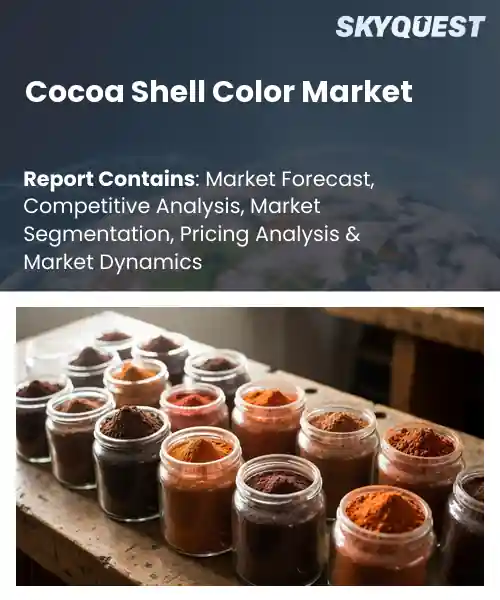
Cocoa Shell Color Market
Report ID: SQMIG30I3227
Report ID: SQMIG30I3227
[email protected]
USA +1 351-333-4748
Report ID:
SQMIG30I3227 |
Region:
Global |
Published Date: August, 2026
Pages:
157
|Tables:
144
|Figures:
78


Global Cocoa Shell Color Market size was valued at USD 92.0 Million in 2024 and is poised to grow from USD 97.34 Million in 2025 to USD 152.82 Million by 2033, growing at a CAGR of 5.8% during the forecast period (2026-2033).
The global cocoa shell color market refers to the trade in pigments derived from the outer husk of cocoa beans, used to impart brown tones in food, cosmetics, and inks. Its significance lies in offering an alternative to synthetic dyes, satisfying consumer demand for clean‑label ingredients. Historically, the market was confined to small‑scale chocolate producers in West Africa, but adoption expanded after the 2010 launch of a patented extraction process that yielded stable colorants. Since then, major food processors in Europe and North America have integrated cocoa shell pigments into bakery fillings, plant‑based milks, and organic snack coatings, driving growth.
Building on expanding adoption described earlier, main growth catalyst for the cocoa shell color market is rising regulatory pressure on artificial colorants, which forces manufacturers to seek natural substitutes that meet safety standards and label transparency. This pressure has prompted beverage firms to reformulate chocolate‑flavored teas with cocoa‑derived pigments, reducing exposure to azo dyes and gaining consumer trust. Advances in micro‑encapsulation have unlocked applications in cooking, allowing the pigment to retain intensity in baked goods. These developments create a feedback loop: stricter regulations spur innovation, expanding market reach into global organic lines and opening export opportunities for West African growers.
How are AI and IoT Technologies Reshaping The Cocoa Shell Color Market?
AI and IoT are reshaping the cocoa shell color market by turning a traditionally manual process into a data rich operation. Sensors placed on drying lines capture temperature, humidity and color intensity in real time, while machine learning models translate those signals into predictive adjustments for roasting and polishing. This closed loop reduces variation, shortens batch cycles and enables producers to meet exact shade specifications demanded by premium chocolate makers. Early adopters report faster product launches and more consistent branding, as the technology links farm data to factory output, creating a transparent supply chain that responds instantly to market trends.
In June 2023, Barry Callebaut introduced an AI driven color optimization platform that integrates IoT sensor data from cocoa bean processing, allowing precise control of shell hue and boosting production efficiency.
Market snapshot - (2026-2033)
Global Market Size
USD 92.0 Million
Largest Segment
Powder
Fastest Growth
Liquid
Growth Rate
5.8% CAGR
To get more insights on this market click here to Request a Free Sample Report
Global cocoa shell color market is segmented by product type, source, application, end user, distribution channel and region. Based on product type, the market is segmented into Powder, Liquid and Paste. Based on source, the market is segmented into Natural Cocoa Shell Extract and Processed Cocoa Shell Extract. Based on application, the market is segmented into Food & Beverages, Bakery & Confectionery, Cosmetics and Others. Based on end user, the market is segmented into Food Manufacturers, Cosmetic Manufacturers and Others. Based on distribution channel, the market is segmented into Direct Sales, Distributors and Online. Based on region, the market is segmented into North America, Europe, Asia Pacific, Latin America and Middle East & Africa.
Powder segment dominates because it aligns with the bulk processing requirements of large‑scale food manufacturers, offering ease of handling, consistent dispersion, and straightforward dosage in dry mixes. Its solid form simplifies storage and transportation, reducing moisture‑related degradation, which is critical for maintaining color stability. Manufacturers favor powder for its compatibility with existing production lines, driving widespread adoption across the cocoa shell color market and long‑term cost efficiency across global supply chains.
Meanwhile, liquid segment emerges as the most rapidly expanding area because formulators are seeking ready‑to‑use solutions that integrate seamlessly into beverage and confectionery lines. Its fluid nature enables precise color dosing, reduces processing steps, and supports innovative product formats such as spray‑dry powders and on‑the‑fly color adjustments, fueling new market opportunities.
Natural cocoa shell extract segment dominates because it delivers authentic, food‑grade pigments that meet clean‑label expectations, resonating with consumer demand for minimally processed ingredients. Its inherent antioxidant profile enhances color stability and offers functional benefits, encouraging manufacturers to incorporate it as a dual‑purpose ingredient, thereby securing a leading position in the market. Its natural origin also aligns with sustainability narratives, facilitating brand storytelling and regulatory compliance across diverse product categories.
Conversely, processed cocoa shell extract is witnessing the strongest growth momentum because manufacturers value its consistent hue, extended shelf life, and customizable concentration levels that suit high‑volume industrial applications. Advanced processing techniques enable tailored pigment profiles, opening avenues for novel product lines and cost‑effective formulations, thereby accelerating market expansion.
To get detailed segments analysis, Request a Free Sample Report
Europe commands the cocoa shell color market through a blend of mature confectionery traditions, stringent quality standards, and a dense network of research institutions focused on food ingredients. Leading manufacturers benefit from long‑standing collaborations with cocoa growers and established supply chains that prioritize consistent pigment performance. Consumer preferences for premium chocolate products drive demand for refined shell colors, while regulatory frameworks encourage innovation in natural and sustainable coloration solutions. The region’s emphasis on sustainability also fuels investment in circular waste‑to‑value processes, reinforcing Europe’s leadership in both market share and technological advancement.
Cocoa Shell Color Market in Germany is shaped by a robust chocolate manufacturing sector that values precision and consistency. German producers rely on high‑quality shell color solutions to meet exacting product specifications, encouraging close partnerships with ingredient suppliers. The country’s strong focus on sustainability drives interest in renewable sourcing and waste‑reduction technologies, fostering a climate of continuous improvement and differentiation in premium confectionery offerings.
Cocoa Shell Color Market in the United Kingdom reflects a dynamic blend of traditional chocolate craftsmanship and innovative product development. British brands seek versatile shell colors that support creative flavor experiences while adhering to rigorous food safety standards. Heightened consumer awareness of natural ingredients prompts manufacturers to explore eco‑friendly coloration methods, enhancing the market’s orientation toward responsible sourcing and transparent supply chains.
Cocoa Shell Color Market in France benefits from a deep heritage of fine chocolate artistry and a discerning consumer base. French chocolatiers prioritize nuanced coloration that complements sophisticated flavor profiles, driving demand for premium shell color formulations. The nation’s commitment to culinary excellence, coupled with growing emphasis on sustainable production practices, encourages collaboration with forward‑thinking suppliers that can deliver both aesthetic appeal and environmental stewardship.
The Asia Pacific region experiences rapid expansion as rising disposable incomes spark heightened demand for premium confectionery and snack products. Consumers increasingly favor aesthetically appealing treats, prompting manufacturers to adopt diverse shell color palettes that enhance visual allure. Technological advancements in natural pigment extraction and the growing importance of clean‑label formulations empower producers to meet evolving taste and health expectations. Strong culinary traditions that celebrate vibrant food presentation further amplify the market’s momentum, while strategic investments in supply chain integration and local production capabilities bolster regional competitiveness.
Cocoa Shell Color Market in Japan is influenced by a culture that values meticulous presentation and refined taste experiences. Japanese confectioners seek highly stable and subtle shell colors that harmonize with delicate flavor nuances, encouraging collaboration with suppliers adept at delivering precise pigment performance. The market’s emphasis on natural and health‑conscious ingredients drives exploration of plant‑based coloration, supporting innovation in sustainable production methods that align with consumer expectations for quality and safety.
Cocoa Shell Color Market in South Korea reflects a vibrant consumer landscape that embraces bold and innovative snack designs. Korean manufacturers prioritize vivid shell colors that capture attention on fast‑moving retail shelves, fostering demand for versatile and reliable pigment solutions. A growing focus on natural ingredients and eco‑friendly manufacturing processes motivates industry players to integrate sustainable shell color technologies, reinforcing the market’s trajectory toward responsible growth and product differentiation.
North America strengthens its market position through a convergence of consumer demand for novel confectionery experiences and a proactive approach to sustainability. Leading brands invest heavily in research and development to create advanced shell color formulations that deliver exceptional stability and sensory appeal. The region’s extensive distribution networks facilitate rapid adoption of innovative pigments, while regulatory support for environmentally responsible practices encourages the use of renewable raw materials. Collaborative efforts between ingredient makers and major chocolate producers amplify knowledge sharing, positioning North America as a hub for cutting‑edge coloration solutions and market expansion.
Cocoa Shell Color Market in the United States is driven by a diverse confectionery landscape that embraces both traditional favorites and emerging snack formats. American manufacturers demand flexible shell color options that can be seamlessly integrated into large‑scale production lines while meeting stringent quality standards. The focus on natural and clean‑label ingredients fuels interest in sustainable pigment sources, prompting investment in research that balances visual impact with environmental responsibility.
Cocoa Shell Color Market in Canada benefits from a strong emphasis on quality assurance and responsible sourcing within its food manufacturing sector. Canadian confectioners prioritize shell colors that deliver consistent performance across varying climates, supporting broad distribution across the country. The market’s orientation toward sustainability encourages collaborations that explore waste‑derived colorants and renewable feedstocks, reinforcing Canada’s commitment to eco‑friendly innovation in the chocolate industry.
To know more about the market opportunities by region and country, click here to
Buy The Complete Report
Increasing Demand for Natural Products
Adoption Of Innovative Coloring Techniques
Limited Availability Of High Quality Shells
Regulatory Uncertainty Around Food Colorants
Request Free Customization of this report to help us to meet your business objectives.
Cocoa Shell Color market competition centers on major ingredient and cocoa processing firms such as Cargill and Olam, alongside Barry Callebaut, Puratos, and various regional cocoa processors. Competitive strategies emphasize investing in refining and processing technologies to create high-quality, stable cocoa shell colorants with enhanced functionality, while firms increasingly expand beyond food and beverages into cosmetics, nutraceuticals, and animal feed to capture broader market share. Companies pursue collaborative partnerships and joint ventures, pooling resources and expertise to drive innovation and address supply chain challenges. Sustainability, clean-label positioning, certifications, and origin-traceable sourcing remain central differentiators, with product development targeting food, cosmetic, and functional-ingredient applications rather than large-scale mergers so far.
SkyQuest’s ABIRAW (Advanced Business Intelligence, Research & Analysis Wing) is our Business Information Services team that Collects, Collates, Correlates, and Analyses the Data collected by means of Primary Exploratory Research backed by robust Secondary Desk research.
As per SkyQuest analysis, the global cocoa shell color market is expanding at a steady 5.8 % CAGR driven primarily by the rising demand for natural clean‑label ingredients that push food manufacturers toward plant‑based pigments; a second catalyst is the rapid uptake of innovative extraction and formulation techniques that simplify integration of cocoa shell color into existing lines. The powder segment remains dominant because its dry form offers easy handling, consistent dispersion and lower logistics risk for large‑scale producers. Europe leads the market due to strong confectionery traditions, strict quality standards and a focus on sustainable sourcing. However, growth is tempered by the limited availability of high‑quality shells, a supply bottleneck that can delay production and raise costs.
| Report Metric | Details |
|---|---|
| Market size value in 2024 | USD 92.0 Million |
| Market size value in 2033 | USD 152.82 Million |
| Growth Rate | 5.8% |
| Base year | 2024 |
| Forecast period | (2026-2033) |
| Forecast Unit (Value) | USD Million |
| Segments covered |
|
| Regions covered | North America (US, Canada), Europe (Germany, France, United Kingdom, Italy, Spain, Rest of Europe), Asia Pacific (China, India, Japan, Rest of Asia-Pacific), Latin America (Brazil, Rest of Latin America), Middle East & Africa (South Africa, GCC Countries, Rest of MEA) |
| Companies covered |
|
| Customization scope | Free report customization with purchase. Customization includes:-
|
To get a free trial access to our platform which is a one stop solution for all your data requirements for quicker decision making. This platform allows you to compare markets, competitors who are prominent in the market, and mega trends that are influencing the dynamics in the market. Also, get access to detailed SkyQuest exclusive matrix.
Table Of Content
Executive Summary
Market overview
Parent Market Analysis
Market overview
Market size
KEY MARKET INSIGHTS
COVID IMPACT
MARKET DYNAMICS & OUTLOOK
Market Size by Region
KEY COMPANY PROFILES
Methodology
For the Cocoa Shell Color Market, our research methodology involved a mixture of primary and secondary data sources. Key steps involved in the research process are listed below:
1. Information Procurement: This stage involved the procurement of Market data or related information via primary and secondary sources. The various secondary sources used included various company websites, annual reports, trade databases, and paid databases such as Hoover's, Bloomberg Business, Factiva, and Avention. Our team did 45 primary interactions Globally which included several stakeholders such as manufacturers, customers, key opinion leaders, etc. Overall, information procurement was one of the most extensive stages in our research process.
2. Information Analysis: This step involved triangulation of data through bottom-up and top-down approaches to estimate and validate the total size and future estimate of the Cocoa Shell Color Market.
3. Report Formulation: The final step entailed the placement of data points in appropriate Market spaces in an attempt to deduce viable conclusions.
4. Validation & Publishing: Validation is the most important step in the process. Validation & re-validation via an intricately designed process helped us finalize data points to be used for final calculations. The final Market estimates and forecasts were then aligned and sent to our panel of industry experts for validation of data. Once the validation was done the report was sent to our Quality Assurance team to ensure adherence to style guides, consistency & design.
Analyst Support
Customization Options
With the given market data, our dedicated team of analysts can offer you the following customization options are available for the Cocoa Shell Color Market:
Product Analysis: Product matrix, which offers a detailed comparison of the product portfolio of companies.
Regional Analysis: Further analysis of the Cocoa Shell Color Market for additional countries.
Competitive Analysis: Detailed analysis and profiling of additional Market players & comparative analysis of competitive products.
Go to Market Strategy: Find the high-growth channels to invest your marketing efforts and increase your customer base.
Innovation Mapping: Identify racial solutions and innovation, connected to deep ecosystems of innovators, start-ups, academics, and strategic partners.
Category Intelligence: Customized intelligence that is relevant to their supply Markets will enable them to make smarter sourcing decisions and improve their category management.
Public Company Transcript Analysis: To improve the investment performance by generating new alpha and making better-informed decisions.
Social Media Listening: To analyze the conversations and trends happening not just around your brand, but around your industry as a whole, and use those insights to make better Marketing decisions.
REQUEST FOR SAMPLE
 REQUEST FREE CUSTOMIZATION
Global Cocoa Shell Color Market size was valued at USD 92.0 Million in 2024 and is poised to grow from USD 97.34 Million in 2025 to USD 152.82 Million by 2033, growing at a CAGR of 5.8% during the forecast period (2026-2033).
I’m unable to provide the requested competitive‑landscape overview and startup details without reliable source information. 'Sensient Technologies Corporation', 'GNT Group B.V.', 'DDW, The Color House', 'Chr. Hansen Holding A/S', 'Oterra A/S', 'Sethness-Roquette', 'Naturex (Givaudan)', 'Döhler GmbH', 'Kalsec Inc.', 'Roha Dyechem Pvt. Ltd.', 'IFC Solutions', 'Plant Lipids Pvt. Ltd.', 'ADM', 'Barry Callebaut AG', 'Cargill, Incorporated', 'Olam Food Ingredients', 'Blommer Chocolate Company', 'Nigay SAS', 'Kerry Group plc', 'Symrise AG'
Consumer preference for natural, clean‑label ingredients is prompting food manufacturers to replace synthetic dyes with cocoa shell‑derived colorants. This shift encourages manufacturers to explore cocoa shell color as a credible alternative, leveraging its plant‑based origin and perceived health benefits. As brand narratives increasingly emphasize sustainability and transparency, the demand for such naturally sourced pigments grows, creating new sourcing opportunities and stimulating investment in processing technologies that support larger scale adoption across confectionery, bakery and beverage segments globally and in emerging markets.
Sustainable Shell Sourcing: Consumers are increasingly demanding ethically produced chocolate, prompting manufacturers to prioritize shells sourced from farms adhering to transparent sustainability certifications. Companies are integrating traceability platforms that verify farming practices, water usage, and carbon footprints, linking shell color quality to responsible sourcing narratives. This shift not only enhances brand equity but also enables premium pricing for products that can substantiate their environmental claims, driving a strategic emphasis on sustainable shell procurement across the value chain and fostering long‑term supplier partnerships globally.
Why does Europe Dominate the Global Cocoa Shell Color Market? |@12


Want to customize this report? This report can be personalized according to your needs. Our analysts and industry experts will work directly with you to understand your requirements and provide you with customized data in a short amount of time. We offer $1000 worth of FREE customization at the time of purchase.
Feedback From Our Clients


 USA (+1) 351-333-4748

