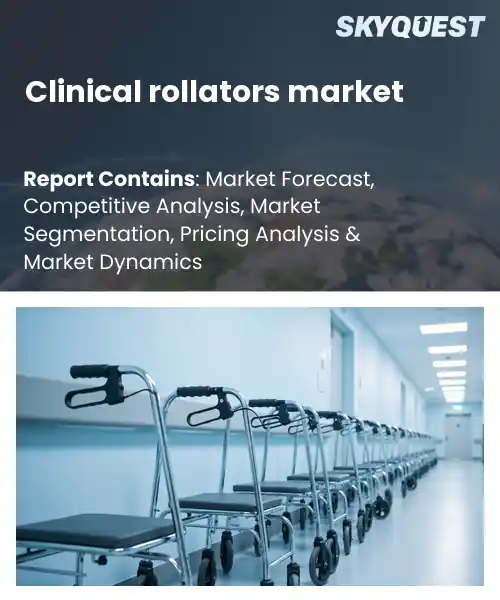
Clinical rollators market
Report ID: SQMIG35A4183
Report ID: SQMIG35A4183
[email protected]
USA +1 351-333-4748
Report ID:
SQMIG35A4183 |
Region:
Global |
Published Date: July, 2026
Pages:
157
|Tables:
180
|Figures:
79


Global Clinical Rollators Market size was valued at USD 2.0 Billion in 2024 and is poised to grow from USD 2.17 Billion in 2025 to USD 4.1 Billion by 2033, growing at a CAGR of 8.3% during the forecast period (2026-2033).
Expanding geriatric population, increasing prevalence of mobility disorders, rising incidence of chronic diseases, advancements in mobility assistance technologies, and growing demand for rehabilitation and home healthcare are driving demand for clinical rollators.
Rising incidence of osteoarthritis, stroke, neurological disorders, and post-operative rehabilitation needs is increasing the demand for advanced mobility aids in hospitals, rehabilitation centers, and home healthcare settings. Continuous advancements in lightweight designs, ergonomic features, and sensor-enabled rollators are improving patient safety, comfort, and mobility. Growing adoption of smart mobility solutions, increasing investments in rehabilitation services, and expanding home healthcare infrastructure are also expected to strengthen sales of clinical rollators. Rise in aging population and increasing prevalence of conditions affecting mobility are expected to primarily drive clinical rollators market growth.
On the contrary, high costs of advanced clinical rollators, limited reimbursement coverage in certain regions, low awareness in developing countries, and availability of lower-cost mobility aids are anticipated to slow down clinical rollators market penetration over the coming years.
How is AI Improving Safety Features in Clinical Rollators?
The advancements made possible through AI in the development of clinical rollators will lead to safer and smarter devices for patients. These AI-driven sensors analyze the movement pattern, environment, and walking patterns of the user in order to recognize obstacles and anticipate a fall or an imbalance in their movement. It even adjusts the braking function of the wheel chairs according to the patient’s movements. An alert in the form of voice message is sent to the caregiver whenever any anomaly is noticed in the movement pattern.
Market snapshot - (2026-2033)
Global Market Size
USD 2.0 Billion
Largest Segment
Standard Rollators
Fastest Growth
Specialty Clinical Rollators
Growth Rate
8.3% CAGR
To get more insights on this market click here to Request a Free Sample Report
Global clinical rollators market is segmented by product type, wheel configuration, material type, end user, application, weight capacity, and region. Based on product type, the market is segmented into standard rollators, bariatric rollators, foldable rollators, indoor rollators, outdoor rollators, pediatric rollators, and specialty clinical rollators. Based on wheel configuration, the market is segmented into three-wheel rollators, four-wheel rollators, and heavy-duty multi-wheel rollators. Based on material type, the market is segmented into aluminum, steel, carbon fiber, and composite materials. Based on end user, the market is segmented into hospitals, rehabilitation centers, long-term care facilities, home healthcare, and ambulatory care centers. Based on application, the market is segmented into mobility assistance, post-operative rehabilitation, geriatric care, neurological rehabilitation, and orthopedic rehabilitation. Based on weight capacity, the market is segmented into standard duty, heavy duty, and bariatric. Based on region, the market is segmented into North America, Europe, Asia Pacific, Latin America, and Middle East & Africa.
The standard rollators segment is forecasted to spearhead the global clinical rollators market revenue generation across the study period. It meets the fundamental mobility requirements of a wide variety of patients through dependable performance, user-friendly features, and cost-effective production processes. The simplicity of its design is consistent with clinical guidelines and purchase requirements of hospitals, ensuring its easy acceptance throughout hospitals. The ergonomics of the device and the small amount of training needed for its operation add to its superiority in the clinical rollators market and sustainability issues.
However, foldable rollators are witnessing the strongest growth momentum as per this clinical rollators market forecast, as they have a small form factor to accommodate space limitations in clinical settings. The introduction of light-weighted frames and rapid folding systems is contributing towards greater popularity of these products, which makes it possible for carers to transport them easily and hence expand the market.
The four-wheel rollators segment is predicted to account for the highest global clinical rollators market share going forward. The additional stability that they offer is in line with the safety norms required for patient transportation as well as post-operative treatment. The doctors prefer the four-sided structure for the better stability it offers on any type of floor, decreasing the chances of falls and allowing higher load capacity. They are strong enough to make maintenance easier, while the handling is consistent with the therapy offered.
On the other hand, three-wheel rollators are emerging as the key high growth subsegment as their ease of maneuverability makes it easier for them to move around narrow aisles and patient rooms. Due to the smaller footprint and lighter frame, they will be adopted more in home care and ambulatory settings, prompting innovation and market expansion.
To get detailed segments analysis, Request a Free Sample Report
Mature healthcare ecosystems, robust reimbursement frameworks, and a culture of early adoption of assistive technologies are forecasted to help this region hold sway over others. There exists a well-developed infrastructure of hospitals, rehabilitation centers, and long-term care institutions that emphasize the need for mobility and safety of patients in the region. An effective R&D capability ensures constant innovations, whereas efficient distribution channels provide prompt availability of products in the market. The presence of clear regulatory and policy frameworks enhances market confidence, making it possible for producers to launch innovative and ergonomic products on a larger scale. All of these factors combine into a strong platform that ensures high demand for rollators.
Clinical rollators market in the United States thrives on extensive hospital networks, sophisticated reimbursement mechanisms, and a proactive consumer base that values independence and safety. Manufacturers work together with healthcare professionals to develop solutions that will address varied requirements, whereas an effective logistics network enables faster product development. Innovation centers have a pool of experts skilled in ergonomics and materials science who facilitate the design of more lightweight and multipurpose rollators that are well-received by both doctors and patients. An enabling regulatory environment also ensures that the process is simplified for market access.
Clinical rollators market in Canada reflects a strong commitment to accessible mobility within public health institutions and community care settings. Comprehensive insurance programs and collective funding methods eliminate financial constraints, making it easier for the product to be adopted widely across the provinces. Local research institutes aid in improving the product through their focus on comfort and durability in various weather conditions. Collaboration between the manufacturers and rehabilitators ensures custom-made solutions that comply with clinical guidelines, thus ensuring better patient results. All these efforts combined ensure a stable environment for the development of rollators clinically in Canada.
Patient-centered mobility, backed by sophisticated healthcare systems that prioritize rehabilitation and aging-in-place strategies are expected to boost the demand for clinical rollators in the region. The existence of robust regulation brings about standardization in products, facilitating trade across borders and also providing incentives for manufacturing companies to venture into regional distributions. The emphasis on preventive healthcare by both the public and the private sectors is bound to foster demand for assistive devices promoting autonomy and minimizing dependency. Innovation through research collaboration will drive design, while the health-conscious public is bound to seek quality mobility products. These factors will create a favorable environment for growth in Europe.
Clinical rollators market in Germany benefits from a well‑structured healthcare architecture that integrates mobility solutions into acute and post‑acute care pathways. Renowned engineering expertise contributes to the development of precision‑crafted devices that align with rigorous safety standards. Strong collaboration between hospitals, rehabilitation centers, and device manufacturers fosters tailored solutions that address both clinical efficacy and patient comfort. Comprehensive insurance coverage further catalyzes adoption, ensuring that advanced rollators are readily accessible to diverse patient groups across the country.
Clinical rollators market in the United Kingdom is energized by an escalating emphasis on community‑based healthcare and early intervention programs. National health policies promote mobility aids as important elements in restorative care, advocating for the mass acquisition of such items through public health care systems. Innovation clusters concentrate on using light materials and designing mobility devices that are flexible in addressing various mobility issues. Digital health technologies provide room for monitoring and customizing these aids, thus making rollators important in the treatment regime. This evolving scenario leads to the fast growth of clinical rollators in the UK.
Clinical rollators market in France is emerging through concerted efforts to improve elderly autonomy and reduce hospital readmissions. Inclusions of assistive devices into care plans are among priorities of governmental policies aimed at facilitating accessibility in both urban and rural areas. Developmental activities conducted by universities in cooperation with manufacturers facilitate improvements of ergonomics of the products to meet specific needs of the French population. Moreover, increased understanding of mobility management among healthcare professionals increases the demand for such products in France.
Demographic shifts, rising health awareness, and proactive government policies that emphasize senior welfare and rehabilitation services support consistent demand for clinical rollators in the region. Healthcare technology is gaining popularity as countries from the region are adopting state-of-the-art healthcare systems that include the use of assistive devices in both public and private sectors. Local designers are improving design skills by focusing on light weight and cultural designs to address users’ preferences. Middle-class people from different regions require high standards of living and are therefore seeking quality mobility aids. Joint business ventures with international organizations are speeding up technology exchange, creating a competitive environment for innovation in the region.
Clinical rollators market in Japan reflects a deep commitment to elder care through advanced medical facilities and community support systems. Cultural emphasis on dignity and independence fuels demand for high‑quality mobility aids that blend functionality with refined design. Domestic research institutes focus on ergonomic optimization, ensuring devices cater to specific mobility constraints prevalent among the aging population. Integrated health insurance schemes facilitate broader access, while collaborations between manufacturers and rehabilitation professionals promote continuous refinement of rollator features. This synergy sustains Japan’s prominent role in the regional market.
Clinical rollators market in South Korea is propelled by a rapid modernization of healthcare services and an aging demographic that values active living. Government health programs encourage the incorporation of assistive devices into standard care pathways, expanding availability. Local manufacturers prioritize innovative materials and compact designs that align with urban lifestyles. Partnerships with hospitals and outpatient clinics enable tailored solutions that address diverse therapeutic needs. Rising public consciousness about mobility health further amplifies interest, positioning South Korea as a dynamic contributor to the Asia Pacific clinical rollators landscape
To know more about the market opportunities by region and country, click here to
Buy The Complete Report
Aging Population Increases Demand
Home Care Services Expanding
High Cost Limit Adoption of Clinical rollators
Regulatory Approvals Delay Launches
Request Free Customization of this report to help us to meet your business objectives.
Companies are investing in lightweight materials, foldable designs, adjustable features, and sensor-enabled rollators to improve patient safety, comfort, and ease of use. Integration of AI-powered monitoring, automatic braking systems, and remote health tracking capabilities is emerging as a key area of product differentiation. Strategic partnerships with hospitals, rehabilitation centers, home healthcare providers, and distributors, along with mergers, acquisitions, and geographic expansion, remain common growth strategies.
SkyQuest’s ABIRAW (Advanced Business Intelligence, Research & Analysis Wing) is our Business Information Services team that Collects, Collates, Correlates, and Analyses the Data collected by means of Primary Exploratory Research backed by robust Secondary Desk research.
As per SkyQuest analysis, growing geriatric population, increasing prevalence of mobility disorders, rising incidence of chronic diseases, and growing demand for rehabilitation and home healthcare are anticipated to drive the demand for clinical rollators going forward. However, high costs of advanced clinical rollators and limited reimbursement coverage in certain regions are slated to slow down the adoption of clinical rollators in the future. North America is slated to spearhead the demand for clinical rollators owing to advanced healthcare infrastructure, high adoption of rehabilitation technologies, growing elderly population, and strong availability of home healthcare services. AI-enabled mobility assistance and integration of sensor-based smart rollators are anticipated to be key trends driving the clinical rollators sector in the long run.
| Report Metric | Details |
|---|---|
| Market size value in 2024 | USD 2.0 Billion |
| Market size value in 2033 | USD 4.1 Billion |
| Growth Rate | 8.3% |
| Base year | 2024 |
| Forecast period | (2026-2033) |
| Forecast Unit (Value) | USD Billion |
| Segments covered |
|
| Regions covered | North America (US, Canada), Europe (Germany, France, United Kingdom, Italy, Spain, Rest of Europe), Asia Pacific (China, India, Japan, Rest of Asia-Pacific), Latin America (Brazil, Rest of Latin America), Middle East & Africa (South Africa, GCC Countries, Rest of MEA) |
| Companies covered |
|
| Customization scope | Free report customization with purchase. Customization includes:-
|
To get a free trial access to our platform which is a one stop solution for all your data requirements for quicker decision making. This platform allows you to compare markets, competitors who are prominent in the market, and mega trends that are influencing the dynamics in the market. Also, get access to detailed SkyQuest exclusive matrix.
Table Of Content
Executive Summary
Market overview
Parent Market Analysis
Market overview
Market size
KEY MARKET INSIGHTS
COVID IMPACT
MARKET DYNAMICS & OUTLOOK
Market Size by Region
KEY COMPANY PROFILES
Methodology
For the Clinical rollators market, our research methodology involved a mixture of primary and secondary data sources. Key steps involved in the research process are listed below:
1. Information Procurement: This stage involved the procurement of Market data or related information via primary and secondary sources. The various secondary sources used included various company websites, annual reports, trade databases, and paid databases such as Hoover's, Bloomberg Business, Factiva, and Avention. Our team did 45 primary interactions Globally which included several stakeholders such as manufacturers, customers, key opinion leaders, etc. Overall, information procurement was one of the most extensive stages in our research process.
2. Information Analysis: This step involved triangulation of data through bottom-up and top-down approaches to estimate and validate the total size and future estimate of the Clinical rollators market.
3. Report Formulation: The final step entailed the placement of data points in appropriate Market spaces in an attempt to deduce viable conclusions.
4. Validation & Publishing: Validation is the most important step in the process. Validation & re-validation via an intricately designed process helped us finalize data points to be used for final calculations. The final Market estimates and forecasts were then aligned and sent to our panel of industry experts for validation of data. Once the validation was done the report was sent to our Quality Assurance team to ensure adherence to style guides, consistency & design.
Analyst Support
Customization Options
With the given market data, our dedicated team of analysts can offer you the following customization options are available for the Clinical rollators market:
Product Analysis: Product matrix, which offers a detailed comparison of the product portfolio of companies.
Regional Analysis: Further analysis of the Clinical rollators market for additional countries.
Competitive Analysis: Detailed analysis and profiling of additional Market players & comparative analysis of competitive products.
Go to Market Strategy: Find the high-growth channels to invest your marketing efforts and increase your customer base.
Innovation Mapping: Identify racial solutions and innovation, connected to deep ecosystems of innovators, start-ups, academics, and strategic partners.
Category Intelligence: Customized intelligence that is relevant to their supply Markets will enable them to make smarter sourcing decisions and improve their category management.
Public Company Transcript Analysis: To improve the investment performance by generating new alpha and making better-informed decisions.
Social Media Listening: To analyze the conversations and trends happening not just around your brand, but around your industry as a whole, and use those insights to make better Marketing decisions.
REQUEST FOR SAMPLE
 REQUEST FREE CUSTOMIZATION
Global Clinical Rollators Market size was valued at USD 2.0 Billion in 2024 and is poised to grow from USD 2.17 Billion in 2025 to USD 4.1 Billion by 2033, growing at a CAGR of 8.3% during the forecast period (2026-2033).
I’m unable to generate the requested Competitive Landscape section with the specified startup details based on the information provided. 'Human Care Group', 'TOPRO Industri', 'Drive DeVilbiss Healthcare', 'Invacare Corporation', 'Sunrise Medical', 'Meyra Group', 'Bischoff & Bischoff', 'Karma Medical', 'Rehasense', 'TrustCare', 'Eurovema Mobility', 'Dolomite', 'Mobilex A/S', 'Rollz International', 'Medline Industries', 'GF Health Products', 'Vermeiren Group', 'Evolution Technologies', 'Benmor Medical', 'Access Health'
The growing proportion of elderly individuals creates a sustained need for mobility assistance, prompting caregivers and healthcare providers to seek reliable rollators that enhance safety and independence. As age‑related mobility challenges become more prevalent, patients and families prioritize devices that offer stability and ease of use, driving demand for clinically designed rollators across hospitals, rehabilitation centers, and home environments. This demographic shift fuels continuous market expansion by encouraging product innovation and broader distribution channels. Manufacturers respond by integrating ergonomic features and lightweight materials, further attracting users seeking comfort and durability.
Integrated Telehealth Partnerships: The growing convergence of telehealth platforms with rollator providers enables real‑time monitoring of mobility metrics, remote physiotherapy guidance, and seamless data exchange with clinicians. Manufacturers embed sensor suites and connectivity modules, allowing caregivers to receive alerts and adjust support settings without onsite visits. This collaborative ecosystem enhances patient independence, reduces hospital readmissions, and creates new revenue streams through subscription‑based analytics services, positioning rollators as integral components of digital health delivery models across aging populations globally and fostering sustained market expansion.
Why does North America Dominate the Global Clinical rollators market? |@12


Want to customize this report? This report can be personalized according to your needs. Our analysts and industry experts will work directly with you to understand your requirements and provide you with customized data in a short amount of time. We offer $1000 worth of FREE customization at the time of purchase.
Feedback From Our Clients


 USA (+1) 351-333-4748

