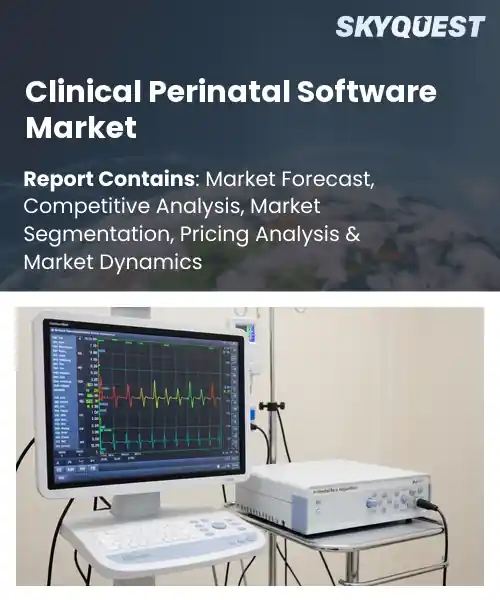
Clinical Perinatal Software Market
Report ID: SQMIG35D2598
Report ID: SQMIG35D2598
[email protected]
USA +1 351-333-4748
Report ID:
SQMIG35D2598 |
Region:
Global |
Published Date: July, 2026
Pages:
157
|Tables:
142
|Figures:
78


Global Clinical Perinatal Software Market size was valued at USD 320.0 Million in 2024 and is poised to grow from USD 355.2 Million in 2025 to USD 818.57 Million by 2033, growing at a CAGR of 11.0% during the forecast period (2026-2033).
The clinical perinatal software market includes digital tools that collect, analyze, and exchange maternal‑fetal health information across hospitals, birthing centers, and research networks. It matters because high‑risk pregnancies are increasing and clinicians need evidence‑based decision support to lower neonatal mortality. The sector originated as isolated electronic health‑record add‑ons in the early 2000s, yet the pandemic spurred integration of predictive analytics and tele‑monitoring, speeding adoption. In 2019 a major U.S. health system launched a cloud‑based perinatal suite that linked prenatal labs with real‑time risk scores, cutting intervention delays. This progression shows technology becoming central to modern perinatal care for providers worldwide.
Building on that technological foundation, the key trend driving the global clinical perinatal software sector is the integration of artificial‑intelligence risk stratification within perinatal workflows, which transforms raw data into actionable alerts. When predictive models flag elevated preeclampsia probability, clinicians can initiate prophylactic therapy earlier, thereby decreasing intensive‑care admissions and shortening hospital stays. This cause‑effect chain has attracted venture capital, leading firms such as Medtronic to acquire AI‑focused startups that specialize in fetal heart‑rate pattern recognition. Simultaneously, expanding tele‑obstetrics programs in rural Europe illustrate how remote monitoring platforms generate revenue while addressing equity gaps. Consequently, the market anticipates double‑digit CAGR as hospitals seek scalable, outcome‑based solutions.
How is Ai-Driven Automation Reshaping the Clinical Perinatal Software Market?
The automation of data collection, risk assessment, and coordination of care in the perinatal clinics is done by utilizing AI. Machine learning helps in scanning the electronic health records to highlight the cases of high-risk pregnancy to the clinicians for early intervention as well. Natural language processing helps in identifying the most important information from ultrasound reports and lab results, thus, reducing human errors. Dashboard integration allows monitoring the real-time information regarding the patient population and makes it possible to use evidence-based solutions in planning the resources.
In October 2025, GE HealthCare launched CareIntellect™ for Perinatal, a cloud-first SaaS application that uses AI-driven clinical insights to integrate maternal and fetal data from multiple sources into a unified dashboard. The platform enables real-time monitoring, faster risk identification, and improved clinical decision-making, enhancing outcomes in perinatal care.
Market snapshot - (2026-2033)
Global Market Size
USD 320.0 Million
Largest Segment
Integrated Software
Fastest Growth
Standalone Software
Growth Rate
11.0% CAGR
To get more insights on this market click here to Request a Free Sample Report
Global clinical perinatal software market is segmented by product type, deployment model, application, functionality, end-use and region. Based on product type, the market is segmented into integrated software and standalone software. Based on deployment model, the market is segmented into on-premise and cloud-based. Based on application, the market is segmented into fetal monitor data services, workflow management and clinical decision support. Based on functionality, the market is segmented into data management & integration, patient monitoring & alerts and analytics & reporting. Based on end-use, the market is segmented into hospitals, clinics and maternity centers. Based on region, the market is segmented into North America, Europe, Asia Pacific, Latin America and Middle East & Africa.
Integrated software segment dominates because it unifies patient records, fetal monitor feeds, and decision‑support algorithms into a single platform, eliminating siloed data exchanges that hinder real‑time clinical insight. This integration simplifies the processes, minimizes the chances for human errors when entering data, and improves interactions between different departments, which is especially important in perinatal care, where many things depend on combining different units. If organizations use tools that allow users to smooth processes, this will help them get a better operational experience leading to an overall improvement of patient care.
Meanwhile, standalone software segment emerges as the key high‑growth area as healthcare providers seek flexible, modular tools that can be rapidly deployed alongside existing systems. Its plug‑and‑play nature allows maternity centers to adopt specific functionalities—such as analytics or alerts—without overhauling legacy infrastructure. This adaptability fuels accelerated adoption, driving broader market penetration and opening avenues for niche innovation that expands the overall market landscape.
Cloud‑based deployment model stands out because it offers scalable access to workflow management modules from any location, supporting the increasingly mobile and collaborative nature of perinatal teams. Central data storage makes it easier to update systems in real-time, simplifing IT management and allowing connection with other health IT systems, which add to improvement in helping to coordinate care processes and eliminating any delays in important decision making.
Conversely, on‑premise deployment model is witnessing the strongest growth momentum as institutions prioritize data security and latency control for sensitive fetal monitoring information. Advances in local server technology and customizable integration options make on‑premise solutions more attractive for organizations with strict compliance requirements, prompting a surge in investments that broadens market depth and diversifies deployment choices.
To get detailed segments analysis, Request a Free Sample Report
As per the global clinical perinatal software market share, North America leads the industry because of its mature healthcare infrastructure, extensive adoption of electronic health records, and strong emphasis on patient safety and outcome optimization. The area reaps the rewards of a series of well-established research institutions that enhance innovation in perinatal care technologies. High levels of reimbursements and supportive regulation systems attract investors from leading software providers, thus stimulating a healthy competition segmentation that speeds up product improvement. Quality partnerships among healthcare institutions, universities, and technology companies ensure the region’s ability to deliver integrated, smart solutions capable of answering the complex requirements of obstetric and neonatal health care.
United States Clinical Perinatal Software Market
Clinical perinatal software market in the United States is shaped by a large, diverse patient population and a deep pool of clinical expertise. Leading hospitals and health systems prioritize digital transformation, driving demand for advanced analytics, remote monitoring, and interoperable platforms. Strong venture capital activity fuels start‑up innovation, while established vendors expand functionality to address regulatory compliance and quality reporting requirements.
Canada Clinical Perinatal Software Market
Clinical perinatal software market in Canada reflects a national commitment to universal health coverage and standardized care pathways. The various health organizations in the provinces support the adoption of integrated solutions that connect maternal health facilities to community health services. By providing multilingual assistance and culturally sensitive interfaces, health organizations enhance accessibility, while cooperation with research centers makes it possible to advance the tools for the provision of perinatal support that is based on reliable data.
Based on global clinical perinatal software regional forecast, Europe’s rapid expansion stems from coordinated policy initiatives that promote digital health adoption across member states, coupled with a strong emphasis on clinical research and cross‑border collaboration. The variety and disparity of the healthcare systems in this area create an opportunity for vendors to customize their solutions to comply with different regulations and languages, enabling improvements in the areas of multilingual interfaces as well as adherence to data privacy regulations. Investment in telemedicine and remote patient monitoring is rapidly growing due to new care models that are based on the principle of continuity of care. Additionally, solid academic networks and collaboration between public and private sectors enhance the creation of interoperable systems that allow better data sharing practices and clinical results across the continent.
Germany Clinical Perinatal Software Market
Clinical perinatal software market in Germany is anchored by a highly organized hospital network and rigorous quality standards. A strong partnership between university healthcare facilities and the technology sector ensures the development of advanced decision-making algorithms and a smooth integration with the national healthcare information exchanges. Precision medicine and data analysis contribute to the ongoing improvement of tools for assessing pregnancy risks.
United Kingdom Clinical Perinatal Software Market
Clinical perinatal software market in the United Kingdom is propelled by aggressive digital health strategies that encourage rapid rollout of interoperable systems across the NHS. The need for mobile applications and telemonitoring systems is increasing because of the focus on patient-centered care. Collaborative projects in hospitals and startups are creating solutions through language‑specific user interfaces and culturally relevant educational elements.
France Clinical Perinatal Software Market
Clinical perinatal software market in France is emerging alongside national initiatives that prioritize telemedicine and standardized clinical pathways. Adoption is driven by public health programs that seek to reduce disparities in maternal care across urban and rural settings. Hospitals and startups working together create innovative solutions that include language-specific interfaces along with educational materials tailored to local cultures.
As per global clinical perinatal software regional outlook, Asia Pacific is strengthening its position through accelerated digital infrastructure development and growing awareness of perinatal health outcomes. Various policies are being put in place by some governments to promote the adoption of electronic health record systems and the use of telemedicine, providing a perfect ground for software implementation in the region. Given the high population of people with good knowledge of technology in the region, there is increasing demand for mobile-based solutions for immediate patient monitoring and individualized assistance. Collaboration of local companies with international health establishments allows for timely adaptation of sophisticated data analytics and AI systems. Besides, training programs enhance specialists’ ability to apply innovations to improve maternal and baby health.
Japan Clinical Perinatal Software Market
Clinical perinatal software market in Japan is characterized by advanced technology adoption and a strong focus on safety and precision. Connecting perinatal software to national health databases enables the aggregation of patient history data and the tracking of outcomes effectively. High consumer expectations for quality of care promote the use of sophisticated monitoring devices and predictive analytics within obstetric practice.
South Korea Clinical Perinatal Software Market
Clinical perinatal software market in South Korea benefits from a highly connected society and government incentives that promote e‑health solutions. The fast adoption of mobile health platforms allows for continuous engagement of pregnant women while effective research collaborations motivate the application of the most modern AI algorithms in clinical workflows. The focus on the rapid conversion of research into practice speeds up the introduction of innovative technologies in perinatal care.
To know more about the market opportunities by region and country, click here to
Buy The Complete Report
Increasing Adoption of Cloud Platforms
Healthcare providers are moving toward cloud‑based solutions to enhance accessibility, scalability, and collaborative care across perinatal units. Cloud technology has made it possible for obstetricians, neonatologists, and other medical personnel to share data in real time, thus making crucial decisions with minimal delay. The technology also makes it easier for companies to carry out system updates and maintain the software, thus allowing them to dedicate more resources to ensuring patient care instead of worrying about IT systems. Meanwhile, as clinicians realize the benefits of this technology in providing better service to their patients, the popularity of the perinatal software increases.
Integration With Electronic Health Records
Effective integration of perinatal software with currently available electronic health records systems has an impact on patient data flow by reducing manual processes and potential mistakes. Due to the automatic transfer of data obtained during prenatal visits, laboratory tests, medications, and imaging operations, medical professionals are able to understand conditions of both attending and developing patients to provide timely intervention. This approach improves cooperation between different specialist groups, enhances documentation accuracy, and speeds up billing. The medical practice becomes aware of these advantages and invests in technologies focused on interoperability, which contributes to the market development.
High Implementation Cost Concerns
Deploying advanced perinatal software often requires substantial capital outlay for licensing, hardware upgrades, and specialized training. Organizations with limited resources have to justify their investment against other priorities such as hiring and facility upgrades. The financial risks perceived by prospective clients might postpone the adoption decision, especially when hospitals and clinics are small and their resources are limited. Therefore, cost sensitivity slows down the penetration of the market, as potential clients wait for clear evidence of return on investment before adopting the technology.
Regulatory Compliance Complexity
Stringent health‑care regulations governing data privacy, security, and clinical documentation impose rigorous standards on perinatal software solutions. Sellers must keep modifying their offerings to comply with changing local and global regulations, which may cause the lengthening of the process of developing products and increase the costs for compliance. Additionally, hospitals may delay the Purchasing process due to the fear of any possible penalties or reputational loss, being sure that the solution is compliant. This precaution prevents fast market penetration.
Request Free Customization of this report to help us to meet your business objectives.
The competitive landscape in the global clinical perinatal software market outlook is shaped by large EHR vendors expanding perinatal modules through strategic partnerships and acquisitions, while niche innovators drive differentiation with AI‑based risk analytics, remote monitoring, and integrated telehealth. Epic’s partnership with Maven Clinic to embed virtual prenatal visits, Cerner’s acquisition of a perinatal analytics firm, and Philips’ integration of AI fetal monitoring illustrate how technology innovation and consolidation are accelerating market differentiation.
Top Player’s Company Profile
Recent Developments
SkyQuest’s ABIRAW (Advanced Business Intelligence, Research & Analysis Wing) is our Business Information Services team that Collects, Collates, Correlates, and Analyses the Data collected by means of Primary Exploratory Research backed by robust Secondary Desk research.
As per SkyQuest analysis the global clinical perinatal software industry is being propelled chiefly by AI‑driven risk‑stratification that turns raw maternal‑fetal data into actionable alerts, accelerating early interventions and drawing strong venture capital support. A second driver comes from the shift to cloud‑based deployment, which offers scalable access, real‑time data sharing and easier updates for perinatal teams. The market’s growth is tempered by high implementation costs that many hospitals and clinics must weigh against limited budgets. North America remains the dominant region thanks to its mature health‑IT ecosystem and strong reimbursement environment, while integrated software solutions lead the segment landscape by unifying records, monitoring feeds and decision‑support tools into a single platform.
| Report Metric | Details |
|---|---|
| Market size value in 2024 | USD 320.0 Million |
| Market size value in 2033 | USD 818.57 Million |
| Growth Rate | 11.0% |
| Base year | 2024 |
| Forecast period | (2026-2033) |
| Forecast Unit (Value) | USD Million |
| Segments covered |
|
| Regions covered | North America (US, Canada), Europe (Germany, France, United Kingdom, Italy, Spain, Rest of Europe), Asia Pacific (China, India, Japan, Rest of Asia-Pacific), Latin America (Brazil, Rest of Latin America), Middle East & Africa (South Africa, GCC Countries, Rest of MEA) |
| Companies covered |
|
| Customization scope | Free report customization with purchase. Customization includes:-
|
To get a free trial access to our platform which is a one stop solution for all your data requirements for quicker decision making. This platform allows you to compare markets, competitors who are prominent in the market, and mega trends that are influencing the dynamics in the market. Also, get access to detailed SkyQuest exclusive matrix.
Table Of Content
Executive Summary
Market overview
Parent Market Analysis
Market overview
Market size
KEY MARKET INSIGHTS
COVID IMPACT
MARKET DYNAMICS & OUTLOOK
Market Size by Region
KEY COMPANY PROFILES
Methodology
For the Clinical Perinatal Software Market, our research methodology involved a mixture of primary and secondary data sources. Key steps involved in the research process are listed below:
1. Information Procurement: This stage involved the procurement of Market data or related information via primary and secondary sources. The various secondary sources used included various company websites, annual reports, trade databases, and paid databases such as Hoover's, Bloomberg Business, Factiva, and Avention. Our team did 45 primary interactions Globally which included several stakeholders such as manufacturers, customers, key opinion leaders, etc. Overall, information procurement was one of the most extensive stages in our research process.
2. Information Analysis: This step involved triangulation of data through bottom-up and top-down approaches to estimate and validate the total size and future estimate of the Clinical Perinatal Software Market.
3. Report Formulation: The final step entailed the placement of data points in appropriate Market spaces in an attempt to deduce viable conclusions.
4. Validation & Publishing: Validation is the most important step in the process. Validation & re-validation via an intricately designed process helped us finalize data points to be used for final calculations. The final Market estimates and forecasts were then aligned and sent to our panel of industry experts for validation of data. Once the validation was done the report was sent to our Quality Assurance team to ensure adherence to style guides, consistency & design.
Analyst Support
Customization Options
With the given market data, our dedicated team of analysts can offer you the following customization options are available for the Clinical Perinatal Software Market:
Product Analysis: Product matrix, which offers a detailed comparison of the product portfolio of companies.
Regional Analysis: Further analysis of the Clinical Perinatal Software Market for additional countries.
Competitive Analysis: Detailed analysis and profiling of additional Market players & comparative analysis of competitive products.
Go to Market Strategy: Find the high-growth channels to invest your marketing efforts and increase your customer base.
Innovation Mapping: Identify racial solutions and innovation, connected to deep ecosystems of innovators, start-ups, academics, and strategic partners.
Category Intelligence: Customized intelligence that is relevant to their supply Markets will enable them to make smarter sourcing decisions and improve their category management.
Public Company Transcript Analysis: To improve the investment performance by generating new alpha and making better-informed decisions.
Social Media Listening: To analyze the conversations and trends happening not just around your brand, but around your industry as a whole, and use those insights to make better Marketing decisions.
REQUEST FOR SAMPLE
 REQUEST FREE CUSTOMIZATION
Global Clinical Perinatal Software Market size was valued at USD 320.0 Million in 2024 and is poised to grow from USD 355.2 Million in 2025 to USD 818.57 Million by 2033, growing at a CAGR of 11.0% during the forecast period (2026-2033).
The competitive landscape is shaped by large EHR vendors expanding perinatal modules through strategic partnerships and acquisitions, while niche innovators drive differentiation with AI‑based risk analytics, remote monitoring, and integrated telehealth. Epic’s partnership with Maven Clinic to embed virtual prenatal visits, Cerner’s acquisition of a perinatal analytics firm, and Philips’ integration of AI fetal monitoring illustrate how technology innovation and consolidation are accelerating market differentiation. 'Koninklijke Philips N.V.', 'GE HealthCare', 'PeriGen Inc.', 'Epic Systems Corporation', 'Oracle Health', 'K2 Medical Systems Ltd.', 'Trium Analysis Online GmbH', 'Clinical Computer Systems Inc.', 'Huntleigh Healthcare Limited', 'EDAN Instruments Inc.', 'Cerner Corporation', 'Allscripts Healthcare Solutions', 'MEDITECH', 'NextGen Healthcare', 'athenahealth Inc.', 'McKesson Corporation', 'Veradigm', 'Microsoft', 'Revvity Inc.', 'Siemens Healthineers'
Ai‑Driven Decision Support: Healthcare providers are increasingly adopting AI‑driven decision support tools embedded within perinatal software to streamline risk assessment and personalize care pathways. These intelligent modules analyze maternal vitals, genetic markers, and historical outcomes, offering real‑time recommendations that enhance early detection of complications. The shift accelerates clinical efficiency, reduces manual data entry, and fosters collaborative multidisciplinary teams, positioning AI as a core capability that reshapes workflow dynamics across hospitals and outpatient clinics worldwide and improves patient satisfaction metrics globally through evidence‑based insights.
Why does North America Dominate the Global Clinical Perinatal Software Market? |@12


Want to customize this report? This report can be personalized according to your needs. Our analysts and industry experts will work directly with you to understand your requirements and provide you with customized data in a short amount of time. We offer $1000 worth of FREE customization at the time of purchase.
Feedback From Our Clients


 USA (+1) 351-333-4748

