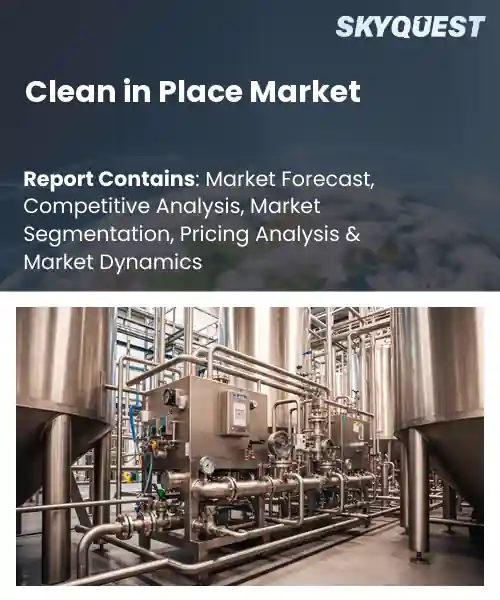
Clean in Place Market
Report ID: SQMIG20I3247
Report ID: SQMIG20I3247
[email protected]
USA +1 351-333-4748
Report ID:
SQMIG20I3247 |
Region:
Global |
Published Date: July, 2026
Pages:
157
|Tables:
120
|Figures:
77


Global Clean In Place Market size was valued at USD 10.2 Billion in 2024 and is poised to grow from USD 11.57 Billion in 2025 to USD 31.63 Billion by 2033, growing at a CAGR of 13.4% during the forecast period (2026-2033).
The Clean in place market covers systems that enable the sanitary cleaning of equipment without disassembly and are used by the food processing, dairy, beverage and pharmaceutical industries. The importance of it is that product safety must be ensured with minimum downtime and labor cost. The market first appeared in the 1960s when dairy producers began using automated washing lines, and grew rapidly during the 1990s as hygiene standards were increased by regulatory agencies. In the past decade, the scope of adoption has expanded to biotech facilities where sterility is critical. This illustrates how compliance pressures and technology improvements have changed, from a niche solution to an industry-wide requirement for global manufacturers across the globe.
The rising demand for higher production efficiency coupled with stringent sanitation rules is the key growth driver for the CIP market. Manufacturers using automated CIP systems are seeing shorter cycle times, less water and chemical use, and less labor exposure – all of which improve profit margins. The same cause-effect relationship can be seen in breweries that replaced manual scrubbing with programmable units and reduced downtime by up to 30 percent creating cost savings. IoT sensors integration adds value by providing temperature and concentration data, which enables predictive maintenance and reduces waste. This presents processing hubs in Southeast Asia as fertile ground for vendors with scalable, digital‑ready solutions.
How are AI and IoT Technologies Driving Innovation in the Clean In Place Market?
AI and IoT are changing the face of Clean-in-Place operations, connecting sensors, controllers and analytics platforms in real time. Smart sensors measure temperature, flow and chemical concentrations and send data to cloud based AI models to predict fouling and recommend optimal cleaning cycles. This reduces downtime, consumes less water and chemicals, and prolongs equipment lifespan. Integrated dashboards provide operators with useful information and machine‑learning algorithms continually optimize cleaning protocols based on historical performance. The market is in the billions and is quickly being adopted as manufacturers look to improve efficiency and adhere to tighter sustainability standards.
Market snapshot - (2026-2033)
Global Market Size
USD 10.2 Billion
Largest Segment
Equipments
Fastest Growth
Services
Growth Rate
13.4% CAGR
To get more insights on this market click here to Request a Free Sample Report
Global clean in place market is segmented by offering, system type, application, cleaning agent type and region. Based on offering, the market is segmented into Equipments, Solutions & Detergents and Services. Based on system type, the market is segmented into Single-Use CIP Systems and Multi-Use CIP Systems. Based on application, the market is segmented into Food & Beverage Processing, Dairy Processing, Pharmaceutical Manufacturing, Biotechnology Processing, Cosmetics Manufacturing and Others. Based on cleaning agent type, the market is segmented into Alkaline Cleaners, Acid Cleaners, Sanitizers & Disinfectants and Others. Based on region, the market is segmented into North America, Europe, Asia Pacific, Latin America and Middle East & Africa.
Solutions & Detergents segment is leading the way with integrated chemical formulations that make validation easy and reduce changeover time, and comply with strict hygiene standards. Manufacturers prefer bundled solutions that deliver cleaning efficacy and compliance to environmental mandates, creating regular procurement cycles. The combination of formulation knowhow and regulatory compliance is a powerful value proposition and influences plant managers to choose this over just equipment or service contracts. This preference also fosters further supplier investment into R&D, cementing the segment’s leadership.
However, services segment is witnessing highest growth momentum as plants are outsourcing cip optimization to the specialized providers to gain expertise in process analytics as well as digital monitoring. This change helps reduce the capital burden and speeds the adoption of advanced cleaning protocols, unlocking new sources of income for service firms and expanding the overall market footprint.
Multi Use CIP Systems segment is projected to be the largest segment, as they allow repeated cycles without disassembly, thereby providing consistent cleaning performance, and optimizing equipment uptime. By integrating with existing process lines, retrofitting costs are reduced and this matches the industry focus on continuous production. Operators appreciate the ability to adjust cleaning parameters between product changeovers, enhancing operational efficiency and maintaining high throughput, thus solidifying their market leadership status.
Single Use CIP Systems segment is emerging as the key high growth area as manufacturers are focusing on contamination control and rapid changeover. Disposable components reduce cross contamination risk and validation complexity, which is attractive to industries requiring high sterility. That capability is helping to accelerate adoption, to fuel market expansion, and to open new opportunities for equipment innovators.
To get detailed segments analysis, Request a Free Sample Report
The Asia Pacific is the leading region in the global Clean in Place market due to sophisticated manufacturing skills, a strong focus on operational efficiency, and proactive regulatory settings that support sustainable processing. The region has a deep pool of engineering talent and a tradition of continuous improvement in sectors such as food, beverage and pharmaceuticals. And the presence of leading equipment manufacturers and a collaborative ecosystem of suppliers, integrators and end‑users accelerates technology adoption as well. In the region, investment in advanced Clean in Place solutions continues to be driven by customer demand for high-purity processes and less downtime. Regional trade agreements allow companies to collaborate across borders, sharing best practices and scaling innovations quickly. Further, the culture of quality and compliance ensures that Clean in Place infrastructure is always being upgraded, solidifying the region’s leadership position.
Japan Clean in Place Market is driven by a large number of food processing and pharmaceutical manufacturers requiring strict hygiene. Close collaboration with technology providers is also encouraged by large industrial zones with clusters of industries, which allows for fast integration of advanced automation. This focus on precision engineering, along with a regulatory landscape emphasizing product safety, further incentivizes investment in advanced Clean in Place systems, solidifying the nation's reputation for quality-centric manufacturing.
South Korea Clean in Place Market is driven by a biotechnology sector and growing food and beverage industry that demand rigorous sanitary controls. As government programs drive automation and digitalization, manufacturers are adopting Clean in Place solutions. Cooperation between equipment companies and technology leaders brings better access to designs. When selecting the systems, a key consideration is energy efficiency to minimize water and utility usage during production cycles.
North America’s Clean in Place market is experiencing rapid expansion driven by heightened focus on food safety, increasing automation, and a shift toward sustainable manufacturing practices. The United States and Canada host a dense concentration of multinational producers that demand flexible and high‑throughput sanitation solutions. Strong investment in digital technologies and data analytics enables real‑time monitoring, reducing downtime and enhancing compliance. Additionally, regulatory frameworks that emphasize stringent hygiene standards push manufacturers to adopt advanced Clean in Place systems. Collaborative ecosystems involving equipment providers, service integrators, and research institutions further accelerate innovation, positioning North America as a dynamic hub for next‑generation sanitation technologies. The region’s emphasis on operational excellence encourages continuous upgrades to cleaning protocols, while a strong culture of supplier competition drives cost‑effective solutions. Emerging interest in modular and scalable Clean in Place configurations further supports rapid deployment across diverse processing environments.
Clean in Place Market in United States is characterized by a broad spectrum of food, beverage, and pharmaceutical manufacturers that prioritize sanitation technologies to meet rigorous regulatory expectations. The presence of leading equipment innovators and a mature supply chain facilitates rapid adoption of automated cleaning solutions. Emphasis on sustainability drives demand for water‑saving and energy‑efficient systems, while integration with digital platforms enhances traceability and operational visibility across complex production lines.
Clean in Place Market in Canada is driven by a dairy and beverage sector that requires hygiene standards across operations. Research initiatives between universities and equipment manufacturers foster development of cleaning solutions suited to the country’s regulatory context. Environmental stewardship mandates encourage adoption of water‑recycling technologies, while government incentives support modernization of processing facilities. This combination of industry demand and policy creates a environment for advanced Clean in Place adoption.
Europe is strengthening its position in the Clean in Place market through a combination of stringent regulatory standards, strong engineering expertise, and a concerted focus on sustainability. The region’s mature food and beverage sectors demand high‑level sanitation, prompting continuous upgrades to cleaning infrastructure. Collaborative research programs across the European Union foster innovation in water‑recycling and energy‑efficient technologies, while a well‑established network of specialist equipment manufacturers ensures rapid deployment of advanced solutions. Moreover, an increasing emphasis on circular economy principles drives the adoption of modular and retrofit‑friendly Clean in Place systems, reinforcing Europe’s reputation as a leader in environmentally responsible processing. The integration of digital twins and predictive maintenance tools further enhances operational reliability, allowing manufacturers to anticipate cleaning needs and minimize downtime. Additionally, strong government incentives for eco‑friendly technologies encourage both new installations and upgrades of existing facilities, cementing Europe’s commitment to continual improvement in sanitation practices.
Clean in Place Market in Germany benefits from a robust industrial base and a tradition of precision engineering that drives adoption of high‑efficiency sanitation systems. Food processing, brewing, and pharmaceutical firms prioritize stringent hygiene protocols, prompting investment in automated cleaning solutions. Collaborative initiatives between research institutes and equipment manufacturers accelerate development of water‑conserving technologies, while strong regulatory guidelines ensure consistent implementation of best practices across the sector global continuous quality.
Clean in Place Market in United Kingdom is propelled by a food and beverage industry that demands reliable and scalable sanitation solutions. The presence of leading engineering firms and a regulatory environment encourages integration of cleaning technologies. Emphasis on reducing water consumption aligns with sustainability goals, fostering development of recyclable cleaning agents and loop systems. Collaborative projects between academia and manufacturers further drive innovation in smart monitoring and process optimization.
Clean in Place Market in France is driven by a dairy and bakery sector that requires hygiene to meet domestic and export standards. The nation’s emphasis on research fosters partnerships that produce innovative cleaning chemistries and equipment. Government programs economy promote water reclamation and waste reduction in processing plants. Combined with a regulatory framework that enforces sanitation protocols, these factors accelerate adoption of Clean in Place technologies across French manufacturers.
To know more about the market opportunities by region and country, click here to
Buy The Complete Report
Increasing Regulatory Stringency
Rising Demand for Sustainable Production
High Initial Capital Investment
Complex Integration With Existing Lines
Request Free Customization of this report to help us to meet your business objectives.
The competitive landscape in the Clean‑in‑Place market is shaped by intense rivalry among established equipment manufacturers and chemical suppliers, driving accelerated innovation and strategic consolidation. Companies are pursuing technology upgrades such as IoT‑enabled monitoring and energy‑efficient spray systems, while recent M&A activity—exemplified by a leading detergent producer acquiring a niche CIP automation firm—and partnerships between sensor developers and global integrators illustrate efforts to broaden service portfolios and capture emerging demand in food, beverage, and pharma sectors.
In May 14, 2025, Goma Engineering introduced an automated CIP solution for pharmaceutical and bioprocess manufacturing, focused on audit documentation, contamination control, and reduced human error.
In May 22, 2025, Control Concepts showcased its AirSweep CIP system, which cut cleaning time at an infant-formula facility by 75%, from 40 hours to 10 hours, while lowering water and chemical waste.
SkyQuest’s ABIRAW (Advanced Business Intelligence, Research & Analysis Wing) is our Business Information Services team that Collects, Collates, Correlates, and Analyses the Data collected by means of Primary Exploratory Research backed by robust Secondary Desk research.
As per SkyQuest analysis, the Clean‑in‑Place market is being propelled primarily by tightening regulatory standards that force food, beverage and pharmaceutical manufacturers to adopt automated sanitation to ensure compliance and reduce contamination risk. A second strong catalyst is the rapid infusion of AI and IoT technologies, which deliver real‑time monitoring, predictive maintenance and optimized chemical dosing, further boosting efficiency and sustainability. The market is led by the Solutions & Detergents offering, where integrated chemical formulations simplify validation and meet hygiene mandates. Asia Pacific dominates regionally, driven by extensive food and pharma production and supportive policies. However, high upfront capital costs remain a notable restraint that can slow adoption, especially for smaller plants.
| Report Metric | Details |
|---|---|
| Market size value in 2024 | USD 10.2 Billion |
| Market size value in 2033 | USD 31.63 Billion |
| Growth Rate | 13.4% |
| Base year | 2024 |
| Forecast period | (2026-2033) |
| Forecast Unit (Value) | USD Billion |
| Segments covered |
|
| Regions covered | North America (US, Canada), Europe (Germany, France, United Kingdom, Italy, Spain, Rest of Europe), Asia Pacific (China, India, Japan, Rest of Asia-Pacific), Latin America (Brazil, Rest of Latin America), Middle East & Africa (South Africa, GCC Countries, Rest of MEA) |
| Companies covered |
|
| Customization scope | Free report customization with purchase. Customization includes:-
|
To get a free trial access to our platform which is a one stop solution for all your data requirements for quicker decision making. This platform allows you to compare markets, competitors who are prominent in the market, and mega trends that are influencing the dynamics in the market. Also, get access to detailed SkyQuest exclusive matrix.
Table Of Content
Executive Summary
Market overview
Parent Market Analysis
Market overview
Market size
KEY MARKET INSIGHTS
COVID IMPACT
MARKET DYNAMICS & OUTLOOK
Market Size by Region
KEY COMPANY PROFILES
Methodology
For the Clean in Place Market, our research methodology involved a mixture of primary and secondary data sources. Key steps involved in the research process are listed below:
1. Information Procurement: This stage involved the procurement of Market data or related information via primary and secondary sources. The various secondary sources used included various company websites, annual reports, trade databases, and paid databases such as Hoover's, Bloomberg Business, Factiva, and Avention. Our team did 45 primary interactions Globally which included several stakeholders such as manufacturers, customers, key opinion leaders, etc. Overall, information procurement was one of the most extensive stages in our research process.
2. Information Analysis: This step involved triangulation of data through bottom-up and top-down approaches to estimate and validate the total size and future estimate of the Clean in Place Market.
3. Report Formulation: The final step entailed the placement of data points in appropriate Market spaces in an attempt to deduce viable conclusions.
4. Validation & Publishing: Validation is the most important step in the process. Validation & re-validation via an intricately designed process helped us finalize data points to be used for final calculations. The final Market estimates and forecasts were then aligned and sent to our panel of industry experts for validation of data. Once the validation was done the report was sent to our Quality Assurance team to ensure adherence to style guides, consistency & design.
Analyst Support
Customization Options
With the given market data, our dedicated team of analysts can offer you the following customization options are available for the Clean in Place Market:
Product Analysis: Product matrix, which offers a detailed comparison of the product portfolio of companies.
Regional Analysis: Further analysis of the Clean in Place Market for additional countries.
Competitive Analysis: Detailed analysis and profiling of additional Market players & comparative analysis of competitive products.
Go to Market Strategy: Find the high-growth channels to invest your marketing efforts and increase your customer base.
Innovation Mapping: Identify racial solutions and innovation, connected to deep ecosystems of innovators, start-ups, academics, and strategic partners.
Category Intelligence: Customized intelligence that is relevant to their supply Markets will enable them to make smarter sourcing decisions and improve their category management.
Public Company Transcript Analysis: To improve the investment performance by generating new alpha and making better-informed decisions.
Social Media Listening: To analyze the conversations and trends happening not just around your brand, but around your industry as a whole, and use those insights to make better Marketing decisions.
REQUEST FOR SAMPLE
 REQUEST FREE CUSTOMIZATION
Global Clean In Place Market size was valued at USD 10.2 Billion in 2024 and is poised to grow from USD 11.57 Billion in 2025 to USD 31.63 Billion by 2033, growing at a CAGR of 13.4% during the forecast period (2026-2033).
The competitive landscape in the Clean‑in‑Place market is shaped by intense rivalry among established equipment manufacturers and chemical suppliers, driving accelerated innovation and strategic consolidation. Companies are pursuing technology upgrades such as IoT‑enabled monitoring and energy‑efficient spray systems, while recent M&A activity—exemplified by a leading detergent producer acquiring a niche CIP automation firm—and partnerships between sensor developers and global integrators illustrate efforts to broaden service portfolios and capture emerging demand in food, beverage, and pharma sectors. 'Alfa Laval AB', 'GEA Group AG', 'SPX FLOW, Inc.', 'Tetra Pak International S.A.', 'Ecolab Inc.', 'Krones AG', 'Sartorius AG', 'Donaldson Company, Inc.', 'Pentair plc', 'Pall Corporation', 'Veolia Water Technologies', 'INOXPA S.A.', 'KHS GmbH', 'Bürkert GmbH & Co. KG', 'Centec GmbH', 'Bionet Servicios Técnicos S.L.', 'Sani-Matic, Inc.', 'Millitec Food Systems Ltd.', 'Ziemann Holvrieka GmbH', 'JBT Marel Corporation'
Regulatory agencies worldwide are tightening hygiene and environmental standards for food, beverage, and pharmaceutical processing, prompting manufacturers to adopt Clean in Place (CIP) systems that ensure thorough sanitation without disassembly. This pressure encourages investment in automated cleaning solutions that reduce manual labor, improve consistency, and lower the risk of contamination. As compliance becomes a core operational requirement, companies prioritize CIP technologies to meet audit criteria, thereby catalyzing market expansion through heightened adoption across regulated facilities. The focus on traceability and product safety further reinforces the shift toward integrated cleaning processes.
Sustainable Water Reuse: The industry is shifting toward closed-loop water management, where clean‑in‑place (CIP) systems are integrated with advanced filtration and recycling technologies. Manufacturers are prioritizing minimal discharge, leveraging membrane bioreactors and ion exchange to reclaim cleaning solvents and process water. This reduces environmental impact and aligns with stricter regulations, while also delivering cost efficiencies through reduced fresh water intake. Companies that embed these sustainable loops into their production lines are gaining competitive advantage and strengthening brand reputation among environmentally conscious customers globally today.
Why does Asia Pacific Dominate the Global Clean in Place Market? |@12


Want to customize this report? This report can be personalized according to your needs. Our analysts and industry experts will work directly with you to understand your requirements and provide you with customized data in a short amount of time. We offer $1000 worth of FREE customization at the time of purchase.
Feedback From Our Clients


 USA (+1) 351-333-4748

