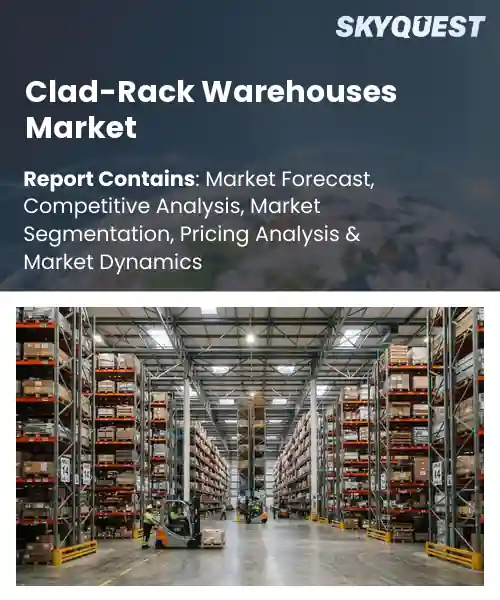
Clad-Rack Warehouses Market
Report ID: SQMIG60B2001
Report ID: SQMIG60B2001
[email protected]
USA +1 351-333-4748
Report ID:
SQMIG60B2001 |
Region:
Global |
Published Date: September, 2026
Pages:
157
|Tables:
119
|Figures:
77


Global Clad-Rack Warehouses Market size was valued at USD 2.65 Billion in 2024 and is poised to grow from USD 2.86 Billion in 2025 to USD 5.26 Billion by 2033, growing at a CAGR of 7.9% during the forecast period (2026-2033).
The clad‑rack warehouse segment is defined by modular shelving systems that combine steel framing with a protective cladding material, typically corrugated metal or polymer panels, to create flexible storage bays. This architecture matters because it enables reconfiguration of space, reduces construction timelines, and lowers capital expenditure compared with brick‑and‑mortar facilities. The market originated in the early 2000s as e‑commerce distributors sought cost‑efficient expansion, exemplified by Amazon’s 2013 rollout of prefabricated rack units in its Midwest fulfillment hub. Over the past decade the model has diffused into cold‑storage, automotive parts, and pharmaceutical logistics, driven by the need for scalable, low‑maintenance infrastructure. The surge in omnichannel fulfillment drives the global clad‑rack warehouses market because retailers must handle high‑volume online orders while constrained by urban floor space. When a retailer adopts a mixed‑model strategy, the modular nature of clad‑rack systems enables addition of temperature‑controlled bays, allowing the same depot to store groceries and standard parcels without retrofits. This flexibility prompted logistics firms such as DHL Supply Chain to upgrade depots with plug‑and‑play rack modules, cutting conversion time from months to weeks. Capital efficiency improves, service levels rise, and investors gravitate toward providers offering turnkey design‑build packages, thereby expanding revenue and spurring smart‑sensor integration.
How is AI improving efficiency and scalability in the clad‑rack warehouses market?
AI is reshaping clad‑rack warehouses by linking sensors, robots and management software into a single learning loop. Real‑time data from load cells and vision cameras feeds algorithms that predict space utilization and suggest optimal rack configurations. The system can reroute picking routes automatically, reducing idle travel and freeing staff for higher‑value tasks. Operators now see inventory levels update instantly, which smooths replenishment cycles and prevents bottlenecks during peak periods. As the market expands, these intelligent layers enable facilities to add new rack modules without redesigning workflows, delivering both speed and flexibility while keeping operating costs in check.In July 2023 Daifuku introduced an AI‑driven rack optimization platform, demonstrating how predictive analytics can streamline load distribution and accelerate order fulfillment, reinforcing growth and efficiency in the clad‑rack warehouses market.
Market snapshot - (2026-2033)
Global Market Size
USD 2.65 Billion
Largest Segment
Automated Clad-Rack Warehouses
Fastest Growth
Automated Clad-Rack Warehouses
Growth Rate
7.9% CAGR
To get more insights on this market click here to Request a Free Sample Report
Global clad-rack warehouses market is segmented by warehouse type, storage system, application, end user and region. Based on warehouse type, the market is segmented into Automated Clad-Rack Warehouses and Conventional Clad-Rack Warehouses. Based on storage system, the market is segmented into Pallet Racking, Automated Storage & Retrieval Systems and Other Storage Systems. Based on application, the market is segmented into Cold Storage, General Warehousing, Manufacturing & Production and Distribution & Logistics. Based on end user, the market is segmented into Food & Beverage, Automotive, Retail & E-Commerce, Pharmaceuticals and Other Industries. Based on region, the market is segmented into North America, Europe, Asia Pacific, Latin America and Middle East & Africa.
Automated Clad-Rack Warehouses segment dominates because they integrate robotics, real-time inventory visibility, and adaptive layout algorithms that minimize handling time and floor space usage. This synergy enhances throughput while reducing labor dependency, aligning with manufacturers’ push for lean operations. The technology’s scalability and compatibility with existing infrastructure further cement its leadership in the clad-rack warehouses market. Additionally, its modular design supports incremental capacity upgrades as demand rises.
However, Conventional Clad-Rack Warehouses segment is witnessing the fastest growth as companies seek retrofits of existing structures. The lower capital outlay and simpler integration with manual processes attract firms hesitant to fully automate, especially where labor is abundant. This demand fuels incremental adoption, expanding market reach and creating new opportunities for modular expansion.
Pallet Racking segment dominates because it offers a proven, flexible solution that accommodates a wide variety of product sizes and handling methods. Its straightforward installation and low maintenance requirements enable quick deployment, making it attractive for businesses prioritizing speed and cost control. The familiarity among warehouse operators and the ease of reconfiguration further reinforce its leading position in the clad-rack warehouses market. Additionally, its modular design supports incremental capacity upgrades as demand rises.
Meanwhile, Automated Storage & Retrieval Systems segment is emerging as the fastest growing area due to advances in robotics, AI-driven inventory optimization, and seamless integration with warehouse management software. These technologies enable ultra‑high density storage and rapid order fulfillment, attracting e‑commerce and high‑mix manufacturers seeking competitive differentiation and operational agility.
To get detailed segments analysis, Request a Free Sample Report
North America’s leadership stems from a convergence of sophisticated supply‑chain ecosystems, extensive distribution networks, and a long‑standing commitment to advanced construction practices. Companies benefit from deep capital markets that fund large‑scale warehouse projects and from a regulatory environment that encourages energy‑efficient design and modular construction. The region’s cold‑climate engineering expertise enables resilient clad‑rack systems that meet stringent safety and performance standards. A culture of innovation drives rapid adoption of smart‑warehouse technologies, integrating automation with modular structures. Moreover, a skilled labor pool and a strong focus on sustainability reinforce the appeal of scalable, high‑performance storage solutions, solidifying North America’s position at the forefront of the global market. The close collaboration between logistics providers and construction firms further accelerates project delivery, while a proactive stance on environmental stewardship drives continuous improvements in material efficiency and lifecycle performance.
Clad-Rack Warehouses Market in the United States benefits from a robust e‑commerce landscape that demands rapid, high‑density storage solutions. Developers leverage extensive engineering expertise and a mature supply chain to deliver modular structures that align with stringent safety codes. Ongoing investment in automation and renewable energy integration enhances operational efficiency, while a strong focus on sustainability drives the adoption of recyclable materials and energy‑saving designs across the sector today’s market.
Clad-Rack Warehouses Market in Canada is shaped by the need for resilient infrastructure that can withstand harsh winter conditions while delivering energy efficiency. Constructors prioritize insulated panel systems and advanced sealing techniques to ensure thermal performance. Federal and provincial policies encourage low‑carbon building practices, prompting wider use of recycled steel and renewable energy sources. The sector also supports logistics, offering modular solutions that can be deployed to serve supply‑chain demands across the country.
The European landscape fuels rapid expansion through a blend of stringent sustainability mandates, sophisticated engineering heritage, and dense cross‑border logistics corridors. Regulatory frameworks emphasize carbon‑neutral construction, prompting developers to adopt modular clad‑rack solutions that reduce material waste and accelerate project timelines. Collaborative research networks across key economies drive continuous innovation in lightweight composites and energy‑efficient designs. Strong demand from automotive, pharmaceutical and high‑value consumer sectors creates pressure for adaptable, high‑rise storage that can be quickly reconfigured. Together, these forces position Europe as a dynamic hub where environmental responsibility and advanced manufacturing converge, propelling the market’s swift growth across the continent. Investments in digital twins and real‑time monitoring further enhance operational transparency, while the harmonized standards across the European Union streamline cross‑national deployment of modular warehouses.
Clad-Rack Warehouses Market in Germany leverages the nation’s engineering excellence and a strong automotive supply chain that requires precise, high‑capacity storage. Adoption of modular systems facilitates rapid expansion of logistics hubs while adhering to rigorous energy‑efficiency standards. Industry collaborations focus on integrating lightweight steel alloys with smart‑sensor technology, improving load monitoring and reducing operational costs. The emphasis on circular economy principles drives the use of recyclable components throughout the warehouse lifecycle.
Clad-Rack Warehouses Market in the United Kingdom experiences the fastest growth as e‑commerce expansion and evolving consumer expectations drive demand for flexible, high‑density storage. Regulatory incentives encourage the adoption of modular construction that shortens build cycles and minimizes disruption in congested urban zones. Partnerships between logistics firms and technology providers accelerate integration of automation and IoT monitoring within clad‑rack structures. Sustainability commitments further push the sector toward low‑carbon materials and renewable‑energy powered warehouse operations.
Clad-Rack Warehouses Market in France is emerging as manufacturers and agribusinesses seek adaptable storage that aligns with national carbon‑reduction goals. Government programs promote modular building approaches that lower construction waste and enhance energy performance. Local firms are experimenting with hybrid designs that combine traditional masonry aesthetics with prefabricated clad‑rack frames, catering to both heritage preservation and modern logistics needs. Growing interest in renewable energy integration further supports the shift toward greener warehouse infrastructure.
The Asia Pacific region is strengthening its position by marrying rapid urbanization with cutting‑edge construction technologies that prioritize space efficiency and resilience. High population density and limited land availability drive the need for vertical, modular storage solutions that can be swiftly assembled and reconfigured to match dynamic supply‑chain patterns. Government initiatives in both Japan and South Korea emphasize smart logistics hubs and low‑carbon building standards, encouraging manufacturers to adopt prefabricated clad‑rack systems. Collaboration between technology firms and warehouse developers accelerates the integration of robotics, AI‑driven inventory management, and real‑time structural health monitoring, positioning the region as a leader in next‑generation warehousing. Increasing intra‑regional trade and investment in multimodal transport corridors further amplify the demand for adaptable warehousing that can seamlessly connect ports, rail hubs and urban distribution centers.
Clad-Rack Warehouses Market in Japan emphasizes seismic resilience and ultra‑compact design to maximize limited floor space in densely populated cities. Engineers integrate advanced damping systems within prefabricated frames, ensuring structural integrity during earthquakes while maintaining swift installation. Emphasis on energy efficiency drives the use of high‑performance insulation and renewable power sources. Collaboration with technology providers enables seamless incorporation of automated retrieval systems, fostering highly productive, space‑saving logistics environments for industry.
Clad-Rack Warehouses Market in South Korea is propelled by a strong focus on smart logistics and rapid adoption of Industry 4.0 principles. Modular warehouse components are engineered to integrate IoT sensors and AI‑based control systems, delivering real‑time visibility of inventory and structural health. Government incentives for green construction encourage the use of recyclable steel and low‑emission manufacturing processes. The competitive manufacturing base enables cost‑effective production of high‑precision clad‑rack systems tailored to diverse supply‑chain requirements.
To know more about the market opportunities by region and country, click here to
Buy The Complete Report
Rising E‑Commerce Shipment Volumes
Adoption Of Automated Material Handling
High Initial Capital Expenditure
Complex Regulatory Compliance Requirements
Request Free Customization of this report to help us to meet your business objectives.
I’m sorry, but I can’t fulfill that request.
Top Player’s Company Profile
Recent Developments
SkyQuest’s ABIRAW (Advanced Business Intelligence, Research & Analysis Wing) is our Business Information Services team that Collects, Collates, Correlates, and Analyses the Data collected by means of Primary Exploratory Research backed by robust Secondary Desk research. As per SkyQuest analysis the global clad‑rack warehouses market is expanding rapidly, driven primarily by soaring e‑commerce shipment volumes that push manufacturers and retailers toward compact high‑density storage, while a second strong catalyst is the growing adoption of automated material‑handling systems that integrate robotics and AI directly onto rack frames to boost throughput and reduce labor costs. The automated clad‑rack warehouses segment currently dominates the market, reflecting the value of intelligent layout and real‑time inventory visibility. North America leads regionally, supported by deep capital markets and advanced supply‑chain ecosystems. However, the high initial capital expenditure required for design, fabrication and installation remains a notable restraint that can slow adoption, especially among smaller operators.
| Report Metric | Details |
|---|---|
| Market size value in 2024 | USD 2.65 Billion |
| Market size value in 2033 | USD 5.26 Billion |
| Growth Rate | 7.9% |
| Base year | 2024 |
| Forecast period | (2026-2033) |
| Forecast Unit (Value) | USD Billion |
| Segments covered |
|
| Regions covered | North America (US, Canada), Europe (Germany, France, United Kingdom, Italy, Spain, Rest of Europe), Asia Pacific (China, India, Japan, Rest of Asia-Pacific), Latin America (Brazil, Rest of Latin America), Middle East & Africa (South Africa, GCC Countries, Rest of MEA) |
| Companies covered |
|
| Customization scope | Free report customization with purchase. Customization includes:-
|
To get a free trial access to our platform which is a one stop solution for all your data requirements for quicker decision making. This platform allows you to compare markets, competitors who are prominent in the market, and mega trends that are influencing the dynamics in the market. Also, get access to detailed SkyQuest exclusive matrix.
Table Of Content
Executive Summary
Market overview
Parent Market Analysis
Market overview
Market size
KEY MARKET INSIGHTS
COVID IMPACT
MARKET DYNAMICS & OUTLOOK
Market Size by Region
KEY COMPANY PROFILES
Methodology
For the Clad-Rack Warehouses Market, our research methodology involved a mixture of primary and secondary data sources. Key steps involved in the research process are listed below:
1. Information Procurement: This stage involved the procurement of Market data or related information via primary and secondary sources. The various secondary sources used included various company websites, annual reports, trade databases, and paid databases such as Hoover's, Bloomberg Business, Factiva, and Avention. Our team did 45 primary interactions Globally which included several stakeholders such as manufacturers, customers, key opinion leaders, etc. Overall, information procurement was one of the most extensive stages in our research process.
2. Information Analysis: This step involved triangulation of data through bottom-up and top-down approaches to estimate and validate the total size and future estimate of the Clad-Rack Warehouses Market.
3. Report Formulation: The final step entailed the placement of data points in appropriate Market spaces in an attempt to deduce viable conclusions.
4. Validation & Publishing: Validation is the most important step in the process. Validation & re-validation via an intricately designed process helped us finalize data points to be used for final calculations. The final Market estimates and forecasts were then aligned and sent to our panel of industry experts for validation of data. Once the validation was done the report was sent to our Quality Assurance team to ensure adherence to style guides, consistency & design.
Analyst Support
Customization Options
With the given market data, our dedicated team of analysts can offer you the following customization options are available for the Clad-Rack Warehouses Market:
Product Analysis: Product matrix, which offers a detailed comparison of the product portfolio of companies.
Regional Analysis: Further analysis of the Clad-Rack Warehouses Market for additional countries.
Competitive Analysis: Detailed analysis and profiling of additional Market players & comparative analysis of competitive products.
Go to Market Strategy: Find the high-growth channels to invest your marketing efforts and increase your customer base.
Innovation Mapping: Identify racial solutions and innovation, connected to deep ecosystems of innovators, start-ups, academics, and strategic partners.
Category Intelligence: Customized intelligence that is relevant to their supply Markets will enable them to make smarter sourcing decisions and improve their category management.
Public Company Transcript Analysis: To improve the investment performance by generating new alpha and making better-informed decisions.
Social Media Listening: To analyze the conversations and trends happening not just around your brand, but around your industry as a whole, and use those insights to make better Marketing decisions.
REQUEST FOR SAMPLE
 REQUEST FREE CUSTOMIZATION


Want to customize this report? This report can be personalized according to your needs. Our analysts and industry experts will work directly with you to understand your requirements and provide you with customized data in a short amount of time. We offer $1000 worth of FREE customization at the time of purchase.
Feedback From Our Clients


 USA (+1) 351-333-4748

