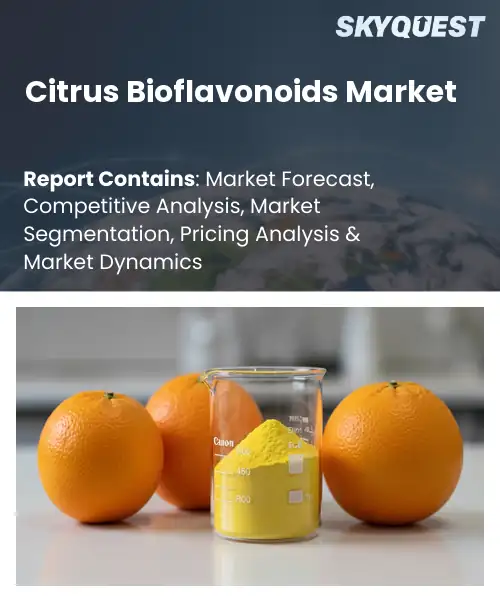
Citrus Bioflavonoids Market
Report ID: SQMIG15E3455
Report ID: SQMIG15E3455
[email protected]
USA +1 351-333-4748
Report ID:
SQMIG15E3455 |
Region:
Global |
Published Date: May, 2026
Pages:
157
|Tables:
246
|Figures:
81


Global Citrus Bioflavonoids Market size was valued at USD 1.4 Billion in 2024 and is poised to grow from USD 1.49 Billion in 2025 to USD 2.47 Billion by 2033, growing at a CAGR of 6.5% during the forecast period (2026-2033).
The growing demand for natural, scientifically proven health ingredients is the primary factor affecting citrus bioflavonoids market growth. As a result, the sourcing and formulation of ingredients throughout the food, pharmaceutical and cosmetic industries have changed dramatically. Suppliers of bioflavonoids primarily extract and purify flavonoid compounds from citrus peel and other processing wastes to provide antioxidants and anti-inflammatory ingredients to the supplement, functional food and ingredient formulation markets. The sector has historically moved from small-scale artisan extractions to standardized large-scale production, given the maturity of both regulatory frameworks and large-scale production processes which are free of solvents and using enzymes.
One of the principal drivers of citrus bioflavonoids market trends has been the convergence of scientific validation with scalable supply chain (i.e., bringing products to market in larger quantities and lower costs), which generates commercial confidence and broadens the range of potential applications. In addition, with clinical studies supporting the antioxidant, vascular and anti-inflammatory properties of compounds such as hesperidin and rutin, formulators are increasingly incorporating these active compounds into dietary supplements, functional foods and topical therapeutics; thereby enhancing their awareness and utilization by consumers. Simultaneously, valorisation of citrus waste (by-products from juice production) has resulted in lower costs of production; furthermore, this has led to the establishment of long-term contracts between juice processors and extractors (e.g., for dried juice pulp). Companies have also begun to invest significantly in product innovation and regulatory filing efforts in order to establish a market presence in personalised nutrition, clean labels and cosmeceuticals (i.e., therapeutic cosmetics).
How is AI Improving Supply Chain Efficiency in the Citrus Bioflavonoids Market?
AI is increasing the efficiency of supply chains in the citrus bioflavonoids market share by improving demand forecasting, aligning harvest schedules, and optimizing inventories so extractors and brands can minimize waste by avoiding excessive overprocessing or issues with shortages. Since the industry is significantly based on seasonal fruit and there is a high level of complexity associated with the extraction process; implementing more intelligent defining demand forecasting and planning methods allows for better time in market while reducing waste. The use of computer vision and predictive analytics will also provide assistance when it comes to sorting for quality and equipment availability; thereby maintaining consistency in production output. Leveraging digital twins with AI-driven traceability will also allow all stakeholders (growers, processors, and formulators) to have faster and more reliable access to provenance information while improving their ability to make timely decisions throughout the value chain.
In May 2026, at Vitafoods Europe, HealthTech Bio Actives introduced Leanara, a citrus bioflavonoid ingredient, and leveraging AI-driven forecasting and traceability tools should provide substantial benefits in scaling production of Leanara as well as aligning citrus sourcing with demand and ensuring a consistent level of quality so that producers can rely on consistent sourcing of this ingredient to support market growth at an accelerated pace.
Market snapshot - (2026-2033)
Global Market Size
USD 1.4 Billion
Largest Segment
Orange
Fastest Growth
Mandarin
Growth Rate
6.5% CAGR
To get more insights on this market click here to Request a Free Sample Report
Global citrus bioflavonoids market is segmented by source, product type, form, extraction method, purity level, application, end user, distribution channel and region. Based on source, the market is segmented into orange, lemon, grapefruit, mandarin, lime, bergamot and others. Based on product type, the market is segmented into hesperidin, naringin, neohesperidin, rutin, tangeretin, diosmin and others. Based on form, the market is segmented into powder, liquid, capsules & tablets, granules and others. Based on extraction method, the market is segmented into solvent extraction, supercritical fluid extraction, cold press extraction, enzyme-assisted extraction and others. Based on purity level, the market is segmented into below 50%, 50%–80% and above 80%. Based on application, the market is segmented into dietary supplements, functional food & beverages, pharmaceuticals, cosmetics & personal care, animal nutrition, nutraceuticals and others. Based on end user, the market is segmented into food & beverage manufacturers, nutraceutical companies, pharmaceutical companies, cosmetic manufacturers, feed manufacturers and research institutes. Based on distribution channel, the market is segmented into direct sales, distributors & wholesalers, online retail, specialty stores and pharmacies & drug stores. Based on region, the market is segmented into North America, Europe, Asia Pacific, Latin America and Middle East & Africa.
Orange is by far the dominant segment because the juice and peel of oranges are the two main raw materials that give a reliable and routine harvest of concentrated and consistent quality bioflavonoids for sourcing and scaling up for manufacturers. Manufacturers are already familiar with the processes for extracting orange-derived materials, and there is also a continuing supply chain established between processors and manufacturers for sourcing orange-based actives, both of which provide buyers with high levels of confidence when creating new products. As a result, formulators can expect reliability in performance and regulatory compliance when creating new products.
On the other hand, grapefruit is becoming a growing source of naringin, which is interesting to developers of functional beverages as well as to researchers to use as a bitter mask and to promote metabolic health. The innovation of extraction and formulation methods is providing increasing opportunity to develop new applications and supplier partnerships for grapefruit.
Hesperidin segment has the largest market share due to its proven bioactivity, formulation stability, compatibility with a variety of delivery formats, established manufacturing know-how, and experienced extraction profiles that reduce formulation risk. In addition, since it has well-known regulatory familiarity and consumer acceptance, companies can launch products more quickly and create new ways to use hesperidin through functional foods, nutraceuticals, and various therapeutic products.
Naringin will be the fastest-growing segment as formulators utilize naringin’s unique bitter taste and metabolic properties for creating innovative functional beverages and therapeutics. With improvements in technologies such as debittering, micronization, and other forms of value-added processing methods, more applications for naringin-based products will develop. Increased interest from both researchers and brands looking for unique marketing opportunities will cause suppliers to increase their investments and enter into new markets.
To get detailed segments analysis, Request a Free Sample Report
Fully integrated ecosystem which includes advanced research capability, manufacturing capabilities of a high standard, and high interest from consumers in functional ingredients, North America is the leader in the global citrus bioflavonoids market. There is a well-established collaboration between academics, contract manufacturers and ingredient suppliers, providing for increased innovation and quality assurance in this market. In addition, the established regulatory framework and transparent labeling increase consumer confidence and trust in this growing market. All of these factors together with mature retail channels and distribution channels, active clinical research, and large amounts of private investment assist in the rapid commercialization of nutraceuticals, pharmaceuticals, and personal care products. Strong strategic alliances and continuous product development provide a reliable supply of high quality, standardized extracts that will meet the needs of sophisticated consumers and the growing demands of industry, creating a long-term competitive advantage in global trade and product development.
Citrus bioflavonoids market regional forecast United States employs a sophisticated development of ingredients and a diverse commercial ecosystem that facilitates premium functional products. Strong support from private investment, contract research, and a wide variety of distribution networks enable the rapid iteration of products into the marketplace. The growing health consciousness of consumers combined with established quality standards and certification avenues supports continued innovation in both supplement and personal care formulation. Cross-sector partnerships continue to facilitate the diversification of applications across the clinical, sports nutrition and beauty segments.
Citrus bioflavonoids market regional outlook in Canada benefits from a culture of collaboration in product development, as well as easy access to U.S. supply chains. Companies in this market are positioning their products using clean labels and natural ingredients. The active involvement of research institutions with extractors has aided the development of formulation expertise among both groups. Smaller manufacturers in Canada mainly use high-quality input products and applications that can be traced; they have established trade links and quality assurance systems to help build trust with consumers interested in health-oriented products.
The market in Europe is rapidly growing as consumers are increasingly looking for natural, clean-label ingredients. Citrus Bioflavonoids are becoming increasingly common in functional foods, dietary supplements, and cosmeceuticals as there is a growing trend for the use of natural products. Regulatory focus on ingredient transparency and sustainability (with an emphasis on sustainable sourcing) is improving trust among consumers and enabling cross-border trade. The manufacturing base is fragmented but there are numerous specialized companies involved in manufacturing the ingredients; extraction and standardization processes are specialized enough that they add significant differentiation to products. There are many research networks and health/wellness companies are increasingly adopting these types of ingredients, so product launches are occurring much quicker; companies that are using these types of ingredients have made a serious commitment to sustainability practices, traceability systems, and investment in clinical studies to validate the claims they make about their brand. With the focus on exporting and working with collaborative clusters, these companies are sharing knowledge and creating more resilient supply chains further fostering growth of the Citrus Bioflavonoids market in Europe.
Citrus bioflavonoids market outlook in Germany is that it is currently leading by providing advanced extraction technology and having a strong industrial base focused on standardizing their ingredients. Research institutions partnering with contract manufacturers creates high-quality ingredients that also allow for higher purity of sourcing, which leads to premium quality ingredients. Strong connections to both pharmaceutical and nutraceutical manufacturers allow for seamless integration into complex product formulations. In addition, an emphasis on sustainability and regulatory compliance lends credibility to support current and future positioning of Germany as a central location for supply and innovation in the overall European Citrus Bioflavonoids market.
Citrus bioflavonoids industry in United Kingdom continues to grow because of an interested consumer base for natural health solutions, as well as an unusually strong innovation ecosystem. Many agile companies who supply to this market are developing unique products that are specifically targeted for either the supplement or beauty formulation segments. Digital retail channels and health care professionals have been important in creating awareness of these products and encouraging consumers to try them. The combination of consumer demand, innovation, and branding has enabled the expansion of citrus bioflavonoid products in various applications.
Citrus bioflavonoids market analysis in France is developing through an intersection of cultural natural product-influenced tradition to culinary and beauty product uses. The small to medium-sized extractors have prioritised artisanal quality, traceable sources, and organic sources as a means to attract discerning consumers. Boutique supplement and skin care brands have aligned with extractors to provide distinctive product narratives. Regulatory compliance with European regulations will further foster a mutual interest in retail boutique and specialty market, which will facilitate more innovative and broader use within the scope of wellness collections.
The citrus bioflavonoids market in Asia-Pacific is benefiting from scientific advancements, manufacturing modernization, and strategic market positioning. Japan and South Korea possess strong scientific capabilities and formulation know-how, producing customised products for therapeutic, supplement, and beauty uses. Investment into high purity extraction and analytical quality control supports competitive ingredient offerings. Preventative health and advanced skin care are culturally important within the region, driving an accelerated uptake in these product categories. The regional supply chain is becoming increasingly integrated, with partnerships with global ingredient companies expanding geographic distribution channels. Increasing regulatory alignment, collaboration with multinational companies, and dynamic e-commerce channels are all accelerating Commercialisation and visibility of products within broader Asia-Pacific markets. This creates opportunities for premium and differentiated product offerings.
Citrus bioflavonoids market penetration in Japan has very high levels of scientific ability and emphasis on preventive health and skin care where universities and private research facilities work with manufacturers to improve the purity and the bioavailability of extracts used in supplements and cosmeceuticals. The level of consumer expectations for quality and efficacy creates a heavy reliance on testing and precision formulation. The existing distribution network supported by specialist retailers and healthcare professionals assists in getting product acceptance in the market, while foreign-based manufacturers tailor their products to meet regional demand.
Citrus bioflavonoids market in South Korea has grown because of the relationship between new developments in cosmetics and nutraceutical research, increased demand for higher performance ingredients to be used in both cosmetics and nutraceuticals, the demand for purity, stability, and innovative delivery systems by significant formulation companies as well as biotechnology companies developing new ways to use citrus bioflavonoids in both topical (i.e., skin) and oral (i.e., through supplementation) applications, the increase in consumer usage through social media and other influential beauty channels, the increase in collaboration among international ingredient suppliers to establish credibility by providing scientific evidence for citrus bioflavonoids use, and increased collaboration on export-oriented product development between various suppliers and manufacturers.
To know more about the market opportunities by region and country, click here to
Buy The Complete Report
Rising Demand In Nutraceuticals
Growing Application In Personal Care
Seasonal Variability In Raw Supply
Regulatory Complexity For Ingredient Claims
Request Free Customization of this report to help us to meet your business objectives.
Competitive pressures in the international market for citrus bioflavonoids mostly arise from how easily (bioavailability) they can be absorbed (bioavailability) as well as through proprietary extraction (proprietary extraction). These factors have resulted in companies pursuing initiatives such as targeted merger and acquisition (M&A) activity, creating partnerships with ingredient companies; thereby allowing for an increase in shelf space. For example, Prinova introduced CitraPeak soluble hesperidin ingredients; however, its ingredient lines are similar to the new [M&A relationships] between Ingredients by Nature through the Brewster Citrus line expansion, while many other companies specialize in various methods used (i.e., patented solubilization) and have also obtained regulatory approval to sell fermented form of hesperidin.
Top Player’s Company Profile
Recent Developments in the Citrus Bioflavonoids Market
SkyQuest’s ABIRAW (Advanced Business Intelligence, Research & Analysis Wing) is our Business Information Services team that Collects, Collates, Correlates, and Analyses the Data collected by means of Primary Exploratory Research backed by robust Secondary Desk research.
As per SkyQuest analysis, an important reason for the worldwide citrus bioflavonoids industry is the increasing need from people for natural evidence-based products. The second reason is that scientific verification of bioflavonoids has converged with development of large enough supply channels to encourage formulators in many industries to use bioflavonoids in their products. The biggest obstacle for the industry is seasonal variation in availability of bioflavonoid raw materials that create challenges for standardizing products and planning production capacities. North America is the most dominant region due to its combination of integrated research and manufacturing sophistication. The orange segment is by far the leading one because of the consistent yield from orange peels and its ability to maintain long-term, stable supply channels. The overall growth of this marketplace continues to be affected by innovation in processes for extracting, providing traceability of raw materials, and the establishment of value chain partnerships.
| Report Metric | Details |
|---|---|
| Market size value in 2024 | USD 1.4 Billion |
| Market size value in 2033 | USD 2.47 Billion |
| Growth Rate | 6.5% |
| Base year | 2024 |
| Forecast period | (2026-2033) |
| Forecast Unit (Value) | USD Billion |
| Segments covered |
|
| Regions covered | North America (US, Canada), Europe (Germany, France, United Kingdom, Italy, Spain, Rest of Europe), Asia Pacific (China, India, Japan, Rest of Asia-Pacific), Latin America (Brazil, Rest of Latin America), Middle East & Africa (South Africa, GCC Countries, Rest of MEA) |
| Companies covered |
|
| Customization scope | Free report customization with purchase. Customization includes:-
|
To get a free trial access to our platform which is a one stop solution for all your data requirements for quicker decision making. This platform allows you to compare markets, competitors who are prominent in the market, and mega trends that are influencing the dynamics in the market. Also, get access to detailed SkyQuest exclusive matrix.
Table Of Content
Executive Summary
Market overview
Parent Market Analysis
Market overview
Market size
KEY MARKET INSIGHTS
COVID IMPACT
MARKET DYNAMICS & OUTLOOK
Market Size by Region
KEY COMPANY PROFILES
Methodology
For the Citrus Bioflavonoids Market, our research methodology involved a mixture of primary and secondary data sources. Key steps involved in the research process are listed below:
1. Information Procurement: This stage involved the procurement of Market data or related information via primary and secondary sources. The various secondary sources used included various company websites, annual reports, trade databases, and paid databases such as Hoover's, Bloomberg Business, Factiva, and Avention. Our team did 45 primary interactions Globally which included several stakeholders such as manufacturers, customers, key opinion leaders, etc. Overall, information procurement was one of the most extensive stages in our research process.
2. Information Analysis: This step involved triangulation of data through bottom-up and top-down approaches to estimate and validate the total size and future estimate of the Citrus Bioflavonoids Market.
3. Report Formulation: The final step entailed the placement of data points in appropriate Market spaces in an attempt to deduce viable conclusions.
4. Validation & Publishing: Validation is the most important step in the process. Validation & re-validation via an intricately designed process helped us finalize data points to be used for final calculations. The final Market estimates and forecasts were then aligned and sent to our panel of industry experts for validation of data. Once the validation was done the report was sent to our Quality Assurance team to ensure adherence to style guides, consistency & design.
Analyst Support
Customization Options
With the given market data, our dedicated team of analysts can offer you the following customization options are available for the Citrus Bioflavonoids Market:
Product Analysis: Product matrix, which offers a detailed comparison of the product portfolio of companies.
Regional Analysis: Further analysis of the Citrus Bioflavonoids Market for additional countries.
Competitive Analysis: Detailed analysis and profiling of additional Market players & comparative analysis of competitive products.
Go to Market Strategy: Find the high-growth channels to invest your marketing efforts and increase your customer base.
Innovation Mapping: Identify racial solutions and innovation, connected to deep ecosystems of innovators, start-ups, academics, and strategic partners.
Category Intelligence: Customized intelligence that is relevant to their supply Markets will enable them to make smarter sourcing decisions and improve their category management.
Public Company Transcript Analysis: To improve the investment performance by generating new alpha and making better-informed decisions.
Social Media Listening: To analyze the conversations and trends happening not just around your brand, but around your industry as a whole, and use those insights to make better Marketing decisions.
REQUEST FOR SAMPLE
 REQUEST FREE CUSTOMIZATION
Global Citrus Bioflavonoids Market size was valued at USD 1.4 Billion in 2024 and is poised to grow from USD 1.49 Billion in 2025 to USD 2.47 Billion by 2033, growing at a CAGR of 6.5% during the forecast period (2026-2033).
Competitive intensity in the global citrus bioflavonoids market centers on differentiation through bioavailability and proprietary extraction. Firms deploy targeted M and A, ingredient partnerships and formulation innovation to secure supply agreements and shelf space. Examples include Prinova launching the CitraPeak soluble hesperidin ingredient, Ingredients by Nature expanding Brewster citrus lines, and specialist suppliers pursuing patented solubilization and regulatory clearances for fermented hesperidin. 'Ingredion Incorporated', 'Cargill, Incorporated', 'Koninklijke DSM N.V.', 'Givaudan SA', 'Kemin Industries, Inc.', 'BASF SE', 'Archer Daniels Midland Company', 'International Flavors & Fragrances Inc.', 'Citrus Extracts LLC', 'Nans Products Pvt. Ltd.', 'Nutrafur S.A.', 'Foodchem International Corporation', 'Xi'an Lyphar Biotech Co., Ltd.', 'Herbal Creations', 'Shaanxi Huike Botanical Development Co., Ltd.', 'Chengdu Wagott Bio-Tech Co., Ltd.', 'Bio-gen Extracts Pvt. Ltd.', 'Hunan Nutramax Inc.', 'Cifal Herbal Private Ltd.', 'Layn Natural Ingredients Corp.'
Consumer shift toward preventive health and preference for natural, plant derived ingredients has elevated the role of citrus bioflavonoids in nutraceutical formulations. Their perceived antioxidant and immune supporting properties make them attractive to manufacturers seeking clean label actives, prompting product development and broader inclusion in dietary supplements and fortified foods. This expanded use encourages upstream sourcing and investment in extraction technologies, while signaling retailers and formulators that bioflavonoids can enhance product differentiation and meet consumer expectations for efficacy and natural provenance.
Expanded Application In Functional Foods: Demand for citrus bioflavonoids is broadening beyond traditional supplements into functional food and beverage formulations, driven by consumer interest in natural, plant-based wellness ingredients. Manufacturers are integrating standardized extracts to enhance antioxidant and flavor profiles while marketing clean-label benefits. This shift incentivizes product innovation, collaborative formulation work across supply chains, and strategic partnerships with ingredient suppliers and co-manufacturers to create differentiated offerings that satisfy taste, stability, and efficacy expectations in competitive retail and food service channels and market positioning strategies.
Why does North America Dominate the Global Citrus Bioflavonoids Market? |@12


Want to customize this report? This report can be personalized according to your needs. Our analysts and industry experts will work directly with you to understand your requirements and provide you with customized data in a short amount of time. We offer $1000 worth of FREE customization at the time of purchase.
Feedback From Our Clients


 USA (+1) 351-333-4748

