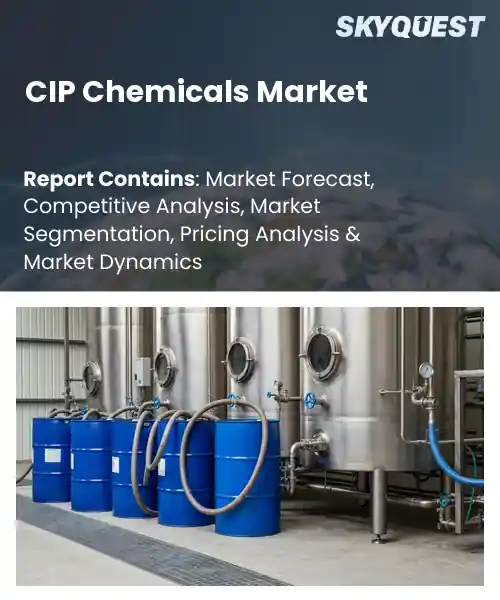
CIP Chemicals Market
Report ID: SQMIG15E4033
Report ID: SQMIG15E4033
[email protected]
USA +1 351-333-4748
Report ID:
SQMIG15E4033 |
Region:
Global |
Published Date: July, 2026
Pages:
157
|Tables:
113
|Figures:
77


Global CIP Chemicals Market size was valued at USD 559.1 Million in 2024 and is poised to grow from USD 578.67 Million in 2025 to USD 762.0 Million by 2033, growing at a CAGR of 3.5% during the forecast period (2026-2033).
High demand for hygienic food and beverage processing, stringent food safety regulations, increasing adoption of automated cleaning systems, rising focus on water and energy efficiency, and growing demand for sustainable cleaning chemicals are driving demand for CIP chemicals.
The increasing trend towards using clean-in-place (CIP) systems among food and beverages, dairy, pharmaceutical, and biotechnology companies is also fueling the growth of the market. The continuous development of biodegradable surfactants, low-phosphorous acids, and efficient cleaning solutions has helped in making the process of cleaning more effective while also cutting down the amount of water usage and energy consumed. There is an increasing tendency towards adopting environmentally sustainable practices, which is helping the manufacturers to opt for environmentally safe CIP chemicals, which can help them save money and reduce wastewater discharge. Emphasis on hygienic manufacturing practices around the world coupled with stringent food safety and quality regulations are expected to primarily drive CIP chemicals market growth.
On the contrary, high costs of advanced sustainable cleaning chemicals, volatility in raw material prices, compatibility challenges with certain industrial equipment, and stringent environmental regulations governing chemical formulations are anticipated to slow down CIP chemicals market penetration going forward.
How are AI and Automation Reshaping Production of CIP Chemicals?
AI will change the CIP chemicals industry through its contribution to increasing the efficiency of the cleaning processes, minimizing chemical wastage and reducing operational costs. AI technology helps in analyzing cleaning processes in order to ascertain the most suitable concentration of chemicals and cycles in each application. AI algorithms help in automated dosing and spraying which leads to efficient cleaning processes with reduced manual interference. Sensors monitor the cleaning process and control the operation parameters so as to achieve efficient use of water and energy.
Market snapshot - (2026-2033)
Global Market Size
USD 559.1 Million
Largest Segment
Alkaline Cleaners
Fastest Growth
Acidic Cleaners
Growth Rate
3.5% CAGR
To get more insights on this market click here to Request a Free Sample Report
Global CIP chemicals market is segmented by CIP chemicals type, application industry, formulation type, sales channel, and region. Based on CIP chemicals type, the market is segmented into acidic cleaners and alkaline cleaners. Based on application industry, the market is segmented into food & beverage and pharmaceutical. Based on formulation type, the market is segmented into liquid formulations and powder formulations. Based on sales channel, the market is segmented into direct sales and distributors. Based on region, the market is segmented into North America, Europe, Asia Pacific, Latin America, and Middle East & Africa.
The acidic cleaners segment is forecasted to lead the global CIP chemicals market revenue generation going forward. These chemicals successfully remove mineral scale and protein buildup that is prevalent in food production equipment, providing excellent sanitization results without damaging the equipment. They meet the highest hygiene standards due to their chemical composition, and producers prefer them for their consistency of results in various temperatures. The effectiveness and convenience of these chemicals make them the top choice for many producers.
Meanwhile, alkaline cleaners are witnessing the strongest growth momentum as they perform well in cleaning organic soils and biofilm formations that have become common in today’s automated assembly lines. The suitability for use in low-temperature processes and the need for environmentally friendly biodegradable products is leading to fast adoption and growth in the market.
The food & beverage industry segment is slated to account for the highest global CIP chemicals market share in the future. high levels of hygiene together with frequent cleaning cycles require effective CIP systems which would ensure that the product is safe for consumption. The emphasis in this case lies in the use of chemicals which will be able to create hygiene as soon as possible without leaving much residue behind, thus helping increase throughput and compliance with food safety guidelines.
On the other hand, the pharmaceutical sector is emerging as the key high growth subsegment as per this CIP chemicals market forecast, since there is high demand for chemical purity and low residues in CIP due to the nature of precision cleaning requirements and regulatory considerations. Developments in the elimination of endotoxins and easy to validate formulations will spur their use, providing opportunities for chemical companies.
To get detailed segments analysis, Request a Free Sample Report
Asia Pacific’s pre-eminence is based on a combination of well-established industrial clusters, a large capacity for food and beverage processing, and abundant resources in chemical engineering. Businesses operating in the area can rely on logistics systems which make possible the swift creation of cleaning solutions specific to high-throughput operations. Investments in sustainable chemistry and automation provide cost-effectiveness and compliance with strict regulatory requirements. In addition, there is a strong focus on innovation through continuous improvement as well as collaboration between producers of chemicals and their end-users.
CIP chemicals market in Japan are propelled by sophisticated food processing networks and a strong tradition of precision engineering. Local manufacturers prioritize high performance and low environmental impact, aligning product development with rigorous safety standards. Collaborative research initiatives between academia and industry accelerate the adoption of novel cleaning agents that enhance productivity while reducing water usage. Customer demand for reliable and eco‑friendly solutions sustains a vibrant market ecosystem that supports both domestic consumption and export opportunities.
CIP chemicals market in South Korea benefit from a rapidly expanding pharmaceutical and dairy sector that relies on robust sanitation protocols. The nation’s advanced chemical manufacturing base emphasizes innovative formulation and rapid response to client specifications. Government incentives for green chemistry encourage the development of biodegradable cleaning agents, reinforcing the market’s commitment to sustainability. Strong ties between equipment suppliers and chemical producers facilitate seamless integration of cleaning systems, fostering a competitive edge in meeting stringent quality and hygiene requirements.
North American markets owe their development to a growing importance of food safety, pharmaceutical regulation, and energy saving practices within processing plants. In response to consumers' demands for quality goods, CIP systems capable of achieving stable microbiological results with minimal disruption are gaining prevalence among companies. Well-developed research and development potential combined with collaboration between chemical developers and equipment suppliers ensures quick emergence of novel environmentally friendly products. Moreover, regulatory requirements, which place importance on traceability and sanitation, provide additional motivation for employing efficient cleaning routines in this region.
CIP chemicals market in the United States are characterized by extensive dairy, beverage, and biotech production that demand rigorous cleaning protocols. Industry leaders emphasize scalable solutions that integrate seamlessly with automated processing lines, reducing labor intensity and resource consumption. Investment in research on biodegradable surfactants and enzyme‑based cleaners reflects a commitment to sustainability while maintaining high efficacy. Competitive dynamics foster rapid adoption of innovative products that address evolving regulatory expectations and operational efficiency goals.
CIP chemicals market in Canada are driven by a strong focus on sustainable practices within a diverse food processing sector. Cleaning agents that combine effective performance with minimized chemical footprint have priority in companies because they fit into environmental policy and green production preferences of consumers. Cooperation between research facilities and chemical companies facilitates the development of unique products suitable for specific use cases like brewing and special meat processing. The importance of reliability and simple implementation contributes to constant market growth all over the country.
The European market for CIP chemicals is strengthened by virtue of stringent regulatory frameworks, efficient manufacturing capacities, and a focus on the circular economy. Companies make use of their proficiency in formulation science to produce cleaning products with maximum efficacy and which conform to strict health and safety requirements. The process of cross-border cooperation in the European Union ensures standardization and makes it easier for companies to enter the market and innovate. There is a focus on minimizing the use of water and chemicals in the production process, leading to the uptake of eco-efficient CIP technologies.
CIP chemicals market in Germany benefit from the country’s world‑renowned chemical industry and precision manufacturing culture. Producers focus on high‑performance agents that cater to the automotive, food, and pharmaceutical sectors, emphasizing consistency and compliance. Integration of digital monitoring tools enhances process control, reducing waste and downtime. Ongoing research into renewable raw materials supports a transition toward greener cleaning solutions, reinforcing Germany’s leadership in sustainable industrial practices.
CIP chemicals market in the United Kingdom are shaped by a diversified food and beverage sector that values reliability and regulatory alignment. Companies prioritize formulations that deliver rapid microbial control while minimizing water and energy consumption. Collaborative initiatives between universities and industry accelerate the development of novel enzymatic cleaners suited to complex processing environments. Emphasis on supply chain resilience and adaptability fuels continual investment in advanced cleaning technologies.
CIP chemicals market in France are influenced by a strong tradition of culinary excellence and a growing emphasis on sustainable production. Industry participants focus on cleaning solutions that safeguard product quality while adhering to strict environmental regulations. Partnerships with research centers foster innovation in biodegradable surfactants and low‑temperature cleaning processes. The commitment to reducing chemical footprints aligns with broader national goals, positioning France as a proactive contributor to the evolving CIP chemicals landscape.
To know more about the market opportunities by region and country, click here to
Buy The Complete Report
Increasing Adoption of Green Technologies
Regulatory Support for Process Efficiency
High Cost of Specialized Formulations
Complexity of Validation Processes
Request Free Customization of this report to help us to meet your business objectives.
The competitive landscape of the global CIP chemicals market is dominated by established giants such as Ecolab, which are intensifying rivalry through strategic acquisitions, collaborative partnerships with major food and beverage processors, and the rollout of advanced low‑environmental‑impact formulations, driving differentiation and market share gains amid rising demand for sustainable cleaning solutions.
SkyQuest’s ABIRAW (Advanced Business Intelligence, Research & Analysis Wing) is our Business Information Services team that Collects, Collates, Correlates, and Analyses the Data collected by means of Primary Exploratory Research backed by robust Secondary Desk research.
As per SkyQuest analysis, growing demand for hygienic food and beverage processing, stringent food safety regulations, and increasing adoption of automated cleaning systems are anticipated to drive the demand for CIP chemicals going forward. However, high costs of advanced sustainable cleaning chemicals, volatility in raw material prices, and compatibility challenges with certain industrial equipment are slated to slow down the adoption of CIP chemicals in the future. North America is slated to spearhead the demand for CIP chemicals owing to stringent food safety standards, widespread adoption of automated processing facilities, and the presence of leading food, beverage, and pharmaceutical manufacturers. Development of AI-powered CIP optimization platforms, biodegradable cleaning formulations, and resource-efficient automated cleaning technologies are anticipated to be key trends driving the CIP chemicals market in the future.
| Report Metric | Details |
|---|---|
| Market size value in 2024 | USD 559.1 Million |
| Market size value in 2033 | USD 762.0 Million |
| Growth Rate | 3.5% |
| Base year | 2024 |
| Forecast period | (2026-2033) |
| Forecast Unit (Value) | USD Million |
| Segments covered |
|
| Regions covered | North America (US, Canada), Europe (Germany, France, United Kingdom, Italy, Spain, Rest of Europe), Asia Pacific (China, India, Japan, Rest of Asia-Pacific), Latin America (Brazil, Rest of Latin America), Middle East & Africa (South Africa, GCC Countries, Rest of MEA) |
| Companies covered |
|
| Customization scope | Free report customization with purchase. Customization includes:-
|
To get a free trial access to our platform which is a one stop solution for all your data requirements for quicker decision making. This platform allows you to compare markets, competitors who are prominent in the market, and mega trends that are influencing the dynamics in the market. Also, get access to detailed SkyQuest exclusive matrix.
Table Of Content
Executive Summary
Market overview
Parent Market Analysis
Market overview
Market size
KEY MARKET INSIGHTS
COVID IMPACT
MARKET DYNAMICS & OUTLOOK
Market Size by Region
KEY COMPANY PROFILES
Methodology
For the CIP Chemicals Market, our research methodology involved a mixture of primary and secondary data sources. Key steps involved in the research process are listed below:
1. Information Procurement: This stage involved the procurement of Market data or related information via primary and secondary sources. The various secondary sources used included various company websites, annual reports, trade databases, and paid databases such as Hoover's, Bloomberg Business, Factiva, and Avention. Our team did 45 primary interactions Globally which included several stakeholders such as manufacturers, customers, key opinion leaders, etc. Overall, information procurement was one of the most extensive stages in our research process.
2. Information Analysis: This step involved triangulation of data through bottom-up and top-down approaches to estimate and validate the total size and future estimate of the CIP Chemicals Market.
3. Report Formulation: The final step entailed the placement of data points in appropriate Market spaces in an attempt to deduce viable conclusions.
4. Validation & Publishing: Validation is the most important step in the process. Validation & re-validation via an intricately designed process helped us finalize data points to be used for final calculations. The final Market estimates and forecasts were then aligned and sent to our panel of industry experts for validation of data. Once the validation was done the report was sent to our Quality Assurance team to ensure adherence to style guides, consistency & design.
Analyst Support
Customization Options
With the given market data, our dedicated team of analysts can offer you the following customization options are available for the CIP Chemicals Market:
Product Analysis: Product matrix, which offers a detailed comparison of the product portfolio of companies.
Regional Analysis: Further analysis of the CIP Chemicals Market for additional countries.
Competitive Analysis: Detailed analysis and profiling of additional Market players & comparative analysis of competitive products.
Go to Market Strategy: Find the high-growth channels to invest your marketing efforts and increase your customer base.
Innovation Mapping: Identify racial solutions and innovation, connected to deep ecosystems of innovators, start-ups, academics, and strategic partners.
Category Intelligence: Customized intelligence that is relevant to their supply Markets will enable them to make smarter sourcing decisions and improve their category management.
Public Company Transcript Analysis: To improve the investment performance by generating new alpha and making better-informed decisions.
Social Media Listening: To analyze the conversations and trends happening not just around your brand, but around your industry as a whole, and use those insights to make better Marketing decisions.
REQUEST FOR SAMPLE
 REQUEST FREE CUSTOMIZATION
Global Cip Chemicals Market size was valued at USD 559.1 Million in 2024 and is poised to grow from USD 578.67 Million in 2025 to USD 762.0 Million by 2033, growing at a CAGR of 3.5% during the forecast period (2026-2033).
The competitive landscape of the global CIP chemicals market is dominated by established giants such as Ecolab, which are intensifying rivalry through strategic acquisitions, collaborative partnerships with major food and beverage processors, and the rollout of advanced low‑environmental‑impact formulations, driving differentiation and market share gains amid rising demand for sustainable cleaning solutions. 'Brenntag AG', 'BASF SE', 'Dow Chemical Company', 'Eastman Chemical Company', 'INEOS Group', 'Shell Chemicals', 'DuPont de Nemours, Inc.', 'Huntsman Corporation', 'Ashland Global Holdings Inc.', 'Lubrizol Corporation', 'Arkema S.A.', 'Mitsubishi Gas Chemical Company, Inc.', 'Solvay S.A.', 'Lanxess AG', 'Croda International Plc', 'Albemarle Corporation', 'Air Products and Chemicals, Inc.', 'PPG Industries, Inc.', 'H.B. Fuller Company', 'Clariant AG'
Sustainable Formulation Shift: Sustainable formulation shift is reshaping the CIP chemicals market as manufacturers prioritize environmentally friendly ingredients to meet stricter regulatory expectations and consumer demand for greener production. Companies are reformulating cleaning agents with biodegradable surfactants, reduced volatile organic compounds, and renewable feedstocks, driving collaborations with green‑chemistry innovators. This transition encourages supply‑chain transparency, promotes circular‑economy practices, and positions early adopters as industry leaders, while also fostering long‑term cost efficiencies through waste reduction and lower disposal fees, significantly enhancing overall operational sustainability.
Why does Asia Pacific Dominate the Global CIP Chemicals Market? |@12


Want to customize this report? This report can be personalized according to your needs. Our analysts and industry experts will work directly with you to understand your requirements and provide you with customized data in a short amount of time. We offer $1000 worth of FREE customization at the time of purchase.
Feedback From Our Clients


 USA (+1) 351-333-4748

