Chronic Brain Damage Management Market
Report ID: SQMIG35A3348
Report ID: SQMIG35A3348
[email protected]
USA +1 351-333-4748
Report ID:
SQMIG35A3348 |
Region:
Global |
Published Date: March, 2026
Pages:
157
|Tables:
118
|Figures:
77


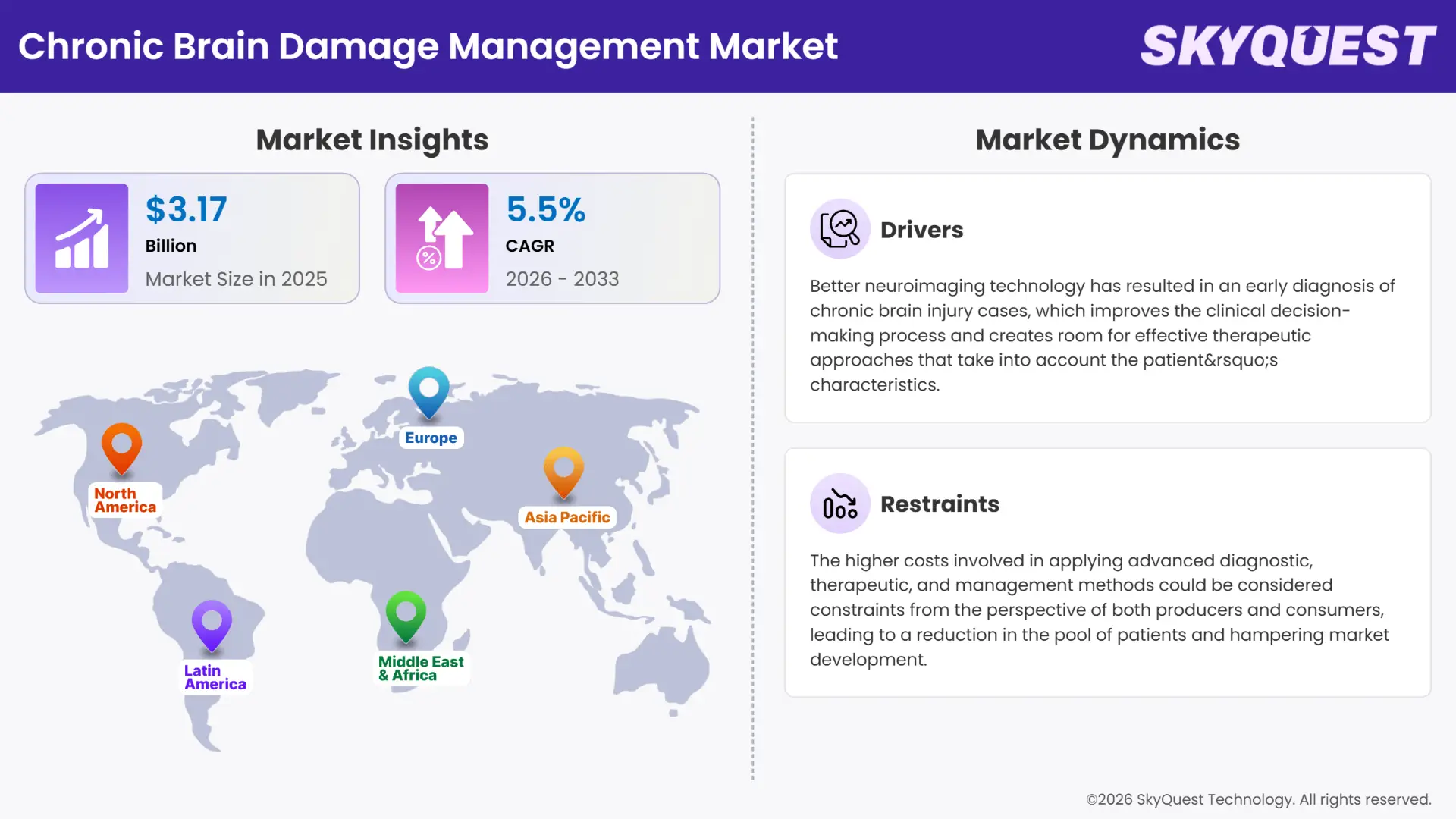
Global Chronic Brain Damage Management Market size was valued at USD 3.00 Billion in 2024 and is poised to grow from USD 3.17 Billion in 2025 to USD 4.86 Billion by 2033, growing at a CAGR of 5.5% during the forecast period (2026-2033).
Key Takeaways: Market Trends & Insights
Growing prevalence of neurological disorders, increasing incidence of traumatic brain injuries and strokes, rising geriatric population, advancements in neurorehabilitation technologies, and emphasis on long-term care are driving demand.
The greater use of digital therapeutic devices, tele-rehabilitation devices, and wearable monitoring devices further improves access and ensures continuous monitoring of patients outside of the hospital premises. Additionally, advances in technology like robot-assisted surgery, virtual reality-based therapy, and artificial intelligence-based diagnosis are adding to treatment efficacy and patient engagement. Increasing funding into reimbursements and development of integrated healthcare delivery systems is driving demand for chronic brain damage management solutions. Surge in incidence of brain injuries and degenerative diseases, after acute events are also creating new opportunities for chronic brain damage management companies. Increasing awareness regarding neurological health and long-term rehabilitation among patients and healthcare providers around the world coupled with a shift toward improving quality of life is expected to primarily drive chronic brain damage management market growth.
On the contrary, high costs of advanced treatment solutions, limited access to specialized care in developing regions, regulatory and reimbursement challenges, and variability in patient response and recovery outcomes are anticipated to slow down chronic brain damage management market penetration through 2033.
How is AI Improving Patient Outcomes through Chronic Brain Damage Management?
AI is contributing greatly to managing chronic brain injuries through improved diagnosis, monitoring, and personalization in rehabilitation. Advanced AI diagnostics, which provide greater clarity regarding the severity of brain damage, and the recovery process of patients away from hospitals are becoming increasingly common. Another rising trend involves using hospital-based decision aids and home-based digital treatments.
In February 2026, Brainomix launched an updated Brainomix 360 Stroke platform with a net water uptake feature. This helps improve injury assessment and supports more targeted rehabilitation. Such innovations enable wider adoption of AI-based solutions in chronic brain damage management.
To get more insights on this market click here to Request a Free Sample Report
Global chronic brain damage management market is segmented by management modality, etiology/cause focus, symptom target, end-user, and region. Based on management modality, the market is segmented into pharmacological management, neuro-rehabilitation, Cognitive Behavioral Therapy (CBT), and neuromodulation/brain stimulation. Based on etiology/cause focus, the market is segmented into Traumatic Brain Injury (TBI) long-term care, post-stroke chronic management, and Hypoxic-Ischemic Encephalopathy. Based on symptom target, the market is segmented into motor function & spasticity, cognitive & memory deficits, and emotional & behavioral regulation. Based on end-user, the market is segmented into specialized rehabilitation centers, long-term care facilities/nursing homes, and home healthcare services. Based on region, the market is segmented into North America, Europe, Asia Pacific, Latin America, and Middle East & Africa.
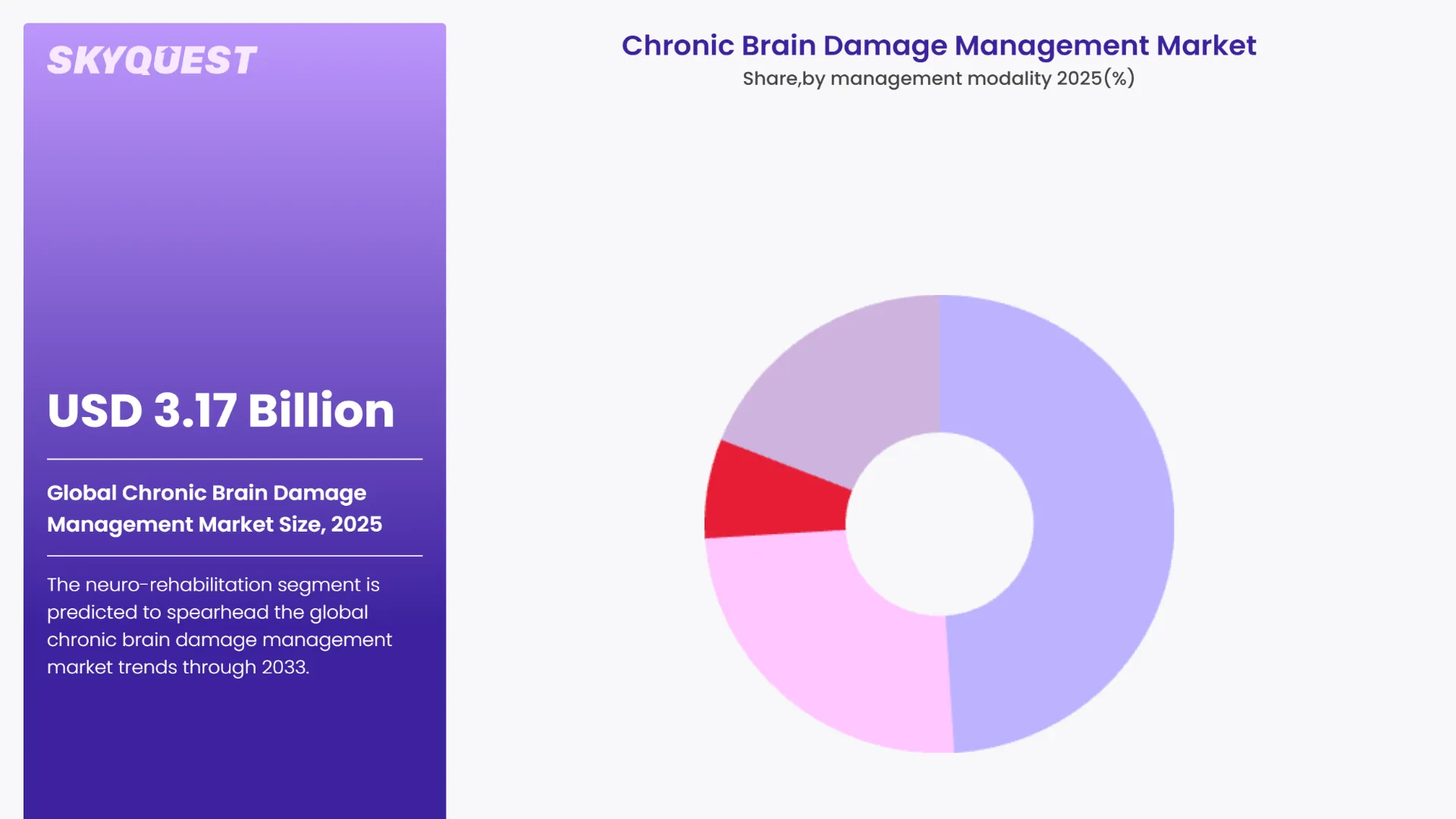
The neuro-rehabilitation segment is predicted to spearhead the global chronic brain damage management market trends through 2033. The approach targets functional recovery across motor, cognitive, and communication domains through coordinated multidisciplinary care, which helps cement its dominance. Incorporation of customized treatments, result-oriented processes, and long-term care strategies ensures constant referrals by practitioners and reimbursement organizations, ensuring steady demand that motivates the development of specialized centers and training for the workforce.
However, neuromodulation/brain stimulation is rapidly expanding as an opportune segment as per this chronic brain damage management industry analysis. Rising investments in device innovation and non-invasive techniques are helping this segment generate new opportunities. With the help of clinical momentum and investor interest, there is an ongoing trend towards adopting new devices which have led to the development of many business opportunities for healthcare providers.
The specialized rehabilitation centers segment is forecasted to account for the highest global chronic brain damage management market share going forward. The access to state-of-the-art neurorehabilitation technology, care team and rehabilitation program ensures this group maintains an upper hand on other groups. The increasing support for reimbursement combined with incorporation of advanced techniques like robots and artificial intelligence therapies further consolidates their dominance.
Meanwhile, home healthcare services is emerging as a rapidly expanding segment in the future. Advancements in tele-rehabilitation, wearable monitoring devices, and digital therapeutics are enabling continuous care outside hospital settings. Patients and caregivers prefer home-based recovery due to comfort, reduced hospital visits, and improved long-term adherence.
To get detailed segments analysis, Request a Free Sample Report
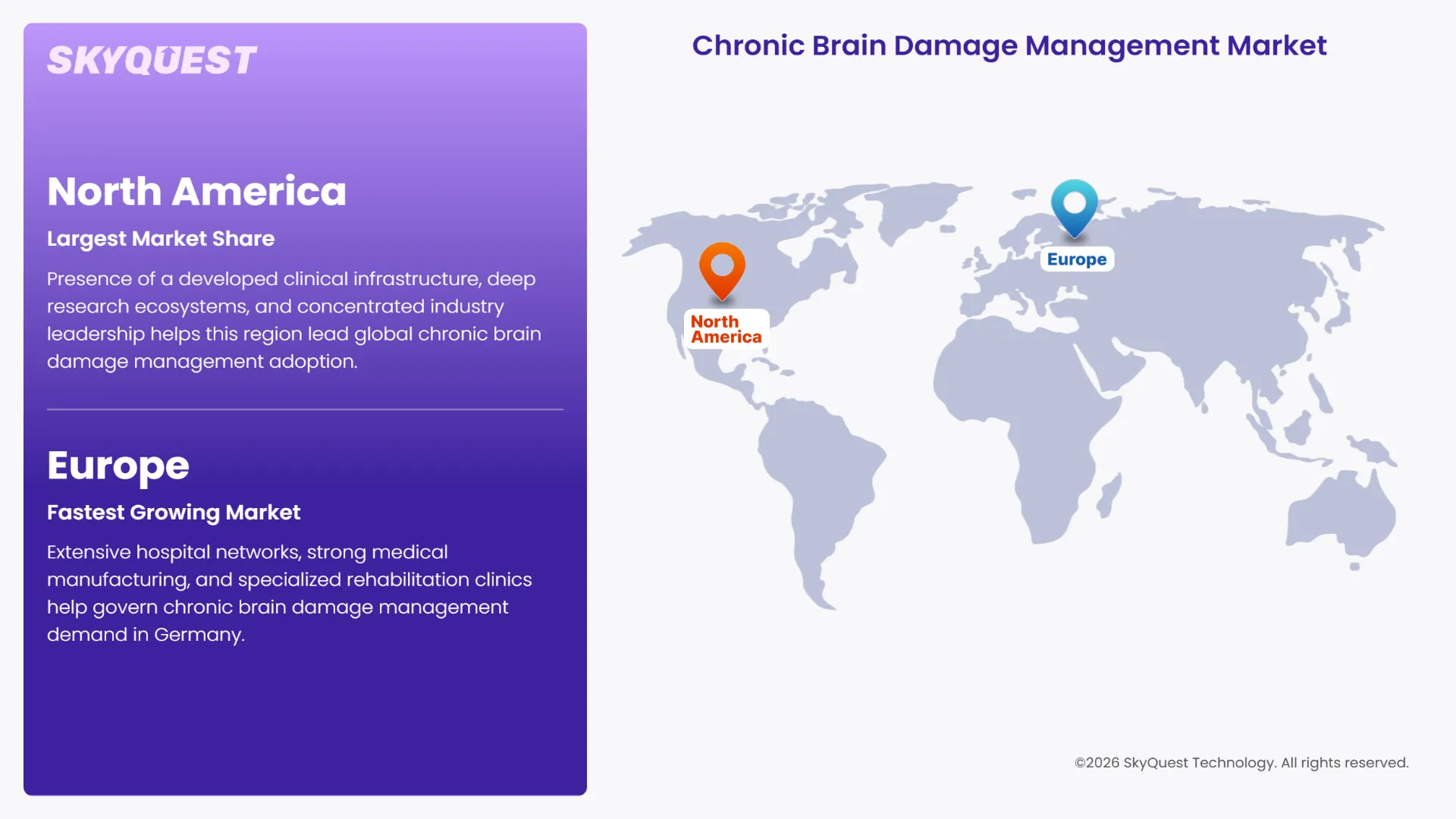
Presence of a developed clinical infrastructure, deep research ecosystems, and concentrated industry leadership helps this region lead global chronic brain damage management adoption. Strong regulatory and reimbursement support driving innovation and commercialization of new therapies and digital tools. Rising collaboration between research, clinical and industry partners working together to translate research findings into practice in the region. Academic institutions are partnering with clinic providers and manufacturers to move research from bench to bedside faster. The combination of trained providers, integrated care centers, and infrastructure investment in tele-health and remote patient monitoring enhances the ability of North America to manage chronic, long-term rehabilitation, and provide continuous care for very complex patients in the region. The level of distribution compared to the size and training of the health care workforce, along with active public/private partnerships, enhances the ability of the chronic brain injury management industry to expand considerably while providing access to patients in rural areas and urban centers.
Robust clinical expertise, extensive rehabilitation networks, and leadership in medical device R&D drives steady chronic brain damage management demand in the United States. Continued investments in post-acute care services and telemedicine help in effective integration of care and improved access for patients. Collaboration between academic institutions, private practices, and industry leads to faster acceptance of new treatment methods. Financial support systems and existing infrastructure make scaling up easier.
Coordinated provincial care models, integrated rehabilitation services, and emphasis on equitable access supports high chronic brain damage management demand in Canada. Collaborations among hospitals, research facilities, and technologic companies facilitate practical application of advanced healthcare delivery models. Effective public financing mechanisms and research collaborations enable clinical applications and knowledge translation. The health sector’s emphasis on multidisciplinary approaches and community integration stimulates the need for advanced treatment interventions.
Coordinated health policy initiatives, strong clinical capabilities, and a dynamic innovation landscape boost chronic brain damage management demand in Europe. Cross-border clinical collaboration and multinational research consortia make possible the rapid generation of evidence and share knowledge regarding chronic brain damage management. A national focus on enhancing long-term outcomes and community-based reintegration also stimulates service development within Europe. The rapid expansion of the chronic brain damage management market will continue to benefit from an advanced medical manufacturing base that is increasing in terms of private sector participation, and a favorable public-private partnership environment that will support scalable deployment of new care models across national health systems. Investment in workforce development, data-driven care models, and interoperability projects will support the adoption of new care approaches into routine clinical practice at scale and across many disparate regulatory environments.
Extensive hospital networks, strong medical manufacturing, and specialized rehabilitation clinics help govern chronic brain damage management demand in Germany. Integrated pathways and rehabilitation programs are beneficial because of their continuity. Cooperation between public-private organizations in pilot projects facilitates scaling and strengthens the German leadership in therapy deployment and innovation.
Proactive health policy reforms, strong adoption of digital therapeutics, and clinical research networks boost chronic brain damage management adoption in the United Kingdom. Patient centered care and community-based therapy and innovations in service delivery models increase access and improve continuity. Innovations by the private industry and conducive regulatory environment speed up adoption of therapies and technology.
Enhanced health initiatives and expanding rehabilitation networks are slated to create new business scope for chronic brain damage management companies in France. Greater consideration of multidisciplinary approaches and implementation research is facilitating the realization of innovation in rehabilitation programs. Emphasis on patient-centered rehabilitation and community integration is influencing service planning and the uptake of therapy. Improved connections among hospitals, regional facilities, and technology vendors have facilitated pilot testing of new models of care delivery.
Targeted investments in advanced healthcare technologies, growing clinical capabilities, and active industry innovation makes this region an attractive market for chronic brain damage management companies. Along with the establishment of strong manufacturing ecosystems and access to skilled engineering talent, rapid prototyping and production of custom devices is taking place locally. Coordinated government initiatives and a growing network of partnerships among hospitals, universities, and private manufacturers promote the clinical validation and roll-out of these devices into the marketplace. The emphasis on cost-effective and scalable solutions, as well as training of the workforce, supports wider access to these technologies, both in urban and rural settings. In addition to becoming more competitive within the global marketplace, through their partnerships with large, multinational companies, the Asia Pacific countries will develop the knowledge necessary to properly implement and utilise these technologies throughout the region. Furthermore, other regulatory and monetary incentives that are changing how brain damage management services are delivered will help to facilitate adoption and integration throughout the region.
Advanced technological capabilities, clinical research, and leadership in rehabilitation robotics boost chronic brain damage management demand in Japan. Emphasis should be placed on the application of digital technologies and tele-rehabilitation for the treatment process. Collaboration between hospitals and electronic device makers leads to innovations and improvements in products. Health care initiatives and dedicated rehabilitation facilities play key roles in the implementation of therapies and treatment plans.
Digital health platforms, rehabilitation robotics, and rehabilitation services are governing chronic brain damage management adoption in South Korea. Integration and implementation in hospitals and clinics assist in promoting products, while collaborations with international companies speed up the process. Government assistance in health-care advancement and education programs enhances workforce capabilities.
To know more about the market opportunities by region and country, click here to
Buy The Complete Report
Advancements In Neuroimaging Technologies
Expansion Of Personalized Therapeutics
High Treatment And Device Costs
Regulatory And Reimbursement Complexity
Request Free Customization of this report to help us to meet your business objectives.
Competitive landscape in chronic brain damage management is consolidating as compete to deliver end to end solutions. Competition is driven by strategic deals and clinical partnerships that create integrated care pathways, for example the Kandu Neurolutions merger and AR therapy collaborations led by Strolll, while rapid BCI and AR innovation reshapes differentiation and provider adoption.
SkyQuest’s ABIRAW (Advanced Business Intelligence, Research & Analysis Wing) is our Business Information Services team that Collects, Collates, Correlates, and Analyses the Data collected by means of Primary Exploratory Research backed by robust Secondary Desk research.
As per SkyQuest analysis, surge in prevalence of neurological disorders and increasing incidence of traumatic brain injuries and strokes are anticipated to drive the demand for chronic brain damage management solutions going forward. However, high costs of advanced therapies, limited access to specialized care, and variability in treatment outcomes are slated to slow down the adoption of chronic brain damage management solutions in the future. North America is slated to spearhead the demand for chronic brain damage management owing to advanced healthcare infrastructure, strong adoption of neurorehabilitation technologies, and presence of leading healthcare providers. Advancements in AI-driven imaging, development of digital therapeutics and remote rehabilitation platforms, and integration of predictive analytics for personalized care are anticipated to be key trends driving the chronic brain damage management sector going forward.
| Report Metric | Details |
|---|---|
| Market size value in 2024 | USD 3.00 Billion |
| Market size value in 2033 | USD 4.86 Billion |
| Growth Rate | 5.5% |
| Base year | 2024 |
| Forecast period | 2026-2033 |
| Forecast Unit (Value) | USD Billion |
| Segments covered |
|
| Regions covered | North America (US, Canada), Europe (Germany, France, United Kingdom, Italy, Spain, Rest of Europe), Asia Pacific (China, India, Japan, Rest of Asia-Pacific), Latin America (Brazil, Rest of Latin America), Middle East & Africa (South Africa, GCC Countries, Rest of MEA) |
| Companies covered |
|
| Customization scope | Free report customization with purchase. Customization includes:-
|
To get a free trial access to our platform which is a one stop solution for all your data requirements for quicker decision making. This platform allows you to compare markets, competitors who are prominent in the market, and mega trends that are influencing the dynamics in the market. Also, get access to detailed SkyQuest exclusive matrix.
Table Of Content
Executive Summary
Market overview
Parent Market Analysis
Market overview
Market size
KEY MARKET INSIGHTS
COVID IMPACT
MARKET DYNAMICS & OUTLOOK
Market Size by Region
KEY COMPANY PROFILES
Methodology
For the Chronic Brain Damage Management Market, our research methodology involved a mixture of primary and secondary data sources. Key steps involved in the research process are listed below:
1. Information Procurement: This stage involved the procurement of Market data or related information via primary and secondary sources. The various secondary sources used included various company websites, annual reports, trade databases, and paid databases such as Hoover's, Bloomberg Business, Factiva, and Avention. Our team did 45 primary interactions Globally which included several stakeholders such as manufacturers, customers, key opinion leaders, etc. Overall, information procurement was one of the most extensive stages in our research process.
2. Information Analysis: This step involved triangulation of data through bottom-up and top-down approaches to estimate and validate the total size and future estimate of the Chronic Brain Damage Management Market.
3. Report Formulation: The final step entailed the placement of data points in appropriate Market spaces in an attempt to deduce viable conclusions.
4. Validation & Publishing: Validation is the most important step in the process. Validation & re-validation via an intricately designed process helped us finalize data points to be used for final calculations. The final Market estimates and forecasts were then aligned and sent to our panel of industry experts for validation of data. Once the validation was done the report was sent to our Quality Assurance team to ensure adherence to style guides, consistency & design.
Analyst Support
Customization Options
With the given market data, our dedicated team of analysts can offer you the following customization options are available for the Chronic Brain Damage Management Market:
Product Analysis: Product matrix, which offers a detailed comparison of the product portfolio of companies.
Regional Analysis: Further analysis of the Chronic Brain Damage Management Market for additional countries.
Competitive Analysis: Detailed analysis and profiling of additional Market players & comparative analysis of competitive products.
Go to Market Strategy: Find the high-growth channels to invest your marketing efforts and increase your customer base.
Innovation Mapping: Identify racial solutions and innovation, connected to deep ecosystems of innovators, start-ups, academics, and strategic partners.
Category Intelligence: Customized intelligence that is relevant to their supply Markets will enable them to make smarter sourcing decisions and improve their category management.
Public Company Transcript Analysis: To improve the investment performance by generating new alpha and making better-informed decisions.
Social Media Listening: To analyze the conversations and trends happening not just around your brand, but around your industry as a whole, and use those insights to make better Marketing decisions.
REQUEST FOR SAMPLE
 REQUEST FREE CUSTOMIZATION
Global Chronic Brain Damage Management Market size was valued at USD 3.0 Billion in 2024 and is poised to grow from USD 3.17 Billion in 2025 to USD 4.86 Billion by 2033, growing at a CAGR of 5.5% during the forecast period (2026-2033).
Competitive landscape in chronic brain damage management is consolidating as device makers, digital therapeutics and care platforms compete to deliver end to end solutions. Competition is driven by strategic deals and clinical partnerships that create integrated care pathways, for example the Kandu Neurolutions merger and AR therapy collaborations led by Strolll, while rapid BCI and AR innovation reshapes differentiation and provider adoption. 'Philips Healthcare', 'GE HealthCare', 'Siemens Healthineers', 'Fujifilm Holdings', 'Raumedic AG', 'Natus Medical', 'Medtronic', 'Stryker Corp', 'Advanced Brain Monitoring', 'Emotiv Systems', 'NeuroSky Inc.', 'Blackrock Neurotech', 'G.TEC Medical', 'InteraXon', 'Compumedics Ltd', 'OpenBCI', 'MindMaze SA', 'BrainCo Inc.', 'Kernel', 'Neurable'
Improved neuroimaging capabilities have enabled earlier and more accurate identification of chronic brain injury, strengthening clinical decision making and enabling targeted therapeutic strategies that better address patient heterogeneity. Enhanced visualization and monitoring of brain structure and function facilitate personalized care pathways and support adoption of advanced interventions and rehabilitation techniques. As clinicians and care teams rely on clearer diagnostic insights, demand for complementary management tools and services grows, stimulating investment and collaboration across technology developers, healthcare providers, and therapeutic innovators, thereby expanding market breadth and depth.
Telehealth Integration Momentum: Remote monitoring, virtual rehabilitation, and coordinated telecare increasingly enable continuous management of chronic brain injury in outpatient and home settings. Providers are adopting hybrid care models that emphasize longitudinal engagement, personalized therapy plans, and caregiver support. Device makers and digital health vendors are partnering to integrate sensors, rehabilitation software, and secure communication into end-to-end solutions. This trend shifts care from episodic interventions toward proactive, patient-centered pathways, expanding access and fostering new operational and commercial models within health systems and networks.
North America Dominate the Global Chronic Brain Damage Management Market.
Pharmacological Management currently dominates the market due to its widespread use in managing symptoms, improving patient outcomes, and supporting long-term treatment plans for chronic brain damage patients.
AI is improving diagnosis, monitoring, and personalized rehabilitation by analyzing imaging data and patient health information. AI-powered tools help healthcare providers deliver more targeted and effective treatment strategies.
High costs of advanced therapies, limited access to specialized neurological care in developing regions, reimbursement issues, and differences in patient recovery outcomes are major challenges facing the market.


Want to customize this report? This report can be personalized according to your needs. Our analysts and industry experts will work directly with you to understand your requirements and provide you with customized data in a short amount of time. We offer $1000 worth of FREE customization at the time of purchase.
Feedback From Our Clients


 USA (+1) 351-333-4748

