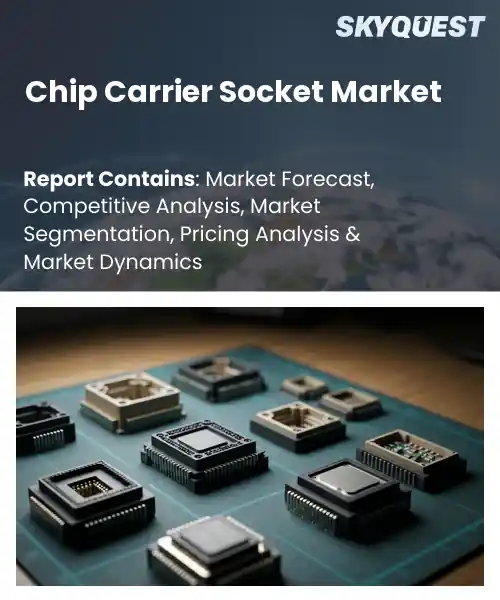
Chip Carrier Socket Market
Report ID: SQMIG45O2208
Report ID: SQMIG45O2208
[email protected]
USA +1 351-333-4748
Report ID:
SQMIG45O2208 |
Region:
Global |
Published Date: August, 2026
Pages:
157
|Tables:
145
|Figures:
78


Global Chip Carrier Socket Market size was valued at USD 962.4 Million in 2024 and is poised to grow from USD 1037.47 Million in 2025 to USD 1892.02 Million by 2033, growing at a CAGR of 7.8% during the forecast period (2026-2033).
The chip carrier socket market supplies the interconnect solutions that link integrated circuits to printed circuit boards, and it helps make sure the electrical performance stays dependable inside different electronic assemblies. Its weight comes from how fast things keep getting smaller in consumer devices, automotive electronics, and those data center builds, where a failure free connection is basically non-negotiable.
One of the biggest factor for the chip carrier socket market growth is the push in driver assistance and autonomous vehicle systems because those setups need dense interconnects for sensor data. When radar, lidar, and cameras added, chip carrier sockets have to deal with higher pin counts plus temperatures that can sit above 150 °C. Because of that, suppliers lean toward ceramic and metal substrates. That also opens room for companies that can deliver stable products, like that recent collaboration where a socket maker teamed up with a chipset company to develop a 0.2 mm pitch socket for power train controllers. At the same time, technology aligns with 5G network needs, where sockets can help reduce latency, and they create new revenue angles for the wider global automotive telecom markets.
AI-driven automation is changing the chip carrier socket market outlook by making the whole flow a bit smoother, especially the complicated parts like molding, plating, and testing. Machine learning models can guess the best process settings earlier, so there’s less trial and error, and scrap gets lowered. There are also vision systems doing real time inspection of each socket, catching odd defects that human eyes might overlook. Plus, integrated robotics place components with steady force, which improves alignment and tends to boost throughput. Overall, these pieces cut cycle times down, and it also frees skilled operators for higher-value work. That makes production lines more flexible when demand swings, or when new form factors show up.
Market snapshot - (2026-2033)
Global Market Size
USD 962.4 Million
Largest Segment
LGA Sockets
Fastest Growth
QFN/QFP Sockets
Growth Rate
7.8% CAGR
To get more insights on this market click here to Request a Free Sample Report
The global chip carrier socket market is segmented by socket type, mounting type, application, end user, contact type and region. Based on socket type, the market is segmented into PGA Sockets, BGA Sockets, LGA Sockets and QFN/QFP Sockets. Based on mounting type, the market is segmented into Surface Mount and Through-Hole. Based on application, the market is segmented into Semiconductor Testing, IC Programming, Burn-In Testing and Prototyping. Based on end user, the market is segmented into Semiconductor Manufacturers, Electronics OEMs and Testing Laboratories. Based on contact type, the market is segmented into Spring Pin, Elastomeric and Leaf Contact. Based on region, the market is segmented into North America, Europe, Asia Pacific, Latin America and Middle East & Africa.
As per the chip carrier socket market analysis, the BGA sockets segment keeps leading because they somehow manage to offer the top connection density and electrical behavior that modern high performance integrated circuits need. Their ball array approach , with that enhanced design, supports better signal integrity and also more sensible thermal handling which matches the rising complexity in processors and memory devices. So naturally, designers go for BGA solutions more often, and that pushes steady demand, basically reinforcing their position across the chip carrier socket market. Plus they can handle fine pitch interconnects while still staying mechanically solid, which makes them a favorite not only for OEMs but also for testing facilities
However, QFN QFP sockets are getting the strongest growth energy. They fit the wave of compact high frequency devices well. The low profile structure and strong thermal behavior makes them a good match for more and more miniaturized consumer electronics, so manufacturers pick them for new product lines. That momentum is opening wider opportunities and it also diversifies the whole socket lineup
According to the chip carrier socket market forecast, Spring pin contacts lead the way because they maintain stable mechanical pressure and they also keep electrical continuity consistent through repeated insertions. The springy metal elements, they just compensate for tolerance shifts , and that helps keep the contact stable even when there is thermal cycling and vibration in real life. This reliability matches the harsh expectations in semiconductor testing and burn in workflows, so manufacturers tend to choose them when they want long lasting output and less maintenance for critical deployments
Meanwhile, elastomeric contacts are becoming the fast-growing side, largely because they can conform to irregular pad surfaces and they also help reduce transmitted mechanical stress. Their polymer-based makeup gives strong protection against corrosion and it speeds up prototyping, which is why designers are taking notice for new flexible and wearable electronics concepts. That uptake extends market reach and encourages new experimentation across multiple socket solution types
To get detailed segments analysis, Request a Free Sample Report
As per the chip carrier socket market regional forecast, Asia Pacific leads the market through a blend of advanced manufacturing ecosystems, real deep semiconductor design know how, and solid supplier channels. The area also gets a boost from heavy research partnerships between industry and academia, which helps things move fast, especially for high frequency and high density packaging ideas. From there, strong pull coming from consumer electronics, automotive electronics, and newer technologies keeps pushing companies to constantly fine tune socket performance + reliability. On top of that, government programs that encourage tech take up and infrastructure investment keep the whole competitive edge sturdy. And because the region is close to big component makers and foundries, lead times shrink and cost efficiency improves, so Asia Pacific ends up acting like a main hub for both chip carrier socket design and production of next gen parts.
Japan Chip Carrier Socket Market
The Japanese Chip Carrier Socket sector is powered by precision engineering, plus a long running culture of ultra reliable component production. Major players blend advanced material science with strict quality checks, so the resulting sockets match tough performance needs for automotive and industrial uses. There’s also a lot of tight work between electronics companies and research institutes which speeds up new development, especially the next wave high pin count solutions. That whole pattern helps keep Japan’s name tied to high value, technically complex offerings.
South Korea Chip Carrier Socket Market
The South Korean Chip Carrier Socket industry is fueled by aggressive investment in advanced packaging, and by a lively semiconductor fab ecosystem. The country is leaning hard into high speed communications and mobile device innovation, which in turn creates demand for compact, high performance socket designs. When major chip makers line up well with socket suppliers, design standards get iterated quickly. Add government backstops for high tech manufacturing, and offers a sustained flow of skilled talent plus state of the art facilities.
North America is seeing quick chip carrier socket market penetration mostly because demand is strong for high performance computing, data center buildouts, and aerospace contexts where reliable dense interconnects are non negotiable. The region puts a big spotlight on innovation, backed by extensive R&D spend and a collaborative vibe among prominent semiconductor companies. That drives the creation of more advanced socket technologies over time. Supply chain resilience and the shift toward advanced manufacturing approaches also support product dependability. On top of everything, customers often want custom, application specific setups, and the presence of major technology clusters keeps pushing improvements + diversification of the chip carrier socket catalog across the United States and Canada.
United States Chip Carrier Socket Market
The Chip Carrier Socket Market in the United States rides on a deep design talent pool and a mindset that favors rapid prototyping. Top manufacturers combine advanced materials with newer testing methods, so they can satisfy the demanding requirements tied to high performance computing and defense related sectors. Since there are close ties between semiconductor designers and socket suppliers, companies can adapt quickly to emerging interface requirements. This makes the US market feel active and gives room for differentiation between products.
Canada Chip Carrier Socket Market
The Chip Carrier Socket Market in Canada leans into its research base, and it also targets narrower use cases like medical devices and renewable energy systems. Joint efforts involving universities, and industry participants help develop extremely dependable sockets for tough operating conditions. With a clear emphasis on quality assurance and alignment with international standards, Canada keeps positioning itself as a trustworthy source for specialized interconnect solutions.
Europe is basically shoring up its stance a bit more now, pushing sustainability alongside standardization and then that high‑precision engineering angle, across a varied industrial set up. The whole thing is powered by eco friendly manufacturing practices, so recyclables get used more often and production leans toward energy efficient routines, especially when it comes to chip carrier sockets. Then there are those collaborative standards bodies which keep interoperability and safety on the table, so European makers can enter markets more smoothly, less friction. Also, there is more investment in advanced automation plus digital twins, which boosts design fidelity, and cuts down time to market, quickly. There is strong connections between automotive, aerospace and telecom too, and that keeps demand steady for dependable high performance socket solutions, so Europe maintains a real competitive edge worldwide.
Germany Chip Carrier Socket Market
The Chip Carrier Socket Market in Germany is usually seen as meticulous engineering with an insistence on top-tier, precision‑made components, mainly for automotive needs and industrial automation. The makers often weave in strict testing protocols as well as modern metallurgical techniques, to build sockets that satisfy demanding performance targets. There is also close cooperation with major automotive OEMs, and it supports continuous upgrades, plus it aligns the work with the growing electrification trend in vehicles.
United Kingdom Chip Carrier Socket Market
The Chip Carrier Socket Market in the United Kingdom benefits from research collaboration, and it also rides on a lively ecosystem of specialist suppliers. The industry supports high frequency communication and defense use cases through inventive material choices and compact form factor concepts. Partnerships between universities and companies help speed up next generation interconnect developments, more like faster prototyping, and faster adoption.
France Chip Carrier Socket Market
Chip Carrier Socket Market in France leans into highly reliable solutions, especially for aerospace and medical device sectors. French manufacturers tend to prioritize strict quality certifications, and they use advanced surface treatment processes to improve long term durability. Collaborative projects with European research institutes also help bring more sophisticated socket architectures forward, designs meant for critical performance constraints.
To know more about the market opportunities by region and country, click here to
Buy The Complete Report
Advancements In Miniaturization Drive Demand
Integration Of High‑Frequency Applications Expands Scope
Supply Constraints Of Rare Materials
Stringent Regulatory Standards Increase Costs
Request Free Customization of this report to help us to meet your business objectives.
The global chip carrier socket manufacturers are heating up the competition, mostly by doing strategic mergers, teaming up on joint development deals, and then rolling out tech fast, especially for high frequency uses and those miniaturized systems where everything is supposed to be tiny but still work. Lately, the M&A scene looks busier too, like when a big substrate provider picked up a niche socket designer , and that move basically widens the product range. At the same time, older OEMs partnering with material innovators helps advanced substrates get adopted sooner, while aggressive patent filing signals a clear pivot toward more distinct socket designs that are built for performance, not just “good enough.”
Top Player’s Company Profile
Recent Developments in the Chip Carrier Socket Market
SkyQuest’s ABIRAW (Advanced Business Intelligence, Research & Analysis Wing) is our Business Information Services team that Collects, Collates, Correlates, and Analyses the Data collected by means of Primary Exploratory Research backed by robust Secondary Desk research.
As per SkyQuest analysis, the global chip carrier socket market is being driven primarily by rapid miniaturization of electronic devices, which is pushing demand for high‑density sockets like BGA that basically dominates the segment map. A second factor is the wider integration of high‑frequency and autonomous‑vehicle applications, these need strong, high‑pin‑count interconnects. There is also a restraint coming from the limited availability of rare‑earth and specialty metals used for advanced substrates, causing lead times to get squeezed. Asia‑Pacific remains the major region due to its established manufacturing ecosystem and semiconductor design know‑how. Overall, the BGA socket segment leads the market while AI‑driven design acceleration, and sustainable material adoption keep shaping growth trajectories.
| Report Metric | Details |
|---|---|
| Market size value in 2024 | USD 962.4 Million |
| Market size value in 2033 | USD 1892.02 Million |
| Growth Rate | 7.8% |
| Base year | 2024 |
| Forecast period | (2026-2033) |
| Forecast Unit (Value) | USD Million |
| Segments covered |
|
| Regions covered | North America (US, Canada), Europe (Germany, France, United Kingdom, Italy, Spain, Rest of Europe), Asia Pacific (China, India, Japan, Rest of Asia-Pacific), Latin America (Brazil, Rest of Latin America), Middle East & Africa (South Africa, GCC Countries, Rest of MEA) |
| Companies covered |
|
| Customization scope | Free report customization with purchase. Customization includes:-
|
To get a free trial access to our platform which is a one stop solution for all your data requirements for quicker decision making. This platform allows you to compare markets, competitors who are prominent in the market, and mega trends that are influencing the dynamics in the market. Also, get access to detailed SkyQuest exclusive matrix.
Table Of Content
Executive Summary
Market overview
Parent Market Analysis
Market overview
Market size
KEY MARKET INSIGHTS
COVID IMPACT
MARKET DYNAMICS & OUTLOOK
Market Size by Region
KEY COMPANY PROFILES
Methodology
For the Chip Carrier Socket Market, our research methodology involved a mixture of primary and secondary data sources. Key steps involved in the research process are listed below:
1. Information Procurement: This stage involved the procurement of Market data or related information via primary and secondary sources. The various secondary sources used included various company websites, annual reports, trade databases, and paid databases such as Hoover's, Bloomberg Business, Factiva, and Avention. Our team did 45 primary interactions Globally which included several stakeholders such as manufacturers, customers, key opinion leaders, etc. Overall, information procurement was one of the most extensive stages in our research process.
2. Information Analysis: This step involved triangulation of data through bottom-up and top-down approaches to estimate and validate the total size and future estimate of the Chip Carrier Socket Market.
3. Report Formulation: The final step entailed the placement of data points in appropriate Market spaces in an attempt to deduce viable conclusions.
4. Validation & Publishing: Validation is the most important step in the process. Validation & re-validation via an intricately designed process helped us finalize data points to be used for final calculations. The final Market estimates and forecasts were then aligned and sent to our panel of industry experts for validation of data. Once the validation was done the report was sent to our Quality Assurance team to ensure adherence to style guides, consistency & design.
Analyst Support
Customization Options
With the given market data, our dedicated team of analysts can offer you the following customization options are available for the Chip Carrier Socket Market:
Product Analysis: Product matrix, which offers a detailed comparison of the product portfolio of companies.
Regional Analysis: Further analysis of the Chip Carrier Socket Market for additional countries.
Competitive Analysis: Detailed analysis and profiling of additional Market players & comparative analysis of competitive products.
Go to Market Strategy: Find the high-growth channels to invest your marketing efforts and increase your customer base.
Innovation Mapping: Identify racial solutions and innovation, connected to deep ecosystems of innovators, start-ups, academics, and strategic partners.
Category Intelligence: Customized intelligence that is relevant to their supply Markets will enable them to make smarter sourcing decisions and improve their category management.
Public Company Transcript Analysis: To improve the investment performance by generating new alpha and making better-informed decisions.
Social Media Listening: To analyze the conversations and trends happening not just around your brand, but around your industry as a whole, and use those insights to make better Marketing decisions.
REQUEST FOR SAMPLE
 REQUEST FREE CUSTOMIZATION
Global Chip Carrier Socket Market size was valued at USD 962.4 Million in 2024 and is poised to grow from USD 1037.47 Million in 2025 to USD 1892.02 Million by 2033, growing at a CAGR of 7.8% during the forecast period (2026-2033).
Global chip carrier socket manufacturers are intensifying competition through strategic mergers, joint development agreements, and rapid technology rollouts, especially in high‑frequency and miniaturized applications. Recent M&A activity, such as a leading substrate provider acquiring a niche socket designer, accelerates portfolio breadth. Partnerships between established OEMs and material innovators enable faster adoption of advanced substrates, while aggressive patent filings underscore a shift toward differentiated, performance‑driven socket architectures. 'Yamaichi Electronics Co., Ltd.', 'Plastronics Socket Partners Limited', 'Ironwood Electronics, Inc.', 'Enplas Corporation', '3M Company', 'TE Connectivity plc', 'Amphenol Corporation', 'Molex, LLC', 'Smiths Interconnect', 'Aries Electronics, Inc.', 'Mill-Max Mfg. Corp.', 'Sensata Technologies', 'Cohu, Inc.', 'Johnstech International Corporation', 'WinWay Technology Co., Ltd.', 'Loranger International Corporation', 'ISC Engineering LLC', 'Advanced Interconnections Corp.', 'Yokowo Co., Ltd.', 'Socket Mobile, Inc.'
The industry is experiencing rapid advancements in component miniaturization, enabling designers to integrate greater functionality within smaller footprints. This trend encourages manufacturers to adopt chip carrier sockets that support higher pin counts and reduced lead lengths, thereby meeting the evolving requirements of portable devices and wearables. As product form factors shrink, the demand for reliable, compact interconnect solutions rises, fostering increased investment in research and development to enhance socket performance and reliability, which collectively drives market growth. These innovations also attract new entrants seeking to capitalize on the emerging opportunities.
Ai‑Driven Design Acceleration: Chip carrier socket manufacturers are integrating artificial intelligence into product development cycles, enabling rapid topology optimization and predictive reliability testing. By leveraging machine‑learning models trained on historical failure data, designers can anticipate performance issues before physical prototypes are built, shortening time‑to‑market and reducing material waste. This shift toward AI‑driven design fosters more customizable solutions for high‑performance computing and automotive electronics, meeting demand for densely packed, low‑latency interconnects while enhancing overall cost efficiency across the supply chain and improving operational resilience.
Why does Asia Pacific Dominate the Global Chip Carrier Socket Market? |@12


Want to customize this report? This report can be personalized according to your needs. Our analysts and industry experts will work directly with you to understand your requirements and provide you with customized data in a short amount of time. We offer $1000 worth of FREE customization at the time of purchase.
Feedback From Our Clients


 USA (+1) 351-333-4748

