Chin Augmentation injectable Fillers Market
Report ID: SQMIG35J2246
Report ID: SQMIG35J2246
[email protected]
USA +1 351-333-4748
Report ID:
SQMIG35J2246 |
Region:
Global |
Published Date: March, 2026
Pages:
157
|Tables:
116
|Figures:
77


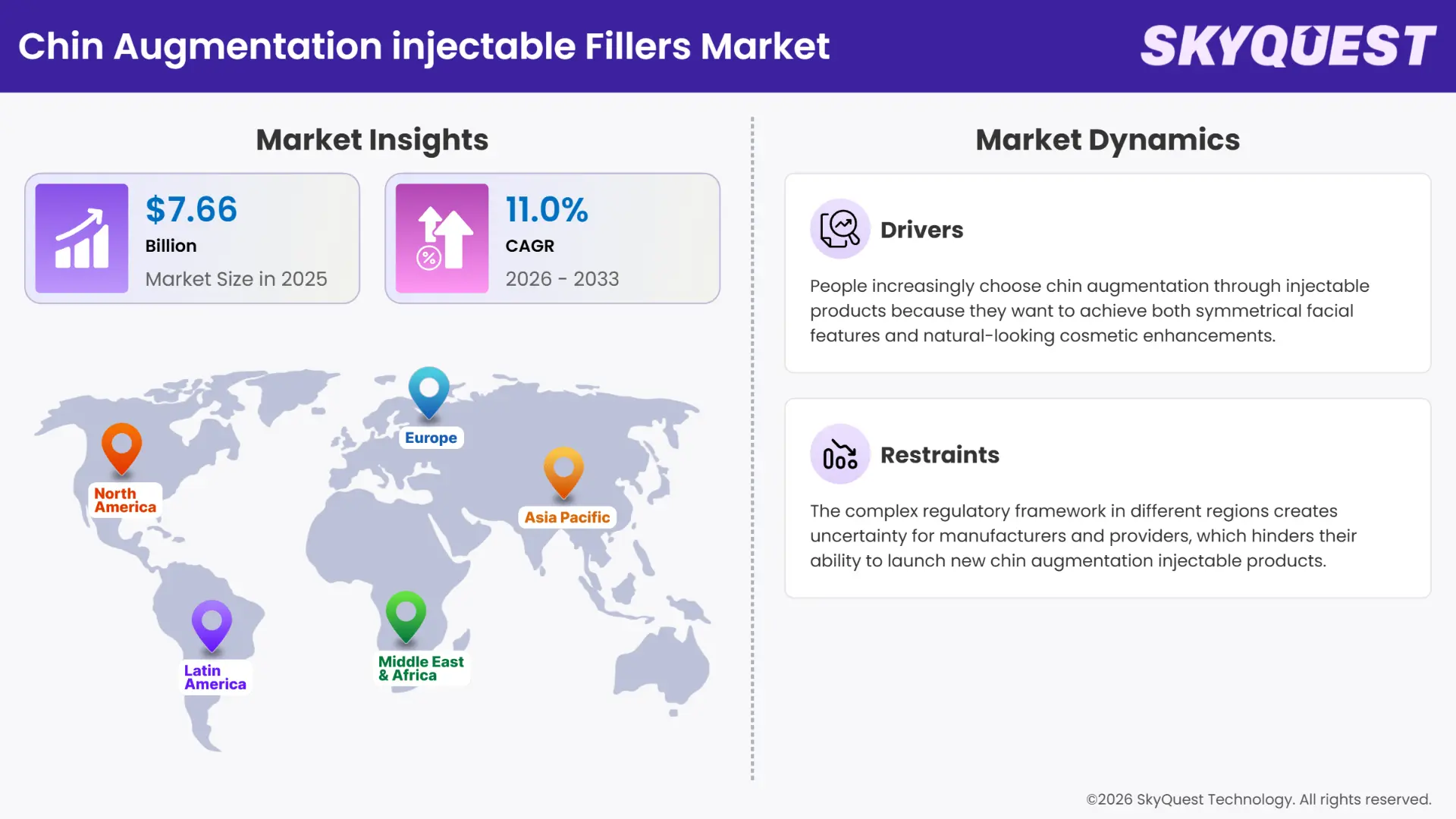
Global Chin Augmentation Injectable Fillers Market size was valued at USD 6.9 Billion in 2024 and is poised to grow from USD 7.66 Billion in 2025 to USD 17.65 Billion by 2033, growing at a CAGR of 11.0% during the forecast period (2026-2033).
Key Takeaways: Market Trends & Insights
The global chin augmentation injectable fillers market growth is driven because consumers want facial harmonization treatments which require fewer invasive methods instead of surgical implants. The market consists of injectable biocompatible materials which doctors use to improve chin projection and contouring without needing general anesthesia because better lower-face balance leads to improved attractiveness and psychosocial benefits. The development of cross-linked hyaluronic acids and calcium hydroxyapatite has progressed during the past two decades after regulatory bodies approved these technologies and clinicians learned to use these techniques which now enable predictable reversible results; Juvederm and Radiesse received mainstream approval because they now function as combination treatments with neuromodulators.
Filler chemistry and delivery techniques continue to evolve which drives the global global chin augmentation injectable fillers market penetration because these enhancements improve product durability and safety which results in higher clinician confidence and expanded patient treatment possibilities. The introduction of cross-linked hyaluronic acids with extended residence times plus cannula placement enables practitioners to deliver accurate chin projection while reducing bruising and touch-up needs which results in better patient buy-in and greater overall treatment value. Manufacturers dedicate resources toward developing local market products while conducting training sessions which create business opportunities in male beauty products and Asian facial aesthetic treatments and facial reconstruction after traumatic injuries; technology enables Brazilian and South Korean market entry to achieve actual market expansion.
How is AI Improving Patient Selection and Outcomes in the Chin Augmentation Injectable Fillers Market?
AI helps doctors select patients for chin augmentation treatments by using advanced facial mapping and predictive analytics which create personalized treatment plans based on facial anatomy. The tools use three-dimensional imaging with outcome simulation functions to assist clinicians in selecting the optimal filler and injection pattern for each patient. The predictive models identify anatomical characteristics which raise complication risks while supporting risk screening to enhance safety with improved follow-up procedures. The market currently favors clinics which use these technologies because they boost consultation efficiency and patient satisfaction while producing more predictable treatment outcomes. Galderma October 2025 introduced new injectable data at AMWC Dubai which showed how combination strategies could help with chin shaping and clinical decision processes. The development allows providers to match product evidence with algorithmic patient matching through AI-enabled facial analysis which helps organizations adopt new technology while achieving better treatment outcomes.
To get more insights on this market click here to Request a Free Sample Report
The global chin augmentation injectable fillers market is categorized based on filler chemistry, procedural objective, duration or longevity, end-user, and region. By filler chemistry, the market includes hyaluronic acid, calcium hydroxylapatite, and permanent or liquid silicone fillers. In terms of procedural objective, it is segmented into chin projection, jawline definition and jowl masking, as well as mental cleft correction. Based on duration or longevity, the market is divided into temporary and semi-permanent solutions. By end-user, the market comprises aesthetic and dermatology clinics, plastic surgery units, and specialized injectable bars. Geographically, the market spans North America, Europe, Asia Pacific, Latin America, and the Middle East and Africa.
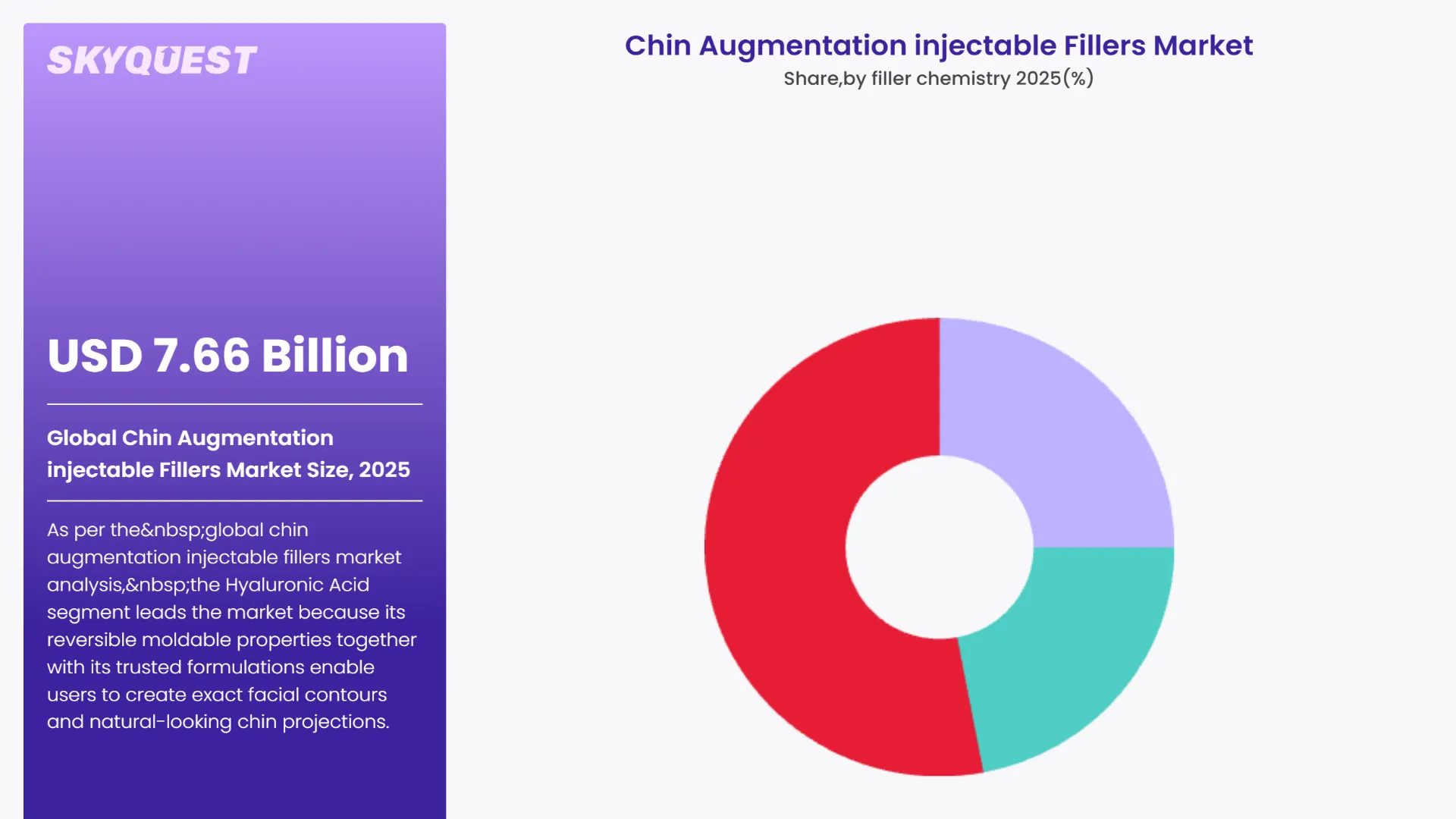
As per the global chin augmentation injectable fillers market analysis, the Hyaluronic Acid segment leads the market because its reversible moldable properties together with its trusted formulations enable users to create exact facial contours and natural-looking chin projections. The product provides accurate rheological data which clinicians use to safely increase volume in tiny amounts while achieving precise procedural results. The combination of product safety and broad availability of medical products encourages doctors to choose this practice, which leads to widespread adoption of clinical practices and medical training, and patient acceptance of chin augmentation.
Whereas the Calcium Hydroxylapatite has emerged as a fast-growing alternative because of its structural lift effects combined with collagen stimulation abilities. Patients who want lasting results are drawn to their durable contours, which lead clinicians to use multiple treatment methods. The recent advancements in delivery techniques and targeted training programs have developed safe implementation pathways which drive chin augmentation acceptance and generate new clinical applications.
According to the global chin augmentation injectable fillers market forecast, the Aesthetic & Dermatology Clinics segment leads the market because these facilities achieve high procedure volumes through their dedicated injector experts who follow standardized safety protocols for regular chin augmentation procedures. They provide clients with access to numerous filler options which enable them to create personalized treatment plans that support gradual treatment changes and continuing medical treatment. Patient trust and practitioner training at clinic networks help establish these locations as the main non-surgical chin enhancement delivery system which generates steady patient referrals.
Whereas the Specialized Injectable Bars category is predicted to achieve the highest chin augmentation injectable fillers market share because they provide consumers with convenient access to aesthetic touchups which represent the most current aesthetics. Young patients who want to achieve fast chin contouring choose these businesses because they operate during flexible hours and use direct advertising. Chin augmentation services grow through business model redesign which creates new staff training initiatives and online appointment management systems.
To get detailed segments analysis, Request a Free Sample Report
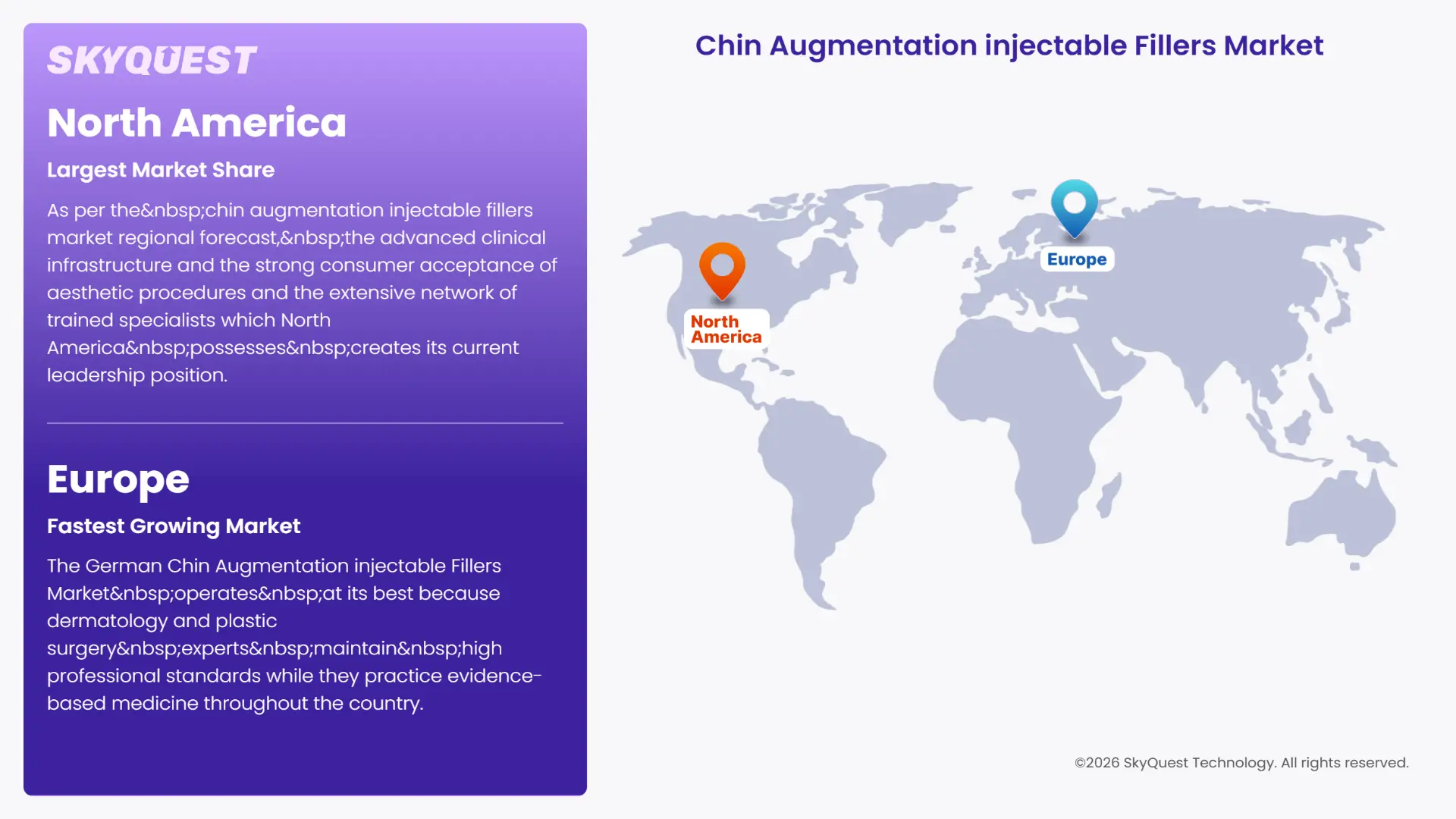
As per the chin augmentation injectable fillers market regional forecast, the advanced clinical infrastructure and the strong consumer acceptance of aesthetic procedures and the extensive network of trained specialists which North America possesses creates its current leadership position. The region's regulatory framework enables companies to conduct thorough product assessments which result in their ability to enter markets through existing distribution systems and specialized aesthetic training programs for doctors. The evidence base and best practice guidelines from trustworthy clinics and academic institutions build clinician confidence and patient trust in their relationships with doctors. The private sector invests heavily, which enables market players to merge their resources for greater operational capacities and improved advertising outreach. The combination of cultural values which prefer less invasive facial treatments and widespread urban demand results in continuous development of new products and expansion of available services.
The United States Chin Augmentation injectable Fillers sector presents a fully developed aesthetic system which contains a wide range of treatment providers and patients who show high awareness of non-surgical cosmetic procedures. Clinical training opportunities and professional societies support quality and safety while leading clinics in metropolitan areas function as hubs for technique development. The product distribution system operates effectively because its advanced channels enable manufacturers to share their product information with clinicians who need to learn about new products. Private practices and specialty clinics choose products based on consumer preferences for natural outcomes which match their products and services to demands.
The Chin Augmentation injectable Fillers industry in Canada presents a controlled combination of established healthcare regulations and the expanding private aesthetics industry which serves urban client needs. The province-based regulations determine clinical operational methods, and the system places strong focus on practitioner competence and safety standards. Major cities function as market drivers because private clinics and specialist practices use their expertise in overseas knowledge sharing to operate their businesses. The steady growth of trained injector networks and educational programs in local areas comes from patient demands which prefer minor enhancements that provide top-notch results.
European market expansion occurs because aesthetic preferences have changed to prefer less invasive facial contouring procedures combined with rising acceptance of non-invasive treatments across various social groups. Strong clinical communities and centers of excellence in core markets facilitate best practice dissemination and clinical training. The product distribution network receives approval from several nations because of regulatory alignment which enables local reimbursement systems to drive private payment methods and service innovation. The regional cross-border medical travel system and active aesthetic tourism create pathways for providers to develop competitive advantages through knowledge acquisition. Manufacturers study cultural patterns which require them to apply local strategies because they must comply with both cultural differences and regulatory requirements while their targeted marketing and professional educational initiatives boost patient knowledge and clinician adoption through critical market zones.
The German Chin Augmentation injectable Fillers Market operates at its best because dermatology and plastic surgery experts maintain high professional standards while they practice evidence-based medicine throughout the country. The established medical training and research institutions support practitioners for skill development and product evaluation. The market mindset favors high quality standards and conservative, natural aesthetic outcomes, leading clinics to prioritize safety and technique refinement. Professional partnerships between doctors emerge at urban medical facilities which create spaces for doctors to work together on developing new medical solutions.
The United Kingdom Chin Augmentation injectable Fillers Market showcases active growth in private clinics together with an aesthetic business sector which quickly adopts new, less invasive beauty treatments. The strong professional training frameworks establish basic requirements for practitioner competence while marketing activities and media content drive consumer demand. Cities function as centers where new techniques and service models are tested. The market adjusts to current fashion styles which customers want while providing different service experiences for their clinics.
The French Chin Augmentation injectable Fillers Market develops through a cultural shift which values use of subtle facial enhancements that link back to aesthetic traditions which value restraint. The specialized clinics which operate in metropolitan areas focus their services on creating personalized treatment plans which need expert medical knowledge. The system ensures secure and high-quality treatment through its clinical oversight mechanisms while patients start to seek non-surgical chin contouring as part of their complete facial aesthetic needs. Local manufacturers and practitioners increasingly collaborate on tailored offerings.
Asia Pacific enhances its competitive stance by quickly adopting facial aesthetic standards while developing its local manufacturing facilities and building its clinical excellence centers which support advanced medical techniques. The cultural focus on achieving facial harmony with clear facial features leads to increasing chin augmentation demand from consumers while the advanced training academies and certification programs boost the abilities of injectors. The combination of regional regulatory changes and specific national market entry approaches from international and domestic manufacturers has created better access to their products. The combination of urban development and expanding private clinic networks increases service availability, plus professional exchange between regions helps spread best practices. Medical tourism and influencer-driven awareness campaigns create greater demand, making the region an important market for product development and specialized techniques.
The Japanese chin augmentation injectable fillers market follows a strict but high-quality process which values facial enhancement safety and subtlety above all else. The urban specialty clinics employ experts who focus on achieving natural results through their selection of patients. The regulatory framework requires complete testing of clinical results, and all healthcare professionals must demonstrate their expertiseto create patient trust in medical results. Patients prefer facial aesthetic improvements which maintain their facial proportions, so clinics offer their services as part of complete facial aesthetic treatment plans.
The South Korean chin augmentation injectable fillers market develops through two main forces which include cultural beliefs that facial balance should be maintained and the cosmetic procedure sector which develops new aesthetic techniques. People across all demographic groups embrace cosmetic procedures which create a high demand for chin contouring because it helps them achieve their goal of facial balance. The extensive training academies and competitive private clinic networks enable fast skill development in the workforce. The market functions as a regional trendsetter because local businesses and specialized facilities introduce their innovative operational methods to improve customer service.
To know more about the market opportunities by region and country, click here to
Buy The Complete Report
Growing Demand for Facial Harmony
People increasingly choose chin augmentation through injectable products because they want to achieve both symmetrical facial features and natural-looking cosmetic enhancements. The treatment options empower clinicians to treat contour deficiencies through non-invasive methods which meet patient needs for both natural results and quick recovery times, making them suitable for all age ranges and lifestyles. Clinicians and patients will accept services which improve facial symmetry through non-surgical methods, while clinics will expand their services, and businesses will develop new products to meet customer demand for aesthetic treatments.
Advances in Filler Formulations
The introduction of new filler materials and application techniques has improved clinical results while increasing the range of chin augmentation procedures. The new filler materials provide better tissue compatibility and improved flow properties, which result in more precise contour rendering and better tissue connection while decreasing the chances of complications. Manufacturers create materials which enhance structural augmentation to provide practitioners with better control of their techniques, leading more clinics to implement these advanced procedures. The growth of product availability brings about an increase in training and promotional activities which lead to greater patient knowledge, while patients begin to view injectables as an alternative option to surgical procedures.
Complex Regulatory Approval Processes
The complex regulatory framework in different regions creates uncertainty for manufacturers and providers, which hinders their ability to launch new chin augmentation injectable products. The different routes to product approval and post-market monitoring requirements demand companies to gather substantial safety evidence, which leads them to choose compliance activities over expansion into new markets. The complex system of regulations restricts product availability in certain areas, which limits clinician access to innovative treatments and delays the strategic launch of new products, thus creating a bottleneck on clinic access to cutting-edge treatments, which affects market expansion.
Perception of Safety and Risks
Patients and clinicians now exhibit greater concern about the possible side effects together with the long-term safety associated with chin augmentation injectables, which has made them less willing to proceed with these procedures. The reports of complications, negative media coverage, and anecdotal experiences lead to raised caution, which produces important effects on clinical decision-making, and results in decreased treatment volume. The safety concerns lead to greater focus on informing patients about their condition and performing follow-up assessments together with a longer patient consultation period, which results in healthcare providers sticking to traditional methods while they move slowly toward accepting modern medical products.
Request Free Customization of this report to help us to meet your business objectives.
The current competitive situation for global chin augmentation injectable fillers emerges from existing companies combining their operations with major AbbVie-Allergan acquisition deals and their business model, which combines distribution agreements with licensing contracts to achieve targeted distribution for PDLLA and hybrid biostimulator products in different regions and their new platform-based AI systems that revolutionize clinic operations by changing how they acquire new patients and handle injectable treatments.
Aesthetic Personalization Demand: Consumers increasingly request personalized chin augmentation treatments which match their unique facial features and ethnic backgrounds and lifestyle patterns, so providers should focus on creating custom treatment plans and choosing the right products. Clinics use advanced imaging and simulation technology to create treatment plans that focus on achieving natural facial balance with minimal treatment effects. Manufacturers provide clinicians with various product options and educational resources to support their work. This shift results in improved patient involvement together with customer retention and unique clinical services while increasing the demand for personalized consultations and precise outcome predictions.
Integration With Minimally Invasive Procedures: Providers combine injectable chin augmentation with non-surgical treatments and soft tissue procedures to create more complete lower face rejuvenation and contouring solutions which increase value for patients. Aesthetic physicians and dermatologist and surgeons work together to create better safety protocols and establish best practices. Market participants develop training modules and bundled service offerings to streamline treatment pathways. This integrated approach encourages doctors to assess all facial features which determine patient eligibility and increases the need for multiple injectable products that doctors can use in various facial aesthetic procedures.
SkyQuest’s ABIRAW (Advanced Business Intelligence, Research & Analysis Wing) is our Business Information Services team that Collects, Collates, Correlates, and Analyses the Data collected by means ofPrimary Exploratory Research backed by robust Secondary Desk research.
As per SkyQuest analysis, the global chin augmentation injectable fillers market is experiencing expansion because more consumers prefer noninvasive procedures that enhance their facial features while manufacturers create new filler products with improved chemical formulas which extend their application range and enhance their performance. However, companies face difficulties which come from the lengthy regulatory approval process because it prevents them from launching products on time and limits their ability to increase market size. North America remains the dominant region due to advanced clinical infrastructure, high consumer acceptance, and strong training and distribution networks. Hyaluronic acid fillers lead the market because they offer reversible results, and they can be easily shaped by clinicians who use them for exact chin projection. The market centers on safety features together with personalized services and increased product acceptance in clinical settings.
| Report Metric | Details |
|---|---|
| Market size value in 2024 | USD 6.9 Billion |
| Market size value in 2033 | USD 17.65 Billion |
| Growth Rate | 11.0% |
| Base year | 2024 |
| Forecast period | 2026-2033 |
| Forecast Unit (Value) | USD Billion |
| Segments covered |
|
| Regions covered | North America (US, Canada), Europe (Germany, France, United Kingdom, Italy, Spain, Rest of Europe), Asia Pacific (China, India, Japan, Rest of Asia-Pacific), Latin America (Brazil, Rest of Latin America), Middle East & Africa (South Africa, GCC Countries, Rest of MEA) |
| Companies covered |
|
| Customization scope | Free report customization with purchase. Customization includes:-
|
To get a free trial access to our platform which is a one stop solution for all your data requirements for quicker decision making. This platform allows you to compare markets, competitors who are prominent in the market, and mega trends that are influencing the dynamics in the market. Also, get access to detailed SkyQuest exclusive matrix.
Table Of Content
Executive Summary
Market overview
Parent Market Analysis
Market overview
Market size
KEY MARKET INSIGHTS
COVID IMPACT
MARKET DYNAMICS & OUTLOOK
Market Size by Region
KEY COMPANY PROFILES
Methodology
For the Chin Augmentation injectable Fillers Market, our research methodology involved a mixture of primary and secondary data sources. Key steps involved in the research process are listed below:
1. Information Procurement: This stage involved the procurement of Market data or related information via primary and secondary sources. The various secondary sources used included various company websites, annual reports, trade databases, and paid databases such as Hoover's, Bloomberg Business, Factiva, and Avention. Our team did 45 primary interactions Globally which included several stakeholders such as manufacturers, customers, key opinion leaders, etc. Overall, information procurement was one of the most extensive stages in our research process.
2. Information Analysis: This step involved triangulation of data through bottom-up and top-down approaches to estimate and validate the total size and future estimate of the Chin Augmentation injectable Fillers Market.
3. Report Formulation: The final step entailed the placement of data points in appropriate Market spaces in an attempt to deduce viable conclusions.
4. Validation & Publishing: Validation is the most important step in the process. Validation & re-validation via an intricately designed process helped us finalize data points to be used for final calculations. The final Market estimates and forecasts were then aligned and sent to our panel of industry experts for validation of data. Once the validation was done the report was sent to our Quality Assurance team to ensure adherence to style guides, consistency & design.
Analyst Support
Customization Options
With the given market data, our dedicated team of analysts can offer you the following customization options are available for the Chin Augmentation injectable Fillers Market:
Product Analysis: Product matrix, which offers a detailed comparison of the product portfolio of companies.
Regional Analysis: Further analysis of the Chin Augmentation injectable Fillers Market for additional countries.
Competitive Analysis: Detailed analysis and profiling of additional Market players & comparative analysis of competitive products.
Go to Market Strategy: Find the high-growth channels to invest your marketing efforts and increase your customer base.
Innovation Mapping: Identify racial solutions and innovation, connected to deep ecosystems of innovators, start-ups, academics, and strategic partners.
Category Intelligence: Customized intelligence that is relevant to their supply Markets will enable them to make smarter sourcing decisions and improve their category management.
Public Company Transcript Analysis: To improve the investment performance by generating new alpha and making better-informed decisions.
Social Media Listening: To analyze the conversations and trends happening not just around your brand, but around your industry as a whole, and use those insights to make better Marketing decisions.
REQUEST FOR SAMPLE
 REQUEST FREE CUSTOMIZATION
Global Chin Augmentation Injectable Fillers Market size was valued at USD 6.9 Billion in 2024 and is poised to grow from USD 7.66 Billion in 2025 to USD 17.65 Billion by 2033, growing at a CAGR of 11.0% during the forecast period (2026-2033).
Global chin augmentation injectable fillers competitive landscape is driven by consolidation among incumbents, high profile M&A such as AbbVie's acquisition of Allergan, targeted distribution and licensing partnerships that accelerate regional rollouts of PDLLA and hybrid biostimulators, and rapid adoption of platform and AI enabled services that change how clinics acquire patients and deploy injectables. 'Allergan', 'Galderma', 'Merz Aesthetics', 'Sinclair Pharma', 'Sientra Inc.', 'Revance Therapeutics', 'Teoxane Laboratories', 'Prollenium Medical', 'BioPlus Co.', 'Croma-Pharma', 'Bloomage Biotech', 'Ipsen', 'Laboratoires Vivacy', 'Anika Therapeutics', 'Hugel Inc.', 'Medytox', 'LG Chem', 'Zimmer Aesthetics', 'Koru Pharma', 'Caregen Co.'
Greater consumer interest in balanced facial proportions and subtle aesthetic enhancement encourages adoption of chin augmentation injectables as an accessible option. Clinicians can address contour deficiencies with minimally invasive techniques that align with patient desires for natural results and shorter recovery, which makes such treatments more appealing across age groups and lifestyles. The perceived ability to improve facial symmetry without surgery fosters wider acceptance among patients and practitioners, supports expanded service offerings in clinics, and drives investment in product development and training to meet evolving aesthetic preferences.
Aesthetic Personalization Demand: Consumers increasingly seek tailored chin augmentation solutions that align with individual facial anatomy, ethnic diversity and lifestyle preferences, prompting providers to emphasize bespoke treatment planning and product selection. Clinics leverage advanced imaging and simulation to co design outcomes, prioritizing natural proportions and subtle enhancement. Manufacturers respond with diverse formulations and educational support for clinicians. This shift fosters stronger patient engagement, repeat business and differentiated clinical offerings while elevating expectations for personalized consultations and outcome predictability.
North America Dominate the Global Chin Augmentation injectable Fillers Market.
Hyaluronic Acid fillers hold the largest market share due to their safety profile, reversibility, natural-looking results, and widespread acceptance among both patients and aesthetic practitioners.
Calcium Hydroxylapatite (CaHA) fillers are projected to witness the fastest growth because they provide stronger structural support, stimulate collagen production, and deliver longer-lasting contouring results.
AI is improving patient assessment through facial mapping, predictive analytics, treatment simulations, personalized filler selection, and complication risk evaluation, helping clinicians achieve more precise and predictable outcomes.


Want to customize this report? This report can be personalized according to your needs. Our analysts and industry experts will work directly with you to understand your requirements and provide you with customized data in a short amount of time. We offer $1000 worth of FREE customization at the time of purchase.
Feedback From Our Clients


 USA (+1) 351-333-4748

