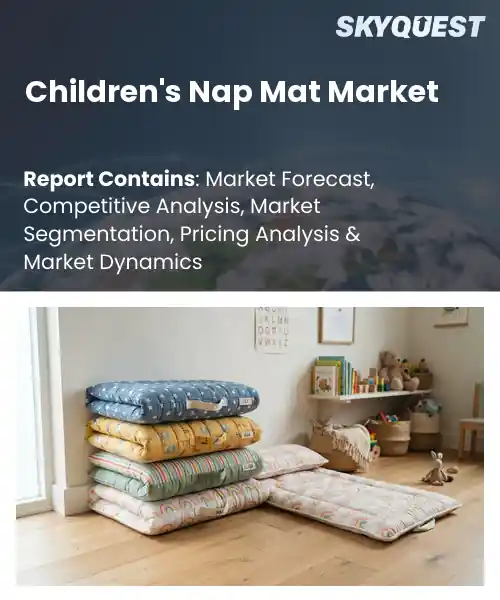
Children's Nap Mat Market
Report ID: SQMIG25F2149
Report ID: SQMIG25F2149
[email protected]
USA +1 351-333-4748
Report ID:
SQMIG25F2149 |
Region:
Global |
Published Date: August, 2026
Pages:
157
|Tables:
120
|Figures:
77


Global Children'S Nap Mat Market size was valued at USD 428.0 Million in 2024 and is poised to grow from USD 452.82 Million in 2025 to USD 710.92 Million by 2033, growing at a CAGR of 5.8% during the forecast period (2026-2033).
Today's global children’s nap‑mat market includes cushioned pads, foldable loungers, and therapeutic foam sheets for preschools, home nurseries, and pediatric facilities. The primary driver is heightened awareness of early‑childhood sleep hygiene, which studies connect to cognitive development and behavior. In the last decade parental worries about fragmented naps have pushed manufacturers to produce ergonomic designs that aid spinal alignment and temperature control. European firms responded to post‑2020 infection concerns by launching antimicrobial‑treated mats, while Asian suppliers widened low‑cost, portable options to suit dense urban housing. This shift marks the transition from simple bedding to health‑focused sleep solutions for children globally. Another decisive factor driving the global children’s nap‑mat market is the integration of smart materials that enable monitoring of sleep quality. Manufacturers embed sensors to track heart rate, movement, and ambient temperature, sending data to caregiver apps that alert parents when a nap deviates from optimal patterns. As schools adopt nap policies, this technology supplies justification for extending nap periods, directly increasing demand for sensor‑enabled mats. Environmental concerns also push parents toward biodegradable foam and recyclable covers, prompting suppliers to launch green lines that command prices. Together, technology and sustainability create scalable export opportunities for firms meeting rising regulatory standards.
How are AI and IoT technologies improving safety features in the children's nap mat market?
AI and IoT are turning nap mats into proactive safety devices. Sensors can detect temperature spikes, moisture and unusual movement, alerting caregivers through a smartphone app. Machine‑learning algorithms analyze patterns to predict restlessness or overheating before they become hazards. Integrated sound detectors mute loud noises and trigger soothing music, creating a calm environment while keeping parents informed in real time. These features align with growing parental demand for smarter, healthier sleep solutions, reinforcing the market’s reputation for combining comfort with cutting‑edge protection.KinderMat highlighted an IoT temperature sensor in June 2026, demonstrating how real‑time alerts and automatic climate control enhance child safety and support market momentum.
Market snapshot - (2026-2033)
Global Market Size
USD 428.0 Million
Largest Segment
Foldable Nap Mats
Fastest Growth
Nap Mats with Blanket
Growth Rate
5.8% CAGR
To get more insights on this market click here to Request a Free Sample Report
Global children's nap mat market is segmented by product type, material, distribution channel, end user and region. Based on product type, the market is segmented into Foldable Nap Mats, Roll-Up Nap Mats, Nap Mats with Pillow and Nap Mats with Blanket. Based on material, the market is segmented into Cotton, Polyester, Foam and Blended Fabrics. Based on distribution channel, the market is segmented into Online Retail, Specialty Stores, Supermarkets & Hypermarkets and Department Stores. Based on end user, the market is segmented into Households, Daycare Centers and Preschools & Kindergartens. Based on region, the market is segmented into North America, Europe, Asia Pacific, Latin America and Middle East & Africa.
Foldable nap mats segment dominates because parents value space efficiency and easy storage in home environments, leading to repeated usage throughout the day. The design aligns with limited living areas and supports quick deployment for spontaneous rest periods, which encourages higher adoption rates. Its versatility across indoor and outdoor settings, combined with low maintenance requirements, creates strong consumer preference and fuels sustained market leadership among families seeking convenience.
Meanwhile, roll up nap mats segment experiences the strongest growth momentum because its compact form factor appeals to mobile families and early childhood centers that require rapid setup and storage. Innovative fabric technologies enhance durability, encouraging broader adoption and opening new avenues for product differentiation and market expansion.
Cotton segment dominates because its natural softness and breathability address parental concerns about skin sensitivity and comfort during naps. The material’s hypoallergenic properties foster trust among caregivers, while its easy laundering capability matches routine household chores, reinforcing repeat purchases. These attributes create a strong emotional connection with buyers, sustaining leading market presence. Additionally, cotton’s renewable nature aligns with growing eco conscious values, prompting families to favor it over synthetic alternatives, thereby reinforcing its dominant position.
Conversely, foam segment is witnessing the fastest growth as its cushioning properties provide superior support for developing bodies, attracting daycare facilities seeking ergonomic solutions. Recent advances in lightweight, washable foam formulations reduce cleaning burdens, making the product appealing for high turnover environments and driving rapid market uptake.
To get detailed segments analysis, Request a Free Sample Report
North America dominates due to high disposable income, strong parental focus on early childhood development, and well‑established retail distribution that spans large nationwide chains and online platforms. Consumer awareness of ergonomics and safety in sleep environments drives preference for purpose‑built nap mats. Manufacturers benefit from robust supply chains, domestic material sourcing, and stringent product safety regulations that build trust. Innovation cycles are rapid, with collaborations between pediatric specialists and design firms generating new features such as antimicrobial fabrics and adjustable firmness. Marketing narratives emphasize wellness and convenience, resonating with busy families, creating a self‑reinforcing ecosystem that sustains market leadership and encourages continuous product refinement.
Children's Nap Mat Market in United States reflects a sophisticated consumer base that values premium comfort and safety certifications. Retail presence spans big‑box stores, boutique baby shops, and e‑commerce platforms that showcase diverse designs. Product development frequently incorporates feedback from pediatric experts, leading to innovations such as temperature‑regulating layers and quick‑dry covers. Strong brand loyalty emerges from consistent quality experiences, while parental communities amplify awareness through social media and parenting online forums and discussion groups.
Children's Nap Mat Market in Canada is shaped by a culture that emphasizes health‑focused infant care and environmental stewardship. Retail channels combine department chains with specialty boutiques that highlight organic, sustainably sourced materials. Product designers collaborate with child health professionals to integrate hypoallergenic fabrics and easy‑clean surfaces. Government guidelines on child safety reinforce trust, while parenting groups spread product knowledge through word‑of‑mouth and digital platforms, fostering demand for innovative nap solutions.
The European expansion is propelled by a convergence of stringent child‑safety legislation, rising parental expectations for ergonomically designed sleep accessories, and a cultural emphasis on early childhood wellbeing. Retail landscapes blend established department stores with vibrant online marketplaces that showcase locally produced, eco‑friendly designs. Designers increasingly draw on interdisciplinary research linking proper nap support with developmental milestones, leading to product lines that feature breathable, natural fibers and modular sizing. Collaborative initiatives among pediatric associations, consumer groups, and manufacturers foster trust and accelerate adoption. Moreover, sustainability narratives resonate strongly, encouraging brands to highlight recyclable components and ethical sourcing, which further stimulates consumer interest across the region.
Children's Nap Mat Market in Germany benefits from a tradition of high design standards and rigorous safety testing. Retail distribution includes major specialty chains and a growing e‑commerce sector that highlights German‑engineered products. Collaborations with pediatric research institutes drive innovations such as temperature‑balanced layers and adjustable firmness settings. Consumer preference for locally manufactured, environmentally responsible goods reinforces brand loyalty, while regulatory compliance ensures confidence in product performance and durability.
Children's Nap Mat Market in United Kingdom is experiencing growth driven by heightened awareness of sleep hygiene among young families. Retail channels combine traditional shops with an online ecosystem that promotes British‑designed nap solutions. Partnerships with health professionals emphasize benefits of proper spinal support, inspiring features such as breathable mesh surfaces and quick‑dry covers. Cultural trends toward minimalist furniture amplify demand, while sustainability commitments encourage use of recyclable fabrics and eco‑friendly manufacturing processes.
Children's Nap Mat Market in France is emerging as consumers place increasing importance on child wellbeing and eco‑conscious product choices. Boutique retailers and niche online platforms highlight French‑crafted nap mats that incorporate natural fibers and design elements. Collaboration with pediatric wellness experts yields innovations such as aroma‑infused fabrics and modular sizing to adapt to growing needs. Growing consumer dialogue around sustainability drives interest in biodegradable materials, positioning France as fertile ground for lifestyle‑oriented offerings.
The Asia Pacific region is strengthening its position through a blend of rapid urbanization, evolving parenting philosophies, and growing consumer appetite for multifunctional home solutions. Manufacturers are leveraging advanced textile technologies, such as memory foam blends and antimicrobial treatments, to meet heightened expectations for comfort and hygiene. Local design sensibilities emphasize compact, space‑efficient products that integrate seamlessly into smaller living spaces. Collaboration with healthcare providers promotes awareness of the developmental advantages of proper nap support, driving demand for ergonomically engineered mats. Additionally, rising environmental consciousness inspires the adoption of biodegradable materials and circular‑economy packaging, aligning product offerings with regional sustainability goals. The convergence of these factors fuels a dynamic market environment that encourages continual innovation and expands the region’s influence in the global landscape.
Children's Nap Mat Market in Japan reflects a preference for compact designs that accommodate limited residential space. Retail distribution includes major department stores and e‑commerce platforms that showcase products with integrated temperature‑regulation and low‑profile cushioning. Partnerships with pediatric research centers drive innovations such as ultrasonic cleaning capabilities and hypoallergenic fabrics. Consumer confidence is reinforced by rigorous safety standards, while cultural emphasis on cleanliness and craftsmanship sustains demand for premium nap solutions.
Children's Nap Mat Market in South Korea is driven by a consumer base that values home integration and versatile furniture. Retail channels blend traditional department stores with online marketplaces featuring product previews. Collaboration with biotech firms yields mats incorporating temperature‑sensing fibers and antimicrobial treatments. Strong government support for child health initiatives amplifies public awareness, while a cultural focus on aesthetic harmony encourages sleek, minimalist designs that complement interiors, propelling market momentum.
To know more about the market opportunities by region and country, click here to
Buy The Complete Report
Rising Demand For Portable Comfort
Eco Friendly Materials Gaining Preference
Higher Production Costs Limit Adoption
Regulatory Standards Vary Across Regions
Request Free Customization of this report to help us to meet your business objectives.
The competitive landscape is defined by established manufacturers expanding product lines and leveraging strategic partnerships to secure distribution in daycare and preschool channels, while new entrants capitalize on tech‑enabled fabrics and portable designs to differentiate. Recent M&A activity saw True Blue Global acquire a niche nap‑mat brand, and Peerless Plastics partnered with a major retail chain to launch a machine‑washable series featuring antimicrobial treatment, intensifying rivalry on quality and convenience.
Top Player’s Company Profile
Recent Developments
SkyQuest’s ABIRAW (Advanced Business Intelligence, Research & Analysis Wing) is our Business Information Services team that Collects, Collates, Correlates, and Analyses the Data collected by means of Primary Exploratory Research backed by robust Secondary Desk research. As per SkyQuest analysis the global children’s nap‑mat market is projected to grow at a 5.8 % CAGR through 2033, fueled first by rising demand for portable comfort as families seek lightweight, quick‑setup mats for travel and home use, and second by a strong shift toward eco‑friendly materials such as organic cotton and recycled fabrics that resonate with environmentally conscious parents, the foldable nap‑mat segment leads the market because its space‑saving design matches the preferences of urban households, North America dominates overall thanks to high disposable income, robust retail networks and early adoption of safety‑focused innovations, while higher production costs for premium safe‑padding and smart features act as a key restraint limiting broader price‑sensitive adoption.
| Report Metric | Details |
|---|---|
| Market size value in 2024 | USD 428.0 Million |
| Market size value in 2033 | USD 710.92 Million |
| Growth Rate | 5.8% |
| Base year | 2024 |
| Forecast period | (2026-2033) |
| Forecast Unit (Value) | USD Million |
| Segments covered |
|
| Regions covered | North America (US, Canada), Europe (Germany, France, United Kingdom, Italy, Spain, Rest of Europe), Asia Pacific (China, India, Japan, Rest of Asia-Pacific), Latin America (Brazil, Rest of Latin America), Middle East & Africa (South Africa, GCC Countries, Rest of MEA) |
| Companies covered |
|
| Customization scope | Free report customization with purchase. Customization includes:-
|
To get a free trial access to our platform which is a one stop solution for all your data requirements for quicker decision making. This platform allows you to compare markets, competitors who are prominent in the market, and mega trends that are influencing the dynamics in the market. Also, get access to detailed SkyQuest exclusive matrix.
Table Of Content
Executive Summary
Market overview
Parent Market Analysis
Market overview
Market size
KEY MARKET INSIGHTS
COVID IMPACT
MARKET DYNAMICS & OUTLOOK
Market Size by Region
KEY COMPANY PROFILES
Methodology
For the Children's Nap Mat Market, our research methodology involved a mixture of primary and secondary data sources. Key steps involved in the research process are listed below:
1. Information Procurement: This stage involved the procurement of Market data or related information via primary and secondary sources. The various secondary sources used included various company websites, annual reports, trade databases, and paid databases such as Hoover's, Bloomberg Business, Factiva, and Avention. Our team did 45 primary interactions Globally which included several stakeholders such as manufacturers, customers, key opinion leaders, etc. Overall, information procurement was one of the most extensive stages in our research process.
2. Information Analysis: This step involved triangulation of data through bottom-up and top-down approaches to estimate and validate the total size and future estimate of the Children's Nap Mat Market.
3. Report Formulation: The final step entailed the placement of data points in appropriate Market spaces in an attempt to deduce viable conclusions.
4. Validation & Publishing: Validation is the most important step in the process. Validation & re-validation via an intricately designed process helped us finalize data points to be used for final calculations. The final Market estimates and forecasts were then aligned and sent to our panel of industry experts for validation of data. Once the validation was done the report was sent to our Quality Assurance team to ensure adherence to style guides, consistency & design.
Analyst Support
Customization Options
With the given market data, our dedicated team of analysts can offer you the following customization options are available for the Children's Nap Mat Market:
Product Analysis: Product matrix, which offers a detailed comparison of the product portfolio of companies.
Regional Analysis: Further analysis of the Children's Nap Mat Market for additional countries.
Competitive Analysis: Detailed analysis and profiling of additional Market players & comparative analysis of competitive products.
Go to Market Strategy: Find the high-growth channels to invest your marketing efforts and increase your customer base.
Innovation Mapping: Identify racial solutions and innovation, connected to deep ecosystems of innovators, start-ups, academics, and strategic partners.
Category Intelligence: Customized intelligence that is relevant to their supply Markets will enable them to make smarter sourcing decisions and improve their category management.
Public Company Transcript Analysis: To improve the investment performance by generating new alpha and making better-informed decisions.
Social Media Listening: To analyze the conversations and trends happening not just around your brand, but around your industry as a whole, and use those insights to make better Marketing decisions.
REQUEST FOR SAMPLE
 REQUEST FREE CUSTOMIZATION


Want to customize this report? This report can be personalized according to your needs. Our analysts and industry experts will work directly with you to understand your requirements and provide you with customized data in a short amount of time. We offer $1000 worth of FREE customization at the time of purchase.
Feedback From Our Clients


 USA (+1) 351-333-4748

