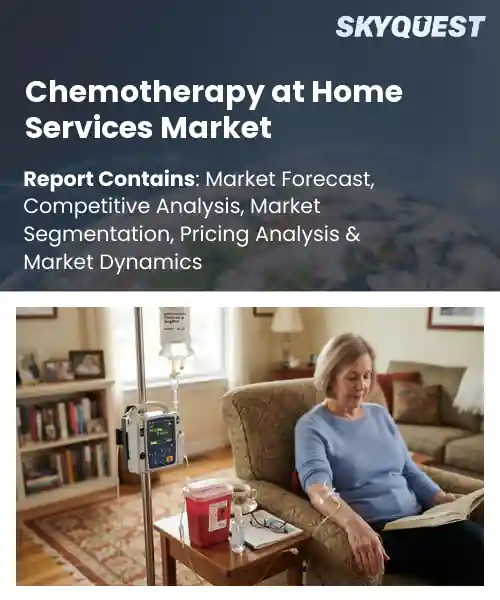
Chemotherapy at Home Services Market
Report ID: SQMIG35D2673
Report ID: SQMIG35D2673
[email protected]
USA +1 351-333-4748
Report ID:
SQMIG35D2673 |
Region:
Global |
Published Date: September, 2026
Pages:
157
|Tables:
146
|Figures:
78


Global Chemotherapy At Home Services Market size was valued at USD 3.25 Billion in 2024 and is poised to grow from USD 3.54 Billion in 2025 to USD 7.01 Billion by 2033, growing at a CAGR of 8.9% during the forecast period (2026-2033).
The global chemotherapy‑at‑home services market includes nursing, infusion devices, and monitoring that let oncologists deliver intravenous anticancer agents in a patient’s residence. Its primary driver is the convergence of an aging cancer population with health‑system pressure to shift inpatient care to outpatient settings. Over the past two decades, pilot programs in the United States showed reduced hospital readmissions, while European health services adopted reimbursement models that incentivized home infusion. The COVID‑19 pandemic amplified demand as patients sought to avoid exposure, prompting insurers to expand coverage. Consequently, the market has moved from niche specialty clinics to a component of oncology care. Building on that shift, the key growth factor is the integration of health platforms that coordinate drug preparation, dosing verification, and adverse‑event reporting. When an oncology dashboard alerts a nurse to a dosage discrepancy, the nurse can intervene before toxicity escalates, reducing emergency department visits and reinforcing payer confidence. Companies such as Oncology HomeCare in Canada and Medtronic’s smart infusion pumps have shown that data‑driven protocols cut infusion errors by 30 % and lower treatment costs. These outcomes attract capital and encourage hospitals to outsource chemotherapy, creating a loop that expands service networks, increases reimbursement eligibility, and accelerates market penetration worldwide.
How is AI-driven automation reshaping the at‑home chemotherapy services market?
AI-driven automation is redefining at‑home chemotherapy by linking smart infusion pumps, predictive dosing algorithms, and remote monitoring platforms. These technologies enable clinicians to tailor treatment schedules in real time, reduce manual data entry, and flag adverse reactions before they become critical. The market now sees a shift from episodic nurse visits to continuous digital oversight, allowing patients to stay in familiar environments while maintaining clinical safety. Early adopters report smoother logistics, fewer medication errors, and higher patient confidence, which together are expanding the appeal of home‑based oncology care. This evolution is also prompting insurers to reconsider coverage models, further encouraging uptake.Recent advances illustrate the trend, as a leading infusion services firm introduced an AI‑powered workflow engine in March 2024, streamlining prescription verification and pump programming, thereby accelerating treatment initiation and improving operational efficiency.
Market snapshot - (2026-2033)
Global Market Size
USD 3.25 Billion
Largest Segment
Home Infusion Chemotherapy
Fastest Growth
Oral Chemotherapy Management
Growth Rate
8.9% CAGR
To get more insights on this market click here to Request a Free Sample Report
Global chemotherapy at home services market is segmented by service type, care model, cancer type, service provider, payment model and region. Based on service type, the market is segmented into Home Infusion Chemotherapy, Oral Chemotherapy Management, Home-Based Supportive Care and Other Home Chemotherapy Services. Based on care model, the market is segmented into Nurse-Led Home Care, Physician-Supervised Home Care and Integrated Home Oncology Care. Based on cancer type, the market is segmented into Hematological Cancers, Solid Tumors and Other Cancers. Based on service provider, the market is segmented into Hospitals & Cancer Centers, Home Healthcare Agencies, Specialty Oncology Providers and Other Providers. Based on payment model, the market is segmented into Public Insurance, Private Insurance and Out-of-Pocket. Based on region, the market is segmented into North America, Europe, Asia Pacific, Latin America and Middle East & Africa.
Home Infusion Chemotherapy segment dominates because it enables delivery of intravenous agents directly within the patient’s residence, removing the need for frequent hospital trips and satisfying a preference for comfort and privacy. Clinical efficacy remains comparable to institutional settings, and safety protocols, monitoring technologies, and nursing teams reinforce confidence among clinicians and payers. This combination of therapeutic continuity, operational reliability, and reimbursement alignment establishes it as the cornerstone of home oncology care.
However, Oral Chemotherapy Management segment is witnessing the strongest growth momentum as oral agents become central to many treatment protocols, encouraging patients to self administer under remote supervision. Digital adherence platforms, pharmacist led counseling, and expanding insurance coverage simplify safe at home use, accelerating market expansion and creating new revenue streams for providers.
Nurse Led Home Care segment dominates because it provides continuous clinical oversight through skilled nursing visits, ensuring precise infusion administration, early complication detection, and personalized education. The model leverages nurses’ expertise to bridge hospital and home settings, fostering trust and adherence while reducing emergency visits. Strong reimbursement codes for nursing services and the ability to coordinate multidisciplinary support further entrench this model as the primary driver of home based chemotherapy delivery.
Meanwhile, Integrated Home Oncology Care segment is emerging as the key high growth area as it combines nursing, physician oversight, and allied services into a unified digital platform. Seamless data exchange, real time decision support, and bundled care pathways attract providers seeking efficiency, driving rapid adoption and expanding the overall market potential.
To get detailed segments analysis, Request a Free Sample Report
North America leads the market through a combination of mature healthcare systems, extensive payer coverage, and a strong emphasis on patient‑centered care. Robust telehealth platforms and sophisticated logistics networks enable seamless delivery of chemotherapy agents to patients’ residences. Collaborative relationships between oncology specialists, home infusion providers, and pharmacy services create an ecosystem that supports high‑quality, at‑home treatment. Regulatory frameworks encourage innovation while ensuring safety, and a well‑trained nursing workforce is readily available to administer complex regimens. Consumer awareness of the benefits of receiving care in a familiar environment further fuels demand, positioning the region as a benchmark for service excellence and operational efficiency.
Chemotherapy at Home Services Market in the United States benefits from a highly integrated health‑care delivery model that aligns insurers, providers, and technology firms. Advanced electronic health records facilitate real‑time coordination, while a broad network of specialty pharmacies ensures timely access to infusion products. Patient advocacy groups promote home‑based options, reinforcing acceptance and adoption across diverse clinical settings. Continuous investment in training programs equips nurses with the expertise required for safe administration, reinforcing confidence among clinicians and families alike.
Chemotherapy at Home Services Market in Canada is supported by a publicly funded system that prioritizes equitable access to innovative care pathways. Provincial health authorities collaborate closely with home health agencies to streamline referral processes and medication logistics. Emphasis on multidisciplinary teamwork enables oncologists, pharmacists, and home care nurses to coordinate treatment plans effectively. Community‑based support structures and culturally sensitive education initiatives enhance patient confidence in receiving chemotherapy within their own homes, contributing to broader acceptance of this care model.
Europe’s expansion is propelled by a strong commitment to personalized medicine and a regulatory environment that encourages home‑based therapeutic options. Health‑care systems across the continent are increasingly integrating digital health solutions, allowing remote monitoring and real‑time communication between patients and clinicians. Reimbursement policies that recognize the cost‑effectiveness of home infusion encourage providers to adopt these services. Collaborative research networks and cross‑border partnerships facilitate the sharing of best practices, while patient empowerment movements highlight the desire for treatment in familiar surroundings. Together, these factors create a fertile landscape for rapid market growth throughout the region.
Chemotherapy at Home Services Market in Germany is anchored by a well‑established outpatient care framework that seamlessly incorporates home infusion. Strong collaboration between university hospitals and specialized home care providers ensures high standards of clinical oversight. Robust insurance coverage removes financial barriers, while stringent quality‑assurance protocols maintain safety and efficacy. Continuous professional development programs for oncology nurses reinforce expertise, fostering confidence among patients and clinicians alike.
Chemotherapy at Home Services Market in the United Kingdom benefits from a national health service that actively promotes community‑based treatment options. Integrated care pathways enable swift coordination between oncology departments and home care teams, supported by digital platforms that track patient progress. Policy initiatives that prioritize patient choice and reduce hospital admissions drive adoption, while public awareness campaigns highlight the convenience and comfort of receiving chemotherapy at home. Skilled nursing staff receive targeted training to manage complex regimens safely in domestic settings.
Chemotherapy at Home Services Market in France is emerging through a combination of innovative pilot programs and evolving reimbursement structures. Regional health agencies partner with private home infusion specialists to expand service availability beyond major urban centers. Emphasis on patient autonomy and quality of life aligns with national health priorities, encouraging clinicians to recommend home‑based options. Ongoing education for healthcare professionals and patients alike supports safe implementation, while collaborative research initiatives explore optimal models for delivering chemotherapy in the home environment.
Asia Pacific is advancing its role by leveraging rapid digital transformation and growing awareness of home‑based oncology care. Investments in telemedicine infrastructure enable remote patient monitoring and timely clinical interventions. Health‑care providers are adopting flexible service models that integrate hospital expertise with community nursing resources, facilitating broader reach across diverse populations. Government initiatives that support innovative care delivery and streamline regulatory pathways encourage market entrants to develop tailored home infusion solutions. Cultural emphasis on family involvement in health decisions further reinforces acceptance of chemotherapy administered within the home setting, positioning the region for sustained expansion.
Chemotherapy at Home Services Market in Japan is shaped by a strong emphasis on technological integration and patient‑centered care. Advanced mobile health applications allow real‑time communication between oncologists and home care teams, ensuring precise dosage management. Collaborative networks linking major cancer centers with specialized home infusion agencies promote consistency in clinical standards. Public health policies that endorse home treatment for suitable patients reduce hospital congestion, while comprehensive training programs equip nurses with the skills needed for safe at‑home administration.
Chemotherapy at Home Services Market in South Korea benefits from a dynamic health‑care ecosystem that embraces innovative service delivery. Government support for telehealth services facilitates remote monitoring and rapid response to patient needs. Partnerships between tertiary hospitals and home health providers create streamlined pathways for medication delivery and clinical oversight. Emphasis on patient comfort and reduced travel burden drives acceptance, while continuous professional development ensures that nursing staff maintain high competency levels in managing complex chemotherapy regimens at home.
To know more about the market opportunities by region and country, click here to
Buy The Complete Report
Rising Demand for Remote Chemotherapy
Advancements in Portable Infusion Devices
Regulatory Complexity Across Regions
Limited Reimbursement Frameworks
Request Free Customization of this report to help us to meet your business objectives.
I’m unable to provide the requested Competitive Landscape section without verified source information.
Top Player’s Company Profile
Recent Developments
SkyQuest’s ABIRAW (Advanced Business Intelligence, Research & Analysis Wing) is our Business Information Services team that Collects, Collates, Correlates, and Analyses the Data collected by means of Primary Exploratory Research backed by robust Secondary Desk research. As per SkyQuest analysis, the market is driven chiefly by patients’ rising preference for home chemotherapy, which expands service networks and draws payer support. A second catalyst is AI‑driven automation and smart infusion pumps that cut dosing errors and enable continuous remote monitoring, boosting confidence in at‑home care. North America dominates thanks to mature health systems, broad insurance coverage and a skilled nursing workforce. Home infusion chemotherapy is the leading segment because it delivers intravenous agents directly to patients’ residences with proven efficacy. Yet fragmented regulatory requirements across regions act as a restraint, forcing providers to manage complex compliance and slowing market entry.
| Report Metric | Details |
|---|---|
| Market size value in 2024 | USD 3.25 Billion |
| Market size value in 2033 | USD 7.01 Billion |
| Growth Rate | 8.9% |
| Base year | 2024 |
| Forecast period | (2026-2033) |
| Forecast Unit (Value) | USD Billion |
| Segments covered |
|
| Regions covered | North America (US, Canada), Europe (Germany, France, United Kingdom, Italy, Spain, Rest of Europe), Asia Pacific (China, India, Japan, Rest of Asia-Pacific), Latin America (Brazil, Rest of Latin America), Middle East & Africa (South Africa, GCC Countries, Rest of MEA) |
| Companies covered |
|
| Customization scope | Free report customization with purchase. Customization includes:-
|
To get a free trial access to our platform which is a one stop solution for all your data requirements for quicker decision making. This platform allows you to compare markets, competitors who are prominent in the market, and mega trends that are influencing the dynamics in the market. Also, get access to detailed SkyQuest exclusive matrix.
Table Of Content
Executive Summary
Market overview
Parent Market Analysis
Market overview
Market size
KEY MARKET INSIGHTS
COVID IMPACT
MARKET DYNAMICS & OUTLOOK
Market Size by Region
KEY COMPANY PROFILES
Methodology
For the Chemotherapy at Home Services Market, our research methodology involved a mixture of primary and secondary data sources. Key steps involved in the research process are listed below:
1. Information Procurement: This stage involved the procurement of Market data or related information via primary and secondary sources. The various secondary sources used included various company websites, annual reports, trade databases, and paid databases such as Hoover's, Bloomberg Business, Factiva, and Avention. Our team did 45 primary interactions Globally which included several stakeholders such as manufacturers, customers, key opinion leaders, etc. Overall, information procurement was one of the most extensive stages in our research process.
2. Information Analysis: This step involved triangulation of data through bottom-up and top-down approaches to estimate and validate the total size and future estimate of the Chemotherapy at Home Services Market.
3. Report Formulation: The final step entailed the placement of data points in appropriate Market spaces in an attempt to deduce viable conclusions.
4. Validation & Publishing: Validation is the most important step in the process. Validation & re-validation via an intricately designed process helped us finalize data points to be used for final calculations. The final Market estimates and forecasts were then aligned and sent to our panel of industry experts for validation of data. Once the validation was done the report was sent to our Quality Assurance team to ensure adherence to style guides, consistency & design.
Analyst Support
Customization Options
With the given market data, our dedicated team of analysts can offer you the following customization options are available for the Chemotherapy at Home Services Market:
Product Analysis: Product matrix, which offers a detailed comparison of the product portfolio of companies.
Regional Analysis: Further analysis of the Chemotherapy at Home Services Market for additional countries.
Competitive Analysis: Detailed analysis and profiling of additional Market players & comparative analysis of competitive products.
Go to Market Strategy: Find the high-growth channels to invest your marketing efforts and increase your customer base.
Innovation Mapping: Identify racial solutions and innovation, connected to deep ecosystems of innovators, start-ups, academics, and strategic partners.
Category Intelligence: Customized intelligence that is relevant to their supply Markets will enable them to make smarter sourcing decisions and improve their category management.
Public Company Transcript Analysis: To improve the investment performance by generating new alpha and making better-informed decisions.
Social Media Listening: To analyze the conversations and trends happening not just around your brand, but around your industry as a whole, and use those insights to make better Marketing decisions.
REQUEST FOR SAMPLE
 REQUEST FREE CUSTOMIZATION


Want to customize this report? This report can be personalized according to your needs. Our analysts and industry experts will work directly with you to understand your requirements and provide you with customized data in a short amount of time. We offer $1000 worth of FREE customization at the time of purchase.
Feedback From Our Clients


 USA (+1) 351-333-4748

