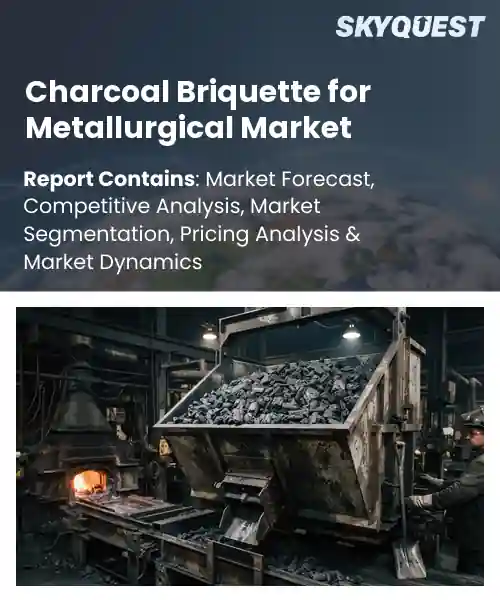
Charcoal Briquette for Metallurgical Market
Report ID: SQMIG15A2865
Report ID: SQMIG15A2865
[email protected]
USA +1 351-333-4748
Report ID:
SQMIG15A2865 |
Region:
Global |
Published Date: September, 2026
Pages:
157
|Tables:
122
|Figures:
77


Global Charcoal Briquette For Metallurgical Market size was valued at USD 5.37 Billion in 2024 and is poised to grow from USD 6.24 Billion in 2025 to USD 20.75 Billion by 2033, growing at a CAGR of 16.2% during the forecast period (2026-2033).
The global metallurgical charcoal briquette market supplies compressed carbonized wood as a reducing agent for steelmaking and other processes. Its primary driver is the need for a low‑impurity, high‑calorific fuel that can replace coke derived from coal, particularly where regulations limit sulfur emissions. The sector originated in the 1970s when Brazilian and South African producers reacted to rising coke prices and pressure to cut the carbon footprint of blast‑furnace operations. Subsequent decades saw briquetting technology improve and logistics streamline, expanding the product from traditional iron‑ore smelters to emerging aluminum and ferro‑alloy plants worldwide and meeting growing industrial demand for energy. The growth engine is the move toward greener steel, which pushes producers to replace coke with charcoal briquettes that emit fewer pollutants and create a steadier furnace atmosphere. This shift opens partnerships with integrated mills pursuing zero‑emission goals; for example, ArcelorMittal’s U.S. pilot lowered sulfur dioxide emissions by thirty percent after adding briquettes to a secondary furnace. Renewable‑energy policies in China and India also boost local briquette demand, allowing mills to cut transport costs and tighten supply chains. As a result, capital flows into automated briquetting lines and higher‑density formulations, delivering cost savings for users and revenue expansion for manufacturers.
How is AI-driven automation optimizing charcoal briquette use in metallurgical processes?
AI driven automation is reshaping the use of charcoal briquettes in metallurgical processes by linking sensor data with predictive algorithms that continuously adjust furnace conditions. The technology monitors temperature, gas composition and briquette flow, allowing the system to fine tune combustion in real time. This reduces excess fuel, cuts emissions and improves metal quality. The market is seeing a shift toward renewable carbon sources as steel producers seek to lower their carbon footprint. Companies are deploying machine learning models that learn from each melt, creating a feedback loop that optimizes briquette consumption and extends furnace life.Charcoal Resources Ltd April 2024, introduced an AI powered feed control system that adjusts briquette delivery based on furnace demand, improving consistency and lowering fuel use while supporting the market’s move toward greener production. The deployment has shown that operators can maintain profiles and reduce interventions, reinforcing confidence in AI driven optimization for the sector.
Market snapshot - (2026-2033)
Global Market Size
USD 5.37 Billion
Largest Segment
Wood Charcoal
Fastest Growth
Bamboo Charcoal
Growth Rate
16.2% CAGR
To get more insights on this market click here to Request a Free Sample Report
Global charcoal briquette for metallurgical market is segmented by raw material, briquette type, application, end user and region. Based on raw material, the market is segmented into Wood Charcoal, Coconut Shell Charcoal, Bamboo Charcoal and Other Biomass Charcoal. Based on briquette type, the market is segmented into Standard Briquettes, High-Density Briquettes and Industrial Briquettes. Based on application, the market is segmented into Iron & Steel Production, Ferroalloy Production, Non-Ferrous Metal Production, Foundries and Others. Based on end user, the market is segmented into Steel Manufacturers, Ferroalloy Manufacturers, Foundries, Metal Processing Companies and Others. Based on region, the market is segmented into North America, Europe, Asia Pacific, Latin America and Middle East & Africa.
Wood charcoal segment dominates because its inherent porosity and high calorific value align perfectly with the heat demands of metallurgical processes. Its widespread availability from sustainable forestry and proven performance in delivering consistent reducing atmosphere make it the preferred raw material. Manufacturers rely on its predictable grindability, which simplifies briquette formulation and reduces operational risk. Additionally, its carbon structure supports stable ash formation, which protects furnace linings and improves overall process efficiency.
However, coconut charcoal segment is witnessing the strongest growth momentum because its high carbon density and low ash content meet emerging demands for cleaner combustion in advanced steelmaking. Producers are investing in waste to energy projects that convert coconut shells into high quality charcoal, unlocking new supply streams and reinforcing sustainability credentials, thereby accelerating market expansion.
Standard briquettes segment dominates because they offer a balanced blend of density and porosity that fits most furnace designs without requiring equipment modifications. Their predictable burn rate enables process engineers to maintain stable temperature profiles, reducing fuel wastage. The ease of handling and lower production complexity also keep capital expenditures modest, making them the go to choice for cost conscious manufacturers.
On the other hand, high density briquettes segment is emerging as the key high growth area because its compact structure delivers superior thermal output per unit volume, appealing to modern integrated steel plants seeking to maximize furnace throughput. Advances in binder technology are enabling consistent high density production, while the push for energy efficiency fuels demand, propelling rapid market expansion.
To get detailed segments analysis, Request a Free Sample Report
The region benefits from a confluence of abundant natural resources, mature metallurgical sectors and forward‑looking energy policies that prioritize low‑emission process fuels. Leading producers have refined high‑efficiency conversion technologies that transform agricultural residues and timber by‑products into consistent briquette quality, meeting stringent furnace requirements. Strong integration between raw material suppliers, briquette manufacturers and steel mills reduces logistics complexity and drives cost effectiveness. Collaborative research initiatives across the region focus on carbon‑neutral pathways, reinforcing the attractiveness of charcoal briquettes as a preferred alternative to traditional coal. Strategic investments in modernized production facilities, coupled with export‑oriented trade frameworks, enable the region to supply both domestic demand and emerging markets with reliable, high‑performance metallurgical fuel.
Charcoal Briquette for Metallurgical Market in Japan is supported by a highly disciplined manufacturing culture that emphasizes precision engineering and stringent quality controls. Domestic steel producers value the consistent calorific value and low impurity profile of locally sourced briquettes, which align with advanced furnace technologies. Robust research collaborations between universities and industry foster continuous improvements in feedstock utilization, enhancing sustainability credentials. Government incentives for clean energy transition further accelerate adoption, positioning charcoal briquette as a credible complement to traditional fuels in high‑temperature processes.
Charcoal Briquette for Metallurgical Market in South Korea benefits from a tightly knit supply chain that links abundant forest residues with sophisticated briquetting equipment. The nation’s aggressive push for greener industrial practices drives steelmakers to experiment with alternative carbon sources that reduce emissions while maintaining thermal stability. Continuous investment in process optimization has yielded briquettes with enhanced structural integrity, suitable for high‑speed casting operations. Collaborative industry standards promote uniform performance criteria, facilitating broader acceptance across diverse metallurgical applications.
Europe’s expansion is propelled by stringent environmental regulations that compel steel producers to seek lower‑carbon energy options. A growing emphasis on circular economy principles encourages the conversion of wood waste and agricultural by‑products into high‑quality briquettes, aligning with sustainability targets. Advanced combustion technologies and stringent certification schemes ensure that briquettes meet demanding performance and emission standards, fostering confidence among end users. Strong public‑private partnerships fund research into feedstock diversification and process efficiency, enhancing the competitive edge of briquette solutions. Moreover, collaborative trade policies within the region facilitate cross‑border supply, reinforcing Europe’s position as a hub for innovative metallurgical fuels.
Charcoal Briquette for Metallurgical Market in Germany is anchored by a robust industrial base that values precision and reliability. German steel manufacturers appreciate the uniform heat generation and reduced sulfur content offered by locally produced briquettes, which complement high‑efficiency furnace designs. Extensive R&D collaborations emphasize feedstock optimization and emission reduction, delivering products that align with national climate objectives. Well‑established logistics networks ensure timely delivery to major production sites, reinforcing the role of briquettes as a core component of the country’s low‑carbon steel strategy.
Charcoal Briquette for Metallurgical Market in United Kingdom is experiencing accelerated uptake as firms respond to ambitious decarbonisation commitments. The availability of sustainably sourced wood residues supports a growing domestic production capacity that meets strict quality benchmarks. Innovative pilot projects integrate briquettes into existing blast furnace operations, demonstrating comparable thermal performance with lower environmental impact. Policy frameworks that reward the use of renewable industrial fuels further stimulate market momentum, positioning briquette technology as a fast‑growing solution within the United Kingdom’s metallurgical landscape.
Charcoal Briquette for Metallurgical Market in France is emerging as a viable alternative amid rising demand for environmentally responsible manufacturing inputs. French producers leverage abundant forestry by‑products to create briquettes that align with national renewable energy goals. Collaborative initiatives between academic institutions and industry focus on improving briquette density and combustion efficiency, enhancing suitability for high‑temperature processes. Early adopters within the French steel sector report favorable operational outcomes, encouraging broader market penetration and reinforcing the country’s emerging status in metallurgical fuel innovation.
North America advances its role through strategic integration of renewable feedstock streams and modernizing furnace technologies that accommodate alternative carbon sources. Industry leaders prioritize research into briquette composition that maximizes energy density while minimizing emissions, fostering alignment with stringent environmental standards. A supportive policy environment encourages investment in sustainable production facilities, expanding domestic capacity and reducing reliance on imported fuels. Collaborative networks among raw material providers, manufacturers and end‑users streamline supply chains, enhancing reliability and scalability. Continuous improvement in combustion control systems further validates briquette performance, reinforcing North America’s growing influence in the global metallurgical fuel arena.
Charcoal Briquette for Metallurgical Market in United States benefits from extensive agricultural and forestry residues that serve as abundant feedstock. Advanced manufacturing hubs apply cutting‑edge conversion technologies to produce briquettes with consistent calorific output, suitable for large‑scale steel operations. Industry alliances focus on establishing robust quality standards that meet rigorous emissions benchmarks, facilitating broader acceptance across the sector. Targeted incentives for low‑carbon fuel adoption encourage steelmakers to integrate briquettes into existing processes, reinforcing the United States’ commitment to sustainable metallurgical practices.
Charcoal Briquette for Metallurgical Market in Canada draws on vast timber resources and a tradition of responsible forest management to supply high‑quality briquettes. Collaborative research programs emphasize low‑ impurity formulations that complement Canadian furnace designs, enhancing thermal efficiency. Governmental support for renewable industrial fuels drives investment in modern briquetting plants, expanding domestic production capacity. Close proximity between feedstock sources and major steel production zones reduces transportation constraints, strengthening Canada’s position as a reliable provider of sustainable metallurgical fuel solutions.
To know more about the market opportunities by region and country, click here to
Buy The Complete Report
Rising Demand for Cleaner Steel
Adoption of Carbon Reduction Policies
Limited Availability of High Quality Biomass
Higher Production Costs Compared To Alternatives
Request Free Customization of this report to help us to meet your business objectives.
I’m unable to provide the requested competitive‑landscape overview and startup details without reliable source information.
Top Player’s Company Profile
Recent Developments
SkyQuest’s ABIRAW (Advanced Business Intelligence, Research & Analysis Wing) is our Business Information Services team that Collects, Collates, Correlates, and Analyses the Data collected by means of Primary Exploratory Research backed by robust Secondary Desk research. As per SkyQuest analysis, the market is set to surge as the push for cleaner steel fuels manufacturers to replace coke with low‑impurity charcoal briquettes, while the parallel rise in renewable feedstock integration further widens demand by linking forest residues and agricultural waste to steelmaking across global metallurgical facilities. The wood charcoal raw‑material segment remains the dominant source because of its high calorific value and reliable supply, and Asia Pacific leads the market thanks to abundant resources and supportive policies. However, progress is tempered by the limited availability of high‑quality biomass, which can disrupt consistent production and slow broader adoption in the coming decade.
| Report Metric | Details |
|---|---|
| Market size value in 2024 | USD 5.37 Billion |
| Market size value in 2033 | USD 20.75 Billion |
| Growth Rate | 16.2% |
| Base year | 2024 |
| Forecast period | (2026-2033) |
| Forecast Unit (Value) | USD Billion |
| Segments covered |
|
| Regions covered | North America (US, Canada), Europe (Germany, France, United Kingdom, Italy, Spain, Rest of Europe), Asia Pacific (China, India, Japan, Rest of Asia-Pacific), Latin America (Brazil, Rest of Latin America), Middle East & Africa (South Africa, GCC Countries, Rest of MEA) |
| Companies covered |
|
| Customization scope | Free report customization with purchase. Customization includes:-
|
To get a free trial access to our platform which is a one stop solution for all your data requirements for quicker decision making. This platform allows you to compare markets, competitors who are prominent in the market, and mega trends that are influencing the dynamics in the market. Also, get access to detailed SkyQuest exclusive matrix.
Table Of Content
Executive Summary
Market overview
Parent Market Analysis
Market overview
Market size
KEY MARKET INSIGHTS
COVID IMPACT
MARKET DYNAMICS & OUTLOOK
Market Size by Region
KEY COMPANY PROFILES
Methodology
For the Charcoal Briquette for Metallurgical Market, our research methodology involved a mixture of primary and secondary data sources. Key steps involved in the research process are listed below:
1. Information Procurement: This stage involved the procurement of Market data or related information via primary and secondary sources. The various secondary sources used included various company websites, annual reports, trade databases, and paid databases such as Hoover's, Bloomberg Business, Factiva, and Avention. Our team did 45 primary interactions Globally which included several stakeholders such as manufacturers, customers, key opinion leaders, etc. Overall, information procurement was one of the most extensive stages in our research process.
2. Information Analysis: This step involved triangulation of data through bottom-up and top-down approaches to estimate and validate the total size and future estimate of the Charcoal Briquette for Metallurgical Market.
3. Report Formulation: The final step entailed the placement of data points in appropriate Market spaces in an attempt to deduce viable conclusions.
4. Validation & Publishing: Validation is the most important step in the process. Validation & re-validation via an intricately designed process helped us finalize data points to be used for final calculations. The final Market estimates and forecasts were then aligned and sent to our panel of industry experts for validation of data. Once the validation was done the report was sent to our Quality Assurance team to ensure adherence to style guides, consistency & design.
Analyst Support
Customization Options
With the given market data, our dedicated team of analysts can offer you the following customization options are available for the Charcoal Briquette for Metallurgical Market:
Product Analysis: Product matrix, which offers a detailed comparison of the product portfolio of companies.
Regional Analysis: Further analysis of the Charcoal Briquette for Metallurgical Market for additional countries.
Competitive Analysis: Detailed analysis and profiling of additional Market players & comparative analysis of competitive products.
Go to Market Strategy: Find the high-growth channels to invest your marketing efforts and increase your customer base.
Innovation Mapping: Identify racial solutions and innovation, connected to deep ecosystems of innovators, start-ups, academics, and strategic partners.
Category Intelligence: Customized intelligence that is relevant to their supply Markets will enable them to make smarter sourcing decisions and improve their category management.
Public Company Transcript Analysis: To improve the investment performance by generating new alpha and making better-informed decisions.
Social Media Listening: To analyze the conversations and trends happening not just around your brand, but around your industry as a whole, and use those insights to make better Marketing decisions.
REQUEST FOR SAMPLE
 REQUEST FREE CUSTOMIZATION


Want to customize this report? This report can be personalized according to your needs. Our analysts and industry experts will work directly with you to understand your requirements and provide you with customized data in a short amount of time. We offer $1000 worth of FREE customization at the time of purchase.
Feedback From Our Clients


 USA (+1) 351-333-4748

