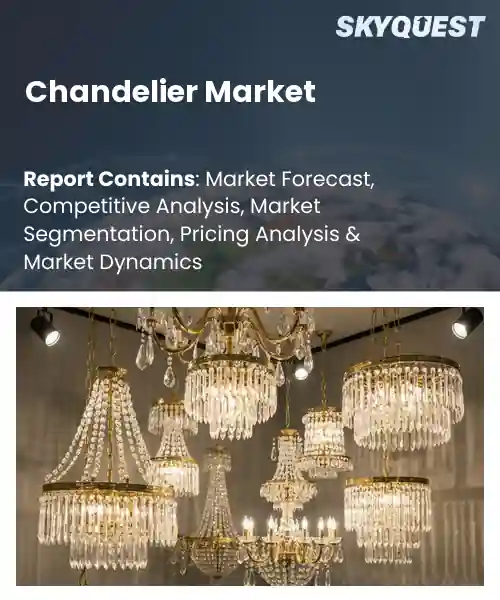
Chandelier Market
Report ID: SQMIG25F2122
Report ID: SQMIG25F2122
[email protected]
USA +1 351-333-4748
Report ID:
SQMIG25F2122 |
Region:
Global |
Published Date: June, 2026
Pages:
157
|Tables:
184
|Figures:
79


Global Chandelier Market size was valued at USD 11.5 Billion in 2024 and is poised to grow from USD 12.13 Billion in 2025 to USD 18.62 Billion by 2033, growing at a CAGR of 5.5% during the forecast period (2026-2033).
The chandelier market is largely driven by the underlying shift in consumer preference towards experiential lighting, which is a combination of aesthetic and energy-efficient smart features that have turned a decorative fixture into an integrated design and branding tool. Manufacturing, wholesale and aftermarket services are offered for traditional crystal pieces and modern LED solutions and that’s important because lighting impacts energy consumption, occupant comfort and property value. Chandeliers were the mark of a good craftsman. Today manufacturers have mechanized production with new materials and electronics, and marketing to commercial spaces like hotel foyers and luxury stores, showing mass acceptance while still telling stories of artisanal heritage.
Technological convergence is a key growth driver that will build on mainstream adoption. LED efficiency, IoT controls and modular manufacturing to reduce operating costs and enable customization at scale all drive broader demand. As energy regulations become stricter, and utilities incentivize low-consumption fixtures, LED chandeliers are the go-to for builders and hotel operators looking to reduce bills and maintenance. This also accelerates specification by architects and procurement teams. Retailers employ e-commerce and virtual visualization to upsell custom designs for high-margin residential and hospitality projects. That opens the door to retrofitting historic properties and launching subscription maintenance services that generate aftermarket revenue while improving sustainability credentials and global expansion.
How is IoT integration transforming the global chandelier market?
The global chandelier market is being transformed by IoT integration, which offers connectivity, sensors and software to decorative lighting. It includes remote control and personalisation, energy aware drivers and predictive maintenance to extend the lifespan of the product. Today, traditional makers and smart lighting firms are adapting design to accept LED modules and wireless controls, making chandeliers more relevant for hotels, restaurants and upscale homes. The change allows for new business models and easier retrofits of vintage pieces, while also allowing for coordinated scenes across rooms for better ambiance and operational savings. Wider deployments at city and infrastructure scale indicate that the market is moving towards systems level integration.
Casambi and Somfy April 2026 Partnership announced to unify lighting and shading ecosystems Show how connected modules can bring chandeliers into unified smart building controls and simplify installation while boosting energy efficiency and use case value.
Market snapshot - (2026-2033)
Global Market Size
USD 11.5 Billion
Largest Segment
Crystal Chandeliers
Fastest Growth
LED Chandeliers
Growth Rate
5.5% CAGR
To get more insights on this market click here to Request a Free Sample Report
Global chandelier market is segmented by product type, design, technology, price range, application, end user and region. Based on product type, the market is segmented into Traditional Chandeliers, Modern Chandeliers, Transitional Chandeliers, Contemporary Chandeliers, Crystal Chandeliers and LED Chandeliers. Based on design, the market is segmented into Tiered, Drum, Globe, Candle-Style, Rectangular/Square, Wagon Wheel and Custom Designs. Based on technology, the market is segmented into Conventional Lighting, LED Lighting, Smart Chandeliers and Energy-Efficient Chandeliers. Based on price range, the market is segmented into Economy/Mass Market, Premium and Luxury. Based on application, the market is segmented into Residential, Commercial, Hospitality, Retail Spaces and Institutional Buildings. Based on end user, the market is segmented into Household Consumers, Hotels & Resorts, Restaurants, Corporate Offices, Shopping Malls and Event Venues. Based on region, the market is segmented into North America, Europe, Asia Pacific, Latin America and Middle East & Africa.
Crystal Chandeliers segment is expected to dominate the market owing to its preference in premium installations due to its association with luxury aesthetics and artisanal craftsmanship. The refractive qualities and the high quality materials produce a visual impact that grounds design narratives, inspiring designers and specifiers to choose these fixtures for statement spaces. Customization and finish options underpin perceived value and are sustained by established brands and skilled manufacturers. This further underpins demand from prestige projects and underpins stable market leadership based on aspirational design influence.
However, LED Chandeliers are the fastest growing due to the availability of energy efficient light engines with compact form factors that can be incorporated seamlessly into modern interiors and retrofits. The rapid innovation in tunable source and driver technology is drawing designers looking for slim profiles and dynamic ambience and is driving adoption in residential and commercial spaces as well as enabling modular strategies.
The Candle Style segment’s classic silhouette and warm glow make this a perennial favorite decorative option for classic and transitional interiors. It’s simple to construct and manufacturers can offer a variety of materials and finishes to fit a range of styles, giving it broad application for installers and homeowners. Multiple mounting types and ease of maintenance keep it in renovation and new build specifications driven by aesthetic familiarity as well as versatility.
Yet the design of the Globe is growing fast, as its minimalist geometry lends itself to contemporary interiors, and is adaptable to cluster and linear configurations. Its simple construction and LED compatibility allow for custom finishes that appeal to designers and homeowners, driving adoption in both residential and commercial applications and creating modular product opportunities and retail ready hospitality offerings.
To get detailed segments analysis, Request a Free Sample Report
The Asia Pacific region is the dominant market, owing to the concentration of demand in the rich urban markets and a high cultural appreciation for ornamental lighting. This appreciation has raised the chandelier from a functional object to a design focal point. The demand for unique lighting solutions is driven by the growth of high end residential developments and premium hospitality projects. Local manufacturing ecosystems and specialized design houses help adapt global trends to regional tastes, cut down lead times and reduce procurement friction. Suppliers have integrated supply chains and a wealth of craftsmanship to support artisanal as well as modern collections. The proliferation of retail channels from boutique showrooms to experiential flagships has meant better discovery and customization and the focus on sustainable materials and efficient lighting solutions means products are more attractive to architects and end users as procurement criteria continue to evolve.
In the Japanese chandelier market, there are sophisticated tastes in design and a strong preference for fine craftsmanship that creates demand for the custom and limited edition products. The growth of boutique interior design companies and renovations of luxury hospitality spaces has enabled us to work with makers both at home and abroad. It is about the nuance of refined, compact compositions a mix of tradition and modernity that stems from a dedication to minimalism and quality of materials, and that creates a market for curated and artisanal lighting solutions.
South Korea’s chandelier market is an exciting mix of contemporary design and artisanal craftsmanship, driven by strong demand from premium residential and experiential hospitality sectors. Collaboration of local designers and manufacturers can give trend-conscious consumer innovative forms and custom finishes. Retail experiences and curated showrooms help with specification and partnerships with international studios give access to global trends which lead to market sophistication and help local players to grow into regional design projects.
North American growth is fueled by a combination of lifestyle trends favoring statement lighting, strong home renovation activity, and a maturing online-to-offline retail ecosystem that is enabling access to a plethora of chandelier choices. Architects, developers and boutique lighting designers are working together to transform the chandelier from a decorative feature, to an essential element of the spatial storytelling of a home or high-end commercial space. Suppliers need to diversify their portfolio and service offerings to meet the demand for customization, flexible modular designs, and integration with smart lighting platforms. Regional manufacturers and specialized fabricators can provide custom finishes and rapid prototyping to fit specific project timelines, supplemented with an expanding cohort of certified installers and after sales services to ease friction for large scale rollouts. Provenance, artisanal craftsmanship and a hybrid vintage contemporary aesthetic appeal to affluent buyers seeking unique statements.
United States Chandelier Market: Renovation momentum, luxury residential projects and experiential hospitality venues driving diverse demand for unique fixtures Thanks to a strong presence of bespoke studios and national retailers, custom finishes and fast fulfillment are available. Integration with smart home ecosystems and liking for flexible, multi scale designs drive manufacturers to showcase modular collections. Focus onProvenance supports premium positioning, and closely encourages collaboration with interior designers.
The Canadian Chandelier market is primarily driven by urban statement projects and the suburban home renovation culture demanding large scale and compact lighting solutions. Some of the selected global lines are easily available through the local showrooms and design networks. Local manufacturers and design firms work in partnership, promoting local finishes and solid project support. Sourcing is based on flexible collections of hardy materials and flexible arrangements.
Europe’s position is strengthening with a mix of design heritage, artisanal networks and a continuous focus on quality and material provenance that appeals to discerning buyers across the globe. Legacy brands and established ateliers continue to support the premium segments, but contemporary studios are also showing experimental forms and cross-disciplinary collaborations. The push towards sustainability and responsible sourcing is a driver for using reclaimed and eco conscious materials and fits the stories of the products. Strong trade networks, well-chosen showrooms and influential interior design communities also play a role in regional trends and the export of unique styles. Promotion of regional manufacturing clusters, small batch and custom manufacturing. The integration with smart lighting systems will be more widespread, making the chandelier suitable for both heritage restorations and modern projects, growing the international appeal.
The German chandelier market benefits from precision manufacturing, strong industrial supply chains and a design culture that values functional beauty and material integrity. Demand for technically refined fixtures and sophisticated finishes is being driven by high-end residential refits and corporate hospitality. Engineering manufacturers and creative studios can work together to create long-lasting and modular solutions that meet installation expectations. The local trade shows and the design associations also support the market visibility and export strategies.
UK Chandelier Market is driven by booming interior design industry, restoration of heritage properties and strong market for custom-made commissions. London districts and regional studios develop collaborations that combine traditional glasscraft with contemporary silhouettes. Demand for statement pieces in luxury retail and hospitality projects is driving makers to look at mixed materials and lighting controls. Specifying and procuring is heavily influenced by curated showrooms and consultancies.
The Chandelier Market is being propelled by the demand for ornate lighting pieces due to the rich culture of decorative arts and deep artisanal traditions in France. Its glassmakers work with interior designers in its Parisian workshops to create pieces that celebrate craftsmanship and storytelling. The love of sculptural forms and custom finishes lends itself well to luxury hospitality and residential refurbishments. Curated galleries and trade relations encourage the experimental designers and contribute to solidifying France’s position as a creative hub for chandelier offerings.
To know more about the market opportunities by region and country, click here to
Buy The Complete Report
Rising Demand For Luxury Interiors
Advances In Smart Lighting Integration
High Production And Maintenance Costs
Regulatory And Safety Compliance
Request Free Customization of this report to help us to meet your business objectives.
The competitive environment for the global chandelier market is characterized by consolidation through strategic acquisitions by industrial and private equity buyers, high-profile designer-brand partnerships at events such as Milan Design Week, and product-level tech innovation that moves the competition to multifunctional and IoT-enabled fixtures. Recent examples include Kingswood’s acquisition of Kichler, Acuity Brands’ bolt-on purchases, design collaborations under Objets Nomades and startup launches of hybrid smart-chandelier products.
SkyQuest’s ABIRAW (Advanced Business Intelligence, Research & Analysis Wing) is our Business Information Services team that Collects, Collates, Correlates, and Analyses the Data collected by means of Primary Exploratory Research backed by robust Secondary Desk research.
As per SkyQuest analysis, the global chandelier market is being propelled by shifting consumer preference toward experiential lighting that blends aesthetic appeal with energy-efficient smart functions as a key driver, while high production and maintenance costs act as a significant restraint. Asia Pacific remains the dominating region due to strong urban demand and integrated manufacturing ecosystems, and crystal chandeliers continue as the dominating segment because of their association with luxury and artisanal value. A second driver is technological convergence of LED, IoT and modular manufacturing, which lowers operating costs, enables customization at scale and expands retrofit and hospitality specification opportunities across regions.
| Report Metric | Details |
|---|---|
| Market size value in 2024 | USD 11.5 Billion |
| Market size value in 2033 | USD 18.62 Billion |
| Growth Rate | 5.5% |
| Base year | 2024 |
| Forecast period | (2026-2033) |
| Forecast Unit (Value) | USD Billion |
| Segments covered |
|
| Regions covered | North America (US, Canada), Europe (Germany, France, United Kingdom, Italy, Spain, Rest of Europe), Asia Pacific (China, India, Japan, Rest of Asia-Pacific), Latin America (Brazil, Rest of Latin America), Middle East & Africa (South Africa, GCC Countries, Rest of MEA) |
| Companies covered |
|
| Customization scope | Free report customization with purchase. Customization includes:-
|
To get a free trial access to our platform which is a one stop solution for all your data requirements for quicker decision making. This platform allows you to compare markets, competitors who are prominent in the market, and mega trends that are influencing the dynamics in the market. Also, get access to detailed SkyQuest exclusive matrix.
Table Of Content
Executive Summary
Market overview
Parent Market Analysis
Market overview
Market size
KEY MARKET INSIGHTS
COVID IMPACT
MARKET DYNAMICS & OUTLOOK
Market Size by Region
KEY COMPANY PROFILES
Methodology
For the Chandelier Market, our research methodology involved a mixture of primary and secondary data sources. Key steps involved in the research process are listed below:
1. Information Procurement: This stage involved the procurement of Market data or related information via primary and secondary sources. The various secondary sources used included various company websites, annual reports, trade databases, and paid databases such as Hoover's, Bloomberg Business, Factiva, and Avention. Our team did 45 primary interactions Globally which included several stakeholders such as manufacturers, customers, key opinion leaders, etc. Overall, information procurement was one of the most extensive stages in our research process.
2. Information Analysis: This step involved triangulation of data through bottom-up and top-down approaches to estimate and validate the total size and future estimate of the Chandelier Market.
3. Report Formulation: The final step entailed the placement of data points in appropriate Market spaces in an attempt to deduce viable conclusions.
4. Validation & Publishing: Validation is the most important step in the process. Validation & re-validation via an intricately designed process helped us finalize data points to be used for final calculations. The final Market estimates and forecasts were then aligned and sent to our panel of industry experts for validation of data. Once the validation was done the report was sent to our Quality Assurance team to ensure adherence to style guides, consistency & design.
Analyst Support
Customization Options
With the given market data, our dedicated team of analysts can offer you the following customization options are available for the Chandelier Market:
Product Analysis: Product matrix, which offers a detailed comparison of the product portfolio of companies.
Regional Analysis: Further analysis of the Chandelier Market for additional countries.
Competitive Analysis: Detailed analysis and profiling of additional Market players & comparative analysis of competitive products.
Go to Market Strategy: Find the high-growth channels to invest your marketing efforts and increase your customer base.
Innovation Mapping: Identify racial solutions and innovation, connected to deep ecosystems of innovators, start-ups, academics, and strategic partners.
Category Intelligence: Customized intelligence that is relevant to their supply Markets will enable them to make smarter sourcing decisions and improve their category management.
Public Company Transcript Analysis: To improve the investment performance by generating new alpha and making better-informed decisions.
Social Media Listening: To analyze the conversations and trends happening not just around your brand, but around your industry as a whole, and use those insights to make better Marketing decisions.
REQUEST FOR SAMPLE
 REQUEST FREE CUSTOMIZATION
Global Chandelier Market size was valued at USD 11.5 Billion in 2024 and is poised to grow from USD 12.13 Billion in 2025 to USD 18.62 Billion by 2033, growing at a CAGR of 5.5% during the forecast period (2026-2033).
The competitive landscape for the global chandelier market is shaped by consolidation through strategic acquisitions by industrial and private equity buyers, high-profile designer-brand partnerships at events such as Milan Design Week, and product-level tech innovation that shifts competition toward multifunctional and IoT-enabled fixtures; recent examples include Kingswood’s acquisition of Kichler, Acuity Brands’ bolt-on purchases, design collaborations under Objets Nomades, and startup launches of hybrid smart-chandelier products. 'Signify N.V.', 'Acuity Brands, Inc.', 'Hubbell Incorporated', 'Savant Systems, Inc.', 'Hudson Valley Lighting Group LLC', 'Maxim Lighting International', 'WAC Lighting Co.', 'Kichler Lighting LLC', 'Swarovski AG', 'Schonbek Worldwide Lighting, Inc.', 'Elegant Lighting Inc.', 'Generation Lighting LLC', 'Feiss Group', 'Quoizel Inc.', 'Baccarat SA', 'Brand van Egmond BV', 'Hubbardton Forge LLC', 'Jaquar Group', 'The White Teak Company', 'Havells India Limited'
High end residential and hospitality renovation preferences are encouraging homeowners and designers to select chandeliers as focal lighting elements, leading manufacturers and retailers to expand premium offerings and customization services. The visual prominence and perceived status associated with ornate lighting fixtures make chandeliers a preferred choice for creating distinctive interior statements, which increases procurement and commissioning by designers. As a result, suppliers invest in craftsmanship, bespoke design capabilities, and collaborations with interior firms, reinforcing product differentiation and stimulating sustained market demand for upscale chandelier solutions.
Smart Lighting Integration: Demand for connected and adaptive lighting solutions is driving chandeliers to incorporate sensors, wireless controls and compatibility with smart home platforms. Designers and manufacturers prioritize interoperability, user customization and energy-conscious operation while preserving aesthetic appeal. This convergence enables remote control, scene setting and integration with broader interior ecosystems, creating opportunities for value-added services and revenue approaches. Market players emphasizing modular designs and firmware upgradability can differentiate offerings and respond to evolving consumer preferences for convenience, personalization and seamless technology experiences.
Why does Asia Pacific Dominate the Global Chandelier Market? |@12


Want to customize this report? This report can be personalized according to your needs. Our analysts and industry experts will work directly with you to understand your requirements and provide you with customized data in a short amount of time. We offer $1000 worth of FREE customization at the time of purchase.
Feedback From Our Clients


 USA (+1) 351-333-4748

