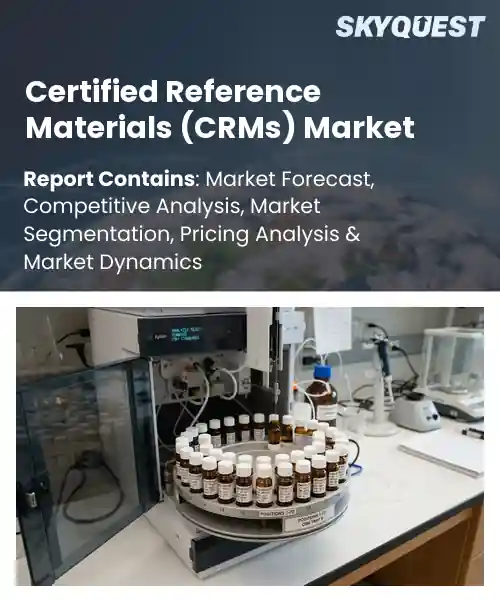
Certified Reference Materials (CRMs) Market
Report ID: SQMIG35J2786
Report ID: SQMIG35J2786
[email protected]
USA +1 351-333-4748
Report ID:
SQMIG35J2786 |
Region:
Global |
Published Date: September, 2026
Pages:
157
|Tables:
124
|Figures:
77


Global Certified Reference Materials (Crms) Market size was valued at USD 2.1 Billion in 2024 and is poised to grow from USD 2.25 Billion in 2025 to USD 3.9 Billion by 2033, growing at a CAGR of 7.1% during the forecast period (2026-2033).
The certified reference materials (CRMs) market supplies characterized substances that laboratories use to validate analytical methods, calibrate instruments, and ensure compliance. Its significance stems from the need for traceable, reproducible data in pharmaceuticals, environmental testing, and food safety. Historically, the market emerged in the 1970s when ISO and AOAC standards demanded reliable benchmarks, and it expanded as globalization intensified quality‑control requirements. For example, the adoption of Good Manufacturing Practice guidelines in Europe forced manufacturers to source CRMs for impurity profiling, driving growth. Consequently, the market evolved from niche providers to an industry with hubs in North America, Europe, and Asia. The accelerating demand for CRMs is driven by frameworks that require documented measurement uncertainty and method validation across sectors. As agencies such as the US FDA, EMA, and EPA tighten contaminant limits, manufacturers must adopt protocols, prompting a surge in CRM purchases to demonstrate compliance. This pressure creates opportunities for providers to expand into emerging fields like nanomaterial detection and biopharmaceutical characterization, where standards are scarce. For example, a Chinese vaccine maker integrated CRMs into potency assays to meet WHO guidelines, cutting batch‑failure rates by 15 %. Consequently, the market benefits from adoption and quest for data credibility, fueling revenue growth.
How is AI-driven automation influencing the certified reference materials market?
AI driven automation is reshaping the certified reference materials market by streamlining production, improving traceability and enhancing quality control. Manufacturers now embed intelligent sensors and predictive algorithms into mixing, packaging and labeling steps, which reduces human error and accelerates turnaround times. The market sees growing demand from pharmaceutical, environmental and food testing labs that require consistent standards. Companies are adopting cloud based data platforms to monitor batch performance and to share certification records with customers in real time. This shift creates a more responsive supply chain and encourages broader adoption of CRMs across emerging analytical techniques.Thermo Fisher Scientific announced in June 2023 a new AI driven automation platform for producing certified reference materials which speeds batch consistency and reduces manual inspection, supporting market growth and efficiency. The system integrates machine learning models that predict impurity trends and adjust processing parameters in real time, delivering higher reliability for laboratories worldwide.
Market snapshot - (2026-2033)
Global Market Size
USD 2.1 Billion
Largest Segment
Inorganic Reference Materials
Fastest Growth
Biological Reference Materials
Growth Rate
7.1% CAGR
To get more insights on this market click here to Request a Free Sample Report
Global certified reference materials (crms) market is segmented by material type, certification type, application, end user and region. Based on material type, the market is segmented into Organic Reference Materials, Inorganic Reference Materials, Biological Reference Materials, Environmental Reference Materials and Others. Based on certification type, the market is segmented into Chemical Composition, Physical Properties, Microbiological Properties and Others. Based on application, the market is segmented into Analytical Testing, Calibration, Quality Control, Method Validation and Others. Based on end user, the market is segmented into Pharmaceutical Companies, Food & Beverage Companies, Environmental Laboratories, Research Institutions and Others. Based on region, the market is segmented into North America, Europe, Asia Pacific, Latin America and Middle East & Africa.
Organic reference materials segment dominates because it provides the foundational standards required for accurate quantification of a wide range of analytes across pharmaceutical, food safety and environmental testing. Its broad chemical diversity satisfies the stringent purity expectations of regulated industries, fostering trust among end users. Continuous innovation in synthetic routes and scalable production enhances availability, while regulatory mandates for traceability reinforce its centrality in the certified reference materials market.
Meanwhile inorganic reference materials segment experiences the fastest growth as emerging clean energy technologies demand precise elemental analysis for battery materials and catalysts. Increased adoption of high resolution spectrometry drives need for matrix matched standards, prompting manufacturers to expand portfolios. This momentum unlocks new revenue streams and strengthens overall market expansion.
Calibration segment leads because it ensures instrument accuracy, a non negotiable requirement for laboratories that rely on certified reference materials. By providing traceable standards, calibration reduces measurement uncertainty, supports compliance with quality regulations, and underpins confidence in analytical results. The growing complexity of analytical platforms intensifies demand for dedicated calibration solutions, reinforcing its pivotal role in sustaining market credibility and fostering long term customer relationships.
On the other hand analytical testing segment emerges as the fastest growing area as industries expand routine screening programs for contaminants and quality attributes. Advances in multiplexed assays and real time monitoring elevate the need for matrix specific standards, prompting providers to launch broader product lines. This surge fuels new adoption cycles and broadens the overall market footprint.
To get detailed segments analysis, Request a Free Sample Report
North America maintains a leading position in the global Certified Reference Materials market due to a confluence of mature research ecosystems, rigorous regulatory frameworks, and a dense concentration of manufacturers that specialize in high‑purity standards. The United States and Canada benefit from extensive funding for scientific initiatives, well‑established standardization bodies, and a culture of collaboration between academia, industry, and government agencies. This environment drives continuous innovation in analytical techniques and fuels demand across sectors such as pharmaceuticals, environmental monitoring, food safety, and advanced materials. International collaborations with European and Asian research bodies broaden market reach, while proactive standard updates keep pace with new analytical demands. A strong focus on sustainability and traceability further builds user confidence, cementing the region’s role as a quality benchmark.
Certified Reference Materials (CRMs) Market in the United States benefits from a network of research universities, agencies, and enterprises that drive analytical standards. The presence of standardization organizations ensures consistent quality, while a diverse industrial base creates strong demand across pharmaceuticals, environmental testing, food safety, and materials sectors. Investment in technology a supply chain enable rapid delivery of materials, reinforcing the United States as a pivotal source for users.
Certified Reference Materials (CRMs) Market in Canada is supported by strong governmental programs that prioritize environmental stewardship and resource management. Collaboration between academic institutions and industry fosters development of high‑quality standards for sectors such as mining, water quality, and agricultural testing. Emphasis on traceability and compliance with international guidelines enhances confidence among domestic and cross‑border users, while a well‑integrated logistics network ensures timely distribution of reference materials throughout North America.
Europe experiences rapid expansion of the Certified Reference Materials market driven by a cohesive regulatory environment, deep scientific expertise, and a commitment to sustainability across the continent. Harmonized standards under European directives facilitate cross‑border trade and reduce barriers for manufacturers, while extensive public and private research funding fuels innovation in analytical methods. The region’s strong pharmaceutical, environmental, and food sectors generate consistent demand for high‑quality reference materials. Germany’s industrial precision and established standardization bodies anchor the market, the United Kingdom’s vibrant biotech ecosystem accelerates adoption, and France’s emerging focus on advanced therapeutics adds significant momentum. Collaborative networks among universities, industry clusters, and regulatory agencies continually reinforce Europe’s position as a leading hub for reference material development and distribution.
Certified Reference Materials (CRMs) Market in Germany is anchored by a tradition of engineering excellence and a robust network of standardization institutes that prioritize precision and reliability. The country’s strong chemical and automotive industries demand high‑grade reference materials for quality control and regulatory compliance. Close collaboration between research universities and industrial partners accelerates development of innovative standards, while a well‑established export infrastructure ensures timely delivery to European and global customers.
Certified Reference Materials (CRMs) Market in the United Kingdom benefits from a dynamic biotech landscape and academic research that drive demand for cutting‑edge analytical standards. Government initiatives supporting innovation and regulatory alignment with European frameworks encourage adoption across pharmaceuticals, environmental monitoring, and food safety sectors. Strong partnerships between universities, contract research organizations, and reference material producers foster improvement, while a responsive distribution network ensures that high‑quality materials reach end‑users efficiently throughout the region.
Certified Reference Materials (CRMs) Market in France is emerging as a focal point for pharmaceutical innovation and environmental analytics, driven by government incentives that promote research and development. Collaboration between leading universities and specialized manufacturers accelerates the creation of tailored reference standards for emerging therapeutics and climate‑related testing. Emphasis on compliance with international quality norms enhances market credibility, while a growing network of distribution partners expands accessibility of French‑produced materials across Europe and beyond.
Asia Pacific is strengthening its position in the Certified Reference Materials market through a combination of rapid industrial growth, strategic government investment, and a cultural emphasis on precision and quality. Nations such as Japan and South Korea lead the region with sophisticated manufacturing sectors that require reliable standards for electronics, automotive, and emerging biotech applications. Continual collaborative initiatives between research institutes and reference material producers accelerate the development of materials tailored to high‑technology processes. Regulatory frameworks are evolving to align with international best practices, enhancing confidence among global users. Additionally, the region’s focus on innovation ecosystems and robust export‑oriented supply chains ensures that high‑quality reference materials are readily available to both domestic industries and international markets.
Certified Reference Materials (CRMs) Market in Japan is driven by precision engineering and a stringent regulatory environment that require analytical standards. Collaboration between leading universities, consortia, and government agencies fosters creation of reference materials for high‑performance semiconductor manufacturing, automotive safety testing, and pharmaceutical quality control. An efficient logistics network and a reputation for reliability ensure that Japanese‑produced CRMs are trusted by both domestic manufacturers and international global partners.
Certified Reference Materials (CRMs) Market in South Korea benefits from a strong focus on semiconductor and biotechnology sectors that require precise analytical benchmarks. Government‑backed research programs and close ties between universities and leading manufacturers accelerate the development of specialized reference standards for electronic materials, medical diagnostics, and environmental monitoring. A well‑organized distribution framework and commitment to international quality accreditation enable South Korean CRMs to serve both domestic high‑tech industries and export markets with confidence.
To know more about the market opportunities by region and country, click here to
Buy The Complete Report
Increasing Regulatory Compliance Needs
Adoption Of Advanced Analytical Techniques
High Cost Of Certified Materials
Limited Availability Of Standardized Materials
Request Free Customization of this report to help us to meet your business objectives.
The competitive landscape of the global Certified Reference Materials market is shaped by aggressive M&A activity, strategic partnerships, and rapid technology adoption, with major players such as Merck KGaA acquiring niche CRM businesses to broaden portfolios, Thermo Fisher Scientific forming joint development agreements with LGC Standards to co‑create isotopic standards, and Agilent Technologies deploying AI‑driven quality‑control platforms that enhance CRM traceability and reduce production cycle times.
Top Player’s Company Profile
Recent Developments
SkyQuest’s ABIRAW (Advanced Business Intelligence, Research & Analysis Wing) is our Business Information Services team that Collects, Collates, Correlates, and Analyses the Data collected by means of Primary Exploratory Research backed by robust Secondary Desk research. As per SkyQuest analysis, the global CRM market is being propelled primarily by increasing regulatory compliance needs, which push labs to adopt certified standards, while the rapid uptake of advanced analytical techniques such as high‑resolution mass spectrometry serves as a second catalyst accelerating demand. The organic reference materials segment leads the market because of its broad chemical diversity that meets purity requirements across pharma, food and environmental testing, and North America remains the dominant region thanks to its mature research ecosystem and stringent standards. However, the premium price of certified materials restrains uptake, especially among smaller laboratories, tempering overall growth.
| Report Metric | Details |
|---|---|
| Market size value in 2024 | USD 2.1 Billion |
| Market size value in 2033 | USD 3.9 Billion |
| Growth Rate | 7.1% |
| Base year | 2024 |
| Forecast period | (2026-2033) |
| Forecast Unit (Value) | USD Billion |
| Segments covered |
|
| Regions covered | North America (US, Canada), Europe (Germany, France, United Kingdom, Italy, Spain, Rest of Europe), Asia Pacific (China, India, Japan, Rest of Asia-Pacific), Latin America (Brazil, Rest of Latin America), Middle East & Africa (South Africa, GCC Countries, Rest of MEA) |
| Companies covered |
|
| Customization scope | Free report customization with purchase. Customization includes:-
|
To get a free trial access to our platform which is a one stop solution for all your data requirements for quicker decision making. This platform allows you to compare markets, competitors who are prominent in the market, and mega trends that are influencing the dynamics in the market. Also, get access to detailed SkyQuest exclusive matrix.
Table Of Content
Executive Summary
Market overview
Parent Market Analysis
Market overview
Market size
KEY MARKET INSIGHTS
COVID IMPACT
MARKET DYNAMICS & OUTLOOK
Market Size by Region
KEY COMPANY PROFILES
Methodology
For the Certified Reference Materials (CRMs) Market, our research methodology involved a mixture of primary and secondary data sources. Key steps involved in the research process are listed below:
1. Information Procurement: This stage involved the procurement of Market data or related information via primary and secondary sources. The various secondary sources used included various company websites, annual reports, trade databases, and paid databases such as Hoover's, Bloomberg Business, Factiva, and Avention. Our team did 45 primary interactions Globally which included several stakeholders such as manufacturers, customers, key opinion leaders, etc. Overall, information procurement was one of the most extensive stages in our research process.
2. Information Analysis: This step involved triangulation of data through bottom-up and top-down approaches to estimate and validate the total size and future estimate of the Certified Reference Materials (CRMs) Market.
3. Report Formulation: The final step entailed the placement of data points in appropriate Market spaces in an attempt to deduce viable conclusions.
4. Validation & Publishing: Validation is the most important step in the process. Validation & re-validation via an intricately designed process helped us finalize data points to be used for final calculations. The final Market estimates and forecasts were then aligned and sent to our panel of industry experts for validation of data. Once the validation was done the report was sent to our Quality Assurance team to ensure adherence to style guides, consistency & design.
Analyst Support
Customization Options
With the given market data, our dedicated team of analysts can offer you the following customization options are available for the Certified Reference Materials (CRMs) Market:
Product Analysis: Product matrix, which offers a detailed comparison of the product portfolio of companies.
Regional Analysis: Further analysis of the Certified Reference Materials (CRMs) Market for additional countries.
Competitive Analysis: Detailed analysis and profiling of additional Market players & comparative analysis of competitive products.
Go to Market Strategy: Find the high-growth channels to invest your marketing efforts and increase your customer base.
Innovation Mapping: Identify racial solutions and innovation, connected to deep ecosystems of innovators, start-ups, academics, and strategic partners.
Category Intelligence: Customized intelligence that is relevant to their supply Markets will enable them to make smarter sourcing decisions and improve their category management.
Public Company Transcript Analysis: To improve the investment performance by generating new alpha and making better-informed decisions.
Social Media Listening: To analyze the conversations and trends happening not just around your brand, but around your industry as a whole, and use those insights to make better Marketing decisions.
REQUEST FOR SAMPLE
 REQUEST FREE CUSTOMIZATION


Want to customize this report? This report can be personalized according to your needs. Our analysts and industry experts will work directly with you to understand your requirements and provide you with customized data in a short amount of time. We offer $1000 worth of FREE customization at the time of purchase.
Feedback From Our Clients


 USA (+1) 351-333-4748

